
Plug-ins, Hosts, Apps,
Hardware, Soundware
Developers
(Brands)
Videos Groups
Whats's in?
Banks & Patches
Download & Upload
Music Search
KVR
   
KVR Forum » DSP and Plug-in Development
Thread Read
DPW experiments
Goto page 1, 2  Next
Ichad.c
KVRist
- profile
- pm
- e-mail
- www
PostPosted: Fri Dec 14, 2012 4:43 am reply with quote
Hey people, been mucking around with Differentiated Parabolic Waveforms for a while now - and quite amazed by its simplicity and versatility. Obviously - it's inferior to all the blips,blams and bleps - but as a c++ and mathematical noob, I think it is probably the easiest qausi bandlimiting technique out there - even wavetables isn't so easy to implement - and even harder to "populate" with anything 'custom',IMHO.

Sofar, I've done:
Standard Saw, Standard Pulse, Standard Triangle, Vintage(rounded) Saw, Pulse-Width Saw, Pulse-Width Triangle, Exponential Triangle, Soft Saw (nearly same harmonic slope as triangle), Vintage Saw to Fake sine morph(can maybe morph Saw-Sine-Triangle).

Strangely enough - after reading alot of old digital synth manuals - some of these shapes have popped up(more than once) - especially stuff from Roland Shocked Surprised

Inanyway, any other papers/blogs out there that has more info on DPW? Especially related to making other shapes - apart from a standard Saw & Triangle?

Or, I'll show you mine and you show me yours?
(Except if you're under-age Laughing )
^ Joined: 08 Feb 2012  Member: #274678  Location: South - Africa
Richard_Synapse
KVRist
- profile
- pm
PostPosted: Fri Dec 14, 2012 5:52 am reply with quote
You can make anything with DPW using samples, ie you simply pre-integrate a wavetable then differentiate it on playback. For the ones you made, which order did you use, and care to share your formulas? Smile

Richard
----
Synapse Audio Software - www.synapse-audio.com
^ Joined: 19 Dec 2010  Member: #245936  
Ichad.c
KVRist
- profile
- pm
- e-mail
- www
PostPosted: Fri Dec 14, 2012 9:11 am reply with quote
Richard_Synapse wrote:
You can make anything with DPW using samples, ie you simply pre-integrate a wavetable then differentiate it on playback...


Good idea, but I'm a noob - all my stuff works with a simple counter i.e. a good old saw.

Richard_Synapse wrote:
For the ones you made, which order did you use, and care to share your formulas? Smile


All are first order (I did mention simplicity Smile ) , taking into account that I probably will use a modest 2x oversampling - which gives about -18dB less aliasing, first order seems practical - and no need to fire-up Maxima. I'll share one 'new' shape - a Vintage Saw.

A DPW triangle:
a= abs(saw) - 0.5;//centre it around zero
b = a * abs(a);//parabole
c = a - b;
d = differentiate(c);

Now a DPW "Vintage saw":
a1 = abs(saw) - 0.5;
a2 = a1 * a1;//parabole
b = a2 * a2;//another parabole
c = b - a2;
d = differentiate(c);
output will be one octave higher though, so freq/2.


All my waveshapes are simple variations of the above - the pulse-width saw and pulse-width triangle are even a tad cheesier - all can be written in 5 lines or less - like the above. Also - thinking of the roland thing - it does make some sense - memory was expensive in those old mashines.
^ Joined: 08 Feb 2012  Member: #274678  Location: South - Africa
Richard_Synapse
KVRist
- profile
- pm
PostPosted: Fri Dec 14, 2012 1:16 pm reply with quote
Cool, I'll try it...what is the pulse-width triangle? Smile

Here's how you do any shape. Take a buffer of say 2048 samples with whatever shape you want in it. Then simply add up the 2048 samples from first to last (this is the integration step). This gives you a new set of 2048 samples, and of course you do this prior to runtime and only once. Now using your terminology the realtime output is then simply

d = differentiate( buffer[i] );

where 'i' is between 0..2047 in this example and corresponds to your 'saw' variable. You probably want to use interpolation, but the above will work for a start.

Richard
----
Synapse Audio Software - www.synapse-audio.com
^ Joined: 19 Dec 2010  Member: #245936  
Ichad.c
KVRist
- profile
- pm
- e-mail
- www
PostPosted: Fri Dec 14, 2012 1:50 pm reply with quote
Richard_Synapse wrote:
Cool, I'll try it...what is the pulse-width triangle? Smile


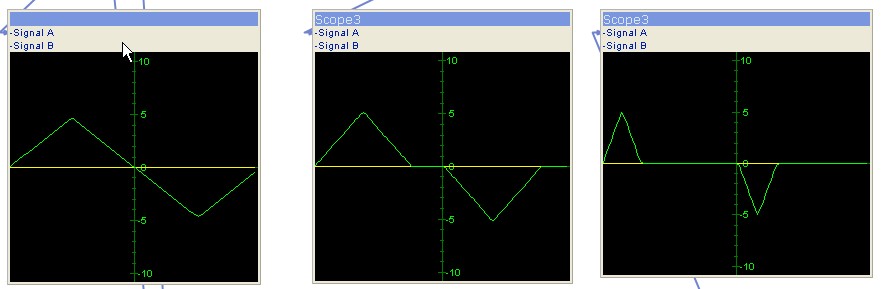
Not sure if it completely qualifies as "pulse-width" Smile :


Can make it assymetrical, but the aliasing creeps back a bit.
^ Joined: 08 Feb 2012  Member: #274678  Location: South - Africa
hibrasil
KVRist
- profile
- pm
- www
PostPosted: Fri Dec 14, 2012 4:25 pm reply with quote
seems the amplitude varies a lot based on frequency. Do you know if there is a precise way to compensate for this?

cheers,

oli
^ Joined: 23 Jun 2002  Member: #3139  Location: York, UK
Richard_Synapse
KVRist
- profile
- pm
PostPosted: Sat Dec 15, 2012 2:55 am reply with quote
Yes, you simply divide the output by frequency (more precisely, the phase increment). If you use higher order DPWs, be sure to use doubles, otherwise you'll quickly run into numerical issues.

Richard
----
Synapse Audio Software - www.synapse-audio.com
^ Joined: 19 Dec 2010  Member: #245936  
hibrasil
KVRist
- profile
- pm
- www
PostPosted: Sat Dec 15, 2012 5:36 am reply with quote
thanks, that works. Anyone know if a quasi-bandlimited saw-triangle morph can be achieved with this approach?
^ Joined: 23 Jun 2002  Member: #3139  Location: York, UK
Sendy
KVRAF
- profile
- pm
- e-mail
PostPosted: Sat Dec 15, 2012 5:51 am reply with quote
Ichad.c wrote:
Richard_Synapse wrote:
Cool, I'll try it...what is the pulse-width triangle? Smile


Not sure if it completely qualifies as "pulse-width" Smile :


Can make it assymetrical, but the aliasing creeps back a bit.


Technically, anything that isn't a pulse can't *really* have a pulsewidth, a more technically accurate term might be "duty cycle" as it appears to be speeding up each excursion and introducing a relaxation period (essentially the triangle works twice as fast so it can go on holiday at the end of the week HiHi ).

But yeah, pulsewidth is just one of those terms that has become a catch-all term and it's not overly technical, so I'd stick with that.
----
Livin' la diva loca Wink

http://soundcloud.com/sendy
^ Joined: 20 Jul 2010  Member: #236000  
Ichad.c
KVRist
- profile
- pm
- e-mail
- www
PostPosted: Sat Dec 15, 2012 12:27 pm reply with quote
hibrasil wrote:
thanks, that works. Anyone know if a quasi-bandlimited saw-triangle morph can be achieved with this approach?


Probably not - the DPW saw and DPW tri - are two different approaches, there might be another 'different morph' available. I still haven't done the gain compensation for my non-bandlimited saw-tri morph(unity parabole method) yet - anybody want to share their formula? I'm still going to try and do a saw-tri morph with DPW though - if I can find a way around the "abs" function in the DPW triangle case - it should be doable - I think.

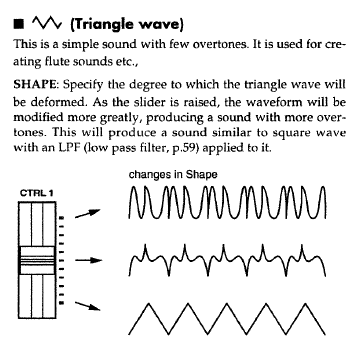
Random note - has anybody seen the "triangle mod" of the Roland JP-8080? Page 66 of the manual. That's simple interger wrap around Shocked , must be highly oversampled though Question Also - I've done all of the 'shapes' of the jp-8080 saw (page67) seperately with DPW - think I *might* be able to combine them...
^ Joined: 08 Feb 2012  Member: #274678  Location: South - Africa
Sendy
KVRAF
- profile
- pm
- e-mail
PostPosted: Sun Dec 16, 2012 3:41 am reply with quote
The Triangle Mod wave is pretty interesting, but the parameter range is WAY too small. Actually, the diagrams in the manual overstate the variance in the waveform you can produce. Some softsynths like Zebra, Zeta, Helix etc can do a much better job giving you a nice full sweep, some can even wrap the wave multiple times.

More interesting I found was the regular Triangle wave in the JP:


Unlike the Triangle Mod waves, these diagrams match the synth output precicely, and it's a really weird and interesting transform that I haven't seen implimented anywhere else. Notice that in the middle position the waveform's already lost it's symmetry as well as changed tension. It's great for making intricate but soft sounds.
----
Livin' la diva loca Wink

http://soundcloud.com/sendy
^ Joined: 20 Jul 2010  Member: #236000  
antto
KVRAF
- profile
- pm
- www
PostPosted: Sun Dec 16, 2012 5:46 am reply with quote
i have aproximated both the trianglemod and triangle from the jp-8000 (based on audio recordings from, Sendy Wink ) in my polysynth (which is under construction)

the trianglemod is basically funky math and modulo
the triangle was much harder, it required a funky shaper

and after i looked a bit more into this shaper, i wonder - maybe they used THAT same shaper for the weird shape of the sawtooth (in the supersaw)

here's some audio: https://www.box.com/s/nbpl1zuxkxx7rkc4d548
btw, thanks Sendy for the very precious audio recordings from the jp8000 ;]
----
It doesn't matter how it sounds..
..as long as it has BASS and it's LOUD!
^ Joined: 04 Sep 2006  Member: #118997  Location: 127.0.0.1
Ichad.c
KVRist
- profile
- pm
- e-mail
- www
PostPosted: Sun Dec 16, 2012 2:17 pm reply with quote
Interisting waveshaper antto! Guess there is truly different ways to skin a cat! Don't know if we are refering to the same 'supersaw' - but a shaper on that seems unlikely - the odd supersaw shape comes from the phase of the tracking HP, IMHO.

P.S. What software did you use for you expession evaluator? It looks cool.
^ Joined: 08 Feb 2012  Member: #274678  Location: South - Africa
antto
KVRAF
- profile
- pm
- www
PostPosted: Mon Dec 17, 2012 3:12 am reply with quote
Ichad.c wrote:
Interisting waveshaper antto! Guess there is truly different ways to skin a cat! Don't know if we are refering to the same 'supersaw' - but a shaper on that seems unlikely - the odd supersaw shape comes from the phase of the tracking HP, IMHO.

exactly that shape, but i strongly don't think they actually use a HP filter tracking the oscillator frequency
this shaper can be bent to give that same waveform
Quote:

P.S. What software did you use for you expession evaluator? It looks cool.

uhm.. mIRC HiHi

EDIT:
here, using the same shape you get this which looks pretty much like one of the jp8000 supersaws
----
It doesn't matter how it sounds..
..as long as it has BASS and it's LOUD!
^ Joined: 04 Sep 2006  Member: #118997  Location: 127.0.0.1
Ichad.c
KVRist
- profile
- pm
- e-mail
- www
PostPosted: Tue Dec 18, 2012 9:29 am reply with quote
antto wrote:
Ichad.c wrote:
Interisting waveshaper antto! Guess there is truly different ways to skin a cat! Don't know if we are refering to the same 'supersaw' - but a shaper on that seems unlikely - the odd supersaw shape comes from the phase of the tracking HP, IMHO.

exactly that shape, but i strongly don't think they actually use a HP filter tracking the oscillator frequency
this shaper can be bent to give that same waveform


Hmmm, interisting hypothesis. Does your "shaper" explain the theoretically reduced aliasing below the fundamental? And what do you feed it with - a naive saw or something else?
^ Joined: 08 Feb 2012  Member: #274678  Location: South - Africa
All times are GMT - 8 Hours

Printable version
Page 1 of 2
Goto page 1, 2  Next
Display posts from previous:   
ReplyNew TopicPrevious TopicNext Topic
You cannot post new topics in this forum
You cannot reply to topics in this forum
You cannot edit your posts in this forum
You cannot delete your posts in this forum
You cannot vote in polls in this forum
Username: Password:  
KVR Developer Challenge 2012