?
KVR Rank: 1887 1823 [30-Day: 1253; 7-Day: 1437; Yesterday: 1481]
| 5 members are watching GGate for news |
| Product | GGate |
| Developer | GVST |
| Primary Type | Gate |
| Price (MSRP) | Free |
Plug-in Formats
| Effect(s) |
Operating System Availability
| Operating System |
Latest Version |
Download | Is it Available? |
| 1.0 | Free Download | ![]() |
Miscellaneous Information
| Copy Protection | None |
| Average User Rating | ![]() |
Compatibility Unknown
Receptor is the Hardware Plug-in Player from Muse Research
advertisement

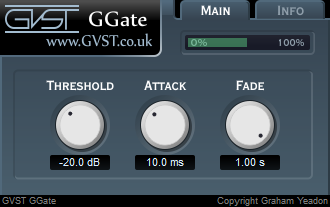
GGate is a noise-gate effect. It silences the signal when its level drops below the threshold, given by the Thresh parameter.
You can specify the Fade, which is the amount of time taken to mute the signal, and the Attack, which is the time taken to unmute the signal.
When you are mixing several recorded tracks together, the little noise present in each adds up. During quieter passages, the background noise from "silent" tracks can become a problem. A noise-gate is a simple and convenient way to silence the parts of a track that are supposed to be silent.
Reviews, articles, interviews, etc. for GGate.
None listed yet.
Products by GVST
GBand is a band-pass filter. It removes frequencies from the input that are above or below the specified cut-off points. GBand uses a high- and a low-pass filter in series to remove the unwanted frequencies. It is equivalent to using GHi and GLow, one after the other. Band-pass filters are useful during mixing to remove unnecessary frequencies from a track. A track that sounds fine on its own can sometimes be difficult to fit into a mix. Narrowing its frequency range will often help. Resonance boosts the volume of frequencies around the cut-off points. This can create large peaks in the out... [more]
GChorus is a chorus effect. The incoming signal is mixed with a delayed copy of itself. The effect is created by modulating the playback speed of the delayed copy. GChorus uses a sinusoidal LFO to vary the playback speed of the delayed signal. The magnitude and rate of this LFO are set using the Depth and Freq parameters. When GChorus is used on a stereo signal, a separate LFO is used for each channel. The R Phase parameter controls the phase of the right-channel LFO relative to the left. When R Phase is 0°, the two LFOs are synchronised. Changing the R Phase parameter causes the two LFO... [more]
GClip is a wave-shaping signal clipper. It prevents the input signal level from exceeding a specified maximum. The clipping function used can be altered to have a hard- or soft-knee. A graph showing the shape of the clipping function is displayed on the GUI. There is also a wave display that shows what effect the clipping curve is having on the signal.... [more]
GComp is a combined compressor and limiter for controlling the dynamics of an audio signal. GComp tracks both the peak and the RMS level of the incoming signal. The level considered for compression can be either of these, or a mix of both. The mix is controlled by the RMS/Peak parameter. The compression curve is defined by the Threshold, Ratio, Limit and Softness parameters, and is displayed on the GUI. The GUI also features a wave-display that shows the compression and limiting thresholds relative to the incoming audio.... [more]
GComp2 is a compressor featuring a band-pass filter and a gate. The compression is controlled with the Attack, Release and Compress parameters. The Compress parameter controls the compression curve, replacing the usual threshold and ratio parameters. The level of the signal going into the compressor also affects the result. The Gain parameter controls the input gain. The Output parameter can be used to control the output level. The gate is actually an expander, which turns the signal down when it drops below a given threshold. The Gate parameter sets that threshold.... [more]
GDelay is a digital delay effect. The delayed signal can also be fed-back into the delay line. The output is a mix of the original and delayed signals. The level of each is controlled by the Dry and Effect parameters.... [more]
GDuckDly is a digital delay that allows the wet signal to be compressed by the dry signal. Using high levels of feedback in a digital delay can create a busy sound. This can obscure the original, dry signal. In particular, it can make vocal tracks incomprehensible. The compression in GDuckDly is configured so that the effect is turned down when the dry signal sounds. When the dry signal is quiet the effect is turned back up. This allows the dry signal to be heard over even extreme delay effects.... [more]
GFader is a simple volume knob. It has a range of -100 to 0 dB. The signal is silenced at the minimum setting.... [more]
GGain is a simple volume knob. It boosts or cuts the level of the input signal by up to 12dB.... [more]
GGate is a noise-gate effect. It silences the signal when its level drops below the threshold, given by the Thresh parameter. You can specify the Fade, which is the amount of time taken to mute the signal, and the Attack, which is the time taken to unmute the signal. When you are mixing several recorded tracks together, the little noise present in each adds up. During quieter passages, the background noise from "silent" tracks can become a problem. A noise-gate is a simple and convenient way to silence the parts of a track that are supposed to be silent.... [more]
GGrain breaks down the incoming signal into grains and then reassembles it. A grain is just a very short section of the sound, shaped to avoid clicks. You can specify the number and size of the grains taken from the incoming signal. The level and pitch of each grain can then be altered before the sound is reconstructed, giving a variety of interesting effects. The grain-size, pitch and level can all be randomized using the SizeVar, PitchVar and GainVar parameters. These specify the largest variation from the associated centre value, set by the Size, Pitch and Gain parameters. For example, i... [more]
GHi is a resonant high-pass filter. It is used to remove all frequencies from a signal below a given cut-off point. Increasing the resonance of the filter causes the frequencies around the cut-off to be boosted. Resonance can create large peaks in the output. Because of this, the GUI features a peak display showing the maximum peak output level. The peak display is reset by clicking on it. High-pass filters are especially useful for removing unwanted or inaudible bass frequencies. In a mix, you usually want the bass to come from one or two specific tracks. Removing the bass from the other t... [more]
GLow is a resonant low-pass filter. It is used to remove all frequencies from a signal above a given cut-off point. Increasing the resonance of the filter causes the frequencies around the cut-off to be boosted. Resonance can create large peaks in the output. Because of this, the GUI features a peak display showing the maximum peak output level. The peak display is reset by clicking on it.... [more]
GMax is a maximizing limiter. It is designed to boost the level of the signal without letting the peaks exceed a given maximum. The Gain parameter sets the desired boost in volume. The signal will be boosted by this amount before going into the limiter. The limiter reduces the signal level as necessary to keep it below that specified by the Ceiling parameter. The Release parameter sets the time taken for the limiter to recover after turning the volume down. A meter is displayed on the GUI showing the gain reduction applied by the limiter. The resolution of this meter is 1dB per bar.... [more]
GMulti is a three-band compressor and stereo enhancer. First, the signal is split at user-defined frequencies into three bands. Each of these bands can then be compressed independently and have its stereo width altered before being mixed back together. The compression of each band is specified in the usual manner with threshold, ratio, attack and release controls. The GUI contains gain-reduction meters for each band, which have a resolution of 1dB per bar. There is also a before/after waveform display, which can display any of the three bands. The waveform display features a zoom control, whic... [more]
GNormal tries to remedy denormal problems by introducing extremely low-level noise to the signal path. (If you don't know what that means, then you probably don't need it). Some CPUs employ techniques to extend the accuracy of floating-point calculations for very small numbers. These small numbers are called denormals. Unfortunately, calculations involving denormals can be very slow. This can drastically affect audio DSP performance. In most cases, these numbers are too small to be of any interest anyway. Adding noise to the signal path can sometimes prevent denormals from getting into subs... [more]
GRevDly is a delay effect that plays the delayed signal in reverse. Reversed chunks are cross-faded to eliminate clicks. The Overlap parameter controls the amount each chunk overlaps with the next.... [more]
GSinth is a monophonic synth with three sine oscillators. It also features an LFO for controlling the output level. The first oscillator will play at the frequency of the MIDI note pressed. The remaining two oscillators can be set to play at a multiple of this frequency. You can also de-tune each oscillator. For each oscillator, you can set attack, release and portamento times. The portamento time is the time taken to "slide" from one note to the next. The PortaRst parameter sets the amount of time before resetting portamento. After that time, a new note will not "slide"... [more]
GSinth2 is essentially the same as GSinth, but with a few extra features. Most notably, GSinth2 offers new oscillator types: triangle, square and saw-tooth. GSinth is a monophonic synth with three sine oscillators. It also features an LFO for controlling the output level. The first oscillator will play at the frequency of the MIDI note pressed. The remaining two oscillators can be set to play at a multiple of this frequency. You can also de-tune each oscillator. For each oscillator, you can set attack, release and portamento times. The portamento time is the time taken to "slide" f... [more]
GSnap is an auto-tune effect. It can be used subtly to correct the pitch of a vocal, or, with more extreme settings, to create a robot-voice effect. For GSnap to work effectively, the input signal should be monophonic, at a good level and reasonably noise-free. For example, a clean, mono vocal recording, without excessive noise or reverb. Effect plug-ins should be placed after GSnap in the signal chain. GSnap starts off by detecting the pitch of the incoming audio. The Min Freq and Max Freq parameters help the pitch-detector by narrowing the range of frequencies it needs to consider. Also, t... [more]
GTune is a chromatic instrument tuner which operates much like its hardware counterparts. It will automatically detect the pitch of a note being played, and display the Western scale note that it is closest to. The main part of the display mimics a typical electronic tuner. When a pitch is detected, the nearest note is displayed along with an LED-style indication of flatness/sharpness. There is also a text display providing more accuracy, should it be needed. It gives the detected frequency in Hertz and its position in the Western scale. The latter is shown as a note-name and an offset in ce... [more]
Coming Soon...