

I can't think that I've ever heard of anyone using a circle of fifths to determine which song should follow another.
Jazz players certainly don't use the circle of fifths to "seamlessly move from one song/progression to another". Jazz progressions and modulations are very different from those used in rock and pop, and manifest themselves in works like "Giant Steps", which does anything but move to adjacent keys in the circle of fifths.
The circle of fifths is a piece of reference material that makes it easy to look things up. It doesn't dictate how anyone should compose or improvise, and it certainly shouldn't be necessary for simple modulations (V/V, etc.), and is not particularly useful for things like chromatic modulations.
Changing key in a song
-
- KVRist
- 53 posts since 18 Nov, 2019
You're not supposed to notice it. That's the point. Just because you haven't noticed it or heard of it occurring does not mean it's not true. If you google Mixing in Key, you get the Camelot Wheel which is exactly what the OP has which was made by DJs who mix in key and use the Circle of 5ths, except they put it into numbers instead of keys which is used by the DJ software "Mixed in Key".Forgotten wrote: Sun Feb 16, 2020 3:43 am I can't think that I've ever heard of anyone using a circle of fifths to determine which song should follow another.
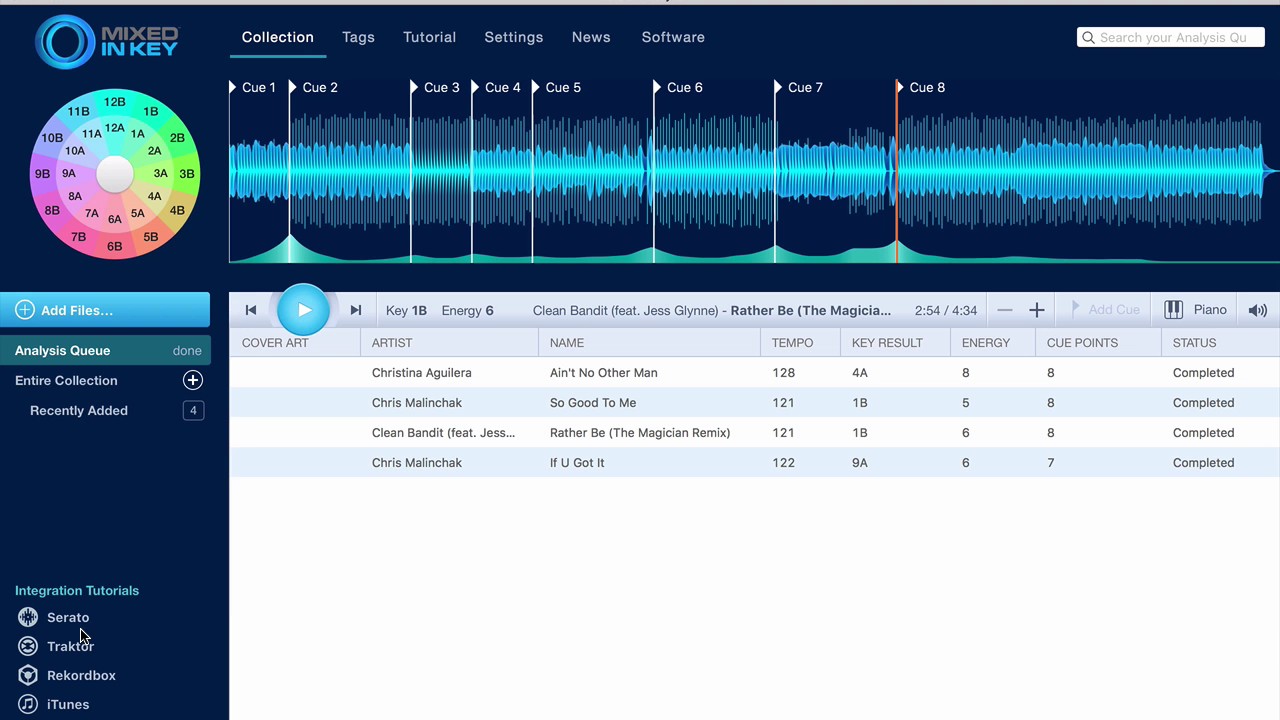
That is where the OP's Camelot Wheel comes from and that wheel came from the Circle of 5ths. The word "Camelot Wheel" means the wheel you see above which has those numbers instead of the keys but sometimes also shows the keys in addition to those numbers. The Circle of 5ths is actual exercise and wheel where this technique came from in the first place which doesn't use those numbers and is therefore simply called the Circle of 5ths rather than The Camelot Wheel.
DJs didn't invent this technique. Like I said, it stems from Jazz bands and how they improvise and move between songs and progressions. Obviously you haven't studied Jazz improvisation as this is one of the first things most people learn.
So this is really not worth arguing about.
-

- KVRAF
- 11000 posts since 15 Apr, 2019 from Nowhere
Can you cite me an example of a jazz band that uses the circle of fifths to determine which song should follow the current one being played?currentsound wrote: Sun Feb 16, 2020 3:48 am Like I said, it stems from Jazz bands and how they improvise and move between songs and progressions. Obviously you haven't studied Jazz improvisation as this is one of the first things most people learn.
So this is really not worth arguing about.
"Obviously you haven't studied Jazz improvisation". Non sequitur, so I assume you're just flinging an insult. Not to mention bullshit, as 1. jazz improvisation is not one of the first thing people learn, and 2. jazz improvisation has nothing to do with moving from one song to the next.
Yes, this is DEFINITELY worth disagreeing with you on as you're are misleading the OP by stating things that have no factual basis.
-
- KVRist
- 53 posts since 18 Nov, 2019
I will explain 1 last time:
Jazz musicians used the Circle of 5ths as a way of moving in between songs and progressions smoothly (part you disagree with, yes it has other uses too)
Some DJs started doing the same thing
Software developers made the music Mixed In Key https://mixedinkey.com/ and renamed the circle of 5ths to the Camelot Wheel and which automatically tags songs into numbers 1,2,3 rather than C,G,D etc... based on the Circle of 5ths, which made it easier for DJs who didn't know music theory to know the next number/key to go to as they could easily go 1,2,3,4,5 around the wheel when they were DJing.
The OP downloaded the Camelot Wheel, this is the number version invented by Mixed in Key.
I pointed out the origin of the Camelot Wheel and referred him to the Circle of 5ths
You got mad
You got more mad
You want to argue about it
I'm not saying it doesn't have other uses, I'm just telling you of it's origin. You need to calm down.
Jazz musicians used the Circle of 5ths as a way of moving in between songs and progressions smoothly (part you disagree with, yes it has other uses too)
Some DJs started doing the same thing
Software developers made the music Mixed In Key https://mixedinkey.com/ and renamed the circle of 5ths to the Camelot Wheel and which automatically tags songs into numbers 1,2,3 rather than C,G,D etc... based on the Circle of 5ths, which made it easier for DJs who didn't know music theory to know the next number/key to go to as they could easily go 1,2,3,4,5 around the wheel when they were DJing.
The OP downloaded the Camelot Wheel, this is the number version invented by Mixed in Key.
I pointed out the origin of the Camelot Wheel and referred him to the Circle of 5ths
You got mad
You got more mad
You want to argue about it
I'm not saying it doesn't have other uses, I'm just telling you of it's origin. You need to calm down.
-
- KVRAF
- 11000 posts since 15 Apr, 2019 from Nowhere
So an example of a jazz band that does this?
I assume you can’t cite an example or provide any kind of reference?
I’m glad you’ve decided to stop this nonsense and not make anymore attempts at stating unsubstantiated ‘facts’.
I assume you can’t cite an example or provide any kind of reference?
I’m glad you’ve decided to stop this nonsense and not make anymore attempts at stating unsubstantiated ‘facts’.
-

- KVRAF
- 26033 posts since 20 Oct, 2007 from gonesville
It is changing the key, period.currentsound wrote: Sun Feb 16, 2020 3:04 am Cmajor to Am is still the same scale since they are relative so that's not really changing the key other than
-
- KVRAF
- 26033 posts since 20 Oct, 2007 from gonesville
I’ve been involved in some form with jazz or jazz musicians for over 50 yrs. Including decisions as to a set list. Song to song by circle of fifths is not a thing in jazz. AFAIK it’s only something DJs do. It would get kind of old, fast. It is not an actual musical idea, it’s the paint-by-numbers quality of ideation we get from EDM folk. It’s boring.
If you want people to acknowledge you’re right, demonstrate it, support your assertion. ‘U mad bro’ is not that.
You want to argue about it.
He argued about it being something in jazz. You distorted that, reiterated this whole schmear about these devices no jazz musician needs whatsoever, all patronizing like.
If you want people to acknowledge you’re right, demonstrate it, support your assertion. ‘U mad bro’ is not that.
You want to argue about it.
He argued about it being something in jazz. You distorted that, reiterated this whole schmear about these devices no jazz musician needs whatsoever, all patronizing like.
-
- KVRist
- 482 posts since 10 Mar, 2013
@ everyone in this thread berating the dude and claiming that nobody uses the circle of fifths to move from one song to another:
When I used to DJ, that is literally what we'd do. You do it so the total elements of the two tracks you're mixing don't clash with each other.
Also wtf, stop being so rude to everyone. The guy came in here to be helpful and he didn't share anything factually incorrect. Please relax, and channel that negative energy into something productive.
When I used to DJ, that is literally what we'd do. You do it so the total elements of the two tracks you're mixing don't clash with each other.
Also wtf, stop being so rude to everyone. The guy came in here to be helpful and he didn't share anything factually incorrect. Please relax, and channel that negative energy into something productive.
-
- KVRist
- 282 posts since 20 Feb, 2020
I am still learning alot about this topic, but what definately works for my ears always is to change from one key to another with a sequence of 2 chords where the first chord belongs to both the old and the new key, and the second only belongs to the new key. For example: you are in C Major and want to change to F Major. If you use an FMaj chord (which appears in both keys) before going to a BMaj (which belongs only to your new key F Major) it will sound interesting and somewhat unexpected for the listener, but never dissonant/unpleasant.
-
- KVRian
- 880 posts since 26 Oct, 2011
Huh? They go circle of fifths constantly, it's like the most standard thing in jazz. Not from one song to another, though. But like, going counter-clockwise is pretty standard thing. I mean, the whole point of the ii-V-I turnaround is that it makes this very thing extremely easy. II7 and woop, your V is the new I. I7 and woop, there ya go, what used to be IV can now be your I.Forgotten wrote: Sun Feb 16, 2020 3:43 am Jazz players certainly don't use the circle of fifths to "seamlessly move from one song/progression to another".
Although I agree in the sense that this whole thing seems to have nothing to do with these other claims - also agree with Jan that limiting yourself only to circle of fifths-based modulation isn't great.
As per topic, my favorite kind of modulation is going from major to parallel minor. This movement can be done through my favorite device: IV -> iv (which I employ in minor all the time without any modulation) or just by ending on the V7, slightly prolonged, and then beginning with the major tonic.
The aforementioned "pop-modulation" (half- & whole-step modulation) can be fun although extremely cliché. One way to do it that I personally prefer is going for halfstep down into minor after V7, i.e. in C major, you play G7 and then you go for that Bm. This sort of modulation is considered as cliché but the good news is that younger audience isn't that sensitive to it. For instance, I've never cared for Eurovision or much of the pop music that did this so to me it doesn't have the association.
But large part of modulation isn't really only the modulation in and of itself but like, the structural significance of the modulation itself. Does it occur suddenly as the section changes? Does it prepare for a new section instead on the last measures of the previous section? Does it occur in a very deceptive and ambiguous way, creeping in through clever use of somewhat ambiguous passage without necessarily any super obvious pivot chords?
All of these are musical considerations and I like to personally think that all the different ways to modulate just serve these goals. The pop modulation is the most obvious example of this, but likewise, modulation was very much integral part of the forms themselves in classical music. Some of these ways to modulate are better suited for different purposes, so thinking of them without any context isn't necessarily too helpful except perhaps allowing you to explore their characteristics to some degree
-
- KVRAF
- 11000 posts since 15 Apr, 2019 from Nowhere
I know the circle of fifths is used widely in jazz, but I was disagreeing (along with others) that it is NOT used to "seamlessly move from one song/progression to another". I have never known any jazz player to use it to move from one song to another.Functional wrote: Tue Apr 21, 2020 2:15 amHuh? They go circle of fifths constantly, it's like the most standard thing in jazz. Not from one song to another, though. But like, going counter-clockwise is pretty standard thing. I mean, the whole point of the ii-V-I turnaround is that it makes this very thing extremely easy. II7 and woop, your V is the new I. I7 and woop, there ya go, what used to be IV can now be your I.Forgotten wrote: Sun Feb 16, 2020 3:43 am Jazz players certainly don't use the circle of fifths to "seamlessly move from one song/progression to another".
-

- addled muppet weed
- 111245 posts since 26 Jan, 2003 from through the looking glass
maybe if they did more people would enjoy stinky old jazz?

-

- KVRian
- 766 posts since 26 Jan, 2020
It’s more fun to play jazz than listening to it.
There are two kinds of people in the world. And you're not one of them.
-
 thecontrolcentre thecontrolcentre https://www.kvraudio.com/forum/memberlist.php?mode=viewprofile&u=76240
 - KVRAF
- 37262 posts since 27 Jul, 2005 from Scottish Borders
Just like DJing then?
