47 KVR members have added Receptor to 6 MyKVR groups 47 times.
Download KVR Studio Manager (FREE)
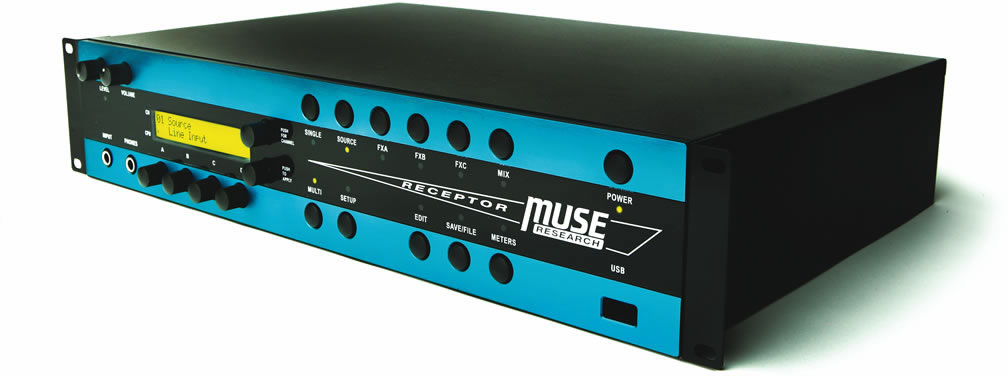
Receptor is a 2U rack-mountable multi-timbral sound and effects module that runs standard Windows VST instruments and effects. It combines the power of a computer with the ease-of-use, portability and reliability of dedicated synth and effects hardware.
Receptor's intuitive, mixer-like architecture combines up to 16 different audio sources, which can be either internal VSTi instruments or external analog/digital inputs. Each source is then routed through its own inline effects matrix that allows three VST plugins to be configured in every possible parallel/series arrangement. From there, each source is sent to a dedicated mixer channel, where the sound can be further processed by sending it to two dedicated effects busses, each with another fully configurable VST effects matrix. Need more processing? There is yet another VST effects matrix on the master output, for mastering and sweetening effects.
In all, Receptor provides architectural support for as many as 16 simultaneous VSTi instruments and 57 VST effects, while further offering the ability to process external inputs using its front-panel high-Z input, its rear-panel balanced analog inputs, or its S/PDIF digital input.
And, all this effects power can be harnessed through Receptor's intuitive front-panel interface, with full front panel and MIDI access to millions of internal patch locations. For those who prefer mice to buttons, you can connect a mouse, keyboard and monitor directly to Receptor, or you can network it to your Mac or PC and control it remotely from a window on that machine.


I'm not able to update Komlete to v.7 on my Receptor 2 pro.
How can I do that?
Best Regards
Les.
I am relatively new to the MIDI and Plugins World.
I have a Receptor 2 with Komplete 7 inside connected to my Mallet Kat as my MIDI Controller.
I change kits/setups on my MalletKat and certain channels immediately drop volume on Receptors Main Mixer screen.
The setup/kits on my Malletkat has it's own Volume control turned off. and I have saved the Multi patches and Plugin settings (and Volume) on receptor"s Main mixing screen. I can change multis and reload the original multi and the volume stays the same. but when I switch to a specific Kit on my MK, the volume drops considerably on Receptors third slot of the main screen.
Not sure if this is a CC problem. Maybe a CC is telling Receptor that when i switch to Kit 7 on the MK, drop the volume on channel 3? Not sure how to turn this off (on the MK or Receptor) if that is the case Any Ideas
Hi,
I am new to kvr forums so please excuse me if im off topic, i recently purchased the receptor and i tried hooking it up via MIDI to my korg pa800 i can hear the sound coming thru receptor while hitting notes but i cant seem to get the receptor to respond to bank/patches commands from my keyboard it stays on the same sound even while selecting a new sound thru my pa800. However Transpose and octave messages seem to work though, ive tried setting the channel on both (receptor korgpa800) to ch 1 as well on other chanels but no luck tin terms of having this problem resolved. PLEASE HELP IF I CANT SOLVE THIS I JUST BLEW 2,000 OUT THE WINDOW!!
P.s i am desprate
Thanks in advance
Sol,
Please log in to join the discussion
Submit: News, Plugins, Hosts & Apps | Advertise @ KVR | Developer Account | About KVR / Contact Us | Privacy Statement | Sell @ KVR | KVR Marketplace Terms & Conditions
© KVR Audio, Inc. 2000-2026