
KVR Audio is the Internet's number one news and information resource for open standard audio plugins. We report new releases, product announcements and product updates (major and minor) for all VST Plugins, DirectX Plugins and Audio Units Plugins. We manage a fully searchable audio plugin database (updated daily), and offer many free member services including user reviews, product update notifications and a very active discussion forum. We also host official support forums for many plugin developers plus the official Receptor support forum.
Plug-in Database: Virtual
Instruments, Effects & Hosts
Banks & Patches
Download & Upload
Plug-in Ratings
by KVR Members
Wiki: Tutorials,
Audio Lexicon, ...
Listen to Music
by KVR Members
Search
KVR
Quick
Links

Google Powered Search:

in new window

KVR Powered Plug-in Search:

Moog Modular V
by Arturia
48 members are watching Moog Modular V for news
Product Moog Modular V
Developer Arturia
Primary Type Synth (Modular)
Price (MSRP) €199 / $249
Plug-in Formats
Instrument(s)VSTDirectXAudio Unit
Operating System Availability
Operating
System
Latest
Version
Download Is it
Available?
Windows 2.2 Demo / TrialReleased
Mac OS XMac OS X Universal Binary 2.2 Demo / TrialReleased
Miscellaneous Information
Copy Protection CD Check (Installation/Update)
Average User Rating Average rating - 8.018
Compatibility Unknown
advertisement
Moog Modular V
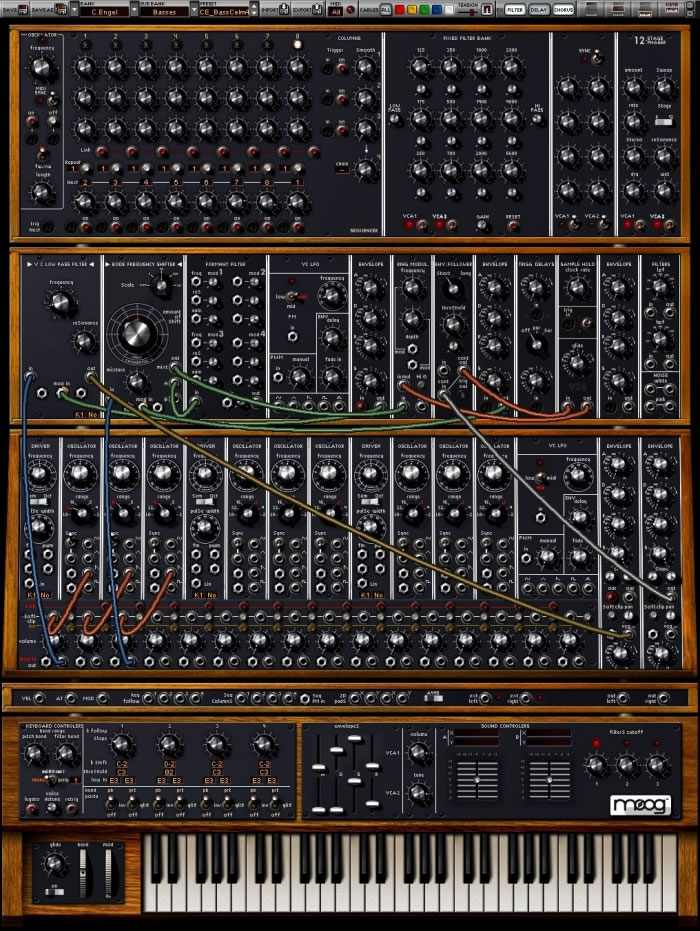
  • 9 oscillators (921 Mg series).
  • 2 dedicated LFOs.
  • 3 filter slots can be chosen among classic Mg 904 series (low-pass 24 dB, high-pass 24 dB, filter coupler), and an additional 12 dB multimode filter (7 modes).
  • 1 noise generator (white and pink – 923 Mg module).
  • 6 ADSR auxiliary envelopes (911 Mg module).
  • 2 VCAs (with their own envelopes, and 1 panoramic potentiometer for natural stereo effects)
  • 16 auxiliary VCAs with modulation inputs.
  • 1 sequencer (3x8 steps – 960 Mg module).
  • 1 filter bank (14 bands with their own bandwidth).
  • 1 stereo delay.
  • 1 chorus.
  • Mono/polyphonic (up to 64 voices).
  • Stereo synthesizer.
  • Absolutely pure and top quality sound (aliasing-free), like the original Moog sound.

User Reviews by KVR Members for Moog Modular V.

CLICK HERE TO ADD YOUR REVIEW


By taijiguy
On 23rd June 2006
Version: 2.0

Read all reviews by
taijiguy


6 of 6 people found
this review helpful.

Was this review
helpful to you?
Yes | No
  GUI
Sound
Features
Docs
Presets
Support
VFM
Stability
I’ve been using the Moog Modular V since it first came out. If I could only own one soft synth, this would be it.

GUI: The user interface looks very impressive, but it’s difficult to use. The most annoying thing is the need to scroll up and down because the entire interface can’t be displayed at one time. I’m sure this is because of the enormous number of modules and controls that made up the hardware MMV and the need of Arturia to make the interface as manageable as possible while staying true to the original instrument. If the entire interface were to be displayed, the controls would have to be a lot smaller than they are. But it makes programming very difficult and time-consuming.

Sound: The sound is fantastic! Although I’ve never played with a hardware MMV, I’m guessing that the sound is very similar. At the very least, it’s the best sounding software version of any Moog synth and quite a bit better than many analog-modeling hardware synths. It can produce many types of sounds from a fat, growling bass to high-pitched bells or spacey sound effects.

Features: The MMV is loaded with features, including the ability to change the module selection to some degree. It can be used as a VSTi or as a standalone soft synth. The patch cords are a nice touch.

Docs: A pretty extensive manual comes with the MMV and it includes several tutorials that range in complexity from producing a simple sound using the least number of modules to complex multi-oscillator sounds incorporating the sequencer. But the real fun of playing with the MMV comes after you’ve learned what works and what doesn’t, and you are able to create your own sounds.

Presets: There are plenty of onboard presets that were created by some well-known Moog users. Analysis of them is very helpful in learning to use this complex piece of software. You can also download user banks from the Arturia website or from other sources on the Web. I think it’s worthwhile to create your own user bank from the presets that you find useful, as well as your own presets. Because of the enormous number of presets that come with the MMV, it will make finding the ones you like a lot easier.

Support: The few times I’ve used Arturia support, they were quick to respond and very helpful.

VFM: The MMV is priced fairly and has actually come down in price since it was first release.

Stability: When MMV was first released, it was a CPU hog and regularly locked up my PC when using complex sequences. Those problems seem to have been solved with version 2.
 
   Report

By MarkM
On 28th December 2004
Version: 2.0

Read all reviews by
MarkM


2 of 2 people found
this review helpful.

Was this review
helpful to you?
Yes | No
  GUI
Sound
Features
Docs
Presets
Support
VFM
Stability
MMV2 reminds me of a flight simulator. In front of you is a realistic representation of a Moog Modular with nine oscillators, LFOs, EGs, several filters, a 3x8 sequencer, chorus, phaser, white and pink noise generators, a sample and hold module, a ring modulator, an enveloope follower, fixed filter modules and other modules ready to be connected together with virtual (Reason-like) cables. There is no mod matrix buried under pages of menus. It's all in front of you just like Moog initially designed. In a sense, it is like a primer for sound design.
MMV comes with some wonderful presets that get you up and running. There is a fairly good manual that will walk you through the modules and give you a lesson on synth theory.
Installing is easy and painless; you just enter your serial number and then you can register to be able to downlaod more presets. I think one of the few cons I have against MMV2 is that to import more presets or banks you have to use the original installation disk.
I love the sound. It's warm and gritty. The filters are very responsive. Unlike the real Moog, this virtual version can be polyphonic. However, when adding additional voices the CPU gets gobbled up quickly. Stereo is easily accomplished with the MMV2 because there are two VCAs; each with it's own panning pot. The effect modules are stereo and can be assigned to either or both VCAs. The delay is terrific as is the chorus. The phaser is mediocre at best.
I am enjoying the step sequencer. It's very flexible and besides doing the Berlin school thing, it can easily be used to modulate other parameters in the synth. I like that you can have a heavy pad sound going with a light sequence going on in the background for texture. The sequencer can go backwards, forwards, both ways, in rows or in columns. You can configure one or more oscillators to sequence through one line of the sequencer and another set of oscillators to go through a different line or column, and at the same time you could have one of the lines modulate a filter.
There are several filters to choose from and you can go out of one filter into another very easily. The low pass filters are very responsive. I also like the formant filter which will give you some vowel like sounds. There can be some extensive mods made to it. The Bode Frequency Shifter is an unusual module. It can produce some 50s sci-fi sounds. I confess I haven't used it much only because I am not too familiar with it. None of my other synths have anything that sounds like it. I find the other filters (high pass, general) mediocre.
Another great feature is the Unison mode. This can really fatten up the sound.
I have had a few crashes, because it is very easy to gobble of CPU power when adding voices and unison. But in most cases this is a fairly stable program.
Does it sound like a Moog Modular? I don't know. I have never owned one. But I don't really care if it sounds like the real thing or not. It sounds great; very warm, fat bottom end, breathy sweeps. A versatile pad machine as well as a strong lead synth. The step sequencer is one of the best features and distinguishes it from most VSTi's.
Customer service is ok. I had a question and received an email answer two days later. There is a Yahoo users group as well.
A couple other cons: when used in standalone the virtual control pots move easily. But in VST mode they are too sensitive to the mouse. However, with an external controller the pots can be assigned and are easier to control. The graphics are so detailed, it is hard to read the settings. Fortunately a popup with the current setting appears as soon as the mouse appears over the pot.
This would be a great synth for anyone wanting to learn the basics of sound design. It is also a great sounding instrument that complements other synths.
 
   Report

By ChamomileShark
On 29th September 2004
Version: V2

Read all reviews by
ChamomileShark


2 of 2 people found
this review helpful.

Was this review
helpful to you?
Yes | No
  GUI
Sound
Features
Docs
Presets
Support
VFM
Stability
Quick review. I've had this for nearly a year and have been kick started into creating my own sounds by the release of version2. Note that now the spec above doesn't include the new modules. The total number of modules are I think the same but you can swap modules. So you can add sample & hold (x2 by swapping out 2 envelopes) a Bode Frequency shifter, a formant filter (swaps with an LFO) and a ring modulator (swaps out an envelope).
Coming to Modular synthesis for the first time (my background is early 80s monsynths) it was a bit of a steep learning curve but the manual is very good.

User interface - now scrollable, I do sometimes find it hard to get fine control even pressing shift.

The presets are a little better in V2 with banks by Klaus Schulze among others, but overall I don't think they are a great advert. I would have prefered less.
Stability - sometimes I have problems when running several instances with other heavy VSTs but that comes with the territory. Having said that I understand V2.1 is on it's way.

Oh, and nearly forgot...it sounds great! The sound is very heavy and organic, I've not really got any "delicate light sounds" but that is probably down to my programming but again it's also down to the actually real life model for this software, it was a bit of a bruiser! The new modules do open up a lot more sound creation possibilities, especially if you are going for complex sounds like those on the early Tomita albums.
 
   Report

By HoTRocK
On 31st August 2004
Version: MMV2

Read all reviews by
HoTRocK


4 of 4 people found
this review helpful.

Was this review
helpful to you?
Yes | No
  GUI
Sound
Features
Docs
Presets
Support
VFM
Stability
It looks great, in keeping with the original.It feels great, in keeping with all moogs and it sounds...like a Mooooooooog! And thats why you pay your bucks... and considering an original would set you back over £5000 its damn good value. You get all the digital advantages including polyphonic, instant loading and saving (If you didn't have a polaroid you had a lot of drawing to do if you ever wanted to get the same sound again) and you can have as many as your computer can cope with. What more can a guy ask for. This is truly a big boys toy! (Sorry girls but you know what I mean)
Heavy on cpu and you do have to be careful what you're doing while you're twiddling knobs if you want to keep your speaker cones but thats true of every synth:The trick is to change things slowly, these things can do some really slow and deep sweeps that go through a hell of a lot of frequencies that can sneek up on you unawares, be warned: even the nasty's resemble the real thing.
Running a P4 3200,1gig mem, I have used 11 instances of MMV2 plus battery plus Crystal and several fx before cubase SX2 crashes.Then I simply recorded all onto seperate VST tracks and started again.
The size of MMV2 is quite something. Just about everything can be controlled with a cc (SX2 can start to get pretty confusing, trust me) although there are still some things you can't...which of course are the things I want to control i.e. the link buttons etc on the sequencer section (Although this thing is so big It may be I simply haven't found out how yet)
The MMV is a truly awesome bit of programming and Arturia deserve to win awards for it. The update to v2 is free to registered users which include 6 new modules - all of which were on the 'wish list' on the users forum as well as GUI improvements we asked for. There are a still few minor irritants that could do with ironing out, most of which has already been said by others here so I won't reiterate.
Arturia are now asking what other classic synths we want emulated. This is a company that LISTENS!
Many company's would do well to follow Arturia's example in customer service and attention to detail. Lets face it, the MMV got BOB MOOGs blessing...and deservedly so. The MMV2 is a truly AWESOME soft synth.

Rob Benn. A very happy user.
(As soon as I get a web page up I'll post the tunes I've done with it to date.)
 
Last edited by HoTRocK on 31st August 2004    Report

By bandasound
On 4th February 2004
Version: 1.2

Read all reviews by
bandasound


4 of 6 people found
this review helpful.

Was this review
helpful to you?
Yes | No
  GUI
Sound
Features
Docs
Presets
Support
VFM
Stability
This thing is awesome. I spent 2-days playing with this thing making presets...this thing does sound like an analog unit. it is so warm...and clear..no noise...this is another product by arturia showing there craftsman ship...honestly i didnt think it could be made to sound this good. Worth every $ i paid for it. User interface is definitly delictible...and the patching is insane...nice touch when you move across the cables and the move like you touched them...Routing options are are excellant with a visual feedback. I see that arturia has the CS-80v (i like to see if it matches up) and the minimoog when it comes out...

cons: does have a CPU load issue!!
 
   Report
Latest 5 reviews from a total of 7 - Click here to read them all

Reviews, articles, interviews, etc. for Moog Modular V.

None listed yet.

Products by Arturia

Product: Analog Factory
Developer: Arturia
Type: Synth (Analogue / Subtractive)
Price: €199 / $249
OS&Formats: WindowsMac OS XUniversal BinaryVSTAudio Unit
Analog Factory is a powerful yet easy-to-use virtual instrument which comes loaded with 2000 legendary synthesizer sounds that have shaped modern music production - from classic phat lead lines to crystalline digital pads. The interface includes a smart Preset Manager that allows in just a few clicks to find desired sounds from within the huge preset collection. But Analog Factory is not only a collection of sounds. Since it is based on synthesis, all sounds are modifiable - a set of the most essential parameters provides the user with an efficient way to tweak and alter the sonic character o... [more]

 
Product: ARP2600 V
Developer: Arturia
Type: Synth (Analogue / Subtractive)
Price: €199 / $249
OS&Formats: WindowsMac OS XUniversal BinaryVSTAudio UnitDirectX
The ARP2600 V is a reproduction of the ARP 2600.Introduced in 1972 with its "Blue Meanie" version, the ARP 2600 has evolved over the years to become a synthesizer celebrated by respected musicians. Capable of creating amazing sounds thanks to the exclusive ARP technologies, it can be operated with or without patch cords since all of the functions are internally wired and can be controlled via sliders and switches.With the ARP2600 V, Arturia brings this powerful semi-modular synthesizer back to life. Offering all the features of the original version, Arturia has added new functions such as MIDI... [more]

 
Product: Brass
Developer: Arturia
Type: Brass
Price: $349
OS&Formats: WindowsMac OS XUniversal BinaryVSTAudio UnitDirectX
Brass is a software recreation of three wind instruments - a trumpet, a saxophone and a trombone - based on physical models. All the characteristics of the real instruments have been analyzed and modeled through mathematical algorithms.After five years of research at IRCAM, the models have reached a point where it would be hard for anyone to distinguish the original instruments from their software counterparts. Indeed, Brass allows you to play these instruments like experienced performers would - with the same control, the same flexibility and the same expression. Brass comes loaded with more ... [more]

 
Product: CS-80V
Developer: Arturia
Type: Synth (Analogue / Subtractive)
Price: €199 / $249
OS&Formats: WindowsMac OS XUniversal BinaryVSTAudio UnitDirectX
The CS-80V offers all the features of the original synth, plus a new generation of innovative features, taking the original design to a new and upper level: A modulation matrix. A multitimbral mode. An arpeggiator. Features: Stereo synthesizer Polyphonic (8 voices) No aliasing from 0.1 Hz to 16 kHz 64-bit floating point precision Sampling rate: up to 96 kHz More than 400 presets, made by professionals Playable through a MIDI keyboard 2 oscillators 4 filters 2 LFOs 4 ADSR envelopes 2 VCAs 1 sub-oscillator (for vibrato) 1 arpeggiator 1 stereo delay 1 chorus 1 ring modulator Expression and su... [more]

 
Product: Jupiter-8V
Developer: Arturia
Type: Synth (Analogue / Subtractive)
Price: €199 / $249
OS&Formats: WindowsMac OS XUniversal BinaryVSTAudio Unit
Jupiter-8V is a software recreation of Roland's famous Jupiter-8 which was in production from 1981 to 1984. Based on the latest version of TAE - Arturia's proprietary technology for analog emulation - the Jupiter-8V offers a new generation of features: The integration of effects within the synthesis line allows for drastic modifications of the original sound; with Galaxy, a graphical tool made to program two LFOs at the same time, you get a unique and innovative source of modulation; and with the modulation sequencer you can create new evolving sounds extremely easily. The Jupiter-8V include... [more]

 
Product: minimoog V
Developer: Arturia
Type: Synth (Analogue / Subtractive)
Price: €199 / $249
OS&Formats: WindowsMac OS XUniversal BinaryVSTAudio UnitDirectX
Features of the original Minimoog: 3 voltage controlled oscillators offering several waveforms (Triangle, Saw triangle, Saw, Square, wide rectangular and narrow rectangular). The third oscillator can modulate either the first two oscillators or the filter. 1 mixer built with an overload circuit. 1 legendary 24db/oct resonant filter. 2 ADSR envelope generators. 1 external audio input. 1 external oscillator and filter modulation input. Additional features of the software version: 1 modulation matrix offering up to 6 different connections. 12 sources and 27 destinations. 1 LFO with sy... [more]

 
Product: Moog Modular V
Developer: Arturia
Type: Synth (Modular)
Price: €199 / $249
OS&Formats: WindowsMac OS XUniversal BinaryVSTAudio UnitDirectX
9 oscillators (921 Mg series).2 dedicated LFOs.3 filter slots can be chosen among classic Mg 904 series (low-pass 24 dB, high-pass 24 dB, filter coupler), and an additional 12 dB multimode filter (7 modes).1 noise generator (white and pink – 923 Mg module).6 ADSR auxiliary envelopes (911 Mg module).2 VCAs (with their own envelopes, and 1 panoramic potentiometer for natural stereo effects)16 auxiliary VCAs with modulation inputs.1 sequencer (3x8 steps – 960 Mg module).1 filter bank (14 bands with their own bandwidth).1 stereo delay.1 chorus.Mono/polyphonic (up to 64 voices).Stereo synthesizer.A... [more]

 
Product: Prophet V
Developer: Arturia
Type: Synth (Hybrid)
Price: €199 / $249
OS&Formats: WindowsMac OS XUniversal BinaryVSTAudio UnitDirectX
Prophet V is a hybrid of two synthesizers that changed the face of music during the '70s and '80s - the warmth of the Prophet 5, one of the first programmable polyphonic analog synths, meets the digital textures of the Prophet VS in this new plug-in. The Prophet V allows you to mix digital sounds with analog. Play the Prophet 5 and the Prophet VS either simultaneously or separate. Deepen and round the sounds designing a sound palette unique to your style of creation, or stick with the sounds you have come to know and love. Features Compatibility with the Presets of the original synthesizer... [more]

 
Product: Storm
Developer: Arturia
Type: Virtual Studio
Price: $149
OS&Formats: WindowsMac OS XVST
13 instruments / 5 types of synthesis: physical modeling, analog modeling, wavetable morphing, substractive synthesis, sample playback10 real-time effectsSample rate/Bit depth: 44.1 KHz/24 bitsMIDI control: Storms synths playable and recordable through a MIDI keyboard/slave and master MIDI syncVST instrument (with Cubase VST, Logic Audio 5, Orion,..)ReWire mixer or device (with Reason, Live, Sonar,...)Automatic tempo or tonality synchronization of samples with synthesized sounds ( time-stretching and pitch-shifting)Included samples:500 MB of WAV filesFile formats: 16/24-bit WAV, 16-24-bit AIFF... [more]

 
Coming Soon...