
|
|||
Hey everyone!
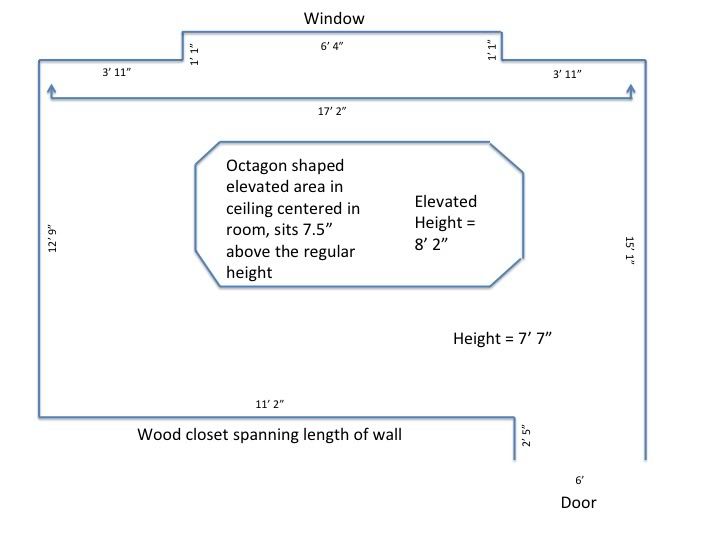
Introduction... I apologize in advance if this is the wrong section of the forum for posting a thread relating to studio construction/design. I would greatly appreciate any advice/suggestions within this thread or direction towards another site/forum to post this type of question. Anyway here we go... A little background... I have done a good amount of research online and I am currently reading "Home Recording Studio Build it Like the Pros - Rod Gervais," "Acoustic Design for the Home Studio - Mitch Gallagher" and "Master Handbook of Acousics - Everest." I realize this might be "overkill" but I am trying to educate myself to the fullest extent before investing in this setup which shall be permanent for quite some time. I have only been producing house/progressive for about 1yr and I am finally settled in a new place. Budget... This one is tricky for me. I have yet to gather an estimate of all the costs because I am not exactly sure of all my acoustic purchases/treatment at this time (obviously wall padding/bass traps). I am trying to minimize costs but I am willing to spend what is necessary for a proper and permanent setup. For a start I have at least 2,000 to spend right now. Producing Setup... 1. Macbook Pro 2. M-audio Oxygen 29 keyboard 3. 26inch Vizio TV monitor 4. 2 - 19inch LG monitors 5. 2 dell inspiron laptops 6. 2 M-Audio BX8 Monitors 7. 2 speaker stands (No additional foam padding just a thin layer that came with the stands) 8. I currently have no acoustic treatment in place Room Specifications... Attached to the post is a sketch of the dimensions as well as photographs of the room The room is fairly large Height = 91in (2.3m) - 98.5in (2.5m) Length = 153in (3.89m) Width = 206in (5.23m) Considerations...(I would appreciate advice on any of these topics). 1. I know monitor placement is essential and should be addressed first including the spacing in the room as well as the equilateral triangle spacing between the monitor and your listening positions. In room there is a small outcove area in front of the window where the wall extends indepth about an inch. You can see what I mean in the drawing. Not sure how to consider this spot with regards to monitor placement 2. Large wood closet built into wall on one side of the room. Not sure how to address/treat this since the rest of the room is dry wall. 3. Carpet floors. 4. Octagon shaped elevated ceiling portion in the center of the room, about 7.5inches above the height of the rest of the ceiling (again refer to sketch) 5. This room would be a dedicated studio but also might double as my bedroom. I have a small twin bed and a dresser. I was wondering what complications would arise by placing these in the room as well. I have the option to sleep in another room if complications arise from other objects such as these 6. The room is not a perfect rectangle/square due to the outcove in front of the window as discussed in #1 as well as the small area upon entering through the door (refer to sketch) 7. Any info on regarding room setup vs type of genre produced (ex: heavy bass in house/dub vs mixing a country track). As stated earlier I am mixing house/progressive house. Attachments... (see below - I apologize for the mess in the room haha) 1. Sketch drawing of the room and its dimensions 2. actual photographs Conclusion... Sorry I wrote this like an essay and I know it is a good amount of information. I will continue to do my research and answer my own questions however I would love to see some personal opinions/advice from members who have more experience in this field than me (which is barely any haha). I really appreciate your time and thoughtfulness, as I said earlier ANY suggestions will be extremely helpful! Thanks in advance!!! PS: Please let me know if there is anything I need to add/edit to this thread to make the information more helpful. I spent some time putting this together and I am attempting to collect as much research/opinions as possible before making my purchases. Hopefully I covered most everything but I know that is probably not the case!
![]() |
|||
| ^ | Joined: 30 Sep 2011 Member: #265816 Location: Seattle, WA | ||
|
|||
http://www.gearslutz.com/board/studio-building-acoustics/
This is the best place on the internet to answer your questions. Rod Gervais post's on there on the regular. If you have 2000 to spend on acoustic treatment that should set you up nicely. Don't waste your money on foam. If your handy with tools you can go the DIY route and save yourself alot of money. |
|||
| ^ | Joined: 14 Nov 2009 Member: #219579 Location: Chicago | ||
|
|||
In all honesty, you have a very nice room there. But for projects with lots of bass, you WILL find yourself more satisfied mixing with headphones.
The Schroeder Frequency of your room is about 118hz or less. Under that frequency is the natural modal boost of frequencies in the bass region, but also nulls. To get it more flat, would require tremendous investment of time and/or money. Above this frequency, the treatment is rather simple, and mineral wool wrapped in fabric is a very good cost effective option. As for your best stereo imaging, you might find the best wall to align your speakers to is the wall right of the door. You would want your speakers close to the wall, with mineral wool behind them. You would require bass trapping for the ceiling and the rear wall. For the side walls, I would use gobo type devices (freestanding absorbers) and play with their positioning. Make sure you measure all your dimensions of your furniture carefully. It is easier to arrange things on paper than in reality, so you can work the layout in a simple cad program or even photoshop. You should make a sketch of how things will be in relation to the speaker and listening setup. Then and only then can you define the final positioning of the acoustic treatment. ---- ![]() |
|||
| ^ | Joined: 16 Feb 2005 Member: #58183 | ||
|
|||
randy4me wrote: http://www.gearslutz.com/board/studio-building-acousti cs/
This is the best place on the internet to answer your questions. Rod Gervais post's on there on the regular. If you have 2000 to spend on acoustic treatment that should set you up nicely. Don't waste your money on foam. If your handy with tools you can go the DIY route and save yourself alot of money. Good point. Posted on there as well, along with some other forums such as anjunabeats, dubstepforums, IDM. What would you recommend instead of foam? Would the best route be to purchase acoustic foam from websites/sources that sell treatment options? what DIY options are there instead? Again I will keep you guys posted as I continue to do research and read more books on the subject, especially Rod's. Thanks again! |
|||
| ^ | Joined: 30 Sep 2011 Member: #265816 Location: Seattle, WA | ||
|
|||
camsr wrote: In all honesty, you have a very nice room there. But for projects with lots of bass, you WILL find yourself more satisfied mixing with headphones.
The Schroeder Frequency of your room is about 118hz or less. Under that frequency is the natural modal boost of frequencies in the bass region, but also nulls. To get it more flat, would require tremendous investment of time and/or money. Above this frequency, the treatment is rather simple, and mineral wool wrapped in fabric is a very good cost effective option. As for your best stereo imaging, you might find the best wall to align your speakers to is the wall right of the door. You would want your speakers close to the wall, with mineral wool behind them. You would require bass trapping for the ceiling and the rear wall. For the side walls, I would use gobo type devices (freestanding absorbers) and play with their positioning. Make sure you measure all your dimensions of your furniture carefully. It is easier to arrange things on paper than in reality, so you can work the layout in a simple cad program or even photoshop. You should make a sketch of how things will be in relation to the speaker and listening setup. Then and only then can you define the final positioning of the acoustic treatment. I am not familiar with the Schroeder frequency but currently looking this up so I can read up about it. What type of investment would be needed to give a more flat bass response? I assume (as you mentioned) I will be placing bass traps in this room but I am not sure on the cost of those/if they will make a significant difference in the bass region? I suppose headphones would be a good idea, especially since the low end is important with the type of music we are producing. I currently have AKGs and a pair of beyerdynamics to work with. Great suggestions regarding sketches, I figured I should probably make a more detailed sketch using a program that you have mentioned (instead of powerpoint haha). So it is necessary to account for all materials and furniture in the room before purchasing treatment? I will most likely just be placing two desks, a work chair and speaker stands in the room, I would rather not deal with trying to double the studio as my bedroom as well, seems like this would only complicate treatment. If I may can I ask about a few things that you could expand on would be awesome...if not no worries I am sure I will come across more knowledge on the subjects shortly. Anyway... 1. why you would position the speakers against that particular wall and why they should be close to the wall? 2. what types of material are best used for absorption. For example you mentioned mineral wool vs gobo type devices placed in different areas. Just wondering the reasoning behind this. I suppose purchasing from a website that sells acoustic material is a safe bet or going out and buying/construction the material and pads yourself is also an option? Really appreciate your time and sharing of knowledge. I am making my best effort to understand more about treatment and acoustics and hearing from others helps significantly in the process |
|||
| ^ | Joined: 30 Sep 2011 Member: #265816 Location: Seattle, WA | ||
|
|||
Greetings, Dave!
I agree that you've got a nice room to work with. I'd start by placing the workstation/mixing desk on the 12'9" wall on the left. Start with the desk about a foot or so away from that wall so you're facing the wall, centered left-to-right. Whenever possible you want to sit so that your room deeper than it is wide. If you need to place your bed and dresser in he room, go ahead and try it out. Don't worry about the carpet. That's fine. You already know about speaker placement and your room is big enough that you don't have to worry about your mixing position being anywhere near the center of the room, so set up your gear and listen to some music. This should give you a feel for the room and a starting point for tweaking and treating. Now that you can hear the room, you can start to think about treatment options. Drapes over the window? Maybe. Some acoustic tiles on the walls at ear height (and possibly on the ceiling) to cut down on early reflections/slap back? Maybe. Bass traps in the corners to keep the bass frequencies under control? Possibly. I write and record primarily Electronica and Hip-Hop style of music, and I recently moved and had to set up a new room, so I know where you're coming from. The tech specs can be a bit overwhelming. I've found that it very useful to start with a basic idea, get my stuff into the room, listen to see what might need to be changed, and then start experimenting with moving things around and adding treatments until I'm happy with the way the room sounds. Good luck with it! ---- Druu LoFREEQ Recordings |
|||
| ^ | Joined: 04 Apr 2012 Member: #278121 | ||
|
|||
bigdaveo11 wrote: camsr wrote: In all honesty, you have a very nice room there. But for projects with lots of bass, you WILL find yourself more satisfied mixing with headphones.
The Schroeder Frequency of your room is about 118hz or less. Under that frequency is the natural modal boost of frequencies in the bass region, but also nulls. To get it more flat, would require tremendous investment of time and/or money. Above this frequency, the treatment is rather simple, and mineral wool wrapped in fabric is a very good cost effective option. As for your best stereo imaging, you might find the best wall to align your speakers to is the wall right of the door. You would want your speakers close to the wall, with mineral wool behind them. You would require bass trapping for the ceiling and the rear wall. For the side walls, I would use gobo type devices (freestanding absorbers) and play with their positioning. Make sure you measure all your dimensions of your furniture carefully. It is easier to arrange things on paper than in reality, so you can work the layout in a simple cad program or even photoshop. You should make a sketch of how things will be in relation to the speaker and listening setup. Then and only then can you define the final positioning of the acoustic treatment. I am not familiar with the Schroeder frequency but currently looking this up so I can read up about it. What type of investment would be needed to give a more flat bass response? I assume (as you mentioned) I will be placing bass traps in this room but I am not sure on the cost of those/if they will make a significant difference in the bass region? I suppose headphones would be a good idea, especially since the low end is important with the type of music we are producing. I currently have AKGs and a pair of beyerdynamics to work with. Great suggestions regarding sketches, I figured I should probably make a more detailed sketch using a program that you have mentioned (instead of powerpoint haha). So it is necessary to account for all materials and furniture in the room before purchasing treatment? I will most likely just be placing two desks, a work chair and speaker stands in the room, I would rather not deal with trying to double the studio as my bedroom as well, seems like this would only complicate treatment. If I may can I ask about a few things that you could expand on would be awesome...if not no worries I am sure I will come across more knowledge on the subjects shortly. Anyway... 1. why you would position the speakers against that particular wall and why they should be close to the wall? 2. what types of material are best used for absorption. For example you mentioned mineral wool vs gobo type devices placed in different areas. Just wondering the reasoning behind this. I suppose purchasing from a website that sells acoustic material is a safe bet or going out and buying/construction the material and pads yourself is also an option? Really appreciate your time and sharing of knowledge. I am making my best effort to understand more about treatment and acoustics and hearing from others helps significantly in the process I appreciate the fact you have read the 'good books' on the topic. The wall right of the door entry may or may not be the best location for the front wall. The reasoning here is, your room has leaks. The door, closet doors, and window are all leaks as far as the bass is concerned. I don't imagine you want to invest in soundproofing, so I will tell you a little secret: the leaks in your room act as open spaces for the bass to travel through and never return. The catch is the amount of bass that leaks is small and only minimally influences the bass response. Some acousticians will say this is undesireable, because it turns the room into an unpredictable resonator, kinda like when you drill a hole into a pipe in the wrong spot and it screws up the resonance. Given the fact your room has leaks on one plane, the modal influence is reduced slightly from side to side. The side walls will resonate less than front and rear, and top and bottom, and tangental modes of. If you were to have the window open, and the closet full of plushy clothes, and the door open, you have a point of absorbtion on each side of the room. Use this to your advantage. Of course, because the size of and location of the leaks is asymetrical, there are still reflection points on the side walls which will cause an asymetric stereo image. Using absorption across from a leak where there is room is a good idea, to clean up the stereo destroying Haas Effect. Symmetric absorption is your friend. As far as putting the speakers close to the wall, the reasoning here is, BECAUSE there IS absorption behind the speaker, it is maximally efficient. The reflection is better nulled. If you do not have good absorption, the recommendation is to place the speakers further into the room. I suggest the right wall for front wall because, with the door open, the boundary is no longer there. See what I mean? My room is low absorption, high leakage, high diffusion, setup with the speakers into the room 56% of the depth and the listening location 38% of the depth. This provides a good distribution of the modal response, yet hardly ideal.
This room is a work in progress, and I have held off on fixed treatments until I move into a better room. Using furniture here and there really adds to the diffusion. ---- ![]() |
|||
| ^ | Joined: 16 Feb 2005 Member: #58183 | ||
|
|||
I followed you all the way until the part about speaker placement. Very well written/explained but my question would then be how to tell if I have good absorption behind the speakers? My guess is I would have to determine/understand this in order to decide whether I should place the speakers further into the room. I am probably misunderstanding this portion I assume.
I just checked out my thread in gearslutz and the only two replies so far suggest I place my speakers in front of the window(which goes against what I have read in the books about placing them so they aim down the longest part of the room). Their explanation behind this is that it allows the rear wall to be closer to my listening position (Not sure of the reasoning behind this). Anyway here is the link to the thread if you want to take a peek. http://www.gearslutz.com/board/studio-building-acoustics/718 660-need-some-advice-new-studio-setup.html#post7769114 Something I need to understand more/practice is how to analyze the frequency graphs (like you posted above) and apply that information in order to make adjustments and improvements to the room. I guess the first problem is I have no recording devices or room analyzing software at the moment and this seems like a must in order to set up a studio properly. Again can't thank you enough for the information provided so far |
|||
| ^ | Joined: 30 Sep 2011 Member: #265816 Location: Seattle, WA | ||
|
|||
The window would also make a good front wall. It might be better overall, actually, for stereo imaging. The location I suggested is based on the diffusion the leaks would provide for the lower modes, yet it would have first reflections in the near area that would require absorption.
My suggestion, get two measurement mics, record them with slow sine sweeps. Setup your room in all the locations you like, and measure the response at the listening location. Measuring frequency response can be very tedious, as relocating things and making sure there is no background noise can be a hassle. If you use two mics, you can measure the stereo field as well, although you will need analysis software to pick out timing differences. ---- ![]() |
|||
| ^ | Joined: 16 Feb 2005 Member: #58183 | ||
|
|||
thanks for your help camsr. I will research further into some analysis software and its uses/how to conduct room tests. |
|||
| ^ | Joined: 30 Sep 2011 Member: #265816 Location: Seattle, WA | ||
|
|||
Here's my quick and dirty setup to get you going;
- background - I recently moved from a large loft space to a small 2 bedroom split level. My new space is a bit smaller then your or about the same really. I spent two or three days moving things around and I finally found the sweet spot. Your room is going to be the same i'm sure. Bass reflection/standing waves, are going to be your worst troubles, I guess you know...so i'm not going to talk about absorbing those. That get into an expense, btu there is a way around it i've found. - first off, try setting up against one wall, the the other to compare. - set you monitors up on stands so the woofers are about 1 foot below half your ceiling height. - The monitors as close to your wall as possible and still be able to turn them 45degs toward center. - For example: place the edge of each monitor so they line up with the edge of your window.Just outside the window edge. - Now here's the catch...rule of thumb says you are to place yourself at the center corner of a triangle whee each side is equal...but that doesn't work best here.Place your self only half the distance from the wall as you would normally be sitting as if in a triangle. - Turn your mons in towards your listening position. As far as a cheap and effective way to deaden your space, call a 'used office furniture' store/shop/warehouse and ask for 'cubicle barriers'(did I spell that right? haha) I used them across each wall and believe me, the room is super dead. The bass is the prob...but with this setup you'll get just a minimum of room-boom and it won't be a prob. I know i' going to get some replies on this, but I recommend if you buy a sub woofer you hang it a little above you, about 1 ft away from your face when sitting up erect. This works, believe it or not. You get a clean subsonic output without any room-boominess. In rooms this size, this setup WORKS! I was confounded when I found it after days of moving my Mackies around...now i'm satisfied. ---- "For many individuals with mental illness, creativity is a valued and central part of their identity." |
|||
| ^ | Joined: 28 Mar 2003 Member: #6523 Location: Location: Location | ||
|
|||
I predict huge phase problems in the crossover frequency range of the subwoofer and monitors. I actually tried this once, except I positioned the subwoofer behind the listening spot. Nothing could have fixed the awful cancellation besides an active crossover, and those are not cheap. Plus, he doesn't need a subwoofer, he has 8 inch monitors in a small room. ---- ![]() |
|||
| ^ | Joined: 16 Feb 2005 Member: #58183 | ||
|
|||
My opinion on your situation is when you finally decide on your monitor position you should basstrap the corners and acoutically treat all the early reflection points and start making music. If you have only been producing for 1yr a perfect sounding room is the least of your problems. It takes at least 2-3yrs to train your ears to mix properly at a minimum.
The fact that you realize that you need acoustic treatment and you are very proactive is a great compliment. Get all your bases covered acoustically and worry about dialing it in later when your ears are trained properly. Acoustical engineering is a science that takes yrs to perfect. It can be very overwhelming if you try to tackle it right off the bat. Just get all your bases covered acoustically and start making music. Don't worry about taking measurements til you are further down the road and your ears are ready! |
|||
| ^ | Joined: 14 Nov 2009 Member: #219579 Location: Chicago | ||
|
|||
annode wrote: Here's my quick and dirty setup to get you going;
- background - I recently moved from a large loft space to a small 2 bedroom split level. My new space is a bit smaller then your or about the same really. I spent two or three days moving things around and I finally found the sweet spot. Your room is going to be the same i'm sure. Bass reflection/standing waves, are going to be your worst troubles, I guess you know...so i'm not going to talk about absorbing those. That get into an expense, btu there is a way around it i've found. - first off, try setting up against one wall, the the other to compare. - set you monitors up on stands so the woofers are about 1 foot below half your ceiling height. - The monitors as close to your wall as possible and still be able to turn them 45degs toward center. - For example: place the edge of each monitor so they line up with the edge of your window.Just outside the window edge. - Now here's the catch...rule of thumb says you are to place yourself at the center corner of a triangle whee each side is equal...but that doesn't work best here.Place your self only half the distance from the wall as you would normally be sitting as if in a triangle. - Turn your mons in towards your listening position. As far as a cheap and effective way to deaden your space, call a 'used office furniture' store/shop/warehouse and ask for 'cubicle barriers'(did I spell that right? haha) I used them across each wall and believe me, the room is super dead. The bass is the prob...but with this setup you'll get just a minimum of room-boom and it won't be a prob. I know i' going to get some replies on this, but I recommend if you buy a sub woofer you hang it a little above you, about 1 ft away from your face when sitting up erect. This works, believe it or not. You get a clean subsonic output without any room-boominess. In rooms this size, this setup WORKS! I was confounded when I found it after days of moving my Mackies around...now i'm satisfied. great suggestions, much appreciated. Never thought about using the cubicle office barriers as panels but I am sure that would save me a good amount of $ as well. When setting up your new space how did you find the "sweet spot"/comparing different monitor placements. I am guessing using room analysis software/mic which is something I am planning on doing and need to research this further as in what to look for when comparing various spots in order to determine the most optimal spot. Additionally how do you recommend I treat that window and the small little alcove that the window is contained in? I was going to fit a piece of plywood (or some other type of material to mount a panel on) into the window slot and then acoustically treat that but that still leaves that small alcove space as well. Anyway not sure how big of an issue this is. |
|||
| ^ | Joined: 30 Sep 2011 Member: #265816 Location: Seattle, WA | ||
|
|||
randy4me wrote: My opinion on your situation is when you finally decide on your monitor position you should basstrap the corners and acoutically treat all the early reflection points and start making music. If you have only been producing for 1yr a perfect sounding room is the least of your problems. It takes at least 2-3yrs to train your ears to mix properly at a minimum.
The fact that you realize that you need acoustic treatment and you are very proactive is a great compliment. Get all your bases covered acoustically and worry about dialing it in later when your ears are trained properly. Acoustical engineering is a science that takes yrs to perfect. It can be very overwhelming if you try to tackle it right off the bat. Just get all your bases covered acoustically and start making music. Don't worry about taking measurements til you are further down the road and your ears are ready! Others have mentioned this as well in other posts I have made on different forums. Couldn't agree more, I need to be continually reminded as I get caught up in the technical aspect of producing/acoustics. I will not be home and into the new room for about another month so I will keep gathering knowledge and working on music through my AKG headphones and then set up the room the best I can at that point and add additional acoustics/re-arrange my setup as needed and as I learn more about the topic. Thank you for the compliment. |
|||
| ^ | Joined: 30 Sep 2011 Member: #265816 Location: Seattle, WA |
| KVR Forum Index » Production Techniques | All times are GMT - 8 Hours |
|
Printable version |
Disclaimer: All communications made available as part of this forum and any opinions, advice, statements, views or other information expressed in this forum are solely provided by, and the responsibility of, the person posting such communication and not of kvraudio.com (unless kvraudio.com is specifically identified as the author of the communication).
Powered by phpBB © phpBB Group


