KVR Audio is the Internet's number one news and information resource for open standard audio plug-ins. We report new releases, product announcements and product updates (major and minor) for all VST Plug-ins, DirectX Plug-ins and Audio Units Plug-ins (and RTAS too). We manage a fully searchable audio plug-in database (updated daily), and offer many free member services including user reviews, product update notifications and a very active discussion forum. We also host official support forums for many plug-in developers plus the official Receptor support forum.
Plug-in Database: Virtual
Instruments, Effects & Hosts
Plug-in
Ranks
Banks & Patches
Download & Upload
Plug-in Ratings
by KVR Members
Wiki: Tutorials,
Audio Lexicon, ...
Listen to Music
by KVR Members
Search
KVR

Google Powered Search:

in new window

KVR Powered Plug-in Search:

Oatmeal
by Fuzzpilz
?
KVR Rank: 145 145 [30-Day: 233; 7-Day: 300; Yesterday: 285]
74 members are watching Oatmeal for news
Product Oatmeal
Developer Fuzzpilz
Primary Type Synth (Analogue / Subtractive)
Price (MSRP) Free
Plug-in Formats
Instrument(s)VST
Operating System Availability
Operating
System
Latest
Version
Download Is it
Available?
Windows 38-1 Free DownloadReleased
Miscellaneous Information
Copy Protection None
Banks & Patches Download Banks
Average User Rating Average rating - 8.708
Known to work
advertisement
Oatmeal
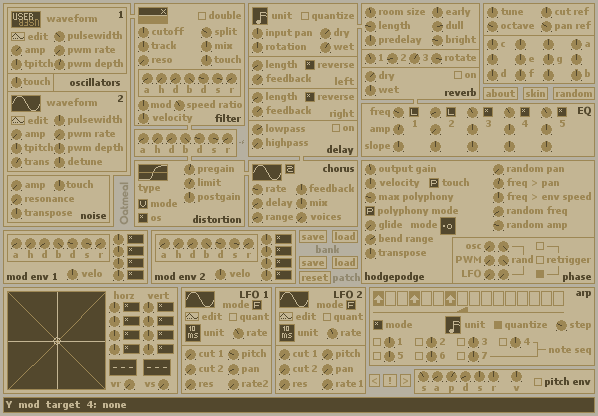
Oatmeal is a two-oscillator subtractive synth.

Features

Two oscillators:

  • Waveform: sine, sawtooth, pulse (square), triangle, user, and "user PWM".
  • Amp: Amplitude of the oscillator.
  • Tpitch (aftertouch > pitch): The effect of note velocity and later pressure changes on the oscillator's pitch.
  • Pulsewidth, PWM rate, PWM depth. These are ignored unless the waveform is "pulse" or "user PWM", in which case they set the base pulsewidth and the modulation rate and depth.
  • Trans (transpose): Transposition of the second oscillator relative to the first (i.e. the voice's pitch).
  • Detune: Constant frequency shift of the second oscillator.
  • Touch (aftertouch > osc amp): The effect of note velocity and pressure changes on both oscillators' amplitude.

Noise (white or bandpassed):

  • Amp: Noise amplitude.
  • Touch: The effect of note velocity and pressure changes on the noise level.
  • Resonance: If this is 0, unfiltered white noise is generated. Higher values increase the resonance of the bandpass filter, making the output purer.
  • Transpose: Transposition of the filter's center frequency relative to the note.

Filter:

  • Filter type.
  • Double (filter doubling): If this is enabled, two copies of the filter are run in parallel. See the "split", "mix", and "speed ratio" parameters.
  • Cutoff: Cutoff or center frequency of the filter.
  • Track (keytracking): In octaves/octave: if it is 1, an increase in the voice's pitch of one octave will cause the cutoff to increase by the same amount.
  • Reso (resonance): Resonance of the filter (if applicable).
  • Split: If doubling is on, the second filter's cutoff frequency will be this much higher than the first's.
  • Mix: If doubling is on, this changes the output amplitude ratio between the two filters.
  • Touch (aftertouch > cutoff): The effect of note velocity and pressure changes on both filters' cutoff frequencies.
  • Mod (envelope modulation): Strength and direction of the filter envelope's effect.
  • Velocity: Effect of note velocity on the envelope modulation depth, not on the filter cutoff itself.
  • Filter envelope: For details, see the envelope block below.
  • Speed ratio: If doubling is on, the second filter's envelope will move at this rate relative to the first's.

Envelope:

  • Attack: The time it takes for the level to reach 1.
  • Hold: After reaching 1, the level stays there for this long.
  • Decay 1: The time it takes for the level to reach the breakpoint; however, if the breakpoint is set to 1 (0 dB), this is skipped.
  • Breakpoint: The point reached after the first decay phase (see just above to see what happens if you set this to 0 dB); immediately followed by
  • Decay 2: The time taken for the level to change from the breakpoint to the sustain level.
  • Sustain: Sustain level.
  • Release: Release time.

Distortion:

  • Type: Hard clip, soft clip (tanh), sine (which can produce fm-like timbres or, failing that, horrible noise), or asymmetric.
  • Mode: This sets where the distortion is applied:
    Global: i.e. once, after summing all the voices.
    Per voice: after the filter.
    Per voice: before the filter.
    Double: i.e. per voice before the filter and then again after summing the voices.
  • Oversample: Oversamples the distortion to reduce aliasing.
  • Pregain.
  • Limit: The level at which the signal is clipped (or the amplitude of the sine).
  • Postgain: In double mode, this is not applied to the per-voice distortion.

Chorus:

  • Mode: Sine, Ramp, and FM are essentially the same thing with different LFO shapes. Irregular is a bit different: the delay times of the voices vary randomly within the given range.
  • Mode (aga

RSS FeedAll KVR Audio news items relating to Oatmeal.

Fuzzpilz releases Oatmeal 38-1 11th March 2008
Fuzzpilz releases Oatmeal 37-6b 23rd January 2008
Fuzzpilz releases Oatmeal 37-5 19th January 2008
Fuzzpilz updates Oatmeal (37-1) 31st May 2006
Fuzzpilz releases Oatmeal 15th March 2006

User Reviews by KVR Members for Oatmeal.

CLICK HERE TO ADD YOUR REVIEW


By jdtrbn
On 5th May 2008
Version: 38-1

Read all reviews by
jdtrbn


1 of 1 people found
this review helpful.

Was this review
helpful to you?
Yes | No
  GUI
Sound
Features
Docs
Presets
Support
VFM
Stability
Possibly the best freeware synth and the only one I've heard producing that screaming progressive metal lead. It supports custom waveforms and has a lot of stuff to tweak. You also get a couple of effects, which is nice. Some of the user made presets are astounding, better than some you hear in commercial synths. How hard or easy it is to get those sounds out of the thing, I do not know.

The GUI isn't the best I've seen. I believe it would work better if it had more than one page, like V-station. Now there are a lot of small knobs and the learning can take some time. After that you can work with it easily, though. You can also download alternative GUIs made by users. The manual basically explains the controls, but doesn't teach you any programming or go into details. This is normal for synth manuals and in the end you have to go through the controls anyway.

It's hard to review the customer support. I'll give it an 8 because the updates are somewhat frequent and there aren't any bugs or other things you'd absolutely need support for.
 
   Report

By lightninrick
On 21st April 2008
Version: 38-1

Read all reviews by
lightninrick


2 of 2 people found
this review helpful.

Was this review
helpful to you?
Yes | No
  GUI
Sound
Features
Docs
Presets
Support
VFM
Stability
Oatmeal is in my opinion one of the best-sounding and most versatile freeware synths available. It sounds great on its own, and it layers beautifully with a wide range of instruments.

The supplied GUI is ugly and complex to the point of baffling, but alternative skins are available that do a very good job of making the instrument more usable. I've rated the user interface as "8" taking these alternatives into account--otherwise it would be more like "5" (usable, but barely).

The large library of 3rd-party patches for this instrument are a terrific bonus--in terms of number, variety, and quality of patches available, Oatmeal is competitive with many commercial synths.

The instrument uses a moderate to small amount of CPU, another factor that makes it useful for layering. It is thoroughly stable under Sonar 6.0 and 6.2.1, and runs very well in Xlusoft Chainer too. (Chainer is a useful way to set up layers using this and other soft instruments and effects, of course.)

In short, this is an instrument that can improve almost anyone's inventory of soft synths. The more I use it, the more I find new uses for it.
 
   Report

By MaliceX
On 18th March 2008
Version: 38-1

Read all reviews by
MaliceX


8 of 8 people found
this review helpful.

Was this review
helpful to you?
Yes | No
  GUI
Sound
Features
Docs
Presets
Support
VFM
Stability
Oatmeal is by far one of the most versatile 2+1-OSC synthesizers out there in the FREEWARE market. (And it recently had an addition of unison!)

Tone-wise, it's quite simple to create simple sounds such as sinus basslines, but once you begin to investigate its options, it's a fully fledged VA under the hood. Various filters to choose from, a semi-modular distortion effect unit, onboard EQ, Reverb, Delay, Chorus, as well as an extremely flexible arpeggiator system.

One of the special nuances of Oatmeal is its wavedrawing mechanism. Now while one can draw whatever the hell they want in this screen for either OSC or LFO, right-clicking will reveal there's even morphing options of sorts for it, which expands the possibilities even more! Then there's the two other oscillator modes, hardsync and FM. Very nice touch, though the FM part is a bit limited due to some pitch limitations, if not a noticeable degradation of quality when one goes down pitch too far for OSC-1.

Anyway, the inbuilt modes for the included effects are amazing. There's so much to choose from. I like how it handles certain parameters with its ouwn modulation routings. My only caveat is it's quite confusing to work with at times, being the uniquely-constructed synth it is. I think this is also one of the only synthesizes that have a routable distortion. (Most synths act how GLOBAL mode does. Pre/Post filter? Sweet!) Now with the inclusion of a 15-voice unison, this can now sound very much like those big supersaw synthesizers. The only current limitation to the new unison is, it hasn't been properly implemented for HARDSYNC and FM as it modulates both OSCs or just OSC1 rather than simply the final shape combination. (ie: Post-generator stage) If this can be fixed, sync/fm unison heaven!

The main pinnacle of Oatmeal is its rather interesting randomizer unit. Comes up with some humorous, pre-programmed name combinations with the odd question (How it affects randomizing, probably nada.) Easy textures it can generate although you'd be better off making your own once you understand its limitations to randomizing.

Oatmeal is also skinnable too!! There are already some high quality skins out there for OAtmeal which not only get around the rather hard-to-read default GUI (single colours), to something more fancy, readable and appealing to work with.

Stability has been so far, excellent. While sometimes skins 'freeze' with some hosts, I have yet to experience any crashes using Oatmeal. It's always been relatively nice to my CPU however the more effects going, the more gets used. Now with unison added, long release, reverb plus multi-voices equals potential CPU choke; nothing strange, it's normal. Fares quite well with both a 1.7GHz AMD Sempron 2400+, and a 1.42GHz Pentium Dual Core.

All in all, it's a great synthesizer. Easy to create presets on-the-go, as well as a great creative-block randomizer for a good starting point. Great included effects, and is now capable to sound as good as anything. From vintage retro keys, to fat basses, to growling leads, to sparkling pads akin to a Fairlight, you can't go wrong with Oatmeal!

It's great nutrition for your workstation, at no cost to your savings account!
 
   Report
Latest 3 reviews from a total of 3

Reviews, articles, interviews, etc. for Oatmeal.

None listed yet.
Quick Jump:


Products by Fuzzpilz

Product: Charsiesis
Developer: Fuzzpilz
Type: FSU
Price: Free
OS: Windows
Formats: VST
Charsiesis, a chorus / delay / wackiness effect - the concept is that several delayed copies of the signal are summed together, with each delay length changing at a random rate that is regenerated periodically.... [more]

 
Product: Oatmeal
Developer: Fuzzpilz
Type: Synth (Analogue / Subtractive)
Price: Free
OS: Windows
Formats: VST
Oatmeal is a two-oscillator subtractive synth.Features Two oscillators: Waveform: sine, sawtooth, pulse (square), triangle, user, and "user PWM". Amp: Amplitude of the oscillator. Tpitch (aftertouch > pitch): The effect of note velocity and later pressure changes on the oscillator's pitch. Pulsewidth, PWM rate, PWM depth. These are ignored unless the waveform is "pulse" or "user PWM", in which case they set the base pulsewidth and the modulation rate and depth. Trans (transpose): Transposition of the second oscillator relative to the first (i.e. the voice's pitch). Detune: Constant freq... [more]

 
None found
Coming Soon...