
196 KVR members have added Aether to 54 MyKVR groups 246 times.
Download KVR Studio Manager (FREE)
Aether is an "Auto Randomizing Algorithmic Reverb Software plug-in".
Features and specification:
Unlike convolution reverbs, Aether is not a static process, and no two instances of Aether are ever exactly the same. The same is true in real world acoustical spaces as well: a building's acoustical character may vary slightly depending on several factors such as its current occupancy, and even more subtle things such as the current temperature and humidity. Thus, acoustic space itself is alive in the real world and is constantly shifting, morphing, and evolving to produce a complex array of potential impulse responses. A sampled impulse response of a real acoustic space, can be quite accurate for that particular moment, but it tells only part of the story. It is like a picture of a lake, versus the lake itself. A lake in the real world is unlikely to spontaneously develop waves the size of those found in the ocean, but it is never quite as still as a picture either. Aether's approach does not simply sample one static picture in time, but rather captures the complete subtly of the dynamic chaotic processes found in life and it retains all the detail and organic feel of these processes.
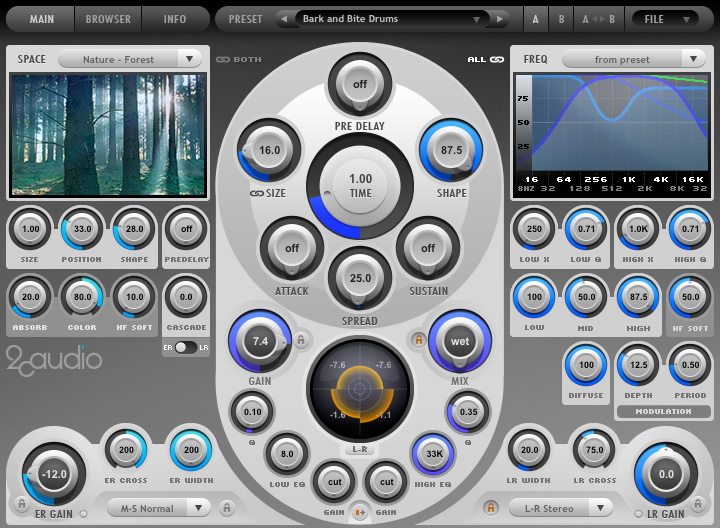
Aether's algorithm is conceptually divided into two parts: Early Reflections, and Late Reflections. The early reflections stage provides discrete delay patterns, which provide spatial cues that identify the nature of the given acoustic space. Aether mathematically calculates and subtly randomizes these ER delay patterns in pure floating point precision based on an incredibly complex algorithm that is designed to accurately mimic physical reality. This part of the algorithm consists of over 75 variable parameters which control the characteristics of the resulting ER patterns. In effort to maximize usability and user friendliness, this complexity is hidden from the user, and is instead wrapped into a single visual macro called Space Type. Thus the user does not have to deal with complex esoteric DSP parameters that only a physicist would understand and instead he simply chooses visually the type of environment he would like to use, and Aether makes the appropriate changes to the algorithm behind the scenes. 33 different default Space Types ship with Aether, and the interface provides five additional control knobs to customize their most important aspects. These controls allow adjustment of the size and geometrical shape of the Space Type default as well the positioning models used to determine where the sound source and listener are in the room.
In a real acoustic space there is no real distinction between Early and Late Reflections and the entire composite response of a real acoustic space consists of ERs, LRs, and frequency characteristics of the given environment. Thus in order to truly represent a given space accurately all three of these things should align to meet the characteristics of the acoustic environment. Aether offers an intuitive solution to this issue by providing a Link button that allows various parameters to be linked to the Space Type macro control. The additional ER controls, the LR controls, both set of controls, or none of the controls can be linked to Space Type. This way, when a user selects the "Telephone Booth" space for example, an appropriate size and reverb time can optionally be set automatically as well. Of course the linked parameters can then be adjusted by the user as desired and hybrid presets can also be developed by quickly combining the characteristics of two or more different space types. The end result is a balance of maximum ease of use and ultimate flexibility.
In addition to the intrinsic variance found at the very heart of the Aether algorithm, Aether also offers even more modulation possibilities to keep the verb from sounding dead and static. Two simple modulation controls are offered to invoke additional random LFO modulations in the Late Reflections section of the algorithm. The Modulation Rate and Period controls create musically-pleasing, randomly shifting resonances in the spectrum of the diffuse Late Reflections. Modulation period length extends to over eight minutes to allow for imperceptibly slow shifts in the resonance of the reverb tail that guarantee the reverb sound will never be exactly the same over the course of an entire song. This completely eliminates the metallic sound which plagues many inferior reverb designs on the market.
These specs continue at 2caudio.com/products/aether/
2CAudio is a sister company of Galbanum.
The best cinematic algo reverb on the market, even now. BUT DON'T BUY IT. The creators have been in a dispute for years and it seems a VST3 version will never appear. THE OWNERS NEED TO MAKE THE CODE PUBLIC DOMAIN TO ALLOW VOLUNTEERS CREATE AN UPDATED VERSION. The current price is extortion from a disputed seller.

THIS POST HAS BEEN REMOVED
THIS POST HAS BEEN REMOVED

MOST AMAZING REVERB AVAILABLE.
True, but DON'T BUY IT! The owner / creators have been in a dispute for years and it looks like it will never be resolved. NO PROSPECT OF A VST3 VERSION and no updating is ever going to ha[[en. The owners need to release it into the public domain for people to be able to upgrade it.
THIS POST HAS BEEN REMOVED
Please log in to join the discussion
Submit: News, Plugins, Hosts & Apps | Advertise @ KVR | Developer Account | About KVR / Contact Us | Privacy Statement | Sell @ KVR | KVR Marketplace Terms & Conditions
© KVR Audio, Inc. 2000-2026