

Anyone here doing sound design with feedback loops? What are your techniques and tools? Do you do it in the box, with outboard gear, or both? How do you deal with volume spikes?
Some time back in 2005 i did some sound design using feedback loops with an amp, a mic, a guitar fx processor (multi-effects, not just distortion), and a DAW. i created a few ambient sounds i really liked and i've wanted to revisit this kind of sound design. The thing is, i don't remember what i did to make these sounds (nowadays i tend to document my creations but i didn't then). i think one of them was created by bringing the mic up to the speaker while the fx included an echo set to infinite feedback, creating a loop of a feedback noise coming closer and moving away from the speaker (is the change of pitch with moving mics in front of speakers caused by the doppler effect?).
i DO remember spiking my ears a few times, and, when i attempted to revisit this technique a couple years ago, i quickly revisited the dangers of hearing damage and gave up early. i'm not at risk of damaging speakers i care about (was using an old Bose DJ setup, not my studio monitors), but i DO care about damaging my ears (more).
Jump ahead to yesterday, i was reminded of this sound design technique while playing with Impaktor (https://itunes.apple.com/us/app/impakto ... 24278?mt=8) on my iPad Pro. Since Impaktor's drum modeling uses a microphone input for the impulse, there's an opportunity for feedback loops, and this creates interesting results. i was also leaving the delay effect's feedback set to infinite to create rhythmic loops, which kept building in intensity with the compounding of new input from the mic, which interestingly resulted in the audio disappearing because it was too loud (bit overflow? reducing the mixer output brought it back, up to a point). It was a fun and chaotic experiment, and i thought i ought to try to see what other ways i can do feedback loops for sound creation.
Delay effects are one thing, but it's the chaos of audio feedback loops from an output being fed back to the input that i care most about. It's almost a performance tool. i've found precious little software that provides this; apparently feedback loops aren't possible entirely ITB, with most audio processing techniques(?). i remember reading that was a specific limitation in SynthEdit(??), and DAWs even expressly block such routings(?).
Anyway, i'm curious to hear anyone else's experiments and learn what your techniques might be. Especially within the context of not wanting to destroy your hearing. What do guitarists do when they're playing with feedback? Just wreck their ears? The volume required for guitar feedback seems to be pretty extreme...

Sound Design via Feedback Loops: What's your technique?
-

- KVRAF
- 6113 posts since 7 Jan, 2005 from Corporate States of America
- dysamoria.com
my music @ SoundCloud
my music @ SoundCloud
-

- KVRAF
- 2876 posts since 10 Jul, 2008 from Orbit SW US
Warning: Way long post ahead
I worked extensively with feedback outta the box for many years. I started with bass guitar feedback in a duo with a guitarist who also did a lot of feedback. We both used a bunch of effects pedals. As for our ears we used beer, earplugs, and standing with our heads above the cabinets. To change the frequencies we would back up. The different frequencies are different wavelengths. Robert Fripp is known for putting tape on the floor to mark different frequencies of feedback. A fun thing we did was for me to start feeding back the bass (thru a lot of power and cabinets) and then the guitarist would stand in front of one of my speakers and start the guitar feeding back off of my fundamental frequency or a harmonic. Something we learned was that it was often easier to get good feedback with one speaker with a lot of wattage than a multi spkr cabinet with medium power. EQ was a almost mandatory effect in the chain so one could accentuate certain freqs and especially dampen the really screechy upper midrange. I've not had much experience (positively) with mic feedback.
After a while i started doing solo recording and gigs ( as 'your brain on drugs') and started to experiment with what i called 'feedback machines' which was a simple digital delay into another delay (or two) and back into a mixer. My bass or synth would go into a channel on the mixer and various outputs from each delay (and parallel chains with effects) would go to other channels of the mixer. Usually i would put a volume pedal on each channel as it hit the mixer. One night at my house i was able to get such a good balance that i turned the sound system down at midnight and when i got up at 7:00am i turned the system back up and the loops were still going and not blurred out into noise. if the gain was too low the sound would decay and if too high it would turn to sonic mush. On this system i started using compressors either in a feedback channel and/or on the output. In live gigs i would do acoustically coupled feedback and feed that into the feedback machine. Always used compressors in that case!
When i started using computers to generate sound in 2000 i used Reason and Reaktor. I built a feedback machine in Reaktor which really rocked. Later, When i started using ableton live i realized that you could send a return channel back into itself which, depending on the effects used, can get really feedbacky.
Last but not least there is an acoustic feedback plug in from Softube. I bought it but lost the disc so i don't know how it sounds.
IMO acoustic feedback from stringed instruments is the most psychedelic of sounds. I still prefer out of the box to ITB for feedback. It's important to be able to control gains and effects in an instant, no screwing around wondering which fader (on a midi controller) controls what function.
I worked extensively with feedback outta the box for many years. I started with bass guitar feedback in a duo with a guitarist who also did a lot of feedback. We both used a bunch of effects pedals. As for our ears we used beer, earplugs, and standing with our heads above the cabinets. To change the frequencies we would back up. The different frequencies are different wavelengths. Robert Fripp is known for putting tape on the floor to mark different frequencies of feedback. A fun thing we did was for me to start feeding back the bass (thru a lot of power and cabinets) and then the guitarist would stand in front of one of my speakers and start the guitar feeding back off of my fundamental frequency or a harmonic. Something we learned was that it was often easier to get good feedback with one speaker with a lot of wattage than a multi spkr cabinet with medium power. EQ was a almost mandatory effect in the chain so one could accentuate certain freqs and especially dampen the really screechy upper midrange. I've not had much experience (positively) with mic feedback.
After a while i started doing solo recording and gigs ( as 'your brain on drugs') and started to experiment with what i called 'feedback machines' which was a simple digital delay into another delay (or two) and back into a mixer. My bass or synth would go into a channel on the mixer and various outputs from each delay (and parallel chains with effects) would go to other channels of the mixer. Usually i would put a volume pedal on each channel as it hit the mixer. One night at my house i was able to get such a good balance that i turned the sound system down at midnight and when i got up at 7:00am i turned the system back up and the loops were still going and not blurred out into noise. if the gain was too low the sound would decay and if too high it would turn to sonic mush. On this system i started using compressors either in a feedback channel and/or on the output. In live gigs i would do acoustically coupled feedback and feed that into the feedback machine. Always used compressors in that case!
When i started using computers to generate sound in 2000 i used Reason and Reaktor. I built a feedback machine in Reaktor which really rocked. Later, When i started using ableton live i realized that you could send a return channel back into itself which, depending on the effects used, can get really feedbacky.
Last but not least there is an acoustic feedback plug in from Softube. I bought it but lost the disc so i don't know how it sounds.
IMO acoustic feedback from stringed instruments is the most psychedelic of sounds. I still prefer out of the box to ITB for feedback. It's important to be able to control gains and effects in an instant, no screwing around wondering which fader (on a midi controller) controls what function.
gadgets an gizmos..make noise~crystalawareness.bandcamp.com/ soundcloud.com/crystalawareness Restocked: 7/2026
if this post is edited -it was for punctuation, grammar, or to make it coherent (or make me seem coherent).
if this post is edited -it was for punctuation, grammar, or to make it coherent (or make me seem coherent).
-
- KVRAF
- Topic Starter
- 6113 posts since 7 Jan, 2005 from Corporate States of America
Excellent post. Thank you for sharing! Do you have any recordings of your experiments online? (by the way, your signature link goes to a 404) Did you post your feedback machine to the Reaktor user library? i've never seen anything there that seemed to target feedback loops (i've looked, but might've missed). i don't do any building in Reaktor (i really don't have the mind for more than the most basic ensemble wiring). Was Reason part of your feedback experiments?CrystalWizard wrote:Warning: Way long post ahead
I worked extensively with feedback outta the box for many years. I started with bass guitar feedback in a duo with a guitarist who also did a lot of feedback. We both used a bunch of effects pedals. As for our ears we used beer, earplugs, and standing with our heads above the cabinets. To change the frequencies we would back up. The different frequencies are different wavelengths. Robert Fripp is known for putting tape on the floor to mark different frequencies of feedback. A fun thing we did was for me to start feeding back the bass (thru a lot of power and cabinets) and then the guitarist would stand in front of one of my speakers and start the guitar feeding back off of my fundamental frequency or a harmonic. Something we learned was that it was often easier to get good feedback with one speaker with a lot of wattage than a multi spkr cabinet with medium power. EQ was a almost mandatory effect in the chain so one could accentuate certain freqs and especially dampen the really screechy upper midrange. I've not had much experience (positively) with mic feedback.
After a while i started doing solo recording and gigs ( as 'your brain on drugs') and started to experiment with what i called 'feedback machines' which was a simple digital delay into another delay (or two) and back into a mixer. My bass or synth would go into a channel on the mixer and various outputs from each delay (and parallel chains with effects) would go to other channels of the mixer. Usually i would put a volume pedal on each channel as it hit the mixer. One night at my house i was able to get such a good balance that i turned the sound system down at midnight and when i got up at 7:00am i turned the system back up and the loops were still going and not blurred out into noise. if the gain was too low the sound would decay and if too high it would turn to sonic mush. On this system i started using compressors either in a feedback channel and/or on the output. In live gigs i would do acoustically coupled feedback and feed that into the feedback machine. Always used compressors in that case!
When i started using computers to generate sound in 2000 i used Reason and Reaktor. I built a feedback machine in Reaktor which really rocked. Later, When i started using ableton live i realized that you could send a return channel back into itself which, depending on the effects used, can get really feedbacky.
Last but not least there is an acoustic feedback plug in from Softube. I bought it but lost the disc so i don't know how it sounds.
IMO acoustic feedback from stringed instruments is the most psychedelic of sounds. I still prefer out of the box to ITB for feedback. It's important to be able to control gains and effects in an instant, no screwing around wondering which fader (on a midi controller) controls what function.
Regarding using a microphone for feedback loops, i found that, with levels set right, and some delays added to the chain, it could sometimes be used like a clumsy theremin (though i certainly didn't put tape on the floor or anything like Robert Fripp; neat to know he did that). i can't remember if i had a source/seed sound in there or if it was just feedback squealing and delays. This is why i'm trying to find out what other people are doing.
- dysamoria.com
my music @ SoundCloud
my music @ SoundCloud
-
- KVRAF
- 2876 posts since 10 Jul, 2008 from Orbit SW US
here's one:Jace-BeOS wrote:
Excellent post. Thank you for sharing! Do you have any recordings of your experiments online? (by the way, your signature link goes to a 404) Did you post your feedback machine to the Reaktor user library? i've never seen anything there that seemed to target feedback loops (i've looked, but might've missed). i don't do any building in Reaktor (i really don't have the mind for more than the most basic ensemble wiring). Was Reason part of your feedback experiments?
Regarding using a microphone for feedback loops, i found that, with levels set right, and some delays added to the chain, it could sometimes be used like a clumsy theremin (though i certainly didn't put tape on the floor or anything like Robert Fripp; neat to know he did that). i can't remember if i had a source/seed sound in there or if it was just feedback squealing and delays. This is why i'm trying to find out what other people are doing.
http://www.dancingbearaudioresearch.com ... cANmAN.mp3
It's chopped but there is some feedback there.
I never did put any of my Reaktor Feedback Machine .ens up in the UL but perhaps i can. I started experimenting with feedback in Reason but i quickly switched to Reaktor for the increased flexibilty. I'll fix some broken links and PM you. Thanks for the heads up.
I think that it would be better using a source sound in a mic to generate feedback because you will have some control of the feedback freq. A mixer on the input, and an EQ somewhere in the chain will be extremely rewarding as well as a compressor/limiter on the output.
gadgets an gizmos..make noise~crystalawareness.bandcamp.com/ soundcloud.com/crystalawareness Restocked: 7/2026
if this post is edited -it was for punctuation, grammar, or to make it coherent (or make me seem coherent).
if this post is edited -it was for punctuation, grammar, or to make it coherent (or make me seem coherent).
-
- KVRAF
- Topic Starter
- 6113 posts since 7 Jan, 2005 from Corporate States of America
Thanks for sharing that MP3. There are some neat sounds in there. At one point near the middle(?) or first third, it sounded almost like an e-bow was being used (something i've had on my mind to acquire, but haven't, considering it's kind of expensive for something so simple and niche).
Putting a compressor/limiter on the output is a good idea. i only have a single channel compressor/limiter and i'm really hoping to do some stereo sounds, as the stuff i want to try to replicate from 2004/5 ended up as ambient backgrounds to a couple of pieces of music. Here's an example: https://soundcloud.com/dysamoria/dysamo ... ly-morning (the sound that comes in first... though, now that i listen to it just now, i think i also ran that sound through a convolution processor in Sound Forge with a "long river" impulse response, which was a kick-ass effect i can't seem to recreate anywhere else).
Putting a compressor/limiter on the output is a good idea. i only have a single channel compressor/limiter and i'm really hoping to do some stereo sounds, as the stuff i want to try to replicate from 2004/5 ended up as ambient backgrounds to a couple of pieces of music. Here's an example: https://soundcloud.com/dysamoria/dysamo ... ly-morning (the sound that comes in first... though, now that i listen to it just now, i think i also ran that sound through a convolution processor in Sound Forge with a "long river" impulse response, which was a kick-ass effect i can't seem to recreate anywhere else).
- dysamoria.com
my music @ SoundCloud
my music @ SoundCloud
-

- KVRAF
- 13140 posts since 7 May, 2006 from Southern California
Yes, feedback is a critical tool for creating chaos in otherwise well behaved systems.
Lots of software will allow you to create feedback loops ITB. Most modular hosts and plug-ins will allow you to do that sort of thing. I made this track with u-he's Zebrify and FabFilter's Timeless, in a feedback loop within Live. The output of a return routed back to an audio track which also fed the return via a send.
https://soundcloud.com/justin3am/stressed
Reason and Reaktor are also awesome for complex feedback patches, as described above.
And don't forget about using feedback as modulation. Of course you have probably used feedback in an FM algorithm, but some modular plug-ins will let you do things like modulate the cutoff frequency of a filter with the filter's own outputs. That is totally possible with Bazille and ACE.
I work with feedback in analog signal paths quite a bit as well. I have a crumby old 10 channel mixer which has 6 sends and 4 busses. I route signal from the sends through effects and then back into the channel inputs to create a feedback matrix mixer that can route signal from any effect into any channel and any channel can be routed to any effect. I also made a passive send/return pedal which can send it's own output back into it's input. It allows me to create feedback loops for effects that don't have their own. This has predictable results with a delay or phaser for example but some fuzz boxes and eqs just go bonkers when feedback into themselves.
Check this out:
https://soundcloud.com/justin3am/umb
Chaotic interactions between primitive oscillators, plus a cheap EQ and BBD in feedback. All three boxes end up interacting and interfering with each other.
I can't do as much with acoustic feedback out of respect for my neighbors but I've found some techniques that allow me to get some acoustic feedback at low levels. I use small speakers and piezo mics on different types of surfaces and membranes. Lots of tonal variation from different kinds of materials.
Lots of software will allow you to create feedback loops ITB. Most modular hosts and plug-ins will allow you to do that sort of thing. I made this track with u-he's Zebrify and FabFilter's Timeless, in a feedback loop within Live. The output of a return routed back to an audio track which also fed the return via a send.
https://soundcloud.com/justin3am/stressed
Reason and Reaktor are also awesome for complex feedback patches, as described above.
And don't forget about using feedback as modulation. Of course you have probably used feedback in an FM algorithm, but some modular plug-ins will let you do things like modulate the cutoff frequency of a filter with the filter's own outputs. That is totally possible with Bazille and ACE.
I work with feedback in analog signal paths quite a bit as well. I have a crumby old 10 channel mixer which has 6 sends and 4 busses. I route signal from the sends through effects and then back into the channel inputs to create a feedback matrix mixer that can route signal from any effect into any channel and any channel can be routed to any effect. I also made a passive send/return pedal which can send it's own output back into it's input. It allows me to create feedback loops for effects that don't have their own. This has predictable results with a delay or phaser for example but some fuzz boxes and eqs just go bonkers when feedback into themselves.
Check this out:
https://soundcloud.com/justin3am/umb
Chaotic interactions between primitive oscillators, plus a cheap EQ and BBD in feedback. All three boxes end up interacting and interfering with each other.
I can't do as much with acoustic feedback out of respect for my neighbors but I've found some techniques that allow me to get some acoustic feedback at low levels. I use small speakers and piezo mics on different types of surfaces and membranes. Lots of tonal variation from different kinds of materials.
-

- addled muppet weed
- 111329 posts since 26 Jan, 2003 from through the looking glass
this will be one of my tools in a few months when they've gone in to production after an extremely successful kickstarter...

-
- KVRAF
- Topic Starter
- 6113 posts since 7 Jan, 2005 from Corporate States of America
Thanks for your post, Justin. "Stressed" has a lot of neat sounds in it. i prefer more structured music/sound, but the sounds in this piece are exactly the kinds of things i love in my music. It was interesting to listen to and i wish i could create such sounds (maybe i can, but i don't know how to?).
Respect for neighbors... ha ha, i show mine more respect than they show me. At this point, i should probably start being rude and making noise... But yeah, the sheer volume levels required to mess with feedback loops in the acoustic/analog realm is a concern to me for multiple reasons. It's a shame the sounds are so interesting to me. i'm fascinated that the sounds you created in "Stressed" are all ITB. Can you create feedback loops in Logic? i own but don't use my license of Live. While i might be able to my old version on Snow Leopard, i never got on with using it.
Respect for neighbors... ha ha, i show mine more respect than they show me. At this point, i should probably start being rude and making noise... But yeah, the sheer volume levels required to mess with feedback loops in the acoustic/analog realm is a concern to me for multiple reasons. It's a shame the sounds are so interesting to me. i'm fascinated that the sounds you created in "Stressed" are all ITB. Can you create feedback loops in Logic? i own but don't use my license of Live. While i might be able to my old version on Snow Leopard, i never got on with using it.
- dysamoria.com
my music @ SoundCloud
my music @ SoundCloud
-
- KVRAF
- Topic Starter
- 6113 posts since 7 Jan, 2005 from Corporate States of America
This looks a bit confusing but also VERY cool! i'm not fond of kickstarters, and i don't want to build kits. Also, i don't think a $400 routing device is in my budget.vurt wrote:this will be one of my tools in a few months when they've gone in to production after an extremely successful kickstarter...

i don't have any pedals, but a device like that makes me think i should have some. The way these little analog-connected devices keep showing up in live performances (Korg's Volka stuff, other small synth devices, pedals, FX, mixers/routers, etc), i have been wondering if i'm missing out on a lot of fun by not having any analog stuff. It seems like people are having fun, even if i am not keen on what they're making. i miss Fun. If my life is never going to get better, i need to find something to occupy myself with that isn't sitting still watching videos or ranting on the internet.
All my stuff is ITB or outboard digital (and mostly digitally-connected) gear. i have nothing analog at all (except an un-modded Korg Poly-800 that i can do nothing interesting with because it has no analog CONTROLS). Everything is connected with ADAT, S/PDIF, or AES. i do have a free mixer and a patch bay to plug crap into, but nothing interesting to plug into them. The only analog utility device i own is a NanoCompressor, boosting the low output of my Yamaha TX802 into an ADAT converter (none of which i really use anyway because the TX802 is the opposite of knobby expresion). Well, i also have one of these junkers: http://www.effectsdatabase.com/model/realistic/reverb
i hate noise that i don't want. i love noise that i do want. So i have focused all my purchases over the years on digital connections to avoid ground loops and electromagnetic interference, while buying devices that seemed like they might make interesting noise. Unfortunately, all that stuff lacks immediate/analog control. It's all buttons and menu diving. When i discovered that filters and pitch and everything else steps noticeably when controlled by MIDI, i started lusting after analog synthesizers and gear, but can afford nothing (i've considered the Korg MS-20, but the one i really wanted, the MS-20 module, is out of my price range and discontinued). Why is it that we have to sacrifice expression to have instant recall, or sacrifice instant recall to have analog expression? Why are these things still mutually exclusive??
i think i'm missing interesting noise and sound opportunities by having made my hardware buying choices, and i'm no longer able to buy things because i have no disposable income (plus, computers are pissing me off again, after my honeymoon of computing during Apple's good years starting to look far behind me).
- dysamoria.com
my music @ SoundCloud
my music @ SoundCloud
-
- KVRAF
- 3511 posts since 27 Dec, 2002 from North East England
I think this is the kicker when it comes to using feedback creatively. The only time I've ever found working with feedback feasible was on the big rack of Behringer outboard gear at my old university because you *need* all those controls instantly accessible if you're to do anything remotely precise. The outboard EQ with a slider for each of its 32 bands was particularly handy as you could essentially play it like a synth tuned to 3-tone equal temperament by momentarily flicking the bands up and down.Jace-BeOS wrote:... Unfortunately, all that stuff lacks immediate/analog control. It's all buttons and menu diving...
As such, I'd suggest minimising your feedback rack to the things you have that instantaneous control over. You'd be amazed just how much you can do purely inside a simple DJ mixer - output patched back to input. Toshimaru Nakamura's albums are all made with his 'No Input Mixing Board' and the variety of sounds he can coax out of it (alongside a loop pedal) is endlessly surprising. It all has a certain sonic 'signature' for sure, but runs the gamut from the more noisy, 'extreme frequencies' end of things down to pretty, almost melodic ambient stuff.
Anyway, I'd suggest EQ as being a great starting point for any feedback explorations. Set up as many bands as you have knobs on your MIDI controller, space them out as desired, and start turning them up and down. I'm guessing you'll need to inject a touch of noise somewhere in the chain though, given that there's no such thing as a noise floor in the plug-in world. Don't forget that no feedback loop is ever complete without a limiter.

Here's the track I made on that big outboard rack of gear circa 2005. 50 Hz (and its harmonics) are ever present thanks to the UK's electricity grid. The vast majority of the performative stuff comes from playing with that EQ as far as I recall. The last half is almost entirely a single track of a feedback loop containing the EQ and a Quadraverb clone (plus the essential limiter, of course). There's even a glitchy menu-dive effect where the delay length is turned down. It was pieced together on digital multitrack from a few sessions worth of improvisations and mixed down live. Only the 'unspooling' noise at 0.59 had any additional editing (a simple varispeed from high to low).
Patchwork.mp3
-
- KVRian
- 730 posts since 17 Sep, 2007 from Planet Thanet
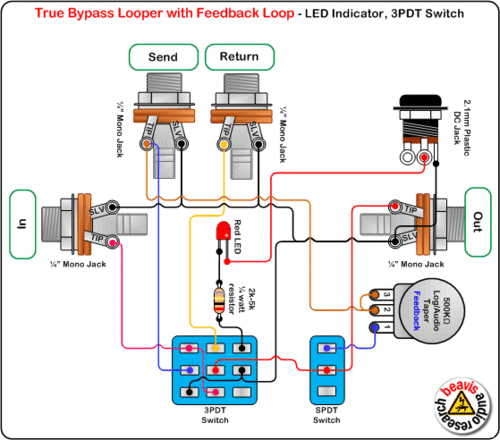
Built something like this yonks ago. Ace for experimenting with pedals and I can't remember why I stopped playing with it or even where it is now. Maybe I'll knock another one up this weekend.
-
- KVRAF
- 13140 posts since 7 May, 2006 from Southern California
I built exactly that:resynthesis wrote:Built something like this yonks ago. Ace for experimenting with pedals and I can't remember why I stopped playing with it or even where it is now. Maybe I'll knock another one up this weekend.
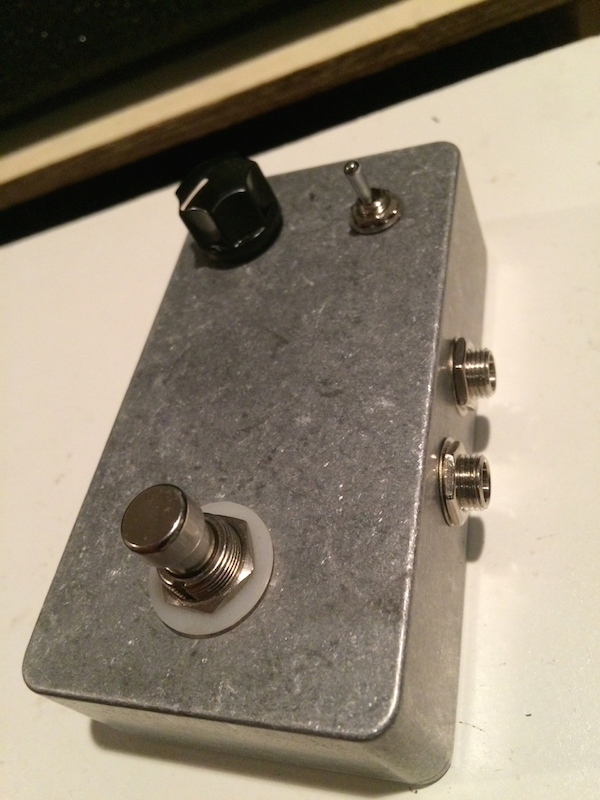
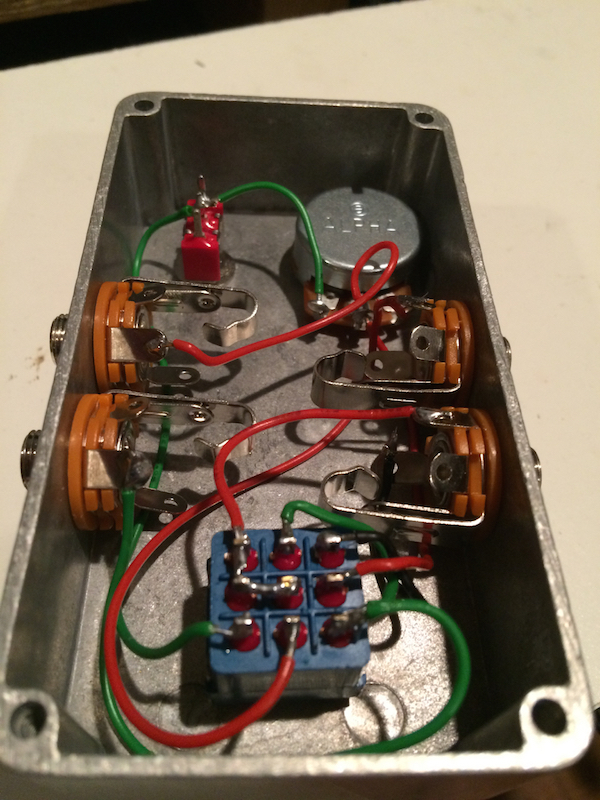
I found basically the same schematic on the Experimentalists Anonymous archive.
It took about half an hour and $25 in parts. I've had lots of fun with it and it doubles as a true-bypass for effects which don't have a bypass switch (e.g. Realistic Reverb, Boss Micro Racks, etc.).
-
- addled muppet weed
- 111329 posts since 26 Jan, 2003 from through the looking glass
nice!
a couple of those could be fun.
sadly im not sure im at that level yet
although if its roughly that price in parts, might be worth a go.
a couple of those could be fun.
sadly im not sure im at that level yet
although if its roughly that price in parts, might be worth a go.
-
- KVRAF
- 2876 posts since 10 Jul, 2008 from Orbit SW US
As always great stuff Justin. A lot noisier than anything else i've heard from you (maybe i need to take another listen thru you SC.)
The parts that sounded like ebow in the tRasHcAnMan piece are guitar with a volume pedal.
As i posted i find feedback more fun to make out of box because of the one to one control of pedals, mixers, etc. That hi-tech Realistic reverb is a great start. It's really a BBD device like flangers, chorus, and analog delay. I once modifried one to do all of the above. Pedals can be had cheap cheap oftentimes on places like CL. Of course even cheap cheap isn't doable always. Perhaps you can scrounge up some free stuff. Yes, as i also posted above an EQ is gold for feedback.
What DAW are you using? It would be worth it to see if you can get your copy of Live Lite working. For this sort of stuff Ableton is quite good. Also what kind of midi controller do you have? You need something, even the simplest thing with a few knobs.
As posted just above you can do a lot with a crappy mixer. With your mixer and your "reverb" you're on your way. Do any of your digital effects have analog ins and outs? If so patch them on the output of the mixer and then run the output of the effect to another in on the mixer. Then run either a guitar, bass, or mic into the mixer. Yes, ideally a limiter and a volume pedal would help but just keep the amp vol Low.
Feedback is fun.
The parts that sounded like ebow in the tRasHcAnMan piece are guitar with a volume pedal.
As i posted i find feedback more fun to make out of box because of the one to one control of pedals, mixers, etc. That hi-tech Realistic reverb is a great start. It's really a BBD device like flangers, chorus, and analog delay. I once modifried one to do all of the above. Pedals can be had cheap cheap oftentimes on places like CL. Of course even cheap cheap isn't doable always. Perhaps you can scrounge up some free stuff. Yes, as i also posted above an EQ is gold for feedback.
What DAW are you using? It would be worth it to see if you can get your copy of Live Lite working. For this sort of stuff Ableton is quite good. Also what kind of midi controller do you have? You need something, even the simplest thing with a few knobs.
As posted just above you can do a lot with a crappy mixer. With your mixer and your "reverb" you're on your way. Do any of your digital effects have analog ins and outs? If so patch them on the output of the mixer and then run the output of the effect to another in on the mixer. Then run either a guitar, bass, or mic into the mixer. Yes, ideally a limiter and a volume pedal would help but just keep the amp vol Low.
Feedback is fun.
gadgets an gizmos..make noise~crystalawareness.bandcamp.com/ soundcloud.com/crystalawareness Restocked: 7/2026
if this post is edited -it was for punctuation, grammar, or to make it coherent (or make me seem coherent).
if this post is edited -it was for punctuation, grammar, or to make it coherent (or make me seem coherent).
-
- KVRAF
- Topic Starter
- 6113 posts since 7 Jan, 2005 from Corporate States of America
That might be the first circuit i could actually build myself... though my soldering skills are shit (i once "accidentally repaired" -via soldering- a PowerMac that had a component knocked off the board when the case was closed up without the protective plastic piece over the logic board). i'd probably wreck, and need to replace, several components on the way to actually building it myself. i deeply respect the skills people have with DIY electronics but my brain (and my hands) just can't do it. i rely on people selling me stuff already assembled. Though, again, given the (redundant copies of) parts and the time, this looks simple enough even for me.resynthesis wrote:Built something like this yonks ago. Ace for experimenting with pedals and I can't remember why I stopped playing with it or even where it is now. Maybe I'll knock another one up this weekend.
- dysamoria.com
my music @ SoundCloud
my music @ SoundCloud