


SACD is dead, Jim. Higher numbers don't always mean it's a significant improvement.lfm wrote:I guess that is why SACD arised and even vinyl still exist!!!!!
Vinyl today has a completely different reason of existance: nostalgia. In technical terms it's audio quality is subpar,
especially when comparing it with CD. What I can gather from the test data presented in that thread, difference between pink noise @ 0dB VU and the noise floor of an unmodulated groove is 30dB @ 60Hz
but 50dB @ 10kHz, say it's averaging at 40dB. There's ofcourse some headroom to add (about 20dB should be plenty) so you'd get a total SNR of 60dB.
FYI: tape has a SNR of about 70dB.
Are you seriously suggesting to add 26dB of noise, add 1% THD and expect it to sound objectively better?lfm wrote:I guess that can be applied to imported 16-bit stuff too. Cover over it with a good tape emulator.
If distortion should be there, then the producer would have added it, not?
You should question what type of people are that exactly? For what exact reasons do they buy vinyl? How much trust do you have in them actually using their ears?lfm wrote:In the beginning of digital revolution everything was perfect. As time went by, people starting using their ears - and went back to vinyl.
You can simply record the vinyl pressing on CD if that "sound" is more preferred. Just like those producers bounce their stuff to tape & back.
But as a storage/playback medium vinyl really sucks. I did prefer the big 60x30cm fold-open sleeves over tiny CD booklets though.
Nope, the turntables of today are not sold on criteria of their technical merits.lfm wrote:I am suprised turntables of today are sold with wow/flutter specs that nobody would even buy back in the day
No buyer looks at the specs. If sound comes out, it's good. Nothing else matters. Bad turntables always were around, it wasn't until 1980 or so that mainstream turntables were as good as it would get.
The amount of pixels in an image is analoguous to the amount of samples per second in audio.lfm wrote:It's not like upscaling from DVD to 1080, or 1080 to 4k is unheard of. [...] So why not smart upscaling bitdepth for audio????
So that is resampling, not a simple bit depth conversion. There are plenty near-perfect resampling algorithms for audio.
There already is a perfect algorithm to convert from 16 to 24 bit: just append one least-significant byte with zeroes. You don't need to shift the bits to the left eight times or add 127 and remove DC for compensation.
So the problem at hand comes down to: is it possible to get a greater bit depth out of something dithered? The answer is yes, but at a cost.
I took a 1-bit dithered image from the wikipedia article about dither :
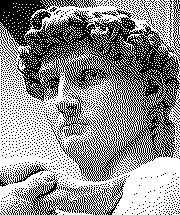
Then in Gimp I smoothened it out:

The bit depth is now 8 bits instead of 1, but at the cost of its sharpness. In audio that would mean the loss of high frequencies.
Since a 1-bit image is pretty bad, the only way is up. So let's repeat the very same process with a somewhat more realistic scenario: an image taken from the same page that was dithered:
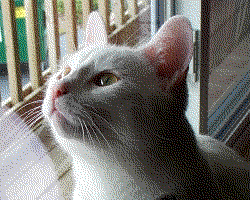
And processed the same way:

Is it better? Or just different? Is it significant? You tell me, but I really prefer the original

What you seem to forget here is that in 16bit audio the dithering noise is already not perceivable, while in the examples with images I have shown it IS perceivable. Why fix a problem that is not perceivable?
Do you own any of the albums Roger Waters made? He has the habit of opening the album with very soft sound, barely audible, inviting you to turn up the volume. Rip it and look at it in an audio editor. You can see the dithering noise there, it starts in essence with audio in one bit. But can you really hear it (and not blow your speakers / eardrums when he really kicks in) ?
Someone wrote that this is akin to showing your friend how nice your acoustic guitar sounds, but one meter in front of a turning jet engine.
It got edited out alas, it really was a good remark!
