

"I introduced myself to him, I told him I was a fiddle player, he said well hell, I am too, we are all fiddle players if we pick up a fiddle and play it, there's only twelve notes of music after all."
-Charley Daneils.

Will we ever see vsts of Korg Z1 or Yamaha VL?
-
- KVRAF
- 5666 posts since 23 Mar, 2006 from pendeLondonmonium
@ Dasheesh,
Our points of view are very similar, if only you' d read what I write....and as I wrote earlier in the thread, it's the hybrid nature of PM that I'm interested in. Using Acoustic-Modeling to create new sounds. But to do so, you need good acoustic models, not only in how well they emulate sounds, but in the range of available parameters that allow you to push the sound further, still keeping an 'acoustic' aura around the sound, as it were. Z1 (and VL-1) offers some very cool ways to do that, unlike Spire.
Why don't you abandon Spire for such sounds, and get yourself AAS' String Studio VS-2. You will be able to twist these acoustic-modeling sounds into new sounds with greater ease and satisfaction.
Our points of view are very similar, if only you' d read what I write....and as I wrote earlier in the thread, it's the hybrid nature of PM that I'm interested in. Using Acoustic-Modeling to create new sounds. But to do so, you need good acoustic models, not only in how well they emulate sounds, but in the range of available parameters that allow you to push the sound further, still keeping an 'acoustic' aura around the sound, as it were. Z1 (and VL-1) offers some very cool ways to do that, unlike Spire.
Why don't you abandon Spire for such sounds, and get yourself AAS' String Studio VS-2. You will be able to twist these acoustic-modeling sounds into new sounds with greater ease and satisfaction.
-
- KVRAF
- 5666 posts since 23 Mar, 2006 from pendeLondonmonium
And, just to quickly add.... the String Studio bow model is weak to say the least. It's easy to get violin timbres that sound like the violin has been drenched in acid for 100 years, so for realistic bowed string sounds String Studio is also not good. However, it works exactly on that hybrid aspect, where the string sounds like 'some' type of string, good for mangling into weird string sounds.
-

- KVRAF
- 11162 posts since 16 Mar, 2003 from Porto - Portugal
I think I see where is your problem. No, Physical Modeling is NOT JUST emulating energetic strings as oscillators. It tries to model the way acoustic instruments work, in that you have the sound producing part (which usually is a string, a plate, a surface, a reed or an air column), the resonance body (which can be a pipe, a box, etc.) and the excitation method (which can be a pluck, a bow, a percussive gesture, a blow). The you have all the variables, like the materials (for the strings, plates or surfaces), the size and nodes they have, then the materials of the resonance bodies, their size, shape - square, cylinder, oval, etc. - if they have holes or not, and the exciters (again size, pressure made, hardness, etc.).Dasheesh wrote:well, physical modeling is emulating energetic strings as oscillators has always been the way I thought about it. You guys have fun going in circles though if it makes you happy. If you want to play a violin pick up a violin. I'm a synthesizer player.
Bear in mind that, although the sizes and materials usually don't vary in the real world (but we can make them vary in a PM synth), the hardness and pressure of the exciter over the sound producing material varies constantly, and also that, for example a string, doesn't vibrate in the same way when it's loose and when it's pressed by the fingers to create nodes. The same goes to air columns inside the tubes of the woodwinds or the brass instruments (that's why the timbre changes from the lower to the higher registers, for example). And so on and so on.
It's all these variables that may be included in a model. The more variables the model includes, the closer it reacts compared to he real thing, but also the more processing power it's demaning and the more difficult it is to manage it. Yet, expressiveness and playability are very tied with the way these variables are implemented, and it's where a common subtractive synth and a sampler usually fall short.
Last edited by fmr on Thu Oct 20, 2016 2:43 pm, edited 1 time in total.
Fernando (FMR)
-
- Banned
- 12367 posts since 30 Apr, 2002 from i might peeramid
..when threads descend into "i don't know and i don't care but i still want to say things about it"
ache it teasy folkyfolks, y'all have a good kvr now
ache it teasy folkyfolks, y'all have a good kvr now
you come and go, you come and go. amitabha neither a follower nor a leader be tagore "where roads are made i lose my way" where there is certainty, consideration is absent.
-
- KVRist
- 198 posts since 24 Dec, 2009 from Berlin
Dasheesh wrote:well, physical modeling is emulating energetic strings as oscillators has always been the way I thought about it.
But this is misleading thought. E.g. check the picture of the signal flow from a Yamaha VL70m:
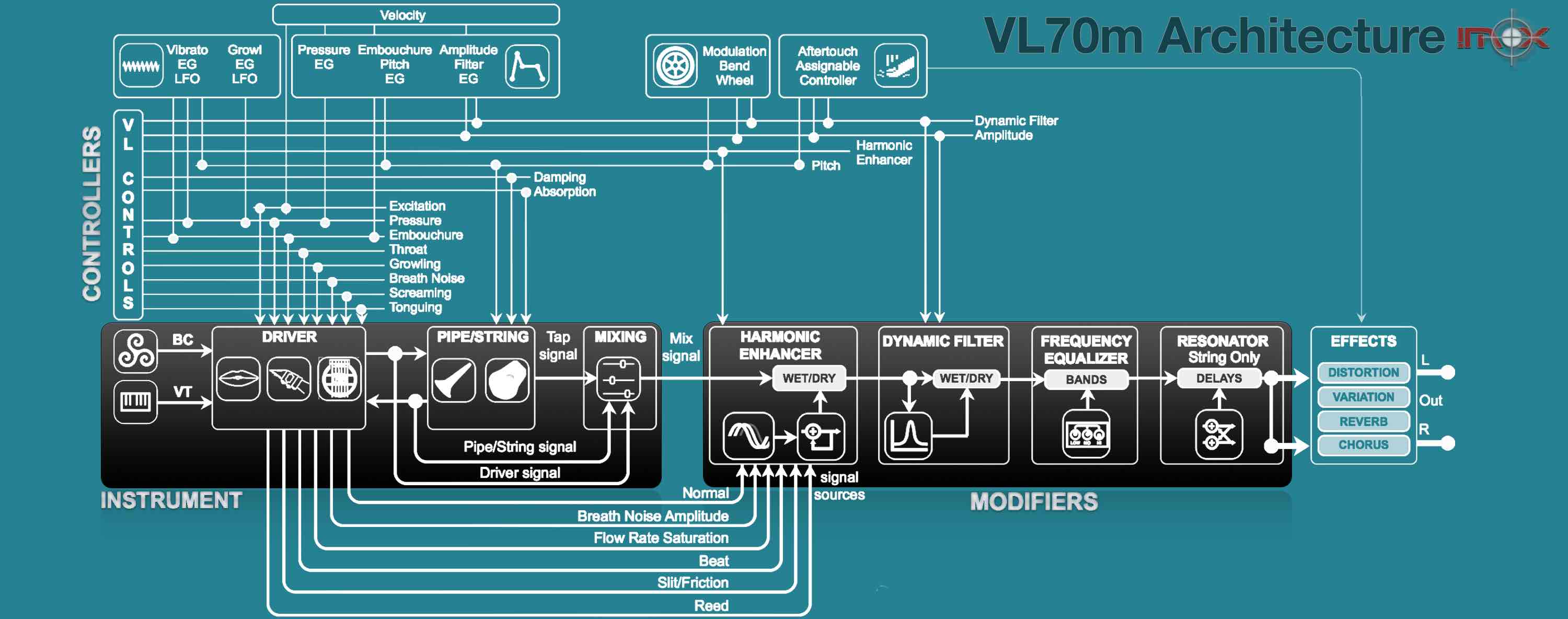
Which arrow is the output of the "oscillator". Maybe you could interpret the Instrument block as the oscillator, but then you ignore, that also the modifier are not (only) standard stuff like a 24db filter, but also tailored to the PM algorithm.
-
- KVRAF
- 4751 posts since 22 Nov, 2012

-
- KVRAF
- 5666 posts since 23 Mar, 2006 from pendeLondonmonium
That's much nicer than before - as a hybrid-string-like sound. Now , start thinking about adding suitable vibrato...
-
- KVRAF
- 11162 posts since 16 Mar, 2003 from Porto - Portugal
Better, but still quite far from how a violin sounds. Even the playing needs to be adjusted, not just the sound.
Fernando (FMR)
-
- KVRAF
- 4751 posts since 22 Nov, 2012
Now you guys are just being picky. Last one. I took off the filter FM because I know you hate the dirt.
https://soundcloud.com/jeremy-me/violint-v5
https://soundcloud.com/jeremy-me/violint-v5
-
- KVRAF
- 6323 posts since 30 Dec, 2004 from London uk
Happened in 1999 - Reality by Seer Systems using Sondius :
http://seersystems.com/tag/reality-synthesizer/
http://seersystems.com/tag/reality-synthesizer/
-
- KVRAF
- 11162 posts since 16 Mar, 2003 from Porto - Portugal
That one used the Sondius (Yamaha) waveguide (among other things). I think they were the only ones to ever license it. After that, I never saw any mention to it in any other soft synth.UltraJv wrote:Happened in 1999 - Reality by Seer Systems :
http://seersystems.com/tag/reality-synthesizer/
Fernando (FMR)
-
- KVRAF
- 11162 posts since 16 Mar, 2003 from Porto - Portugal
Cleaner, but still metallinc and synthetic. Here, take a listen to this: and use as a referenceDasheesh wrote:Now you guys are just being picky. Last one. I took off the filter FM because I know you hate the dirt.
https://soundcloud.com/jeremy-me/violint-v5

Fernando (FMR)
-

- KVRAF
- 37396 posts since 14 Sep, 2002 from In teh net
Wonderfulfmr wrote:And here is a great example of physical modeled violin using Reaktor: