Xhun Audio RawPrime : an original synthesis concept, established on... Aliasing (on purpose) !

VST, AU, AAX, CLAP, etc. Plugin Virtual Instruments Discussion
Post Reply New Topic
RELATED
PRODUCTS
RawPrime$99.00Buy

Post

Now, a brief description of RawPrime Generator "Section D" (the MRPH parameter).

Image

The five (5) output waveforms produced by a single DACs array (also known as overtones-scenarios) are the result of the multiple sampling rates set on each DAC and defined by the selected overtones-coefficients (OVT).

After a mild reconstruction filter, this analogue waveforms produced are then sent into the Morph engine, controlled by the (MRPH) knob.

Here it is possible to morph between the 5 waveforms signals produced : this allows for easy, continuous sound shaping - in a similar way as it happens with multi-dimensional wavetable synthesis (also if RawPrime waveforms are the result of vintage DACs aliasing and NOT derived from wavetables).

As it will be shown later, the morphing values can also be automated and modulated by several sources.

Last edited by xhunaudio on Fri Feb 02, 2024 7:07 pm, edited 3 times in total.
bruno @ Xhun Audio || www.xhun-audio.com || Twitter || Instagram
Image

Post

Finally, a brief description of RawPrime Generator "Section E" (the MATH parameter).

Image

The MATH engine is the final step found in RawPrime oscillator / Generator signal path.

The key parameter of this engine - the MATH knob - is a 3-way continuous selector between three composite signals A, B and C (described below).

Signal (A) - accessible when the MATH knob is set anti-clockwise - is the derivative signal produced from the five internal DACs outputs.

Signal (B) - accessible when the MATH knob is set on half position - is the signal coming directly from the Morph engine (described in my previous post).

Signal (C) - accessible when the MATH knob is set clockwise - is the integral signal produced from the five internal DACs outputs.

By turning the MATH knob, the A / B / C complex signals are countinuously blended producing endless sound nuances.
Last edited by xhunaudio on Fri Feb 02, 2024 7:08 pm, edited 1 time in total.
bruno @ Xhun Audio || www.xhun-audio.com || Twitter || Instagram
Image

Post

Do you do demos? I'll check this out. Sounds fun.
Don't F**K with Mr. Zero.

Post

Sure, here a bunch of simple demo tracks and presets showcase (everything you hear is the product of the sole aliasing partials) :

https://soundcloud.com/xhun-audio/sets/ ... collection
Last edited by xhunaudio on Sat Jan 27, 2024 6:03 am, edited 1 time in total.
bruno @ Xhun Audio || www.xhun-audio.com || Twitter || Instagram
Image

Post

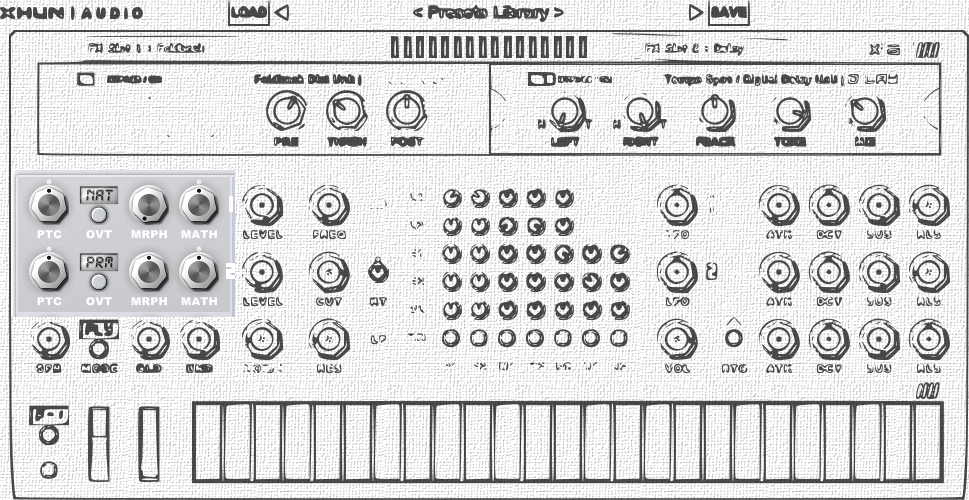
To recap, RawPrime's generators / oscillators parameters are :

Image

OSC1 PTC [-12sem...+12sem] : Tune / set the pitch of oscillator 1.

OSC2 PTC [-12sem...+12sem] : Tune / set the pitch of oscillator 2.

OSC1 OVT [NAT...ODD...PRM...FBN...PI...GLD] : Select the overtones scheme for oscillator 1. An overtones scheme is a specific ratio applied to the different internal sampling rates of the DACs array. This ratio is the product of a series of integers, derived from natural numbers (NAT), odd numbers (ODD), prime numbers (PRM), Fibonacci series (FBN), the Pi value (PI), the golden ratio (GLD).

OSC2 OVT [NAT...ODD...PRM...FBN...PI...GLD] : Select the overtones scheme for oscillator 2. An overtones scheme is a specific ratio applied to the different internal sampling rates of the DACs array. This ratio is the product of a series of integers, derived from natural numbers (NAT), odd numbers (ODD), prime numbers (PRM), Fibonacci series (FBN), the Pi value (PI), the golden ratio (GLD).

OSC1 MRPH [DAC1...DAC5] : Morph between the five different DACs output signal (oscillator 1).

OSC2 MRPH [DAC1...DAC5] : Morph between the five different DACs output signal (oscillator 2).

OSC1 MATH [DRVT...MRPH...INTG] : This engine performs further math transforms on oscillator 1 multi-DAC signals. By setting this knob in the central position, no additional transform is applied (the signal from the Morph engine is not altered). By turning this knob clockwise (from the central position), an integral signal (from the five internal DACs) is produced and blended with the Morph engine output. By turning this knob anti-clockwise (from the central position), a derivative signal (from the five internal DACs) is produced and blended with the Morph engine output.

OSC2 MATH [DRVT...MRPH...INTG] : This engine performs further math transforms on oscillator 2 multi-DAC signals. By setting this knob in the central position, no additional transform is applied (the signal from the Morph engine is not altered). By turning this knob clockwise (from the central position), an integral signal (from the five internal DACs) is produced and blended with the Morph engine output. By turning this knob anti-clockwise (from the central position), a derivative signal (from the five internal DACs) is produced and blended with the Morph engine output.
Last edited by xhunaudio on Tue Jan 30, 2024 4:19 am, edited 2 times in total.
bruno @ Xhun Audio || www.xhun-audio.com || Twitter || Instagram
Image

Post

Audios sound interesting. Something special. Demo when?
ABX is enemy to GAS

Post

Hi, a demo / trial version will be available at day-one, together with RawPrime release.
bruno @ Xhun Audio || www.xhun-audio.com || Twitter || Instagram
Image

Post

I ask just a little bit of patience to all fair people here interested in my RawPrime show and tell, unfortunately I have no control over this thread "unlucky attendances".

Yesterday RawPrime was ranked as #19 of all visited products pages in KVRAudio database ( all this during the NAMM week - thank you ! ) : bad things like haters and vile keyboard warriors are expected in a context of exposure.

I will continue with my posts and further RawPrime sections will be covered - sad to say I can't assure a comfortable readingof that, due to the continuous hateful interruptions.

All the sad troublemakers here will just be ignored.
bruno @ Xhun Audio || www.xhun-audio.com || Twitter || Instagram
Image

Post

One thing that strikes me about this, I know you say that you want the synth to be a AAA synth that uses aliasing to generate the sound but I'm kind of interested in the inharmonic aspects. ie. The ugly stuff.

I'm not necessarily talking about making it sound like a "Lo-fi" synth with a bitcrusher effect on it or just some weird noise maker.

What kind of scope is there to dial in what might be considered the 'less desirable' aspects of the aliasing?

I appreciate that you don't want to build something that sounds noisy and inharmonic.

Is there a risk that despite having an innovative way of producing the sound if it sounds too controlled in the end that it might make it slightly redundant.

In your opinion what does the aliasing generation bring to the overall sound?

Don't get me wrong some of the examples sound really intriguing and I'm definitely drawn to the more angular/spikey side of the synth.

Post

> Is there a risk that despite having an innovative way of producing the sound if it sounds too controlled in the end that it might make it slightly redundant.

Eheh, the point is exactly this : take something completely out of control by definition (aliasing) and make something "under control" out of it. Also if I say "under control", RawPrime sounds intrinsecally kinda "harsh" - you'll notice that when 100% "opening" the filter cutoff. Some of the alising energies are not "perfectly" aligned, also due to jitter.

If you want something even more dirty or "aliased" then, you can use the included bitcrusher or foldback digital distortion for example.

The original idea behind RawPrime is to build a 1980s circa synthesis system using cost-effective electronic components, in order to have a low final price for the device. The same approach as with the glorious Yamaha YM chips, but using a completely different technology.

> In your opinion what does the aliasing generation bring to the overall sound?

In the case of RawPrime, aliasing constitutes 100% of the sound. When you listen to a piano or flute or anything else from Rawprime, everything you hear is made of just pure aliasing.

Example : a "piano sound" preset in RawPrime

is NOT a piano "sample" + its aliasing

it is JUST pure aliasing frequencies mimicking the sound of a piano
bruno @ Xhun Audio || www.xhun-audio.com || Twitter || Instagram
Image

Post

RawPrime sounds intrinsecally kinda "harsh" - you'll notice that when 100% "opening" the filter cutoff

Yeah, that's what I was getting at and that's the aspect that really appeals to me. I could hear that in some of the examples you posted. A kind of roughness but not the kind of affected roughness you get from the usual bit crushing post processing.

I understand that the tech behind it is based on the "side effect" and not the source itself.

I suppose the point I was trying to make is that if you go to all the effort to generate the sound using aliasing but it ends up sounding as if it was made from classic VA/synthesis tech then it kind of defeats the purpose.

But I do hear a very distinct character in a lot of the examples you posted that does sound very different to the usual suspects.

Looking forward to seeing and hearing the end product.

Post

I’ve been on an 80’s hardware kick for many years and have had pretty much every Casio, Yamaha, Ensoniq, and Kawai from that era. This definitely has that character, much more than FM8 or other synths that emulate those sounds. I just hope the filter is analog modeled because my favorites of those synths had analog filters.

Post

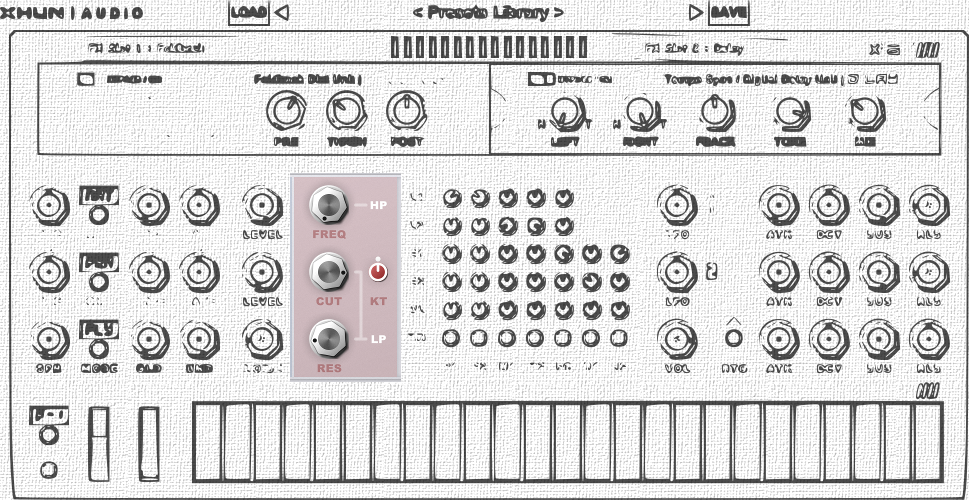
Eheh, just in time with your question. Now that the Generator Section has been fully covered, let's dive into another crucial aspect in RawPrime : the Voltage Controlled Analogue Filter (VCF) Section :

Image

The Voltage Controlled Filter Section features both a 1-pole non-resonant high-pass analogue filter and an expressive, 2-pole resonant low-pass diode-ladder analogue filter.

The latter is a specific, very uncommon design with a steady and slightly aggressive flavor. This VCF section has been entirely modeled by the adoption of the topology preserving transform / zero-delay feedback approach, proving all the non-linearities, saturation and frequency responses (also at extreme modulation scenarios) typical of the hardware circuitry.

VCF Parameters :

HP FREQ [16hz...2000hz] : Set the high-pass filter cutoff frequency.

LP CUT [20hz...20khz] : Set the low-pass filter cutoff frequency.

LP RES [MIN...MAX] : Set the low-pass filter resonance amount.

LP KT [-200%...+200%] : Set how much the key tracking affects the low-pass filter cutoff.
bruno @ Xhun Audio || www.xhun-audio.com || Twitter || Instagram
Image

Post

xhunaudio wrote: Sat Jan 27, 2024 9:44 pm Eheh, just in time with your question. Now that the Generator Section has been fully covered, let's dive into another crucial aspect in RawPrime : the Voltage Controlled Analogue Filter (VCF) Section
Thank you. Does all aliasing takes place before the filter, none after? Sorry if you covered that already.
Last edited by Uncle E on Sat Jan 27, 2024 9:52 pm, edited 1 time in total.

Post

Uncle E wrote: Sat Jan 27, 2024 9:48 pm
xhunaudio wrote: Sat Jan 27, 2024 9:44 pm Eheh, just in time with your question. Now that the Generator Section has been fully covered, let's dive into another crucial aspect in RawPrime : the Voltage Controlled Analogue Filter (VCF) Section
Thank you. Does all aliasing takes place before the filter, none after? Sorry if you covered that already.
Exactly, all the aliasing stuff occurs within the DACs / transducers in the generator block. After that, all signals are output as analogue and sent into the VCF (which behaves as analogue gear and is modeled using also oversampling).

If you want post-filter digital artifacts you can use / select the bitcrusher or foldback digital distortion "rack fx" units, but that is considered as sound "coloration" at the end of synthesis chain.
bruno @ Xhun Audio || www.xhun-audio.com || Twitter || Instagram
Image

Post Reply

Return to “Instruments”