

Vember ShortCircuit is a good starting point if you want to use software.
I was able to get an old version from archive.org from the Vember website circa 2008 or so.
It's still there as a small download.
What do I need to know about "samplers"?
-

- KVRian
- 991 posts since 24 May, 2024
-

- KVRian
- 843 posts since 23 Feb, 2023
Using a Tracker is best way to explore 'samplers' as most are a sampler with an integrated step sequencer with advanced digital readout...
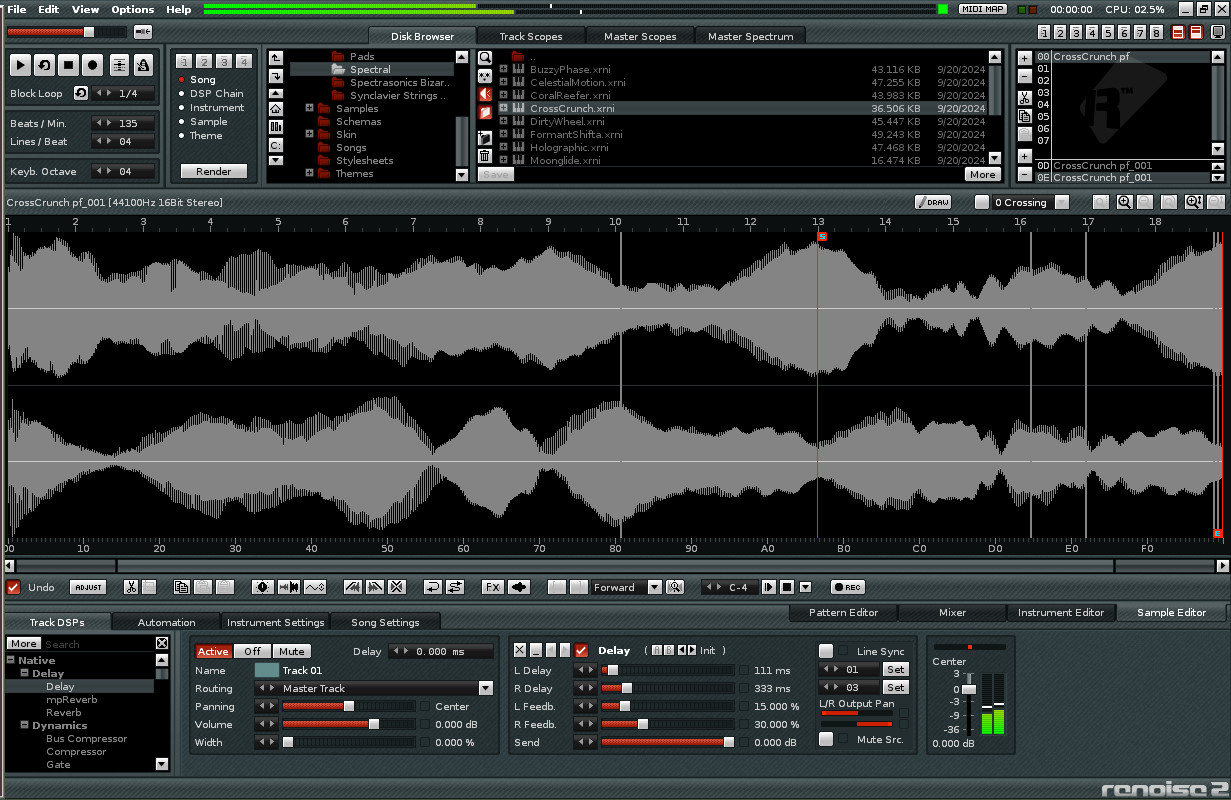
Renoise has quite good sample editor-
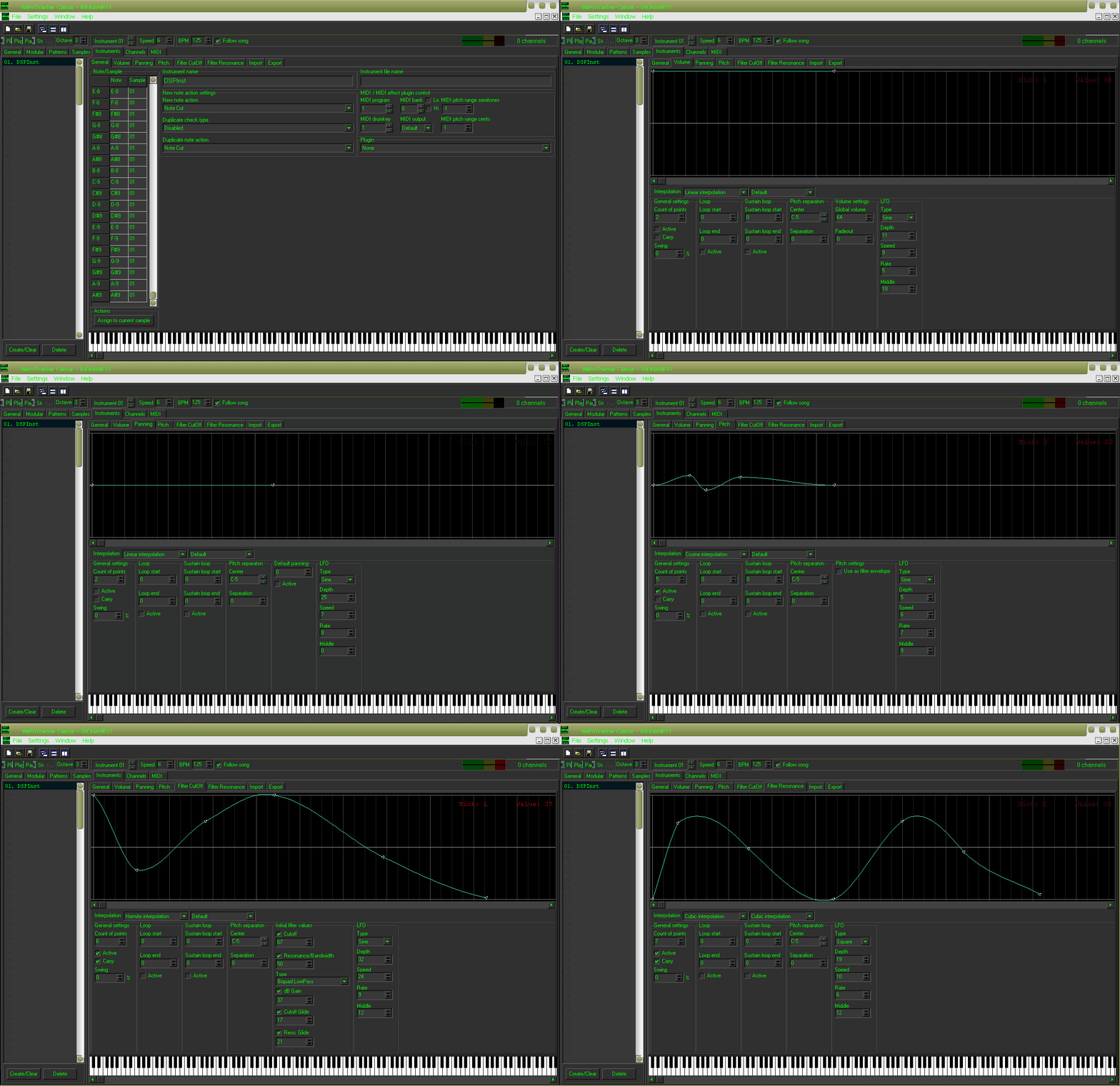
For internal processes that can be applied to one or multi sample instrument BeRoTracker quite rocks-
Many sampler VSTi that were good have come & gone as so many gravitate to OS that can't even install them anymore or get them up & running...
EMU Emulator X & Proteus VX still sound great using simple samples showing that 'crafting' your samples is much more efficient than large 100 GB kontakt libraries that take gobs of time to load...
I still use Cakewalk Dimension it sounds great too & any WAV under 4KB is treated as an oscillator so it's a WT synth as well as sampler...
NI Intakt was pretty good...
I create my own AKAI instruments from sampling VSTi output mostly every semitone sampled & yes they are quite large some 80 MB or more but they sound quite good in Skale Tracker perhaps even better than in Renoise as XRNI...
In this way you use up more RAM but less CPU 'bouncing' your instrument...
Renoise has quite good sample editor-
For internal processes that can be applied to one or multi sample instrument BeRoTracker quite rocks-
Many sampler VSTi that were good have come & gone as so many gravitate to OS that can't even install them anymore or get them up & running...
EMU Emulator X & Proteus VX still sound great using simple samples showing that 'crafting' your samples is much more efficient than large 100 GB kontakt libraries that take gobs of time to load...
I still use Cakewalk Dimension it sounds great too & any WAV under 4KB is treated as an oscillator so it's a WT synth as well as sampler...
NI Intakt was pretty good...
I create my own AKAI instruments from sampling VSTi output mostly every semitone sampled & yes they are quite large some 80 MB or more but they sound quite good in Skale Tracker perhaps even better than in Renoise as XRNI...
In this way you use up more RAM but less CPU 'bouncing' your instrument...
-

- KVRian
- 790 posts since 9 Feb, 2019
I think you should mainly know that samplers can be used in numerous different ways. What is called a sampler today are respectively completely different tools that are more or less focussed on certain use cases.
Samplers can playback single samples, multisamples and libraries, you can use the editing and sound design capabilities, playback and chop drumloops, layer the sounds, loop sounds and generate new waveforms ... just to mention a few. And what is often forgotten: in the 90s they were often used as multitrack recorders (e. g.William Orbit recorded the tracks of Madonnas Ray of Light with his AKAI samplers).
I suggest to have a look at the history of sampling technology (Fairlight CMI, E-mu Emulators, the 90s AKAIS, Ensoniqs, ...) and then try to get a picture of the vast palette of options available today. But: modern "samplers" like eg HALION 7 have numerous synthesis options that have noting to do with sampling itself.
Itßs funny for me that you ask this question. I work with samplers for 30+ years now and often think to myself that many many people don´t really understand much of samplers and sampling anymore. They don´t get the whole thing and often underestimate the power.
Samplers can playback single samples, multisamples and libraries, you can use the editing and sound design capabilities, playback and chop drumloops, layer the sounds, loop sounds and generate new waveforms ... just to mention a few. And what is often forgotten: in the 90s they were often used as multitrack recorders (e. g.William Orbit recorded the tracks of Madonnas Ray of Light with his AKAI samplers).
I suggest to have a look at the history of sampling technology (Fairlight CMI, E-mu Emulators, the 90s AKAIS, Ensoniqs, ...) and then try to get a picture of the vast palette of options available today. But: modern "samplers" like eg HALION 7 have numerous synthesis options that have noting to do with sampling itself.
Itßs funny for me that you ask this question. I work with samplers for 30+ years now and often think to myself that many many people don´t really understand much of samplers and sampling anymore. They don´t get the whole thing and often underestimate the power.
-
Winstontaneous Winstontaneous https://www.kvraudio.com/forum/memberlist.php?mode=viewprofile&u=98336
- KVRAF
- 2592 posts since 15 Feb, 2006 from Another Green World
I love Ableton Live because it's kind of a meta-sampler, meaning it's soooo easy to Always Be Sampling what you're doing in real time, then re-processing. Besides all the Simpler, Sampler and granular tools - just arm an audio track with Input source = Resampling, and you're recording the output of the master channel (or any combination of tracks and groups). Then you can treat that with all the clip transformations, Warp, stretch, reverse, etc. and lather, rinse, resample, repeat. So I basically always have (at least) a track running recording a realtime mix. On more than a few occasions those resampled/manipulated clips turned into sections or songs of their own, or yield fascinating results chopped in Simpler...then resampled, etc. 
This is the way analog recording worked, but I was surprised when I started making computer music in 2006 that not all DAWs make it easy, or possible. I learned it ITB in AudioMulch, it's also super easy in REAPER.
This is the way analog recording worked, but I was surprised when I started making computer music in 2006 that not all DAWs make it easy, or possible. I learned it ITB in AudioMulch, it's also super easy in REAPER.
-

- KVRAF
- 7030 posts since 19 Apr, 2002 from Utah
I agree. The world chromatic, polyphonic, multisamplers went software 25 years ago, and most hardware samplers today are a joke. The closest thing there is in hardware form are things like the Akai MPC series. What I would give for a modern day Akai 6000 or a modern day Akai Z8!!!! Instead, we’ve got drum machines masquerading as samplers, and software samplers with so much extra crap added to them that they are more sampling synthesizers than samplers. It’s no wonder this generation of music makers don’t understand the power of a quality sampler.HAL76 wrote: Thu Jun 12, 2025 7:57 pm I think you should mainly know that samplers can be used in numerous different ways. What is called a sampler today are respectively completely different tools that are more or less focussed on certain use cases.
Samplers can playback single samples, multisamples and libraries, you can use the editing and sound design capabilities, playback and chop drumloops, layer the sounds, loop sounds and generate new waveforms ... just to mention a few. And what is often forgotten: in the 90s they were often used as multitrack recorders (e. g.William Orbit recorded the tracks of Madonnas Ray of Light with his AKAI samplers).
I suggest to have a look at the history of sampling technology (Fairlight CMI, E-mu Emulators, the 90s AKAIS, Ensoniqs, ...) and then try to get a picture of the vast palette of options available today. But: modern "samplers" like eg HALION 7 have numerous synthesis options that have noting to do with sampling itself.
Itßs funny for me that you ask this question. I work with samplers for 30+ years now and often think to myself that many many people don´t really understand much of samplers and sampling anymore. They don´t get the whole thing and often underestimate the power.
Vendor‑Dependent Copy Protection: Customers lose. Pirates win.
(Also: I'm Accused of lying about Linux—it boots, runs my pro audio workflow, stays stable, updates--though yearly dismissed as “niche”. Yet I'm the deluded one.)
(Also: I'm Accused of lying about Linux—it boots, runs my pro audio workflow, stays stable, updates--though yearly dismissed as “niche”. Yet I'm the deluded one.)
-
- KVRian
- 790 posts since 9 Feb, 2019
Oh I must admit that I value compatibility advantages and ergonomical working conditions higher today. But I definitely know what you mean.audiojunkie wrote: Wed Jun 18, 2025 1:24 pm
I agree. The world chromatic, polyphonic, multisamplers went software 25 years ago, and most hardware samplers today are a joke. The closest thing there is in hardware form are things like the Akai MPC series. What I would give for a modern day Akai 6000 or a modern day Akai Z8!!!! Instead, we’ve got drum machines masquerading as samplers, and software samplers with so much extra crap added to them that they are more sampling synthesizers than samplers. It’s no wonder this generation of music makers don’t understand the power of a quality sampler.
Funnily I think the "late 90s generation" did not understand about that already. Their buying descisions were the cause of the downfall of the sampler industry. And that did not happen for no reason. From a todays perspective the old HW samplers werde data graves, time suckers, costly, had severe compatibility restraints and so on.
What I mainly meant is that people don´t see anymore what you can do with a sampler - from the definiition of standards / sound identity by creating selections and combinations over the creation of sampler "instruments" not possible with any other tool up to the amount of control over a sound that samplers offer. When I look at the Kontakt Factrory library for example I think they just created content. There´s no indicator for that the creators knew what you can do with it

-
- KVRist
- 161 posts since 21 Feb, 2024
Yeah, you should try playing with a sampler for the music you're making. If you work with a digital audio workstation (DAW), you probably have one already. Otherwise, "Decent Sampler" is free. And there are plenty of free samples out there to download and use in it.DaveL60 wrote: Fri Apr 19, 2024 1:01 pm One aspect of home recording I've not really educated myself about is "samplers". There are numerous posts here that indicate it's an essential component of a DAW setup, but I'm unclear on whether this primarily refers to sample playback instruments (e.g., Kontact, Decent Sampler) or something more oriented to capturing and manipulating samples. I play guitar and keys, am comfortable with basic recording & mixing, know how to work with VST/VSTi plugins. I mostly work in instrumental classic rock / progressive rock styles. My attempts to search for "sampler 101" sorts of posts / articles /videos have mostly led me to posts about "how to sample from another track", which isn't something I see myself doing.
Bottom line: am I missing out on a tool that would prove really valuable to me? Thanks.
-
- KVRian
- Topic Starter
- 951 posts since 14 Apr, 2004 from Maryland, USA
Thanks for the spectrum of replies and information. I've dipped my toe in the water with Kontact Player 8 and the Water Piano instrument from Impact Soundworks (not in the KVR product database for some reason). I also recently watched the Mastering.com Radio Ready Single event which made heavy use of Kontact instruments plus included a quick demo of creating a simple instrument in Logic from a handful of samples. So I now have a somewhat clearer picture. As my current needs are pretty minimal I don't expect to dive too deeply into this pool but at least I have a clearer picture of what's out there / possible.
You can twist perceptions, reality won't budge.
-- Rush Show Don't Tell
-- Rush Show Don't Tell