Harmor = best additive resynthesizer?

VST, AU, AAX, CLAP, etc. Plugin Virtual Instruments Discussion
Post Reply New Topic
RELATED
PRODUCTS
Harmor

Post

wagtunes wrote:Thanks for the info on the demos. I'll check them out just to get an idea of what kind of music you're into. That will help me in my own sound design for catering to those genres, assuming Harmor can recreate these sounds. My gut tells me it won't be too difficult.
I wouldn't bother, in his own opinion there is no market for it...
Wildfunk wrote: :tu: Unfortunately Harmor isn't very popular in the (deep) house scene... so it would be a waste of time to create a soundset like this. But i'm doing exclusive Harmor sounds for some house guys and that's more worthwhile than a soundset for "all" ;)

Post

I am now starting to think that this Wildfunk guy might not be trolling after all, and might be dead serious.

That's a scary thought.

Post

wagtunes wrote:... assuming Harmor can recreate these sounds. My gut tells me it won't be too difficult.
If Harmor would be able to create the stabs then i would not have used other synths ;) Just take the "Vintage House Stabs" and "House Piano Chords" for example...

Post

Wildfunk wrote:
wagtunes wrote:... assuming Harmor can recreate these sounds. My gut tells me it won't be too difficult.
If Harmor would be able to create the stabs then i would not have used other synths ;) Just take the "Vintage House Stabs" and "House Piano Chords" for example...
Maybe not exactly what you call "vintage" but I'm quite sure that Harmor can make impressive stabs with the right chords and filter modulation!

On the other hand, for powerful stabs a synth like Ogun (also from Image Line) might be better...

Post

Tricky-Loops wrote:Maybe not exactly what you call "vintage" but I'm quite sure that Harmor can make impressive stabs with the right chords and filter modulation!
Of course... and that's what the "VIP customers" get ;) But they are very clean stabs, really not comparable to stuff from vintage machines.

Post

I thought to read some tips on how to use the different and many sections in Harmor and its abilities! Instead the thread turned to be bragging about oneself abilities, so instead of "Harmor is the best" I'm reading "I am the best" :singer:

Boring!
Using: Cubase Pro 15, Reason 13, Tascam US-4x4HR, MODX6, DM12D, LaunchKey 49, Yamaha guitar(Pacifica 612v) and bass (BB234) and some virtual instruments and synths.

Post

As I mentioned, I don't really understand how these sounds in EDM/hip hop/house/trance/etc. are created, or even much about that kind of music, but I hope to use some of these sounds in more prog rock/fusion type music. I'm old, and old school. My idea of "electronic music" is Kraftwerk, Synergy, Vangelis, Tomita, JMJ, T-Dream, Eno, and the like, but it seems to me there is a way to add some of this exciting (IMO) sounds to more established styles to create something new(ish), maybe like Art of Noise meets UK or LTE. Or maybe I'm just dreaming...

But seems to me virtually ANY sound can find a place in music, as long as the context is right. I mean, I hear 1000s of sounds I would have thought totally useless, creating interesting new forms and feels! It's what synths have always been about, for me - pushing the limits and exploring new horizons! Sure some silliness and abuse of tech will occur, like the GTRist that get's a new wah-wah pedal! But in the long run it's all part of the game to find greater colors for the sonic palette, or something like that.

Thanks for all the insights into how Harmor and synths like it function! I think I'll take the splash (so cheap) and see what all the fuss it about.

As for patches I'd like to see; pads, ambient, and anything exciting and new and mind-expanding - it's what synths do best!

Post


Post

Wildfunk wrote:Bumping an image into the resynthesis and doing some modulations is NOT programming. Only lazy people or newbies do this.

I'm talking about the osc parts here... changing single timbres, drawing own filter shapes, using the harmonizer etc.
The former half is using visual method to modify sound. The latter half is using ears to change attributes of sound and eyes to create filters.

There are many tools like EQ, Compressor, Filter, Synth, Analyzer, Exciter, Reverb, etc using visual that makes easier to use. But you are opposed to use visual tools to produce music. Right? Then how about boycott using most VST as they requires you to use "Visual" method in its workflow. On top of that you are already using visual tool to create filter shape and envelopes.... Should we avoid using them too?... :hihi:

Post

Harmor is a beast,
but it need some time to understand the concept,
it's a very flexible vst, all the modules can be reorder, kind of modular, same for the fx,
the 2 filter are good, serie/par, and need some experimentation, trial /error....
Env, lfo are so good, no mod matrix here but all parameters have env, lfo and more,
watch the unisson, you can master it( pitch phase pan per voice....), same with 2 osc and the additive engine is top quality!(512partial)
create some bell with the prism, apply some mask to the filter, create custom lfo curve, design your filter cut off and resonance, play with the phaser in harmonik mode or design your own, add some harmonizer(i don't understand all but you can have some great result) and etc......so powerful but need a lot of time to understand all the creative functions and make it yours:)
THE Men who have programme it is a "genious" but i don't have all his brain capacity, and it take time to understand all the power under my mouse:), the magic key is in the ENV/ADV page!
and harmor is like every synth, it depend how you use it

Post

I have just one problem with Harmor and it's in its modulation capabilities and it's a big one.

Mod Wheel assignment.

Many VSTs have a dedicated mod wheel assignment parameter in its modulation matrix. But more importantly than that, you can set the min and max values.

For example, let's take Zebra 2, which, IMO, has probably the best and most flexible modulation system of any synth I've ever owned.

Let's take something simple like Filter Cutoff. Let's take a simple low pass filter and set the initial cutoff value to 70, which is about mid way.

Now let's go to the filter cutoff modulation slot and choose ModWhl. Let's set the range from 0 to 30.

If you then play the keyboard and move the mod wheel while playing, it modulates the cutoff filter from 70 to 100.

Simple?

This should be STANDARD for any top of the line synth. And I consider Harmor a top of the line synth.

Now, here is how Harmor works and it totally drives me crazy.

We don't even have to get fancy here. Just pull up the default patch upon load and set the filter cutoff to 50%. That's equivalent to Zebra's 70 level.

Next, and it took me a while to figure this out and it's so round about it's stupid, you have to click on Edit Articulations after right clicking on filter cutoff. This brings up the modulation window that defaults to envelope for filter 1 frequency.

To get this to work the same way it works in Zebra, you need to change envelope to modulation Y mapping.

Okay, why?

It has to do with the X and Y axis and how they behave. X moves from right to left and Y goes up and down. How does your mod wheel move? It moves up and down. So Y would be the more intuitive control.

Next, you have to modify the graph itself. To get the same effect, you need to pull the far right hand side of the map's line up and adjust by ear. There is no specific value that I can see while editing. Eventually, if you compare the two side by side, you get the same results.

Zebra 2 is easier, more intuitive and more exact.

Harmor's is more flexible however. You can do some really funky stuff with that modulation on the filter that you simply can't do with Zebra.

So I guess it's a little bit of give and take. But still, this system, for certain things, is way too complex. Simple things take longer. More complex things become possible whereas in other synths they are not.

I guess that's the price you pay for flexibility but boy, what a royal pain in the butt. LOL

** EDIT ** One other thing. The X,Y,Z midi assignments do not save with the patch itself. You need to reassign them to your Mod Wheel upon reload. So that means I'll have to include performance notes with each patch so that they work correctly. Yes, i do this for Zebra 2, but at least the assignments are saved with the patch. There is a big difference between Mod Wheel and CC as far as how your DAW handles them. At least in Cubase, that's the case.

Post

wagtunes wrote:I have just one problem with Harmor and it's in its modulation capabilities and it's a big one.
Argh... would you please learn the oscs parts first and not start with the modulation? ;)

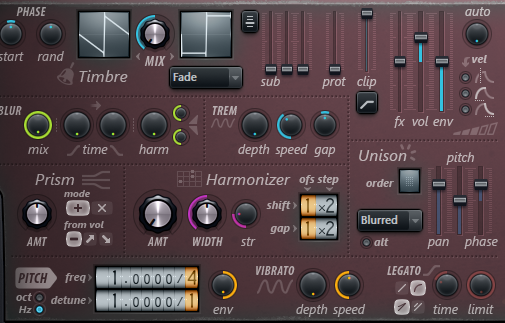
The upper left section of Harmor is the most powerful:

Image
Last edited by Wildfunk on Mon Feb 16, 2015 2:56 pm, edited 1 time in total.

Post

Wildfunk wrote:
wagtunes wrote:I have just one problem with Harmor and it's in its modulation capabilities and it's a big one.
Argh... would you please learn the oscs parts first and not start with the modulation? ;)

The upper left section of Harmor is the most powerful:

Image
Um, no offense, but I know all I need to know about oscillation, thank you. I've been programming synths for 36 years. How long have you been programming synths?

Post

wagtunes wrote:Um, no offense, but I know all I need to know about oscillation, thank you. I've been programming synths for 36 years. How long have you been programming synths?
Lol. How long do you play with Harmor? I doubt that you are familiar with the (additive) oscs and their timbres.

Post

Wildfunk wrote:
wagtunes wrote:Um, no offense, but I know all I need to know about oscillation, thank you. I've been programming synths for 36 years. How long have you been programming synths?
Lol. How long do you play with Harmor? I doubt that you are familiar with the (additive) oscs and their timbres.
Um, yeah, I am. You think Harmor is the only additive synth I've ever worked on?

Post Reply

Return to “Instruments”