Xhun Audio RawPrime : an original synthesis concept, established on... Aliasing (on purpose) !

VST, AU, AAX, CLAP, etc. Plugin Virtual Instruments Discussion
Post Reply New Topic
RELATED
PRODUCTS
RawPrime$99.00Buy

Post

xhunaudio wrote: Sat Jan 27, 2024 10:16 pm Exactly, all the aliasing stuff occurs within the DACs / transducers in the generator block. After that, all signals are output as analogue and sent into the VCF (which behaves as analogue gear and is modeled using also oversampling).
Great. Thank you. Looking forward to this.

FWIW, the famous hybrid synths from the 80’s had 4-pole filters. I know this isn’t an emulation of any particular model (far from it) but maybe worth adding a 4-pole switch at some later date?


Post

Uncle E wrote: Sat Jan 27, 2024 10:58 pm
xhunaudio wrote: Sat Jan 27, 2024 10:16 pm Exactly, all the aliasing stuff occurs within the DACs / transducers in the generator block. After that, all signals are output as analogue and sent into the VCF (which behaves as analogue gear and is modeled using also oversampling).
Great. Thank you. Looking forward to this.

FWIW, the famous hybrid synths from the 80’s had 4-pole filters. I know this isn’t an emulation of any particular model (far from it) but maybe worth adding a 4-pole switch at some later date?
About the VCF : I choosed this specific design because the two-pole diode ladder has a slightly aggresive flavour, not aggressive as a Sallen-Key, but more aggressive than a transistor ladder.

The 2P circuit has a certain "screaming" character compared to the 4P (this is the reason of my choise) and keeps the low-end @ high resonance settings. RawPrime VCF is similar to the Steiner-Parker "brute filter", in this case without the so called "brute factor" (clipping gain).

Anyway adding a 4P design would not be a problem. My approach is not to "pull too many things into the box" when designing a device. RawPrime has to be a device with well defined borders and characteristics, like I will explain in my next show and tell about polyphony and 4-voice assignments.
bruno @ Xhun Audio || www.xhun-audio.com || Twitter || Instagram
Image

Post

Has an estimated/fixed launch date for the release of RawPrime been announced yet?

Post

Hi, yes RawPrime will be available from next week.
bruno @ Xhun Audio || www.xhun-audio.com || Twitter || Instagram
Image

Post

I assume someone already mentioned Mr. Alias by Insert Piz Here.
Anyone who can make you believe absurdities can make you commit atrocities.

Post

Just before talking about the "vintage" 4-voice polyphonic assignment (how it works under the hood) here's an additional audio demo of a RawPrime preset taken from the factory library /leads section and named "Hamelin Flute" :

https://soundcloud.com/xhunaudiorawprim ... ry-library
bruno @ Xhun Audio || www.xhun-audio.com || Twitter || Instagram
Image

Post

About the 4-voice internal routing :

RawPrime is four-voice polyphonic, featuring a full "voice component modeling" approach, as per all other XA synthesizers. It also adopts a vintage polyphony management method, with first-voice re-assign (instead of round-robin).

This method (under certain circumstances also known as note-steal) allows for uncommon behaviours like having a sort of polyphony and monophony at the same time.

As an example : in polyphonic mode, if a note is pressed down - and remains pressed down (also using the damper pedal) - that "note" is assigned to voice #1. Then, by playing a 2nd and 3rd and 4th note separately, it is possible to achive a behaviour similar to having a monophonic routing, since in this case only voice #2 is used (instead of voices #2, #3, #4).

I like very much this uncommon behaviour (found on some vintage digital devices), kinda weirdo...
bruno @ Xhun Audio || www.xhun-audio.com || Twitter || Instagram
Image

Post

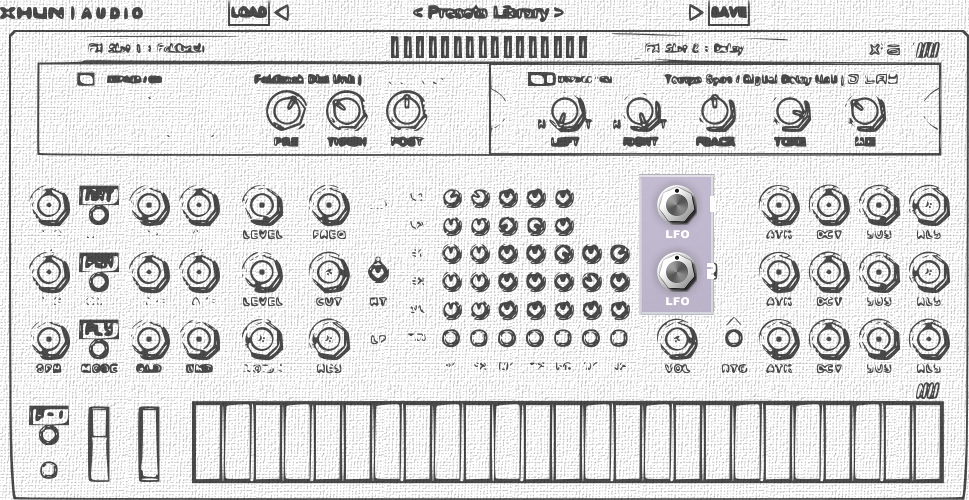
The Digital Low Frequency Oscillators

RawPrime features two digital low frequency oscillators (LFOs), each producing a sine waveform for modulation purposes. They are built in a similar way of the Generator "trigger" signals.

As for the three analogue envelopes (covered later), modulation assignments is performed thanks to the matrix section (itself also covered later).

Image

LFO1 [0.02hz...30hz] : Set the low frequency oscillator 1 frequency.

LFO2 [0.02hz...30hz] : Set the low frequency oscillator 2 frequency.
Last edited by xhunaudio on Tue Jan 30, 2024 4:30 am, edited 2 times in total.
bruno @ Xhun Audio || www.xhun-audio.com || Twitter || Instagram
Image

Post

What would happen if the LFO’s aliased? :-o

Post

Ahahah, indeed...

No, in this case it's not aliased - it's smoothed, further. And it ranges up to 30Hz, so you're dealing with a "nice and polite sine" in this case.
bruno @ Xhun Audio || www.xhun-audio.com || Twitter || Instagram
Image

Post

Strictly out of curiosity (not suggesting you do it), what would happen if an LFO aliased?

Post

Uncle E wrote: Tue Jan 30, 2024 5:37 am Strictly out of curiosity (not suggesting you do it), what would happen if an LFO aliased?
I can only imagine there may be some monstrously bad as well as incredibly good (if not unimaginable) results!.... all completely contingent upon what the LFO is modifying of course ;]

Post

Well, in order for a pure sine LFO to produce aliasing, you have to push it at a frequency greater than 22.05 kHz (@44.1 kHz sampling rate), making it a RRVVVHFO (really really very very very high frequency oscillator). Also in the case of a 7-bit sine you have to go very very high to get aliasing @44.1 kHz SR.

RawPrime LFO goes up to 30Hz and uses a proper DAC (not a degrading one) so it is perfectly fine. Also, it is smoothed at its output, so there is nothing to "fear" in this LFOs scenario. No "monster" effects are produced :)
bruno @ Xhun Audio || www.xhun-audio.com || Twitter || Instagram
Image

Post

Hey! Very sorry if it sounded like my reply was related to RawPrime... it was actually just speculation with Uncle about the *idea* of using an aliasing LFO as a modulator!
Again- apologies for any misunderstanding and for the record- I *will* be checking out RawPrime as soon as its available

Post

Actually most old lfo’s in virtual instruments would alias, as there was a control rate for efficiency reasons. Often at 1 kHz. So if you could push it to more than half the control rate it would alias. But the designers set the max LFO frequency way lower, because already the oscillators or filters you modulate with a control rate LFO start to get into aliasing territory… That would be aliasing without purpose…

Post Reply

Return to “Instruments”