


vst to make digital sound more analogish
-
- KVRer
- 11 posts since 12 Mar, 2006
I like to sugest Spectra'Q from crysonic, I've had really good results with this plugin, it's a little heavy on the cpu but I don't mind that. They have a demo version available, try mode B and increase the second and forth harmonics on the frequecy of your choice, if you push it hard enough you will get verynice saturation, allso the EQ section sounds great, very smooth.
Progress comes from doing things differently
-

- KVRAF
- 19156 posts since 13 Feb, 2003 from Vancouver, Canada
Yeah, that's one awesome-sounding plugin, for sure. Too bad about the CPU, though. 
-
- KVRian
- 556 posts since 30 Aug, 2005
If it's any help, I've used it to reduce ambience in a voiceover that was recorded in less-than-optimal conditions...Right now, I just don't know when someone decides it's time to use it, exactly.

-
- KVRAF
- 19156 posts since 13 Feb, 2003 from Vancouver, Canada
Really? My god, in my line of work (and even on some cuts on my upcoming album) I could use that!! So you can take a mono signal an M/S it? What software are you using for that, if I may ask?aetmos wrote:If it's any help, I've used it to reduce ambience in a voiceover that was recorded in less-than-optimal conditions...Right now, I just don't know when someone decides it's time to use it, exactly.
-
- KVRian
- 556 posts since 30 Aug, 2005
Well, no, not mono. I knew I was going to have problems (we were shooting video at a wide angle, and I didn't have a shotgun mic), so I miked it with a stereo pair of condenser mics. Brought it back to the studio, and used M/S to reduce the ambience. It's not perfect, but it does help.So you can take a mono signal an M/S it?
I used the Voxengo M/S/Encoder/Decoder (MSED)What software are you using for that, if I may ask?
http://www.gersic.com/plugins/index.php?daPlug=72
-
- KVRist
- 380 posts since 30 Aug, 2001 from Pyrlandia
bduffy, m/s is simply a way of encoding stereo image (m=l+r, s=l-r) ie with mono signal you'd have nothing on s side. for example by manipulating gain of s side you just change stereo image width
-
- KVRAF
- 19156 posts since 13 Feb, 2003 from Vancouver, Canada
Thanks, guys. You know, despite not a few years of experience, I'd never heard of M/S processing before coming to kvr, so you'll forgive my apparent ignorance. I had to ask about mono, cos as soon as I hear "vocal", I think mono, and that didn't make sense.
-

- KVRian
- Topic Starter
- 1448 posts since 8 Feb, 2006
looks imteresting, when will you get done with this thing and is it free or how much does it cost?Kingston wrote:I *guarantee* this'll blow your socks off in a few weeks.
Does what it says on the tin. I guess it's the warm up analogizer plugin you lot have been waiting for.
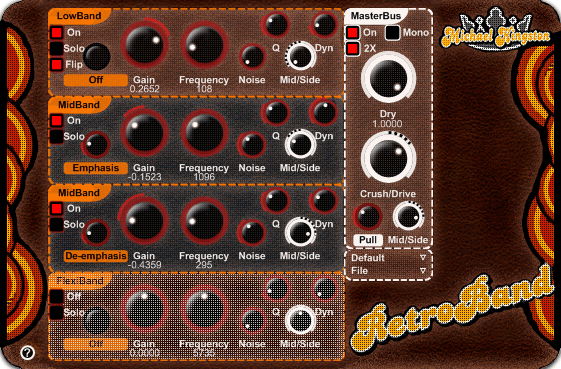
btw, are you finnish? i live there myself but i'm from estonia, have 1/3 finnish blood too. your name's not so finnish you know.

-
- KVRian
- Topic Starter
- 1448 posts since 8 Feb, 2006
leonard wrote:just curious: how's that, 1/3? You got three parents? Lucky guy!deep'n'dark wrote: have 1/3 finnish blood too.
 ok i just throwed something, my grandpa was finnish. and estonians and finlandians have aleady some mixed blood so
-
- KVRAF
- 2249 posts since 6 May, 2003 from rat city au
ohhh.. i ..can't..help..myselfdeep'n'dark wrote:well, you know that reason has very digital sound so i'd like to know if someone knows good remedy for this.
it's good tho that reason has that sound i think, but some sounds really need to be more undigital.
a) define analog(ish) sound
b) define digital(ish) sound
c) define undigital sound
..if you are still convinced you know what you're talking about, it's now a matter of simple math and you have your answer. sigh. if only life were so easy.
-
- KVRAF
- 7045 posts since 28 Apr, 2004 from france
You also have to know if you want very accurate settings, huge frequency range, no ground noise & humming, being able to reach big loudness, in which case you need digital ;
Or if you want "warmth", which is a concept, a view of themind, and not "one thing"... In that case, you'll have to analyze what do YOU think is "warm" or not (analogue can be very cold, and digital very warm), and why...
The question is not as simple as that.
If you want "analogue", then go analogue for real ! But don't go "emulation"...
(Well, everybody can do what he wants, but you can't always get both in the same time one thing and its opposite)
Ad I think that analogue was more recordings techniques, regarding to the potential of the times it was recorded and the material it was aimed to be listend to : you did not care about subbasses and what was below 70hz, when the stereo systems could not even "play" such frequencies... So, the technicians would focus mainly on mid frequencies, but now everuybody wnat "more loudness"...
Or if you want "warmth", which is a concept, a view of themind, and not "one thing"... In that case, you'll have to analyze what do YOU think is "warm" or not (analogue can be very cold, and digital very warm), and why...
The question is not as simple as that.
If you want "analogue", then go analogue for real ! But don't go "emulation"...
(Well, everybody can do what he wants, but you can't always get both in the same time one thing and its opposite)
Ad I think that analogue was more recordings techniques, regarding to the potential of the times it was recorded and the material it was aimed to be listend to : you did not care about subbasses and what was below 70hz, when the stereo systems could not even "play" such frequencies... So, the technicians would focus mainly on mid frequencies, but now everuybody wnat "more loudness"...
-
- KVRian
- 556 posts since 30 Aug, 2005
It's also a miking technique...instead of using a stereo pair, you can set up a cardioid and a figure 8 mic, right on top of each other, with the poles of the figure 8 mic pointing Left and Right ("side"), and the cardioid mic pointing straight ahead ("mid). You can then reassemble a stereo image with L=M+S, R=M-S.I'd never heard of M/S processing before coming to kvr,
-
- KVRer
- 20 posts since 25 Nov, 2005
sinkmusic wrote:I think that analogue was more recordings techniques, regarding to the potential of the times it was recorded and the material it was aimed to be listend to : you did not care about subbasses and what was below 70hz, when the stereo systems could not even "play" such frequencies... So, the technicians would focus mainly on mid frequencies, but now everuybody wnat "more loudness"...
What a great point this is!
It's really important that you plan ahead what you want out of the recording. You just can't have both an enhanced in the extremes mix and an "analog" "warm" sounding mix.
The reason is simple: space.
You only have so much headroom; sublow as well as extreme high freqs take up a lot of it. If you don't understand this your mixes will never sound "warm" and loud at the same time.
The challenge further increases on a cluttered mix. The sparcer the elements in a song, the easier to handle it becomes.
So here is where things get tricky. What kind of sound do you want? think about it.
The so looked after "analog" feel resides right in the most conflictive area of the spectrum: the low mids.
To make things worse, poorly recorded material can really smear this area due to the lack of usable harmonic content that is actually responsible for most of the low mid "warmth" . The low mid information will still be there, but of a very dubious quality. This means endless hours of corrective mixing and a less "natural" sound.
Why is it conflictive? because most instruments have a lot of low mid information in their sound. This means you have to be very good at mixing in order to know exactly which elements stay there and which go. Otherwise it's just mud.
As I already said, planning ahead can make the difference. Sometimes a warm recording doesn't have much to do with plugins or hardware or any fx. It's got much more to do with the kind of sounds you choose and the wise use of the stereo field. That's why you use more than one mic to record an instrument. You're creating an aural landscape and in this landscape you decide the tone of colors you want or need to achieve a certain image.
If you don't record anything at all and use mostly sampled material and synths you can still recreate a "realistic" stereo field by the intelligent use of reverberation, room emulation and delay.
Once you got that laid out, you can start playing with modulation in order to enhance the aural image through delicate phase alterations.
By taking these elements into consideration you will end up getting a more "realistic", less effected mix, and the low mids will be more easily tamed which in exchange will give you a "warm" sounding mix.
I can't stress this enough. Think ahead, and know the style of music you're producing. Each style has it's own dos and dont's.
Compression?
Yes.
and No.
It depends on the style and the frequency response of the instrument you're treating. Believe me, even the most expensive piece of hardware will sound shite if you don't use it wisely.
If you're using buss compression, use it from the beginning, otherwise it's gonna be weird...
Make the mix loud from the beginning, don't leave it till the mastering stage. As I said it before, think ahead.
High mid frequencies are more easily registered by the human ear, therefore they're percieved as louder. Understanding this will save you lots of squeezing in the loudness race.
To end with this ranting let me tell you that probably the mixes you like and admire have much less sublow and high end content than your mixes. They sound deeper and warmer because they're very well crafted mixes, that is, the producer knows what goes where and mixes it in a teasing, playful way, in order to catch your ear, mind and heart.
So IMO you should forget the plugins for now, forget the analog vs. digital clichés and focus on listening to what you're doing and learn where you wanna take it.
Once you've got this, all the fx and the expensive gear will make your music even more atractive by enhancing exactly the magic you've put in your song.
Tape can add lots of harmonic content, then again, this is just another resource to apply a certain vintage coloration you do not always want. There are already loads of threads in this very forum describing the qualities of tape.
Anyways if it isn't there from the beginning then it'll never be there

Hope this helps.
-
ChocoLatteRabbit ChocoLatteRabbit https://www.kvraudio.com/forum/memberlist.php?mode=viewprofile&u=98806
- KVRist
- 97 posts since 19 Feb, 2006 from An icon on my desktoop
Excellent post, Sparrow.
(((Oh Great!!! Come in here on your 19th post and try to make us all feel stupid, why don't ya'? )))
Seriously, thanks for the info and insight into analog versus digital concept, and the differences in compression and harmonic content. Maybe you could put your thoughts into the KVR wikipedia, whatever it's called. Or start an online book on mixing.
Thanks, again,
Choco
(((Oh Great!!! Come in here on your 19th post and try to make us all feel stupid, why don't ya'? )))
Seriously, thanks for the info and insight into analog versus digital concept, and the differences in compression and harmonic content. Maybe you could put your thoughts into the KVR wikipedia, whatever it's called. Or start an online book on mixing.
Thanks, again,
Choco
ChocoLatteRabbit
"They often calls me coffee 'cause I grinds so fine."
Unknown bluesman
"They often calls me coffee 'cause I grinds so fine."
Unknown bluesman