Will we ever see vsts of Korg Z1 or Yamaha VL?

VST, AU, AAX, CLAP, etc. Plugin Virtual Instruments Discussion
Post Reply New Topic
RELATED
PRODUCTS

Post

jackmazzotti wrote:
EvilDragon wrote:Z1 probably never, source code for its DSP is supposedly lost.
Yes because the person who designed it died and no one apparently can understand his notes. I called Korg and that is what they told me.
for the sake of reducing confusion,

julius orion smith III
https://ccrma.stanford.edu/~jos/

sort of the qi jiguang of audio dsp :hihi:

not dead.

because korg holds the copyright to this work, julius is not a source for software implementations. i anticipate that an aspiring developer may, however, cultivate a rapport with him via demonstration of learned use of faust.

:hihi:

audio dsp merdeka eh


yes the prophecy did have reduced versions of the z1 models. the z1 is a *glorious* synthesizer which can fill the right type of person with absolute joy (especially combined with a clavia pitch stick). i've had two of them stolen from me (z1s and pitch sticks, that's how much i like the combo). maybe one day i'll be able to afford to have a third stolen from me.

easy for a nescient to patch... i needed medieval sounding reeds for a "bravely bold sir robin"-alike
http://www.xoxos.net/music/pray_thee_gnomes.mp3

messing around with a mute (45s in)
https://xoxos.bandcamp.com/track/jewel

clarinet, trumpet
https://xoxos.bandcamp.com/track/iv-nibiru


never used the yammie but will corroborate that the z1 was one of the most informative, engaging synthesis experiences i've had, and it's more or less a crime against humanity that these models aren't available to every school child. what the hell is wrong with your species.
you come and go, you come and go. amitabha neither a follower nor a leader be tagore "where roads are made i lose my way" where there is certainty, consideration is absent.

Post

but that is funny because no one can understand his notes :hihi:

*gives same link to all ccrma documentation*
you come and go, you come and go. amitabha neither a follower nor a leader be tagore "where roads are made i lose my way" where there is certainty, consideration is absent.

Post

weren't the point of those 2 synth to emulate real instruments...like guitar,bass guitars flute etc

Today we have Gigs of Ram an pretty powerful CPU s

the Sound library that comes with Kontakt beats those 2 synth...so what would be the point ?

unless we're talking using those synth not as the manufacturer intended...kinda like the Tb-303 (supposed to replace a bass guitar)
Last edited by realmarco on Mon Oct 17, 2016 6:45 am, edited 1 time in total.
If your plugin is a Synth-edit/synth-maker creation, Say So.
If not Make a Mac version of your Plugins Please.

https://soundcloud.com/realmarco

...everyone is out to get me!!!!!!!

Post

Well, not exactly "real" or not only "real".
Physical modeling allows You to emulate sound of something like 3 meters long saxophone made out of cardboard, for example. It's just a set of parameters.
It may sound quite interesting, but nobody ever built such thing :)

Post

As the OP pointed out, with VSTs on the market now that can utilize vast amounts of RAM and much faster CPUs, would the VL1 (which I'd like to see come back) or the Z1 even sound as realistic, considering their programming was designed to run on much more restrictive devices?

If they wouldn't sound as realistic as today's physical modeling VSTs, I doubt Yamaha or Korg would see any reason to bother with them, since they wouldn't sell very well.

Steve
Here's some of my stuff: https://soundcloud.com/shadowsoflife. If you hear something you like, I'm looking for collaborators.

Post

planetearth wrote:If they wouldn't sound as realistic as today's physical modeling VSTs, I doubt Yamaha or Korg would see any reason to bother with them, since they wouldn't sell very well.

Steve
They didn't sell that well in the first place. The Korg Prophecy did OK because it was relatively cheap compared to the others when it launched and because a fair number of people picked one up because of its VA modes. The VL1-m and VL7 ended up on blowout sales. I can't remember what happened with the Z1 but I have the feeling that Korg simply didn't make many of them, so it didn't wind up being discounted so heavily.

But the reason why owners of these things like them is not so much the realism but the responsiveness – they feel and handle more like physical instruments in that you have more than switches and a few knobs to manipulate. The VL plays to this very well. The default bootup message on the VL7 v2.0 software is "use controllers".

And Yamaha implemented its controller handling with a degree of sophistication that is still missing in today's software physical-modelling instruments. You have a lot of control over response curves and envelopes that manipulate the internal models that make a sizeable difference to the handling. In the software world it's largely still a case of having to employ MIDI learn and working with the limited control over the response curves you have with that without resorting to Max or other scripting utilities. The combination of models is also quite sophisticated compared to what exists in software, which still tends to be just waveguide+resonator.

Getting used to that takes time: so it's never going to be a mass-market type of instrument. And so, expecting Korg or Yamaha to go through the pain again is highly unlikely even if they have complete source code and a decent set of notes. However, now that instruments like Falcon are acquiring scripting additions and you can wrap them in Max4Live, it is possible to do something on a more boutique scale in software. Whether it's worth anyone commercialising it is another matter.

Post

Yes we're talking about ancient technology here, but there are reasons why some people still have an interest in them, why they are still 'current'. For example arguably no synth, hard or soft in the 19 years since it came out, has modelled the range of acoustic and electro mechanical instruments that the z1 does (Tassman perhaps? I don't know it well). Even Pianoteq, which is great, arguably only models plucked string and struck tuned percussion. And as for the VL 1, it's still considered state of the art, the most sophisticated implementation of modelling acoustic instruments. So in contrast to sample & synthesis, modelled analogue, even fm this is an area that stands out where tech hasn't moved ahead and shared its creations with the interested public.

Post

Where does Madrona Labs Kaivo and Mutable Instruments Element fit in this World of physical modelling?

Post

stevebard wrote:Yes we're talking about ancient technology here, but there are reasons why some people still have an interest in them, why they are still 'current'. For example arguably no synth, hard or soft in the 19 years since it came out, has modelled the range of acoustic and electro mechanical instruments that the z1 does (Tassman perhaps? I don't know it well). Even Pianoteq, which is great, arguably only models plucked string and struck tuned percussion. And as for the VL 1, it's still considered state of the art, the most sophisticated implementation of modelling acoustic instruments. So in contrast to sample & synthesis, modelled analogue, even fm this is an area that stands out where tech hasn't moved ahead and shared its creations with the interested public.
I do believe these are interesting, classic synths, but do you think the VL1's modeling couldn't be improved upon by AAS or someone like that?

As Gamma-UT noted, these are pretty much "niche" (though valuable and useful) instruments, so no one's going to get rich trying to reinvent this wheel, but it just seems to me that with the multi-processor horsepower that can be brought to bear on modeling now, having improved algorithms would make these instruments that much more desirable. (Though I'm still not sure how many people would lay out $200-$300 for the breath controller.)

Steve
Here's some of my stuff: https://soundcloud.com/shadowsoflife. If you hear something you like, I'm looking for collaborators.

Post

planetearth wrote:
stevebard wrote:Yes we're talking about ancient technology here, but there are reasons why some people still have an interest in them, why they are still 'current'. For example arguably no synth, hard or soft in the 19 years since it came out, has modelled the range of acoustic and electro mechanical instruments that the z1 does (Tassman perhaps? I don't know it well). Even Pianoteq, which is great, arguably only models plucked string and struck tuned percussion. And as for the VL 1, it's still considered state of the art, the most sophisticated implementation of modelling acoustic instruments. So in contrast to sample & synthesis, modelled analogue, even fm this is an area that stands out where tech hasn't moved ahead and shared its creations with the interested public.
I do believe these are interesting, classic synths, but do you think the VL1's modeling couldn't be improved upon by AAS or someone like that?

As Gamma-UT noted, these are pretty much "niche" (though valuable and useful) instruments, so no one's going to get rich trying to reinvent this wheel, but it just seems to me that with the multi-processor horsepower that can be brought to bear on modeling now, having improved algorithms would make these instruments that much more desirable. (Though I'm still not sure how many people would lay out $200-$300 for the breath controller.)

Steve
I'm sure it's possible to move forward from Yamaha's implementation, but it doesn't seem anyone has yet done so. Pianoteq has been exemplary in refining its acoustic piano models over several years. I wouldn't expect Yamaha or Korg to re-issue in hardware what were and would remain niche products but a software version (as with the Korg Wavestation) would I imagine involve far less outlay. But it seems Yamaha is interested neither in vst instruments nor in keeping Vl tech alive. An (updated) Vl or Z1 vst going for say 100 to 200 dollars might be tempting to more people than than the originals were.

Post

planetearth wrote: As Gamma-UT noted, these are pretty much "niche" (though valuable and useful) instruments, so no one's going to get rich trying to reinvent this wheel, but it just seems to me that with the multi-processor horsepower that can be brought to bear on modeling now, having improved algorithms would make these instruments that much more desirable. (Though I'm still not sure how many people would lay out $200-$300 for the breath controller.)
First, we can't be sure how "niche" these are. But we can be sure, that, niche or not, very few people are working producing really quality physical modeling instruments. Moddart is one, for sure, but it is specialized in acoustic piano (the other instruments recreated in Pianoteq don't seem to be really on pair, although the harp sounds really good). AAS is great, but their flagship, Tassman, which is the one that could, more or less, rival with the features of Z1, is still at version 4, and the last update is already from August 2014. The GUI needs a drastic face lift, in order to be really usable (it was always something that really didn't please me on it). The other AAS instruments are specialized ones, so, to have a Z1, we would need to have all of them and still some others.
Apple (Emagic) Sculpture could have been a competitor, but having it buried inside Logic, and little attention paid to it since several years (no evolution that we can see), I no longer have hopes for it. There is also Modelonia, but this one isn't quite there yet, IMO.

So, no, I cannot say that Z1 has really any competition. That the models could be improved... certainly they could, and most surely they would, if someone would recreate a Z1 in software (the models were already enhanced from the Prophecy to the Z1). Yet that doesn't change the fact that physical modeling isn't here to replace anything, especially in something like the Z1. It's the interaction of the models, and, as a user said, the fact that we can build a piano with glass and fiber strings, for example, or a violin with a bigger size and six strings, a flute made of claw and/or with 10 meters, or a flute with strings, a violin with holes to be blown, a piano with bowed strings, etc.

Thinking of a PM synthesizer only to replace a sampler or to realistically emulate acoustic instruments is very reductionistic, IMO. Sure, with good models, it can do that, but it can do much more. And the expressiveness and playability are always their strongest point, even without specialized controllers (the Z1 was a keyboard).
Fernando (FMR)

Post

planetearth wrote:I do believe these are interesting, classic synths, but do you think the VL1's modeling couldn't be improved upon by AAS or someone like that?
I own a VL1 and Tassman (incl. some Harm Visser Patches for Tassman (http://www.hvsynthdesign.com/tassman.php)), and can say for sure, that the VL1 is far better when it comes to wind instruments then all the VSTs I have checked (some of them are great in there own area, like Chromaphone and Pianoteq). If you just want to have an imitation of a clarinet, saxophon etc., I expect that you can get better results with actual sample libraries, but if you want to have a synthesizer that creates sounds that are playable like a wind instrument (e.g. allow to overblow the sound, to get it's overtones), the VL1 is the way to go. It's a pitty, that many parameters of the VL1 can be only changed via SysEx, but I have a controller with allows me to modify a nice subset of the hugh amount of parameters.

AFAIK, Yamaha owns the patents for the waveguide synthesis, so maybe this explains why no VST exist that even try to rival the VL1.

Post

Stollmeister wrote:Where does Madrona Labs Kaivo and Mutable Instruments Element fit in this World of physical modelling?
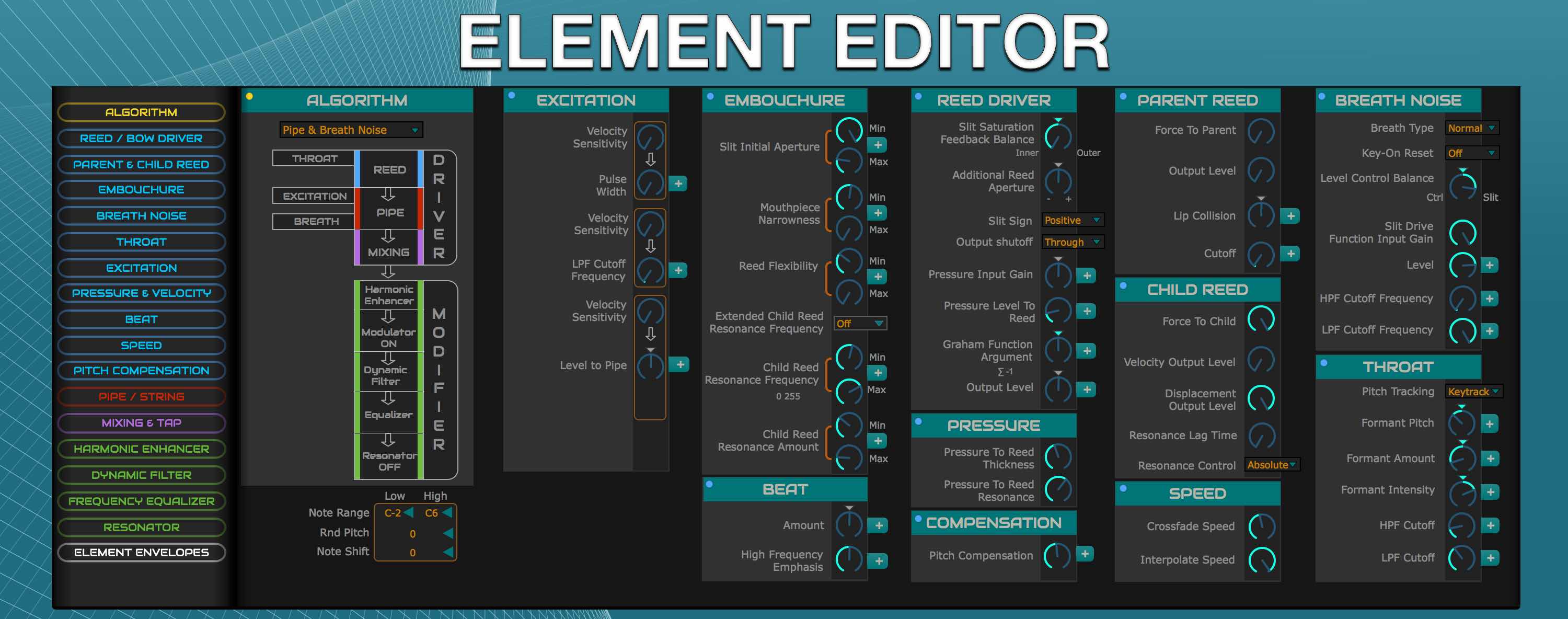
Element looks fab, if I had a Eurorack I would love one, but compared to the VL it's pretty basic (although I don't doubt it sounds great). If you look at the slideshow on the page for the software editor you can get some impression of the huge level of detail per model possible to emulate using the VL, no other physically modelled instrument comes close to this:

http://www.vl70m-editor.com/site/

eg this is just one page for the wind/reed model - you can even control details like relationships between the 2 reeds in double reed instruments

Image

Post

Klinke wrote:AFAIK, Yamaha owns the patents for the waveguide synthesis, so maybe this explains why no VST exist that even try to rival the VL1.
Yamaha licensed the waveguide patents from Stanford and they have now expired. A bunch of synths have had waveguides in them for years. Yamaha seems to have put additional techniques into the VLs but I don't think they were patented in any way – they kept them as trade secrets. In any case, they would have expired by now given that the VP1 first appeared in 1994 and any patents would have been filed before this.

But as I wrote upthread, I don't think waveguide technology is the issue – it's how the model interacts with the controllers that provides the distinction between the VL and today's virtual instruments. That's why, IMO, the instruments on the VL are more playable. To some extent, Kontakt has shown the way with the ability to script articulation changes. I'd say, right now, something like Falcon is the best bet because of this level of control.

Post

xoxos wrote: julius orion smith III
https://ccrma.stanford.edu/~jos/

sort of the qi jiguang of audio dsp :hihi:

not dead.
Yes, I had pointed to the link about waveguide two pages ago ;-)
xoxos wrote: because korg holds the copyright to this work, julius is not a source for software implementations.
AFAIK, it's Yamaha, not Korg, that owns the patents to waveguide synthesis. Korg was then owned by Yamaha, so, they probably licensed them.
EDIT: Gamma-UT beat me to it :hihi: I wasn't aware they had expired. Are you sure? Because I think waveguide has a lot to offer in this domain.
Fernando (FMR)

Post Reply

Return to “Instruments”