


What’s your go-to plate reverb for snare ?
-
Andreya_Autumn Andreya_Autumn https://www.kvraudio.com/forum/memberlist.php?mode=viewprofile&u=553235
- KVRian
- 506 posts since 21 Feb, 2022
Yeah I was wrong about Valhalla, sorry. I don't know why I got that twisted, I'm sure I knew at one point but forgot. Anyway, I disagree somewhat with Sean about the Gold plates like the 240. At least if the Lustruous Plates imitations are to be believed. I do like those, though they do not get used nearly as often as the more straightforward steel models.
-

- KVRAF
- 7648 posts since 2 Sep, 2019
It's not entirely clear that Sean is using Kirchhoff-Love plate theory to physically model wave propagation across specific plate dimensions, the way UVI Plate or Physical Audio Dynamic Plate do. It seems more likely that Sean's "twelve original algorithms" in Valhalla Plate use more traditional black box techniques involving delay, modulation, and filtering to try to replicate the characteristics of complex plate behavior in different materials.
You'll notice that in a true physical model like UVI Plate or Physical Audio Dynamic Plate, you can set the inputs and outputs anywhere on the plate, and soundwaves will be calculated at those specific points.
You'll notice that in a true physical model like UVI Plate or Physical Audio Dynamic Plate, you can set the inputs and outputs anywhere on the plate, and soundwaves will be calculated at those specific points.
THIS MUSIC HAS BEEN MIXED TO BE PLAYED LOUD SO TURN IT UP
-

- KVRAF
- 25010 posts since 12 Jul, 2003 from West Caprazumia
Don't matter as much to me as a single farthing... I vastly prefer Valhalla Plate over UVI PLate for any number of (practical, mind you, practical - right!?) reasons... (while owning licenses for both of 'em)
-
- KVRAF
- 7648 posts since 2 Sep, 2019
That's fine. I'm just addressing whether or not Valhalla Plate is actually a true physical model of an electro-acoustic plate, as was claimed. It certainly could be, depending on your definition of a physical model, but there isn't enough publicly available information about its construction to make that determination. But I would say based on the sort of controls it offers, it seems more like a traditional digital reverb, though one that perhaps is more complex or pays slightly more attention to detail than a rack reverb from the 1980s.
THIS MUSIC HAS BEEN MIXED TO BE PLAYED LOUD SO TURN IT UP
-
- KVRist
- 484 posts since 8 May, 2007
I see no evidence that Valhalla Plate is using physical modelling in the article referred to in the link above. For instance, I don't see any hint of solution of the wave equation in the plate complete with the requisite boundary and initial conditions, including the felt damper, radiation between the plate and the damper and so on. It may be that Valhalla Plate is using physical modelling; again I just don't see any evidence of it.jens wrote: Mon Mar 17, 2025 9:09 pmYou are completely mistaken in regards to Valhalla Plate.Andreya_Autumn wrote: Sun Mar 09, 2025 8:05 pm The important distinction here is between Plate-style algorithmic reverbs (like Valhalla), and (usually convolution) plugins imitating actual electro-acoustic plates. Very different sounds.
It's using physical modelling to emulate real plate reverbs.
Edit: the funky robot beat me to it.

"During the research for ValhallaPlate, I experimented with various models, where I could dial in the amount of dispersion over different frequencies."
One would not "dial in" dispersion in a comprehensive and truly physical model. Dispersion would vary as the result of changing physical parameters and the effect on the underlying physics. One does not have to experiment "with various models." The underlying physics is all very well known. This statement suggests that the model or models are more likely various phenomenological ones, albeit based on physics.
-
- KVRAF
- 25010 posts since 12 Jul, 2003 from West Caprazumia
In what way is this difference relevant to me as a user and non-developer?DaveClark wrote: Mon Mar 17, 2025 10:30 pm
I see no evidence that Valhalla Plate is using physical modelling in the article referred to in the link above. [...]
This statement suggests that the model or models are more likely various phenomenological ones, albeit based on physics.
Either way: please forgive me my technically incorrect way of using the term "physical modelling" - had I ever known, I might have cared one bit!


-
- KVRAF
- 8675 posts since 24 May, 2002 from Tutukaka, New Zealand
Yeah, those are very good. I've been using them for years now.donkey tugger wrote: Mon Mar 17, 2025 9:25 pmSame, usually from these;BackInCheck wrote: Mon Mar 10, 2025 2:50 pm I mostly use impulse responses to get the real plate sound.
https://samplicity.com/bricasti-m7-impu ... nse-files/
The ambiences are also great for small room type of, err, ambiences.
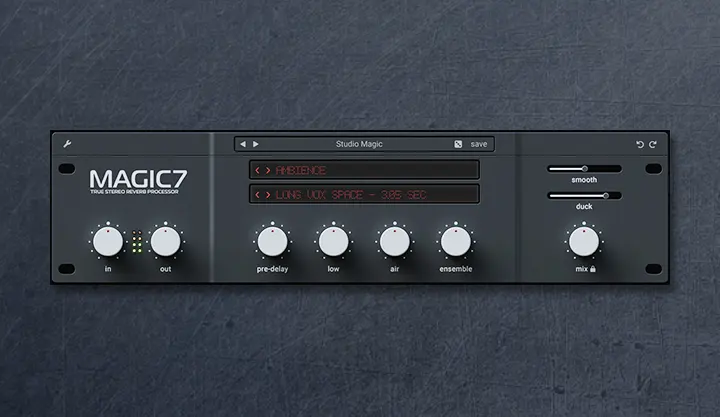
Recently though I've been converted to Magic7, which is a freebie plugin based on Bricasti. There's a paid version which is far more versatile and programmable and the freebie has a more limited set of impulses including some "plate" ones. But I gotta say it's a sweet - sounding reverb for a wide range of reverbs. TBH I've been using it more than Valhalla recently, and I love Valhalla. I've done a few comparisons with similar patches on both (not exact matches, so it's a very rough comparison) and Magic7 immediately sounds richer and lusher, which is exactly what you want for plates. Kinda like swapping between a Digitech and a Lexicon. TBH I really should check out the big version, as I suspect I'd buy it immediately - but the freebie is so good I haven't felt the need to yet. It's ridiculous that a reverb this good is free TBH.
https://www.wavealchemy.co.uk/product/magic7/
-
- KVRian
- 1139 posts since 2 Oct, 2021
Yes, the Magic7 sounds really good. Could be the best free reverb out there.kritikon wrote: Tue Mar 18, 2025 1:15 am
Recently though I've been converted to Magic7,
TBH I've been using it more than Valhalla recently, and I love Valhalla. I've done a few comparisons...
I just wanted to ask which Valhalla you're talking here as the ValhallalaPlate is very different than the Plate algo in VintageVerb. The one in VintageVerb is not so to my liking. And then I would agree. The ValhallaPlate has the qualities that I like in Magic7 with the advantage of tweakability, if wanted.
ABX is enemy to GAS
-
Andreya_Autumn Andreya_Autumn https://www.kvraudio.com/forum/memberlist.php?mode=viewprofile&u=553235
- KVRian
- 506 posts since 21 Feb, 2022
whassup wrote: Tue Mar 18, 2025 11:07 am I just wanted to ask which Valhalla you're talking here as the ValhallalaPlate is very different than the Plate algo in VintageVerb. The one in VintageVerb is not so to my liking. And then I would agree. The ValhallaPlate has the qualities that I like in Magic7 with the advantage of tweakability, if wanted.
That's what I was referring to in my first post on this thread.
Back in the 70s - 80s when digital reverbs started to appear, some of them sought to emulate plate reverbs. They failed rather severely by todays standards, but none the less had a specific sound which some people still like.
Today, some devs try to imitate actual plates while others try to imitate those early digital imitations. And in both cases the UI might just say "plate".
The plate model in VVV (and also that in various plugs based on Bricasti, Eventide and other algorithmic reverb units) is a digital plate emulation emulation.
ValhallaPlate (and also the UVI one, Lustruous Plates etc etc) are actual electro-acoustic plate emulations.
-
- KVRian
- 1139 posts since 2 Oct, 2021
Thanx for the clarification. Makes sense to me and fits with Sean's descriptions of his algorithms in both of his plugins.Andreya_Autumn wrote: Tue Mar 18, 2025 3:31 pm
ValhallaPlate (and also the UVI one, Lustruous Plates etc etc) are actual electro-acoustic plate emulations.
ABX is enemy to GAS
-
- KVRist
- 484 posts since 8 May, 2007
You are now trying to misdirect the discussion, so I'm calling you on it.jens wrote: Tue Mar 18, 2025 12:29 amIn what way is this difference relevant to me as a user and non-developer?DaveClark wrote: Mon Mar 17, 2025 10:30 pm
I see no evidence that Valhalla Plate is using physical modelling in the article referred to in the link above. [...]
This statement suggests that the model or models are more likely various phenomenological ones, albeit based on physics.
As anyone can easily see, my reply was not about YOU (nor anyone who approves your irrelevant comment), but about what you wrote that was incorrect in a public forum which could misinform others about what is going on.
-
- KVRAF
- 25010 posts since 12 Jul, 2003 from West Caprazumia
Nope, I am not trying to misdirect anything.DaveClark wrote: Tue Mar 18, 2025 5:22 pmYou are now trying to misdirect the discussion, so I'm calling you on it.jens wrote: Tue Mar 18, 2025 12:29 amIn what way is this difference relevant to me as a user and non-developer?DaveClark wrote: Mon Mar 17, 2025 10:30 pm
I see no evidence that Valhalla Plate is using physical modelling in the article referred to in the link above. [...]
This statement suggests that the model or models are more likely various phenomenological ones, albeit based on physics.
As anyone can easily see, my reply was not about YOU (nor anyone who approves your irrelevant comment), but about what you wrote that was incorrect in a public forum which could misinform others about what is going on.
You didn't answer my question - which was based on genuine curiosity, mind you.
(Hint: this is not the developer-forum (and you were talking about development techniques that don't mean much to me and neither probably to a lot of other users).)
O4r let me ask differently: is there a method to reliably test which of both methods you mentioned was used for a certain plugin?
If the answer to that question is no, then I think the difference you were pointing out should be entirely irrelevant to the user. Or if you don't think it's irrelevant then please enlighten us on how that is (or rather isn't) the case.
What I meant with "physical modelling" is that the developer looked at the physics of the real thing(s) and then developed a model to emulate the effect of these physics in a plugin.
You may disagree with that definition all you like, Wikipedia may disagree with it all they like; unless you explain the relevance of your disagreement for non-developers you are basically taking the discussion off topic in my opinion by even just voicing it here.
-
- KVRist
- 148 posts since 16 Sep, 2023
M7 IRs / Magic7 is based on the famous Bricasti algorithmic hardware reverb.
I was referring to impulse responses of actual electro-mechanical plate reverbs.
As others have said: there is a clear distinction between algo reverbs like Lexicon, Bricasti and oldschool Yamaha hardware trying to recreate the characteristics of a plate-reverb and an actual physical (electro-mechanical) device built from metal plates.
When I think about plate reverbs, I think about the latter, not the former. I think about EMT 140 / 240 and similar devices. Impulse responses taken from these devices can sound really authentic and there are some physical modelling attempts, which incorporate the interactions between the materials and the soundwaves (to make it sound less static than just an IR file)
I was referring to impulse responses of actual electro-mechanical plate reverbs.
As others have said: there is a clear distinction between algo reverbs like Lexicon, Bricasti and oldschool Yamaha hardware trying to recreate the characteristics of a plate-reverb and an actual physical (electro-mechanical) device built from metal plates.
When I think about plate reverbs, I think about the latter, not the former. I think about EMT 140 / 240 and similar devices. Impulse responses taken from these devices can sound really authentic and there are some physical modelling attempts, which incorporate the interactions between the materials and the soundwaves (to make it sound less static than just an IR file)
-
- KVRAF
- 7648 posts since 2 Sep, 2019
Jens, there is a difference between modeling and physical modeling. That difference being the actual physics behind the behavior being modeled by the latter, rather than just the observable behavior itself.
The difference is going to be accuracy of the results. A proper physical model will produce all of the behaviors because they are natural consequences of the physics. A model that simply measures outputs and tries to emulate the results by applying various techniques is never as accurate or complete. It’s like the difference between a painting and a photograph.
The difference is going to be accuracy of the results. A proper physical model will produce all of the behaviors because they are natural consequences of the physics. A model that simply measures outputs and tries to emulate the results by applying various techniques is never as accurate or complete. It’s like the difference between a painting and a photograph.
THIS MUSIC HAS BEEN MIXED TO BE PLAYED LOUD SO TURN IT UP
-

- KVRAF
- 8037 posts since 28 Dec, 2015 from Atlantis Island
I like Valhalla Plate. A bit dirty, but nice.
https://sonograyn.bandcamp.com/music Experimental Ambient
https://martinjuenke.bandcamp.com/music Alternative Instrumental
https://martinjuenke.bandcamp.com/music Alternative Instrumental