

Making things mono compatible.
-
- KVRAF
- 7579 posts since 17 Feb, 2005
Get to know the Haas Effect and how it can be used in mixing. In my experience, a stereo signal above 150hz sounds fine on most playbacks. Keep the big bass mono. Nothing should disappear in mono, unless it is intended. The stereo should not sound cluttered and overbearing.
-
- KVRist
- 152 posts since 19 May, 2017
Ok, here+#s my take on the matter: having a mix perfectly mono compatible isn't exactly necessary. Sure the ssential melody parts, bass kick and snare (and maybe the Hihats) still need to be heard, but except for the bass you'll have anything in stereo on every device (even phones).
But what you can do if some elements disapear or are to quiet is to work with mid/side eq and compression.
For an example if you boost some of the lower or upper mids of the guitars in mid mod they will come out a little more in the mono field. Just take care that they don't cloud the main melody.
One thing I loved to do, but I don't do this days, is to side chain just the upper and lower mids instrumentals in mid mode with my main vocal
But what you can do if some elements disapear or are to quiet is to work with mid/side eq and compression.
For an example if you boost some of the lower or upper mids of the guitars in mid mod they will come out a little more in the mono field. Just take care that they don't cloud the main melody.
One thing I loved to do, but I don't do this days, is to side chain just the upper and lower mids instrumentals in mid mode with my main vocal

Hi, I'm a Vocal Coach, Songwriter and Producer.
For anyone who needs help on Music Theory or wants to make music contact me here: danielj.golden.official@gmail.com
For Vocal lessons here: gesangsunterrichtdanielreid@gmail.com
For anyone who needs help on Music Theory or wants to make music contact me here: danielj.golden.official@gmail.com
For Vocal lessons here: gesangsunterrichtdanielreid@gmail.com
-

- KVRAF
- 2367 posts since 23 Sep, 2004 from Kocmoc
OD Ancora, Toneprojects Basslane Pro.
Soft Knees - Live 12, Diva, Omnisphere, Slate Digital VSX, TDR, Kush Audio, U-He, PA, Valhalla, Fuse, Pulsar AUDIO, NI, OekSound etc. on Win11Pro R7950X & RME AiO Pro
https://www.youtube.com/@softknees/videos Music & Demoscene
https://www.youtube.com/@softknees/videos Music & Demoscene
-
- KVRian
- 650 posts since 8 Dec, 2025
...but it's only based on static noise. Sure, it's better than nothing, but how useful is it really for music content?kernaudioio wrote: Tue Apr 14, 2026 5:00 pm ERB bands give you a perceptually-weighted frequency axis where the resolution follows roughly how the ear integrates energy
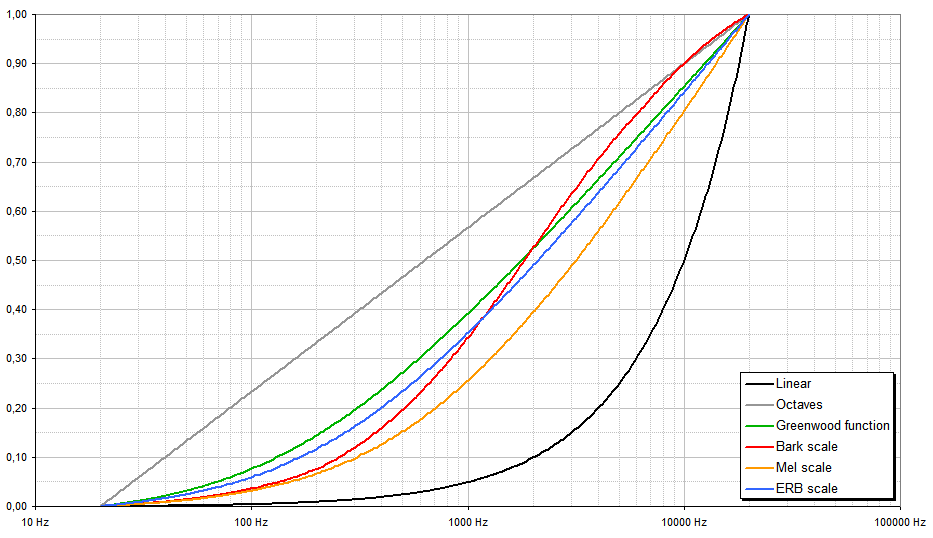
The Bark and Mel scales would have been a better choice when it comes to avoiding putting too much emphasis on deep frequencies:kernaudioio wrote: Tue Apr 14, 2026 5:00 pm which makes the mono correlation readout legible across the whole spectrum without drowning in low-end frequency bins.
But levels and localization are linked. Localization already plays a role when working with mono signals, proximity is part of the localization process. That's why Blauert's ribbons are so interesting. Compare the "mudd" region (Roughly between 250 and 400 Hz according to many books) with the lower "presence" band, for example. You can also call that the "Please get this out of my face" region. Mixing engineers cut there to move the sound away from the listener. The second "presence" band is literally called "presence" in audio production books as well. Look at the upper "diffuse" bands and then think where mixing engineers put cymbals in the stereo image. That's no coincidence, we're already using Blauert's ribbons without realizing it.kernaudioio wrote: Tue Apr 14, 2026 5:00 pm since the problem of "guitars go quiet in mono" is really about level relationships, not localization.
The question is also: How many bands do you really need for a mono compatibility check? ERB seems like overkill to me, like using a multi-band compressor as a volume fader. That doesn't mean CHECK is useless, don't get me wrong.
My suggestion: Make a simpler mono compatibility analyzer based on a different scale like Bark (Which is the most interesting scale because both loudness and pitch play a role) but with fewer bands (based on Blauert's ribbons). Less filters = lighter on the CPU and it's more intuitive to work with. Don't throw CHECK away. Instead, add the Bark and Mel scales to it as well (and raise the price, of course). Turn it into a general analyzer to experiment with. I think its strength isn't really mono/stereo processing, it could be much more useful for specific tasks like (un)masking. And actually be more powerful than a mono compatibility checker.