

Ah, you're right! Though, they specifically called it "analog physical modeling" and not "physical modeling," it seems. Which, I suppose, is less confusing, but still pretty confusing.EvilDragon wrote: Fri May 29, 2026 9:20 amYamaha used that term for AN1x, actually.tumface wrote: Fri May 29, 2026 9:11 amI've never heard that term used to describe an analog polysynth.

UNSTABLE Synth v.1.1.3 - Yamaha CS-80 Clone (PC/MAC/LINUX)
-
- KVRian
- 666 posts since 11 Apr, 2006
-

- KVRist
- Topic Starter
- 61 posts since 27 Sep, 2024 from Germany
In the context of an analog polysynth, "physical modeling" pretty obviously doesn't mean membranes, strings, and air columns — as there are none in a CS-80. It just as obviously means modeling the physical components, and reading it the other way is picking at a term rather than engaging with the point.tumface wrote: Fri May 29, 2026 9:11 amI wasn't asking about learning resources for DSP, no.Morphoice wrote: Fri May 29, 2026 8:57 am If you're interested in learning about physical modeling and DSP in general, Stanford's CCRMA is a great place to start.
But since you've brought up "physical modeling," are you saying that 'Unstable' uses physical modeling? You've referenced that phrase several times in this thread. I've never heard that term used to describe an analog polysynth. Physical modeling is used to describe synths that are reproducing physical acoustic phenomena, like membranes and tubes being struck.
I'm reading very carefully. I didn't put any words in your mouth.Morphoice wrote: Fri May 29, 2026 8:57 am Please read more carefully before putting words in my mouth.
Worth noting Yamaha themselves marketed e.g. their AN1x as an "Analog Physical Modeling" synthesizer — a virtual-analog instrument with no acoustic-instrument modeling whatsoever, where the term explicitly referred to modeling the analog signal path. So this isn't loose hobbyist shorthand; it's the manufacturer's own usage for exactly this kind of synth.
I've been using it the same way: to say we modeled the relevant parts of physcal circuitry — the voice cards, oscillators, filters, and envelopes at the component level — rather than sampling or building everything with generic VA building blocks. "Circuit modeling" or "analog modeling" is the more precise term. Same underlying point either way: the voice architecture is modeled, not sampled or stored in wavetables.
-
- KVRian
- 666 posts since 11 Apr, 2006
It wasn't obvious, no. That's why I was asking. All of the references that term in this thread were vague.Morphoice wrote: Fri May 29, 2026 9:30 am In the context of an analog polysynth, "physical modeling" pretty obviously doesn't mean membranes, strings, and air columns — as there are none in a CS-80. It just as obviously means modeling the physical components, and reading it the other way is picking at a term rather than engaging with the point.
I just replied to the previous post about that, yes.Morphoice wrote: Fri May 29, 2026 9:30 am Worth noting Yamaha themselves marketed e.g. their AN1x as an "Analog Physical Modeling" synthesizer
You were saying "physical modeling," not "analog physical modeling" as in Yamaha's marketing from 1997, if you want to split hairs over it like that.Morphoice wrote: Fri May 29, 2026 9:30 am So this isn't loose hobbyist shorthand; it's the manufacturer's own usage for exactly this kind of synth.
That's a much better answer, thanks.Morphoice wrote: Fri May 29, 2026 9:30 am I've been using it the same way: to say we modeled the relevant parts of physcal circuitry — the voice cards, oscillators, filters, and envelopes at the component level — rather than sampling or faking everything with generic VA building blocks. "Circuit modeling" or "analog modeling" is the more precise term. Same underlying point either way: the voice architecture is modeled, not sampled or stored in wavetables.
(Though I do find it funny that the AN1x appears to be, along with its contemporaries from that era, what you're describing as generic VA building blocks.)
-
- KVRist
- Topic Starter
- 61 posts since 27 Sep, 2024 from Germany
Glad we cleared things up.tumface wrote: Fri May 29, 2026 9:49 amIt wasn't obvious, no. That's why I was asking. All of the references that term in this thread were vague.Morphoice wrote: Fri May 29, 2026 9:30 am In the context of an analog polysynth, "physical modeling" pretty obviously doesn't mean membranes, strings, and air columns — as there are none in a CS-80. It just as obviously means modeling the physical components, and reading it the other way is picking at a term rather than engaging with the point.
I just replied to the previous post about that, yes.Morphoice wrote: Fri May 29, 2026 9:30 am Worth noting Yamaha themselves marketed e.g. their AN1x as an "Analog Physical Modeling" synthesizer
You were saying "physical modeling," not "analog physical modeling" as in Yamaha's marketing from 1997, if you want to split hairs over it like that.Morphoice wrote: Fri May 29, 2026 9:30 am So this isn't loose hobbyist shorthand; it's the manufacturer's own usage for exactly this kind of synth.
That's a much better answer, thanks.Morphoice wrote: Fri May 29, 2026 9:30 am I've been using it the same way: to say we modeled the relevant parts of physcal circuitry — the voice cards, oscillators, filters, and envelopes at the component level — rather than sampling or faking everything with generic VA building blocks. "Circuit modeling" or "analog modeling" is the more precise term. Same underlying point either way: the voice architecture is modeled, not sampled or stored in wavetables.
(Though I do find it funny that the AN1x appears to be, along with its contemporaries from that era, what you're describing as generic VA building blocks.)
On the AN1x being "generic VA building blocks": funnily enough it's almost the reverse. In 1997 it was anything but generic — it was one of the instruments that defined the category by modeling the analog signal path rather than sampling it. "Generic VA building blocks" is what I'd call the off-the-shelf, interchangeable oscillator and filter code that ships in a lot of modern soft synths today — the stuff you drop in without modeling any particular circuit. The AN1x was the novel thing those later generics were chasing. So if anything it's on the side of the line I'm describing, not against it.
Anyway — I'm off to put some more work into the EightySix chorus algorithm and take some more measurements from the JUNO-6 hardware, as I'm about to service a unit. Have a great weekend.
-
- KVRist
- 36 posts since 17 Jan, 2026
Wait, why won't you describe the methods you used to model it? U-he and Cytomic have no problem sharing their methods in detail. I doubt you had enough access to one in person to "physically model" the way you explicitly claim if you are so reluctant to give details, and for some reason instead lead with a story of how you've used them in the past. The lack of just openly telling the story of modeling this synth right off the bat, and instead referencing your history with synths, is very strange.Morphoice wrote: Fri May 29, 2026 6:46 amThe component modeling in UNSTABLE is based on years of hands-on experience with the original hardware. I've been restoring and working on vintage synthesizers since 1998, including owning a CS-80 for several years, and I'm in regular contact with other owners who maintain and service theirs. The measurements and analysis were done on real hardware -- this isn't something you can extract from YouTube videos, and I'd appreciate the question being asked in good faith.MattCable wrote: Fri May 29, 2026 2:48 am Where'd you find a CS-80 to measure and do physical modeling? Or can you do those measurements off youtubes and sound clips? I literally don't know but I'm curious since you made the statement: "with an improved physical model of the original Yamaha CS-80's voice cards and instabilities after months of thorough measurements and analysis of the original hardware."
What did you measure and how?
I understand there is a certain skepticism and general negativity toward newer developers in this space, and that's fair -- but I won't be intimidated into justifying decades of work to satisfy bad-faith questioning. I'm not in a position to share the specific methodology and tooling behind the modeling -- that represents years of hard work. What I can say is: try the plugin and let the sound speak for itself. If it doesn't convince you, that's completely fair.
If you're genuinely interested in plugin development and audio DSP modeling, there's a huge, very open and very friendly community of professionals out there -- but you'd need to strike a much better tone to be welcomed into it. Stanford's CCRMA has excellent courses on physical modeling and digital signal processing if you want to understand the depth of work that goes into something like this.
Also, no offense, but I find it hard to believe you have worked on synths for 30 years based on your website. It has the feeling/aesthetic of a MUCH younger gamer who managed to use enough AI to make a decent synth.
I don't mean to be rude, this isn't about personal attacks, it's about the fact I'm saying I believe you lied in your description of this plugin and are now doubling down. I believed that based off your website, bio, and now especially, based on your reply about how you are offended by being asked to provide details on the process you claimed. I'm getting subtle DARVO (Deny, Attack, Reverse Victim-Offender) vibes from your reply here.
You're not "in a position" to share the methodology (even though, who else would be)? Are you now claiming you used some avant-garde, unknown, or proprietary method to model this? You should probably write a research paper on it so others can benefit. Or, I guess the person who spent years learning development and months modeling this would rather not talk about that at all, just everyone listen to the "sound" and we'll leave it at that.
Last edited by MattCable on Mon Jun 01, 2026 4:55 am, edited 1 time in total.
-
- KVRist
- 36 posts since 17 Jan, 2026
You built it to capture the "soul" as you "experience" it (subjective), or you precisely modeled the components of your exact model (objective)? I wouldn't have cared, but you claimed it as such, then say contradictory statements.Morphoice wrote: Fri May 29, 2026 7:20 am I built UNSTABLE to capture the soul and character of the CS-80 as I experience it, and I'm very happy with where it is and how it sounds, it has been well received among fellow producers, developers and audio professionals. If you enjoy it, great — if not, that's fine too. I'm always open to bug reports, but I won't be discussing the technical details of the modeling publicly. If you have specific questions about the CS-80, there are qualified technicians out there who'll be happy to walk you through it — for the right fee.
-
- KVRist
- 36 posts since 17 Jan, 2026
Good thing you came in with this. OP was sweating prior, and then quoted you ten minutes later like they came up with it.EvilDragon wrote: Fri May 29, 2026 9:20 amYamaha used that term for AN1x, actually.tumface wrote: Fri May 29, 2026 9:11 amI've never heard that term used to describe an analog polysynth.
-
- KVRist
- 247 posts since 16 Apr, 2004
It's probably vibe coded but i don't really mind . I'm not going to buy anything from this dev tough , i mean look at his posts ... Im not going to say anything more.MattCable wrote: Sat May 30, 2026 10:04 pmWait, why won't you describe the methods you used to model it? U-he and Cytomic have no problem sharing their methods in detail. I doubt you had enough access to one in person to "physically model" the way you explicitly claim if you are so reluctant to give details, and for some reason instead lead with a story of how you've used them in the past. The lack of just openly telling the story of modeling this synth right off the bat, and instead referencing your history with synths, is very strange.Morphoice wrote: Fri May 29, 2026 6:46 amThe component modeling in UNSTABLE is based on years of hands-on experience with the original hardware. I've been restoring and working on vintage synthesizers since 1998, including owning a CS-80 for several years, and I'm in regular contact with other owners who maintain and service theirs. The measurements and analysis were done on real hardware -- this isn't something you can extract from YouTube videos, and I'd appreciate the question being asked in good faith.MattCable wrote: Fri May 29, 2026 2:48 am Where'd you find a CS-80 to measure and do physical modeling? Or can you do those measurements off youtubes and sound clips? I literally don't know but I'm curious since you made the statement: "with an improved physical model of the original Yamaha CS-80's voice cards and instabilities after months of thorough measurements and analysis of the original hardware."
What did you measure and how?
I understand there is a certain skepticism and general negativity toward newer developers in this space, and that's fair -- but I won't be intimidated into justifying decades of work to satisfy bad-faith questioning. I'm not in a position to share the specific methodology and tooling behind the modeling -- that represents years of hard work. What I can say is: try the plugin and let the sound speak for itself. If it doesn't convince you, that's completely fair.
If you're genuinely interested in plugin development and audio DSP modeling, there's a huge, very open and very friendly community of professionals out there -- but you'd need to strike a much better tone to be welcomed into it. Stanford's CCRMA has excellent courses on physical modeling and digital signal processing if you want to understand the depth of work that goes into something like this.
Also, no offense, but I find it hard to believe you have worked on synths for 30 years based on your website. It has the feeling/aesthetic of a MUCH younger gamer who managed to use enough AI to make a decent synth. That girl on the synth page is WAY too young for someone in their 40's (she doesn't even look legal, regardless if she's cgi/ai). Your bio also does not read like someone who has been working on synths for 30 years- it's the synopsis of someone with much less life experience. It feels padded.
I don't mean to be rude, this isn't about personal attacks, it's about the fact I'm saying I believe you lied in your description of this plugin and are now doubling down. That's literally all I care about. I believed that based off your website, bio, and now especially, based on your reply about how you are offended by being asked to provide details on the process YOU claimed. I'm getting subtle DARVO (Deny, Attack, Reverse Victim-Offender) vibes from your reply here.
And just for my own sanity check: You thought I was trying to "intimidate" you into revealing your process? You're not "in a position" to share the methodology (even though, who else would be)? Are you now claiming you used some avant-garde, unknown, or proprietary method to model this? You should probably write a research paper on it so others can benefit. Or, I guess the person who spent years learning development and months modeling this would rather not talk about that at all, just everyone listen to the "sound" and we'll leave it at that.
-

- KVRAF
- 20663 posts since 22 Nov, 2000 from Southern California
Guys, please don’t chase off this dev. I’m a fan of his plugins and would like to continue having him here to discuss them.
-

- KVRer
- 14 posts since 21 Apr, 2026
I really appreciate that Morphoice shared this information about how oscillator behavior varies with waveform and frequency. This is genuinely valuable insight into how some products achieve their distinctive sonic character, and it is the kind of practical knowledge that is often difficult to find in technical documentation or scientific publications.
Personally, I learned something from reading this thread, and for that I am grateful to the person who started the discussion.
Personally, I learned something from reading this thread, and for that I am grateful to the person who started the discussion.
-
- KVRist
- 36 posts since 17 Jan, 2026
Sorry Uncle E, this dev has been coming in hot over and over. It only seemed fair to give a little blunt honesty back. Even a person asking them to verify their apple license got ripped into unnecessarily.Uncle E wrote: Sat May 30, 2026 11:53 pm Guys, please don’t chase off this dev. I’m a fan of his plugins and would like to continue having him here to discuss them.
I'm curious how people that have actually used these Unstable synths think they stack up to Softube. I know this is the CS-80 thread, but they both also make a Juno. The Softube Model 84 Juno is I think one of the best synth emulations I've ever heard. I was playing around last night and I don't see how that one could be beat it honestly. It feels authentic and complete from the initial sound and with every tweak.
Now the CS-80 is much more complex (and rare), so I assume much harder to acquire and work with to model. I was genuinely curious (but yes also a little skeptical) of how OP tackled that one, but I got nothing in return. When people get angry when asked basic questions, I really no longer trust them. You'll notice politicians often use this technique, and it's rarely if ever because they are genuinely offended.
-
- KVRAF
- 20663 posts since 22 Nov, 2000 from Southern California
I own Model 77 and prefer the sound of Unstable.MattCable wrote: Sun May 31, 2026 5:32 pm I'm curious how people that have actually used these Unstable synths think they stack up to Softube.
Model 84 is a Juno-106, EightySix is a Juno-60. Completely different synths. I own U-NO-LX and July, and would be happy to give you a comparison of those, if you like.I know this is the CS-80 thread, but they both also make a Juno. The Softube Model 84 Juno is I think one of the best synth emulations I've ever heard.
When someone attacks my business, I find it hard to not get defensive. I hope that people give me some grace and understanding when that happens, and I try to do the same for others.When people get angry when asked basic questions, I really no longer trust them. You'll notice politicians often use this technique, and it's rarely if ever because they are genuinely offended.
-
- KVRist
- 36 posts since 17 Jan, 2026
Judging by some of their comments on the Juno, I'm willing to admit I may have been off-base here. Either way, hopefully this thread is something of a business lesson- keeping the tone professional is important, so I'll also try to do my part and move on.Uncle E wrote: Sun May 31, 2026 6:43 pmI own Model 77 and prefer the sound of Unstable.MattCable wrote: Sun May 31, 2026 5:32 pm I'm curious how people that have actually used these Unstable synths think they stack up to Softube.
Model 84 is a Juno-106, EightySix is a Juno-60. Completely different synths. I own U-NO-LX and July, and would be happy to give you a comparison of those, if you like.I know this is the CS-80 thread, but they both also make a Juno. The Softube Model 84 Juno is I think one of the best synth emulations I've ever heard.
When someone attacks my business, I find it hard to not get defensive. I hope that people give me some grace and understanding when that happens, and I try to do the same for others.When people get angry when asked basic questions, I really no longer trust them. You'll notice politicians often use this technique, and it's rarely if ever because they are genuinely offended.
Nice to hear your thoughts on the Softube CS. I did not even try it out because the demo sounds just didn't do it for me. But the Junos, what do you see as the biggest differences? I'm not schooled in it, but this Youtube they seem shockingly similar at 1:00. At first I found them identical, but in the comments people seem to prefer the 60 quite a bit. After relistening, maybe I do hear some additional clarity/brightness but also weight in the 60, but it's so close almost feels like placebo.
-
- KVRAF
- 20663 posts since 22 Nov, 2000 from Southern California
The filter circuits are completely different, the Juno-60 basically has the same filters as the Jupiter-8. Having owned too many Juno-106's and not enough Juno-60's myself, I can say that a 106 is noticeably thinner and less syrupy. It's great for cleaner JX-style pads or that awesome unison sub bass, but it can't do those rich Juno-60 pads that you hear all over synthwave.MattCable wrote: Mon Jun 01, 2026 4:36 am After relistening, maybe I do hear some additional clarity/brightness but also weight in the 60, but it's so close almost feels like placebo.
-
- KVRist
- Topic Starter
- 61 posts since 27 Sep, 2024 from Germany
EIGHTYSIX (Roland JUNO-6 Clone) UPDATE OUT NOW
v1.1.0
- Added Aftertouch, Pitchbend, VCA/VCF Velocity Response
- ADSR refit to measured hardware
- Modeled accurate chorus BBD noise
- Preset menu: prev/next arrows
- New fader/handle drag subroutine, fader no longer jumps on click
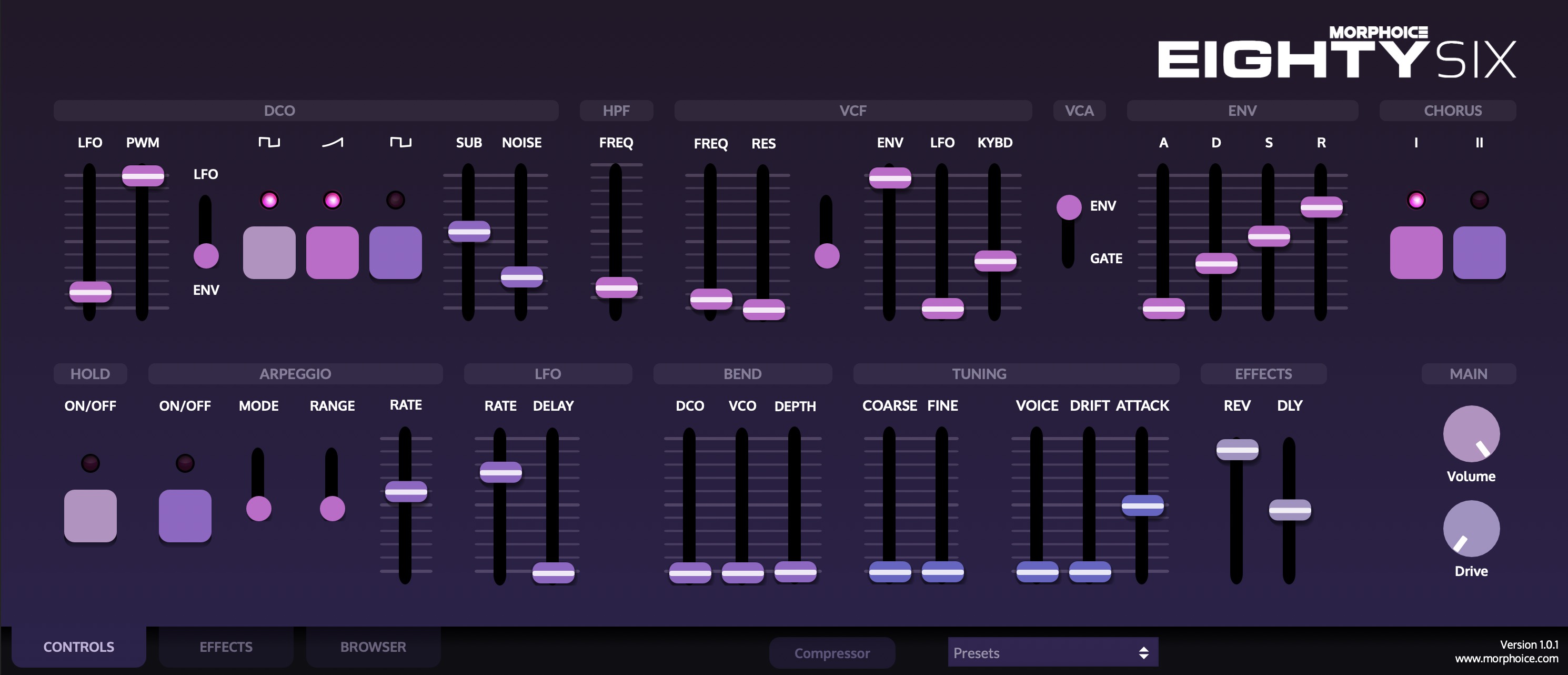
Please note that the presets have changed to match the new parameters and envelope refit. The installer should replace the existing ones. If your factory presets sound different after installing, delete them manually and rerun the installer.
IMPORTANT NOTICE FOR USER PRESETS
If you already created your own presets, note that you may have to readjust the envelope attack to your liking, as it could now be much longer because of the recalibrated setting. This was a one-time adjustment. There will be no further changes to the envelope curves from this version onward as they now accurately match the hardware.
v1.1.0
- Added Aftertouch, Pitchbend, VCA/VCF Velocity Response
- ADSR refit to measured hardware
- Modeled accurate chorus BBD noise
- Preset menu: prev/next arrows
- New fader/handle drag subroutine, fader no longer jumps on click
Please note that the presets have changed to match the new parameters and envelope refit. The installer should replace the existing ones. If your factory presets sound different after installing, delete them manually and rerun the installer.
IMPORTANT NOTICE FOR USER PRESETS
If you already created your own presets, note that you may have to readjust the envelope attack to your liking, as it could now be much longer because of the recalibrated setting. This was a one-time adjustment. There will be no further changes to the envelope curves from this version onward as they now accurately match the hardware.