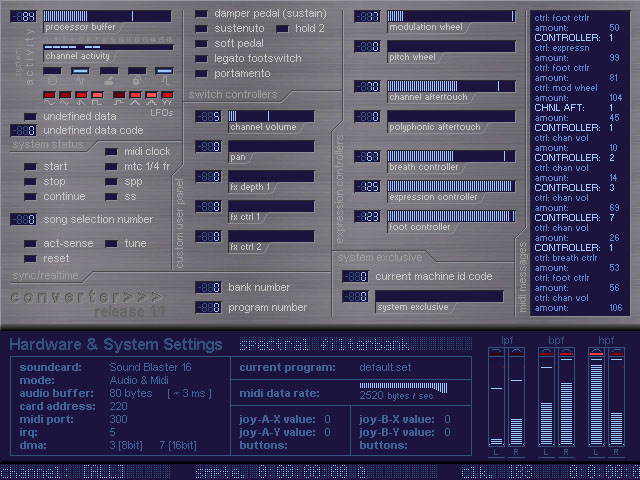
how did you use to make music on DOS? ..

Audio Plugin Hosts and other audio software applications discussion
RELATED
PRODUCTS

Post

grymmjack wrote:
it took us ages to figure out that OUT goes to IN and IN goes to OUT :) hehe then we had to figure out how to get local off so we wouldn't cause a midi feedback loop. ah the old days :)
I'm really surprised people have trouble with this. It's just like when you hook up your stereo or VCR. OUT from your tape deck goes IN to your receiver.

But if you read the forums for guitar MFX units, you still see a lot of this, so I guess it's not that obvious.
Even if the piano player can't play, keep the party going.
http://www.soundclick.com/mumpcake
https://mumpfucious.wordpress.com/

Post

mumpcake wrote:
grymmjack wrote:
it took us ages to figure out that OUT goes to IN and IN goes to OUT :) hehe then we had to figure out how to get local off so we wouldn't cause a midi feedback loop. ah the old days :)
I'm really surprised people have trouble with this. It's just like when you hook up your stereo or VCR. OUT from your tape deck goes IN to your receiver.

But if you read the forums for guitar MFX units, you still see a lot of this, so I guess it's not that obvious.
we were 16 or so :)

we kept connecting in to in and out to out. :)

made sense, square hole = square peg, that kind of logic :)

Post

mumpcake wrote:But if you read the forums for guitar MFX units, you still see a lot of this, so I guess it's not that obvious.
I always thought this was a major design-flaw in MIDI. It's completely counter-intuitive. If you think about it, it's technically correct, however people don't reason this way. People expect to connect A to A and B to B, not A to B and B to A.

Post

mumpcake wrote:
grymmjack wrote:
it took us ages to figure out that OUT goes to IN and IN goes to OUT :) hehe then we had to figure out how to get local off so we wouldn't cause a midi feedback loop. ah the old days :)
I'm really surprised people have trouble with this. It's just like when you hook up your stereo or VCR. OUT from your tape deck goes IN to your receiver.

But if you read the forums for guitar MFX units, you still see a lot of this, so I guess it's not that obvious.
Looking at it from a language neutral point of view, like symbol goes to like symbol. If someone's language doesn't evaluate the meaning of the words, or if the user just doesn't understand the idea of a signal path, it's pretty understandable that he might make this mistake.

Post

impulse tracker is another option.. Personally, fasttracker's gui felt very confining so I felt more at home in Impulse Tracker..

http://www.lim.com.au/ImpulseTracker/

Post

legendCNCD wrote:DOS? you mean AMIGA DOS?
How in earth anyone would have been LIKING to do anything concerning music with PC's? Except some lameass midi stuff maybe.. ;)
:box:
Misspellers of the world, unit!
https://soundcloud.com/aflecht

Post

grymmjack wrote:
legendCNCD wrote:DOS? you mean AMIGA DOS?
How in earth anyone would have been LIKING to do anything concerning music with PC's? Except some lameass midi stuff maybe.. ;)
are you trolling or honestly this clueless about music heritage on computers? c=64/amiga had/has HUGE music scene.

:hihi:
Misspellers of the world, unit!
https://soundcloud.com/aflecht

Post

grymmjack wrote:
CWoodOne wrote:I used to use Cakewalk for DOS, LOL
laugh if you want, but that was a nice package :) i used it myself with a keyboard i borrowed from a buddy (a roland juno1) -- it was what i learned midi on :)

it took us ages to figure out that OUT goes to IN and IN goes to OUT :) hehe then we had to figure out how to get local off so we wouldn't cause a midi feedback loop. ah the old days :)
I started out with some stuff I wrote/built myself, then went over Voyetra Sequencer+ to Cakewalks second DOS-version. I've stayed with Cakewalk ever since. First used a Casio as controller but later got a Juno2. I still remember when I got Rolands MT32 and couldn't believe I could actually pump out something close to a full song from that little box, almost an orchestra. First experience with (real) multitimbrality.

For myself the original Roland MPU that I used wasn't so confusing, but I always got confused when helping people that connected to gameports and the midiplugs on the connected cords were marked. Is the plug marked IN supposed to represent the gameports "IN" or the instruments "IN"?

Post

just curiosity, music software kept being developed for DOS, or "everything stopped" ?. I guess i will liked to see something like Bhajis Loops (palms) for DOS.
by the way, this
http://www.wildmag.de/issue03/it3alpha.gif
never was released?
:(

Post

http://www.urr.ca/software/software.htm

it's not sequencer ,but very interesting app ,and its for DOS
looks nice

Image

Post

BertKoor wrote:So if you definitely want to go for good-ole MS-DOS, I suggest to run 4Dos on top of it.
http://en.wikipedia.org/wiki/4DOS has most of the relevant info about it. Made my life under command prompts much easier!

For instance, 4Dos lets you execute data files by associating your fav program based on the file extension. You can define colours for file types, enter descriptions for files (file names in DOS can only be 8 + 3 chars long), create your own shortcut commands (even with a primitive character-based UI) and numerous other goodies.

One big downer for DOS: hardware support for modern devices like USB and non-soundblaster-compatible soundcards is next to inexistant. DOS seriously lacks driver support. So I wonder how you're going to get sound out of your laptop. Not impossible, but it might be difficult.

Good luck anyway ;-)
http://download.jpsoft.com/4dos/4dos.exe

...

http://en.wikipedia.org/wiki/X86_DOS_Comparison

^ A couple of these look like they might be worth looking into.

Post

RTaylor wrote:
Cone wrote:This was in 1991, by the way. After that I stopped for a looong time...
You mean until pro cards became available?
Nope. Until Steinberg came out with VST, and PCs became powerful enough to overcome a garden variety hardware synth.

A mate of mine did continue all the way though, he had some Turtle Beach "pro" audio cards. Ridiculously expensive in the mid-90s.

Post

Cone wrote:
RTaylor wrote:
Cone wrote:This was in 1991, by the way. After that I stopped for a looong time...
You mean until pro cards became available?
Nope. Until Steinberg came out with VST, and PCs became powerful enough to overcome a garden variety hardware synth.

A mate of mine did continue all the way though, he had some Turtle Beach "pro" audio cards. Ridiculously expensive in the mid-90s.
You said Soundblaster won the beta/vhs style war with the PAS stuff. I said until pro cards came along. I was addressing that rather than why you stopped. Stuff like the Digital Audio Labs CardDeluxe PC soundcard and the early Deltas, Frontier and Yamaha cards and so on, as well as the Turtle Beach cards, went a long way towards making the computer viable as a professional audio tool.

Post

in old DOS days there were 2 ways to make music: the boring way, using MIDI sequencers & hardware, and the fun way, using trackers. I know the way I prefer.

Post

trackers man!

Impulse tracker was king, and imho still is one of the best ways to compose music... I currently still use the IT format by connecting the vsti "revisit" to tracktion which triggers midi all around-- therefore in a certain way, IT3 does exist- in a modular vsti form "REVISIT" :D

revisit can play notes etc through midi to vsti's and fx in the host, so you're all set, if you are into tracking!

I usually try to donate here and there to the dev of revisit, he deserves more credit

RonC

Post Reply

Return to “Hosts & Applications (Sequencers, DAWs, Audio Editors, etc.)”