

The music is in C major for a String Quartet.
Here is the manuscript:

The MIDI can be found here
The MP3 (320kb/s) can be found here here
(both downloads use yousendit.com)
Yes, technically it's a minor seventh. But the seventh is diatonic to the key, I see no need to distinguish between the different sevenths in tonal music.Toxikator wrote:That's cool (I assume ii7b = iim7?). Where'd you find the progression (or did you write it)?
I'd genuinely like to know what this means.JumpingJackFlash wrote:Yes, technically it's a minor seventh. But the seventh is diatonic to the key, I see no need to distinguish between the different sevenths in tonal music.Toxikator wrote:That's cool (I assume ii7b = iim7?). Where'd you find the progression (or did you write it)?

What what means?nuffink wrote:I'd genuinely like to know what this means.JumpingJackFlash wrote:Yes, technically it's a minor seventh. But the seventh is diatonic to the key, I see no need to distinguish between the different sevenths in tonal music.Toxikator wrote:That's cool (I assume ii7b = iim7?). Where'd you find the progression (or did you write it)?
i7. Simple. Of course, the chord would be the same in both harmonic and ascending melodic scales. I suppose you could specify i#7 if you wanted, but there's probably no need (dependant on context).nuffink wrote:Fascinating. So how do you go about naming the 7th chord built upon the first degree of both the harmonic and melodic minor scales in this notation?
hmmm. Interesting.JumpingJackFlash wrote:i7. Simple.
That's quite strange, because it's the inverse of Jazz practice. In jazz, the "7" doesn't really mean that it's a kind of seventh chord: C7 could just as well be played with a 9th or a 13th. What the "7" means is that you're in Mixolydian mode. This is why from a modern, non-classical point of view, using ii7 for iim7 is a strange notation. Furthermore, you could actually be playing II7 V7 Imaj7, or even II7 V7 Im. That's one part of the classic theory I don't like too much - it sorta assumes you always play the same chords on the same degrees, and that all the notes you use stem from the "main" scale of the song. Stylistically, this sounds very classical, and poorly explains some songs where the I chord is always major, but every other chord of the song is from natural minor, including even a Vm7 (a 90s progressive rock song in this case). In short, I'd be wary of applying classical theory too litterally to pop - there's definitely some good common ground between the two, but classical theory also contains stylistic elements that apply mostly only to classical music.JumpingJackFlash wrote: What what means?
I assume you know the difference between a major seventh and a minor seventh, or indeed any other sort of seventh.
I was saying that there's no point (in tonal music) of specifying iimin7, or whatever. - This is seldom done with roman numerals anyway. The point is that it doesn't matter what sort of seventh it is, because the seventh note is always contained within the tonic key.
Assuming no accidentals, in a major key, chord I7 is a major seventh. ii7 is a minor seventh. iii7 is a minor seventh, IV7 is a major seventh, V7 is a dominant seventh, vi7 is a minor seventh and vii7 is a half-diminished seventh.
When notating using letters, then yes, it is more important to distinguish between the different types of sevenths. - For example, G7 is different to Gø, but that kind of thing isn't generally done with roman numerals.
Also, the newbie would undoubtedly be confused by all the different sevenths there are available. Simplifying it makes it easier.
If an accidental was included in the seventh, thereby making it non-diatonic, I would probably just include either b or # in-front of the 7 in the roman numeral. ii#7 for example.
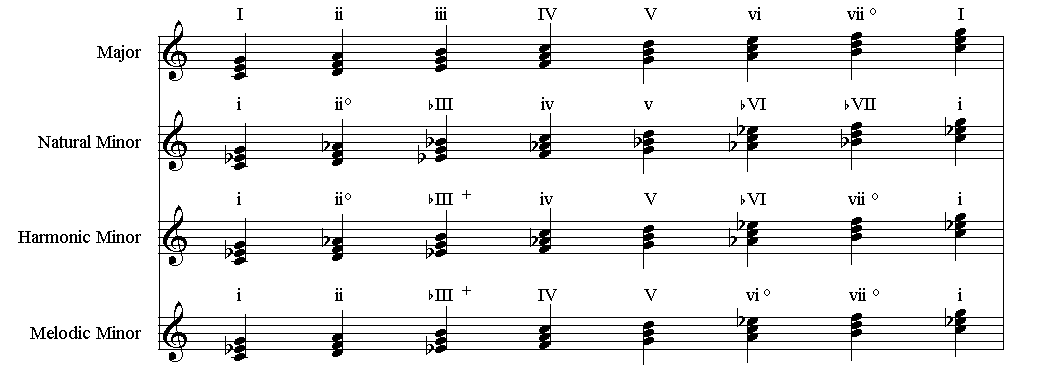 (Click it. It's clearer)
Dolmetsch wrote:All minor scales are named 'relative' to the major scale on the same key-note.

Submit: News, Plugins, Hosts & Apps | Advertise @ KVR | Developer Account | About KVR / Contact Us | Privacy Statement
© KVR Audio, Inc. 2000-2026