

44.1 kHz or 48 kHz?

-

- KVRAF
- 7644 posts since 2 Sep, 2019
According to Dan Lavry of Apogee and Lavey Engineering, the theoretical optimal samplerate is around 60KHz, which is greater than 44.1/48KHz. 88.2/96KHz are the closest samplerates available that meet the 60KHz samplerate minimum.
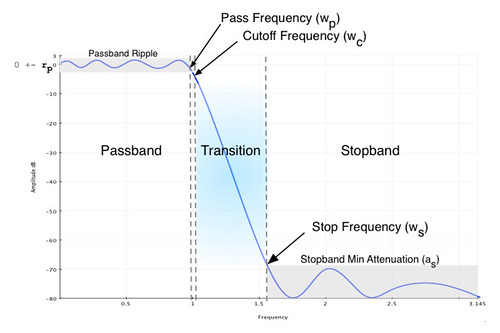
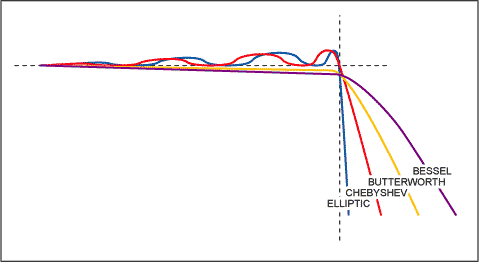
You want to avoid having the passband ripple reach into the audible range, so a samplerate of 60KHz or greater is needed to keep the ripple above it.
Filter Basics: Anti-Aliasing | Analog Devices
Eventually, the samplerate is going to need to be reduced for distribution, but converting only once with a high-quality SRC after mixdown is going to give the best results possible.
You want to keep your audio files at 96KHz straight through to mixdown. All plugins can operate internally at 96KHz, at least, so staying at 96KHz will avoid multiple conversions to and from the edge of the audible range, which would accumulate ripples in the upper octave as oversampled plugins downsample back to 44.1/48KHz as they pass the audio back to the audio engine and on to the next plugin to repeat the cycle.
Recording at 192KHz is actually slightly worse than recording at 96KHz, because it is actually less accurate due to increased jitter distortion from the faster samplerate.
However, an audio device that can record 192KHz is still preferable, because 192KHz converters are a higher quality (and totally different) design, since they must meet tighter tolerances, and lower samplerates will benefit from their better jitter rating.
You want to avoid having the passband ripple reach into the audible range, so a samplerate of 60KHz or greater is needed to keep the ripple above it.
Filter Basics: Anti-Aliasing | Analog Devices
Eventually, the samplerate is going to need to be reduced for distribution, but converting only once with a high-quality SRC after mixdown is going to give the best results possible.
You want to keep your audio files at 96KHz straight through to mixdown. All plugins can operate internally at 96KHz, at least, so staying at 96KHz will avoid multiple conversions to and from the edge of the audible range, which would accumulate ripples in the upper octave as oversampled plugins downsample back to 44.1/48KHz as they pass the audio back to the audio engine and on to the next plugin to repeat the cycle.
Recording at 192KHz is actually slightly worse than recording at 96KHz, because it is actually less accurate due to increased jitter distortion from the faster samplerate.
However, an audio device that can record 192KHz is still preferable, because 192KHz converters are a higher quality (and totally different) design, since they must meet tighter tolerances, and lower samplerates will benefit from their better jitter rating.
THIS MUSIC HAS BEEN MIXED TO BE PLAYED LOUD SO TURN IT UP
-
- KVRer
- 10 posts since 3 Sep, 2021
I like rule 2. It gets to the music faster.BertKoor wrote: Wed Apr 12, 2023 6:25 am What is the sample rate of your published end product?
Then use that from the start.
Rule of thumb #1: avoid any conversions if you can.
Rule of thumb #2: stop worrying about futile things.
-
- KVRAF
- 6780 posts since 17 Dec, 2009
aren't most consumer/prosumer converters sigmadelta, with PCM quantisation happening AFTER actual conversion?jamcat wrote: Tue Apr 18, 2023 12:22 am However, an audio device that can record 192KHz is still preferable, because 192KHz converters are a higher quality (and totally different) design, since they must meet tighter tolerances, and lower samplerates will benefit from their better jitter rating.

-

- KVRAF
- 14080 posts since 20 Nov, 2003 from Lost and Spaced
This is what's from the FAQ on Soundcloud : If you upload a stereo file in a lossless format like WAV, FLAC, AIFF, or ALAC, we’ll transcode it in a high-quality format optimized for music streaming like AAC 256 kbps. (I don't know what AAC is.) Also,: We recommend you to upload in a lossless format like WAV, FLAC, AIFF, or ALAC. If you can, the bit depth and sample rate should be 16 bit and 48 kHz respectively.(I swear I've tried to upload a 24 bit wave and it wouldn't take it. But, I have a free account so you know how that works)
-
 MidnightRunner MidnightRunner https://www.kvraudio.com/forum/memberlist.php?mode=viewprofile&u=610463
 - KVRist
- 98 posts since 13 Apr, 2023
https://en.wikipedia.org/wiki/Advanced_Audio_Codingosiris wrote: Tue Apr 18, 2023 1:54 pm This is what's from the FAQ on Soundcloud : If you upload a stereo file in a lossless format like WAV, FLAC, AIFF, or ALAC, we’ll transcode it in a high-quality format optimized for music streaming like AAC 256 kbps. (I don't know what AAC is.) Also,: We recommend you to upload in a lossless format like WAV, FLAC, AIFF, or ALAC. If you can, the bit depth and sample rate should be 16 bit and 48 kHz respectively.(I swear I've tried to upload a 24 bit wave and it wouldn't take it. But, I have a free account so you know how that works)
I have uploaded 48/24 wave to soundclound and it works fine. I hear no difference between uploaded 44/16 or 48/24 or 96/24 to soundcloud. It all gets converted to their site format. the trick is to get the right loudness so it doesn''t squash the track -- unless you dont care about that and do want a loud track with little dynamics.
-
- KVRAF
- 14080 posts since 20 Nov, 2003 from Lost and Spaced
Their new thing was to offer to 'master a track', for a fee of course on a track I uploaded. I thought that was rich.
-
MidnightRunner MidnightRunner https://www.kvraudio.com/forum/memberlist.php?mode=viewprofile&u=610463
- KVRist
- 98 posts since 13 Apr, 2023
its part of their next pro subscription service.osiris wrote: Tue Apr 18, 2023 2:41 pm Their new thing was to offer to 'master a track', for a fee of course on a track I uploaded. I thought that was rich.
https://blog.soundcloud.com/2020/07/14/ ... oundcloud/
-
- KVRAF
- 7644 posts since 2 Sep, 2019
This is very interesting. IMDs add another layer to complicate the picture even further. They seem to have many similarities to aliasing, in that they are ghost frequencies that arise from non-linear processing, but they are naturally occurring sum and difference frequency products, not digital folding, so they will occur even in the analogue domain.El°HYM wrote: Mon Apr 17, 2023 8:21 pmIn the end of the day there is no perfect solution with all of this, just workarounds and choosing the most non - destructive way.jamcat wrote: Mon Apr 17, 2023 8:13 pm
I had thought so, too, but from what I’ve read, there is no filter at all with 96kHz, because no audio equipment is passing audio above 48kHz.
https://vladgsound.wordpress.com/2014/1 ... ha-version
However, the experiments discussed in the corresponding Gearslutz thread that’s linked seem a little misleading, not just because they rely on conditions that are not likely to occur in the wild, but also because it doesn’t seem to be a problem that is confined only to ultrasonic frequencies. IMDs can occur between frequencies that reside well within the 20 to 20k range, so neither lower samplerates nor ultrasonic filtering will solve those occurrences.
And since they occur in the analogue domain, then eliminating them isn’t relevant to our interests, if our goal is to eliminate digital artifacts to get closer to analogue.
Also, if that TDR Ultrasonic Filter plugin is really so essential, why is it discontinued?
There doesn’t seem to be any such plugin made by anyone that exists for VST3, free or otherwise. If ultrasonic filtering is indeed such a game-changer, why is it so completely overlooked by every single serious developer?
Yes, I know that Airwindows has an ultrasonic filter, but Chris’s unfortunate refusal to support current plugin formats is a disqualifier.
THIS MUSIC HAS BEEN MIXED TO BE PLAYED LOUD SO TURN IT UP
-

- KVRAF
- 16786 posts since 8 Mar, 2005 from Utrecht, Holland
AAC is the audio compression method used in DAB+ broadcasting, BlueTooth etc. It's standard, and pretty good. Better than mp3 of the same bitrate.osiris wrote: Tue Apr 18, 2023 1:54 pm a high-quality format optimized for music streaming like AAC 256 kbps. (I don't know what AAC is.)
https://en.m.wikipedia.org/wiki/Advanced_Audio_Coding
We are the KVR collective. Resistance is futile. You will be assimilated. 
My MusicCalc is served over https!!
My MusicCalc is served over https!!
-
- KVRAF
- 6780 posts since 17 Dec, 2009
Since most if not all digital EQs can do that, and because all quality plugins today oversample/AA filter anyway?jamcat wrote: Tue Apr 18, 2023 4:31 pm
Also, if that TDR Ultrasonic Filter plugin is really so essential, why is it discontinued?
There doesn’t seem to be any such plugin made by anyone that exists for VST3, free or otherwise. If ultrasonic filtering is indeed such a game-changer, why is it so completely overlooked by every single serious developer?
-
- KVRer
- 20 posts since 24 Feb, 2023
can i ask what would be the best sample rate to put on my daw as I'm recording a dj mix and most of the files are in FLAC and mp3 320kbps 44.1? Would have any sense to set it at 48khz instead of 44.1? thankss

-
- KVRAF
- 6780 posts since 17 Dec, 2009
Izotope, fabfilter, weiss, kirchoff (from the top of my head)jamcat wrote: Tue Apr 18, 2023 9:11 pm Which digital EQs have a steep lowpass slope that go up to 24KHz or above?
Probably others