

Quick question: are some third-party modules supposed to have demos while others don't? I'd expect the approach in the store to be consistent where any module can be demoed.
I downloaded the Cherry Modular demo for the first time last night and my initial thoughts were:
1. Honestly, don't want to sound harsh, but I wasn't impressed wtih the raw sound. The basic modules sounded bland to my ear, and the included filters just didn't do it for me at all. That said, I was thinking, "maybe if I check out the Vult stuff or the new PSP stuff, I'll change my mind." That lead to issue #2...
2. Only some modules seem to offer demos. Is that because I'm running the Voltage Modular demo? Or is it up to each vendor to allow that or not? I'd like to be able to demo everything. What if I determined that with different oscs and filters, this would be the perfect product for me? Instead of buying Voltage Modular + additional modules, I'm left with an underwhelmed experience and will likely walk away with no purchase.
3. The look of the program could use some work. This is part of the reason why I took so long to demo in the first place, but the GUI uses way too much color IMO. Living in New Jersey, there's the boondogle called Xanadu in the meadowloands that long had a lego-brick type coloring scheme, and Voltage Modular reminds me of that.
Additionally, it seems like some elements were slightly different sizes (bigger cable jack, smaller cable jack), or some things were almost aligned but not really. I actually think the free VCV modules I've used (on the whole) look much better because the elements have some uniformity to them that's lacking here. If I loved everything else about the basic platform, I could live with the GUI as-is, but not loving the basic sound and finding the GUI overly busy and a bit haphazard just combine to make it a no-go for me.
4. Where I do give the Cherry Audio guys a lot of credit is in the amount of modules they offer upfront, and even more importantly, the support the platform has received. Lots of great updates coming out by the looks of things, and that level of support is what got me interested in the first place. It seems like a really cool platform, but one that just needs some killer modules and more consistency in the UI department IMO.
Anyway, just my initial two cents.

Cherry Audio Voltage modular
-
Funkybot's Evil Twin Funkybot's Evil Twin https://www.kvraudio.com/forum/memberlist.php?mode=viewprofile&u=116627
- KVRAF
- 12443 posts since 16 Aug, 2006
-

- KVRAF
- 8487 posts since 29 Sep, 2010 from Maui
@Funkybot...
I suspect the problem is that the system is not fully in place for a lot of things,
and much is still being worked on. Regarding the demos, at least part of that
is timing. For instance, the new PSP Poly stuff can not be demoed, but the rest can.
*About the scaling, seems like they might have been trying to match the scale
of Eurorack hardware here, as they are pretty damn close (for me anyway @ 1080P)
I suspect the problem is that the system is not fully in place for a lot of things,
and much is still being worked on. Regarding the demos, at least part of that
is timing. For instance, the new PSP Poly stuff can not be demoed, but the rest can.
*About the scaling, seems like they might have been trying to match the scale
of Eurorack hardware here, as they are pretty damn close (for me anyway @ 1080P)
-
- KVRist
- 59 posts since 22 Jun, 2012
7 day demos should be available now.pekbro wrote: Wed Jan 30, 2019 10:46 pm @Funkybot...
For instance, the new PSP Poly stuff can not be demoed, but the rest can.
Antoni
www.PSPaudioware.com
-
Funkybot's Evil Twin Funkybot's Evil Twin https://www.kvraudio.com/forum/memberlist.php?mode=viewprofile&u=116627
- KVRAF
- 12443 posts since 16 Aug, 2006
-
- KVRian
- 1380 posts since 8 Jan, 2012 from frankfurt, Germany
i don't know why we need 3 different cables like CV, Audio, Midi and Poly, this makes everything very complex, and is doubling the modules and needs a lot of translation modules, which kill the workflow .... the new Bitwig 3 doesn't matter and allows everything to connect
-

- KVRAF
- 11162 posts since 16 Mar, 2003 from Porto - Portugal
I too would very much prefer that everything was unified, and we could simply define whether the patch would be monophonic or polyphonic, and how many voices to play simultaneously.sacer wrote: Thu Jan 31, 2019 12:47 pm i don't know why we need 3 different cables like CV, Audio, Midi and Poly, this makes everything very complex, and is doubling the modules and needs a lot of translation modules, which kill the workflow .... the new Bitwig 3 doesn't matter and allows everything to connect
But it seems Voltage Modular was born as a monophonic, and changing everything into mono/poly would imply to rewrite the whole application

Fernando (FMR)
-
- KVRist
- 298 posts since 1 Oct, 2018
Hi KVR friends,
1. All polyphonic synthesizers have monophonic elements. Let's take a very simple classic polysynth, like an 8-voice Oberheim OB-Xa. Sure, it has 8 complete voices, but it isn't a purely polyphonic instrument. There's a single mono LFO that is routed to all voices for modulation purposes. Now consider a more complex poly-synth, like a CS80. In addition to the single LFO, there are also a single ring-modulator, tremelo, and chorus effect unit that process the sound once the poly voices are mixed together. Then there are paraphonic synthesizers, such as classic string synthesizers. Most of these feature a single filter and chorus effect, and often a single envelope generator, that all poly voices are routed through.
To be able to recreate all of these sounds in a modular environment, you need a mix of polyphonic processing and monophonic processing. You wouldn't want an 8 voice synthesizer with 8 separate LFOs and 8 reverb units, for example. The LFOs would be out of sync with each other, and 8 reverbs would require a ton of unnecessary CPU use. Plus effects like distortion and compression would never sound the same if each voice were distorted or compressed individually, versus processing the entire mix.
This is why having a polyphonic modular isn't just a question of pushing a button to turn a patch polyphonic. To do it right requires a much more flexible system.
2. Modular synthesizers are not like traditional poly synths. Polyphonic synthesizer plug-ins are fundamentally easy. Every voice has an envelope, and when a key is pressed and released, that voice will eventually fade to silence. Once it's silent, there's no need to process that voice further until another key is pressed and the envelope opens again.
But modular synthesizers don't work that way. Who says a patch has to have an envelope at the end? And even if fade-outs are desired, who says you have to use an envelope? You can use a filter to reduce a sound to silence, or a switch, or the sound could come from a sampler or a drum module or the Poly Octave generator and fade out naturally. Or voices can drone on endlessly, fading in and out, or randomly triggering themselves in interesting ways.
In short, Patches on a modular synthesizer don't follow the rules of traditional polysynths, and as a result, you can't just enter a polyphonic mode and have it work. We put a great deal of thought into solving the problem of how to support polyphony when polyphony is wanted and where it's necessary, while simultaneously supporting mono signals where they are needed and desirable. And the simplest and best option is to let developers build whatever kind of modules they want to build. Just like in hardware, our modules can take in and output MIDI as well as audio and control signals, and now we offer polyphonic cables that can carry multiple signals - which is exactly how it would be done in hardware, if anyone were doing it. Modules like our Poly Oscillator support both polyphonic modulation and monophonic modulation, which makes them extremely powerful and deeply flexible. The new PSP Poly modules have both poly and mono outputs. And of course there is no limit to the kinds of polyphonic modules that 3rd parties can build.
We'd love to hear ideas for other ways to support polyphony in Voltage Modular! But, give some serious thought to your ideas -- many seemingly workable ideas, like having polyphonic cabinets, are both confusing for users and ultimately not practical, because having a polyphonic cabinet isn't enough, as you have to be able to feed in different control signals for every voice, and you still need a mechanism to do that.
Finally, in other news, more modules are on the way, and we've got several new 3rd party developers that are bringing their existing modules over to Voltage Modular. More news to come!
All the best,
Dan @ Cherry Audio
I wanted to chime in on this comment with a brief discussion about polyphony and modular synthesizers. The idea that Voltage Modular was "born monophonic" just isn't accurate. Polyphony was a consideration from day one, but there are two main issues that music be considered:fmr wrote: Thu Jan 31, 2019 1:29 pm But it seems Voltage Modular was born as a monophonic, and changing everything into mono/poly would imply to rewrite the whole application
1. All polyphonic synthesizers have monophonic elements. Let's take a very simple classic polysynth, like an 8-voice Oberheim OB-Xa. Sure, it has 8 complete voices, but it isn't a purely polyphonic instrument. There's a single mono LFO that is routed to all voices for modulation purposes. Now consider a more complex poly-synth, like a CS80. In addition to the single LFO, there are also a single ring-modulator, tremelo, and chorus effect unit that process the sound once the poly voices are mixed together. Then there are paraphonic synthesizers, such as classic string synthesizers. Most of these feature a single filter and chorus effect, and often a single envelope generator, that all poly voices are routed through.
To be able to recreate all of these sounds in a modular environment, you need a mix of polyphonic processing and monophonic processing. You wouldn't want an 8 voice synthesizer with 8 separate LFOs and 8 reverb units, for example. The LFOs would be out of sync with each other, and 8 reverbs would require a ton of unnecessary CPU use. Plus effects like distortion and compression would never sound the same if each voice were distorted or compressed individually, versus processing the entire mix.
This is why having a polyphonic modular isn't just a question of pushing a button to turn a patch polyphonic. To do it right requires a much more flexible system.
2. Modular synthesizers are not like traditional poly synths. Polyphonic synthesizer plug-ins are fundamentally easy. Every voice has an envelope, and when a key is pressed and released, that voice will eventually fade to silence. Once it's silent, there's no need to process that voice further until another key is pressed and the envelope opens again.
But modular synthesizers don't work that way. Who says a patch has to have an envelope at the end? And even if fade-outs are desired, who says you have to use an envelope? You can use a filter to reduce a sound to silence, or a switch, or the sound could come from a sampler or a drum module or the Poly Octave generator and fade out naturally. Or voices can drone on endlessly, fading in and out, or randomly triggering themselves in interesting ways.
In short, Patches on a modular synthesizer don't follow the rules of traditional polysynths, and as a result, you can't just enter a polyphonic mode and have it work. We put a great deal of thought into solving the problem of how to support polyphony when polyphony is wanted and where it's necessary, while simultaneously supporting mono signals where they are needed and desirable. And the simplest and best option is to let developers build whatever kind of modules they want to build. Just like in hardware, our modules can take in and output MIDI as well as audio and control signals, and now we offer polyphonic cables that can carry multiple signals - which is exactly how it would be done in hardware, if anyone were doing it. Modules like our Poly Oscillator support both polyphonic modulation and monophonic modulation, which makes them extremely powerful and deeply flexible. The new PSP Poly modules have both poly and mono outputs. And of course there is no limit to the kinds of polyphonic modules that 3rd parties can build.
We'd love to hear ideas for other ways to support polyphony in Voltage Modular! But, give some serious thought to your ideas -- many seemingly workable ideas, like having polyphonic cabinets, are both confusing for users and ultimately not practical, because having a polyphonic cabinet isn't enough, as you have to be able to feed in different control signals for every voice, and you still need a mechanism to do that.
Finally, in other news, more modules are on the way, and we've got several new 3rd party developers that are bringing their existing modules over to Voltage Modular. More news to come!
All the best,
Dan @ Cherry Audio
-

- KVRAF
- 6279 posts since 8 Jul, 2009
None of this is an issue for me. I've been using synths including modulars for over 40 years - what you did with the design of VM just makes sense to me. I get the "universal signal flow" thing too, such as in u-he ACE, but I find purpose-built signal paths to help with workflow - it's a constraint that helps keep patches and thinking-about-patches better organized, for me anyway. How to implement poly in a typically mono platform like a modular is tricky and what you did with the whole poly modules and poly signal-path also works well for the same reasons. Again you could have (somehow) gone the "universal" route but then I don't think VM would be as easy to use as it is, which is really it's main selling point, besides sound quality (and versatility). and cost.cherryDan wrote: Fri Feb 01, 2019 9:55 pm Hi KVR friends,
I wanted to chime in on this comment with a brief discussion about polyphony and modular synthesizers. The idea that Voltage Modular was "born monophonic" just isn't accurate. Polyphony was a consideration from day one, but there are two main issues that music be considered: [snip...]fmr wrote: Thu Jan 31, 2019 1:29 pm But it seems Voltage Modular was born as a monophonic, and changing everything into mono/poly would imply to rewrite the whole application
Dan @ Cherry Audio
 VM has a lot going for it.
#NONFR Check out my music at Bandcamp Free Streaming!
Free music with your support on Patreon | Youtube: Music of Plexus Videos (music videos) | Youtube: Plexus Productions (audio related) Stop whining. Make music.
Free Streaming! Free music with your support on Patreon | Youtube: Music of Plexus Videos (music videos) | Youtube: Plexus Productions (audio related) Stop whining. Make music.
-
- KVRAF
- 8487 posts since 29 Sep, 2010 from Maui
It would be great if the VST plugin host module could have its own clock, it’s impossible to use sequencers and the like in the stand alone as there is no transport. Also, performance seems to be an issue for anything remotely complicated. 2 cabinets 1 with a single poly osc, and the other processing ext audio will choke VM considerably IME.
-cheers
-cheers
-
- KVRAF
- 6279 posts since 8 Jul, 2009
I agree about performance. When I demoed I really only tried some of the simpler patches. i did try a complex one that crackled a lot and was unplayable. But I convinced myself that was an anomaly, with no other observable evidence. Now I am finding I fooled myself - VM starts bogging down rather quickly. too quickly for my tastes. i am also finding the PSP modules have a much larger CPU load. Considering the performance of other synths, it seems like VM could be improved in this regard. hopefully...pekbro wrote: Fri Feb 01, 2019 11:29 pm It would be great if the VST plugin host module could have its own clock, it’s impossible to use sequencers and the like in the stand alone as there is no transport. Also, performance seems to be an issue for anything remotely complicated. 2 cabinets 1 with a single poly osc, and the other processing ext audio will choke VM considerably IME.
-cheers
#NONFR Check out my music at Bandcamp Free Streaming!
Free music with your support on Patreon | Youtube: Music of Plexus Videos (music videos) | Youtube: Plexus Productions (audio related) Stop whining. Make music.
Free Streaming! Free music with your support on Patreon | Youtube: Music of Plexus Videos (music videos) | Youtube: Plexus Productions (audio related) Stop whining. Make music.
-
- KVRAF
- 6279 posts since 8 Jul, 2009
Feature request: A global knob to control the brightness of the UI excluding all the "LEDs" and wire signal-flow-"lights" - there are instances where I am working with VM and I'd like to see the signal lights more - in a real situation I would dim the studio lights. The "lights" are helpful to "seeing" the signal flow. I find mixed in with the UI as it is now, the "lights" are hard to see on their own.
#NONFR Check out my music at Bandcamp Free Streaming!
Free music with your support on Patreon | Youtube: Music of Plexus Videos (music videos) | Youtube: Plexus Productions (audio related) Stop whining. Make music.
Free Streaming! Free music with your support on Patreon | Youtube: Music of Plexus Videos (music videos) | Youtube: Plexus Productions (audio related) Stop whining. Make music.
-

- KVRAF
- 1722 posts since 21 Sep, 2007 from USA
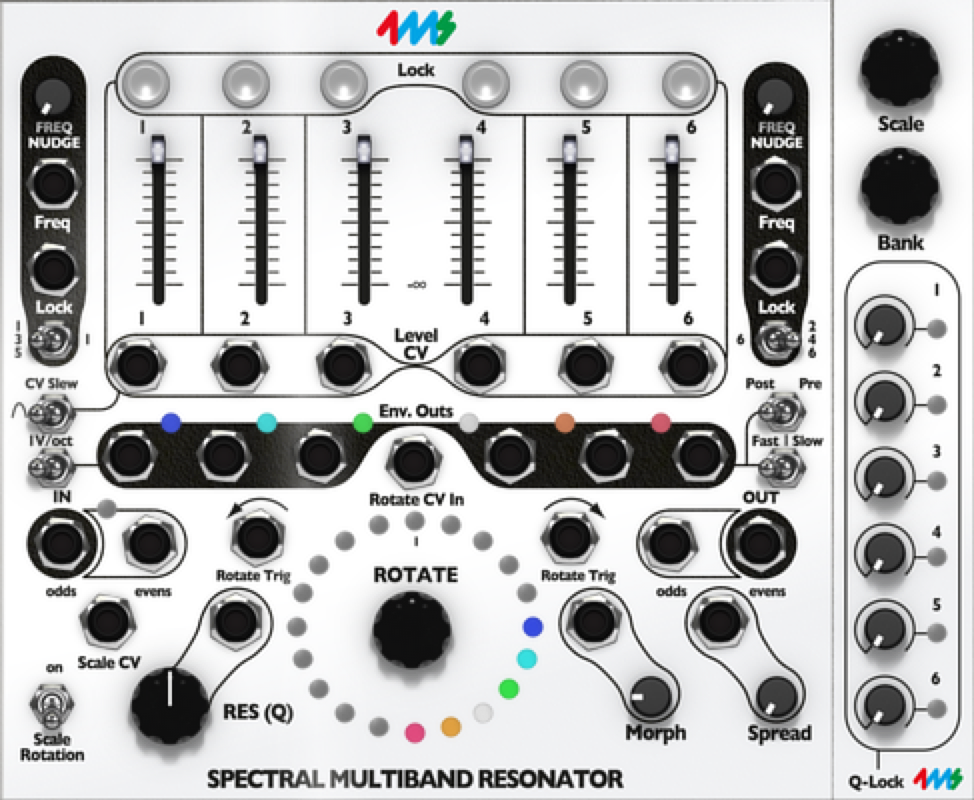
How about the 4MS Spectral Multiband Resonator module? Will that one be ported over?cherryDan wrote: Fri Feb 01, 2019 9:55 pmFinally, in other news, more modules are on the way, and we've got several new 3rd party developers that are bringing their existing modules over to Voltage Modular.
[Core i7 8700 | 32GB DDR4 | Win11 x64 | Studio One 7 Pro | WASAPI ]
-
- KVRAF
- 8487 posts since 29 Sep, 2010 from Maui
+1 The lights should be pretty bright against the modules.plexuss wrote: Sat Feb 02, 2019 3:21 am Feature request: A global knob to control the brightness of the UI excluding all the "LEDs" and wire signal-flow-"lights" - there are instances where I am working with VM and I'd like to see the signal lights more - in a real situation I would dim the studio lights. The "lights" are helpful to "seeing" the signal flow. I find mixed in with the UI as it is now, the "lights" are hard to see on their own.
You do not have the required permissions to view the files attached to this post.
-

- KVRist
- 470 posts since 11 Mar, 2007 from Portugal
True. I think that's even expected, having "mono" elements/sections in a "poly" architecture.
Exactly. It needs to care for both "poly" and "mono" areas i.e. section/module groups, accordingly to what's needed for the sound/patch/instrument design.cherryDan wrote: Fri Feb 01, 2019 9:55 pm To be able to recreate all of these sounds in a modular environment, you need a mix of polyphonic processing and monophonic processing. You wouldn't want an 8 voice synthesizer with 8 separate LFOs and 8 reverb units, for example. The LFOs would be out of sync with each other, and 8 reverbs would require a ton of unnecessary CPU use. Plus effects like distortion and compression would never sound the same if each voice were distorted or compressed individually, versus processing the entire mix.
This is why having a polyphonic modular isn't just a question of pushing a button to turn a patch polyphonic. To do it right requires a much more flexible system.
Agreed and Voltage Modular attracted my attention initially (back in NAMM 2018 demo) exactly because of how it seemed to be willing to handle polyphonic artitechures as much as the traditional monophonic approach of modular environments (even virtual ones) ...with the exception of KarmaFX & in some ways AAS Tassman 4 ...though, I hate those thin Reaktor/Max-style connection linescherryDan wrote: Fri Feb 01, 2019 9:55 pm 2. Modular synthesizers are not like traditional poly synths.
[...]
In short, Patches on a modular synthesizer don't follow the rules of traditional polysynths, and as a result, you can't just enter a polyphonic mode and have it work. We put a great deal of thought into solving the problem of how to support polyphony when polyphony is wanted and where it's necessary, while simultaneously supporting mono signals where they are needed and desirable. And the simplest and best option is to let developers build whatever kind of modules they want to build. Just like in hardware, our modules can take in and output MIDI as well as audio and control signals, and now we offer polyphonic cables that can carry multiple signals - which is exactly how it would be done in hardware, if anyone were doing it.
[...]
We'd love to hear ideas for other ways to support polyphony in Voltage Modular! But, give some serious thought to your ideas -- many seemingly workable ideas, like having polyphonic cabinets, are both confusing for users and ultimately not practical, because having a polyphonic cabinet isn't enough, as you have to be able to feed in different control signals for every voice, and you still need a mechanism to do that.
[...]

Was glad to see PolyCV being added alongside MIDI though sometimes it seems that MIDI is forgotten vs the newer PolyCV, meaning... why wasn't PolyCV implemented by "simply" adding a MIDI-to-PolyCV module with its PolyCV-to-MIDI companion instead of a "main" section for it? But that's an extremely minor and highly subjective critique on one single design option

Speaking of Cabinets, I do try to build Cabinet-centric module-groups (some like VoiceCards), which, to make them reusable, I end up sticking their main I/O at the beginning/left and end/right though a Patchbay-like module with multiple In-Label-Out to make re-wiring the cabinet to existing modules an easier job.
So, if someone wants to make this kind of patchbay-like (that doubles as passthrough+mix+mult) simple modules, be my guest. I'm not going to pay for the Designer just yet to release such simple FREE modules

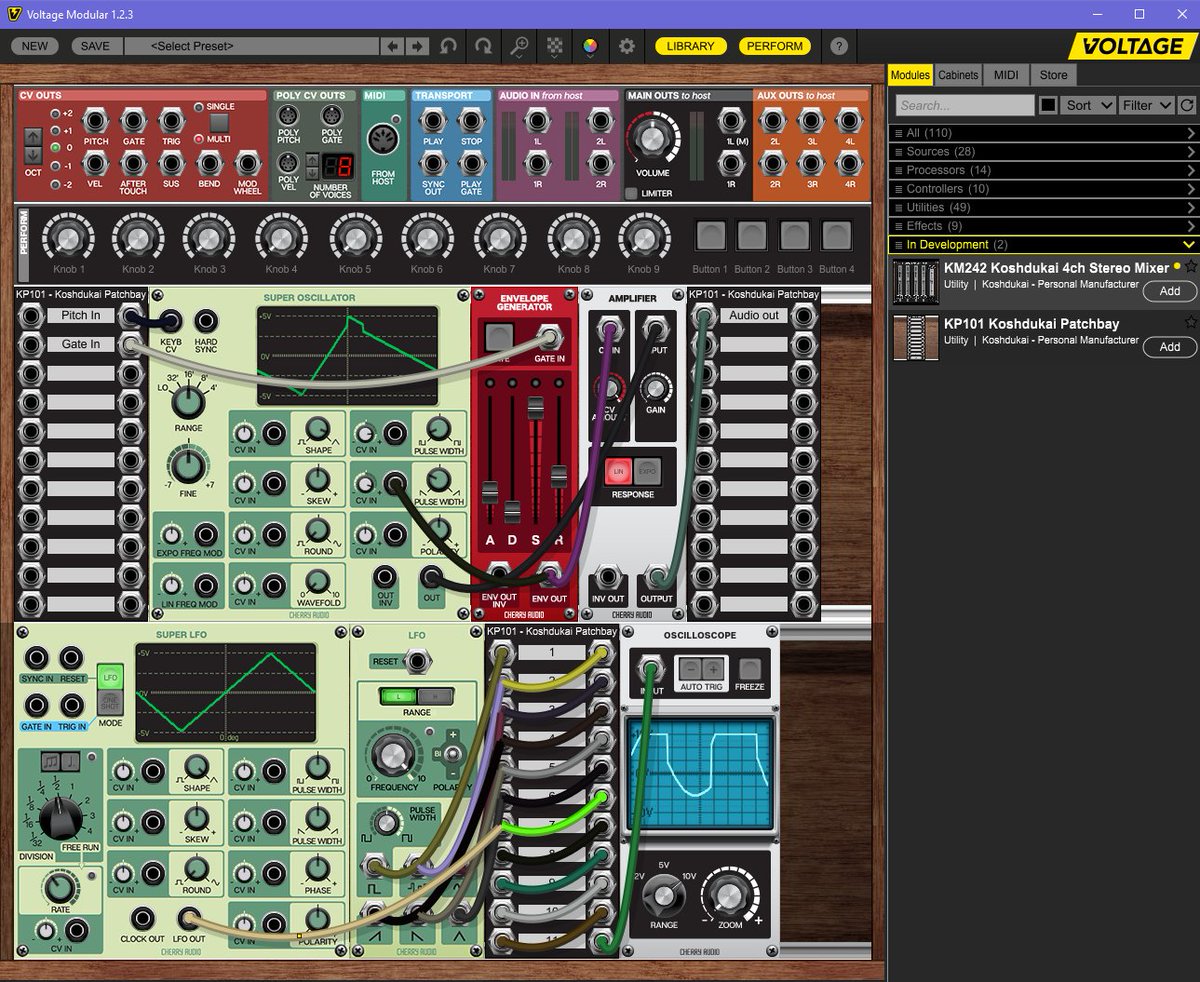
so... yet another Feature Suggestion here: Collapsible Cabinets, that would work like a "Reason Combinator", to make the rack more compact, once some of these cabinets were self-contained in a design-and-forget spirit.
Last edited by Koshdukai on Sat Feb 02, 2019 4:49 pm, edited 1 time in total.
-
- KVRAF
- 5201 posts since 16 Nov, 2014
In modulars like P900 or Model 15 f.e. it just works to switch every preset from mono/legato to 4 or 8 voices via one click. In this case the plug-in just make the moduls polyphonic which makes sense and others (like LFO, reverb f.e.) stay global.plexuss wrote: Fri Feb 01, 2019 10:06 pmNone of this is an issue for me. I've been using synths including modulars for over 40 years - what you did with the design of VM just makes sense to me. I get the "universal signal flow" thing too, such as in u-he ACE, but I find purpose-built signal paths to help with workflow - it's a constraint that helps keep patches and thinking-about-patches better organized, for me anyway. How to implement poly in a typically mono platform like a modular is tricky and what you did with the whole poly modules and poly signal-path also works well for the same reasons. Again you could have (somehow) gone the "universal" route but then I don't think VM would be as easy to use as it is, which is really it's main selling point, besides sound quality (and versatility). and cost.cherryDan wrote: Fri Feb 01, 2019 9:55 pm Hi KVR friends,
I wanted to chime in on this comment with a brief discussion about polyphony and modular synthesizers. The idea that Voltage Modular was "born monophonic" just isn't accurate. Polyphony was a consideration from day one, but there are two main issues that music be considered: [snip...]fmr wrote: Thu Jan 31, 2019 1:29 pm But it seems Voltage Modular was born as a monophonic, and changing everything into mono/poly would imply to rewrite the whole application
Dan @ Cherry Audio
I like polyphonic LFOs as well but you also can do this if wanted.
Otherwise it is more simple and efficient for me to use one instance per voice and use global FX on top.
I wished more modulars make it that easy to switch to poly mode if wanted.