

Music Technology Accessibility: How the Industry Is Opening Up to Disabled Musicians
![Nate [KVR]](https://www.kvraudio.com/forum/download/file.php?avatar=506958_1768372953.jpeg) By Nate [KVR] on
By Nate [KVR] on
For most people working in audio software, accessibility isn't the first thing that comes to mind when evaluating a DAW or controller. Music technology accessibility (the design practices, software features, and hardware adaptations that allow people with physical, visual, cognitive, or other disabilities to make music) though, is getting serious industry attention in 2026, and the tools emerging from that effort are more practical, and more integrated with standard workflows, than most people realize.
This piece covers where the space currently stands: what accessible music technology actually means, who is building it, which major DAWs and software platforms are ahead, and why the human case for getting this right is stronger than any feature checklist.
What is music technology accessibility?
Accessibility in music technology refers to the design of instruments, controllers, software, and educational frameworks so that people with a wide range of physical, sensory, and cognitive differences can use them. In practice, that means many different things: screen reader support in a DAW, alternative input controllers that replace standard keyboards and faders with switch inputs or eye-tracking, high-contrast visual modes, keyboard-navigable interfaces, voice feedback for hardware, and adaptive musical instruments that convert simple physical inputs into MIDI data.
The need is broader than many in the audio community assume. In the United States, approximately 1 in 5 people live with a disability. Around 3.9 million people specifically report dexterity impairments, conditions that directly affect the ability to operate a standard keyboard controller, mouse, or fader. For younger musicians, 1 in 400 children are affected by cerebral palsy and 1 in 1,000 by hemiplegia. Among music industry professionals, the picture is more specific and more striking: 71% of 150 surveyed music professionals reported having a non-visible disability, and 88% of those said they "sometimes" or "never" disclose it to colleagues.
That last statistic changes how you think about the scale of the problem. Accessibility issues in music technology don't just affect a visible minority of users. They affect a large, often unseen portion of the people already working in and around the industry, people who are finding workarounds, managing limitations, or quietly reducing their ambitions because the tools weren't designed with them in mind.
Why it matters more than most people think
The consequences of inaccessible music technology run from practical inconvenience to total exclusion. A visually impaired producer who cannot navigate a plugin's interface without mouse-only interaction is effectively locked out of that tool. A musician with limited dexterity who cannot operate standard controller hardware faces a different kind of barrier, but the result is the same: a practice they want to pursue becomes unavailable to them.
There is also a structural dimension. A 2024 study found that 67% of artists with disabilities have struggled with accessibility problems at music venues, with stage access cited as the most common issue (66%). In the UK, only 7% of disabled young people make music through government-supported Music Education Hubs, a significant underrepresentation relative to the total population of disabled young people who might benefit from music education.
The MIDI Association puts the industry case plainly: "When instruments, controllers, software, and educational practices are designed to include more people from the beginning, the entire music ecosystem benefits." That perspective is increasingly shaping how the more forward-thinking companies in the space approach product development: accessibility as a design quality that raises the ceiling for everyone, not a compliance exercise for a niche population. What helps a user with limited dexterity often also helps someone working quickly in the dark, someone managing repetitive strain, or someone learning an unfamiliar controller for the first time.
The hardware pushing the boundaries
Some of the most technically interesting accessibility work in music technology isn't coming from major DAW developers. It's coming from adaptive hardware designers, open-source contributors, and research-focused organizations working at the intersection of assistive technology and music.
 AptiPlay (AmeNote Inc.) is a MIDI 2.0-based music controller built around a simple premise: accept up to eight on/off switch or lever inputs and translate them into MIDI data. A single switch can be configured to trigger melody notes, step through chord progressions, activate beats, or manage effects. Multiple inputs can be combined for richer musical control. The system is highly customizable per user and compatible with both MIDI 1.0 and MIDI 2.0 hardware and software, so it integrates with existing studio and live setups without requiring everything else to change. AmeNote demonstrated AptiPlay at the 41st CSUN Assistive Technology Conference in Anaheim in March 2026.
UniMIDI Hub (Audio Modeling, developed in collaboration with Manuele Maestri and Musica Senza Confini) approaches the problem differently. Its colorized pad interface can be operated via eye-tracking, touchscreen, standard MIDI devices, or character-based input, and includes an embedded sample player for standalone sound generation. It connects to external MIDI instruments, software, DAWs, sensors, and eye-tracking hardware. UniMIDI Hub won the Software Prototype category at the 2024 MIDI Association Awards and was also demonstrated at CSUN 2026. Its target users include educators working with students with physical, cognitive, or sensory disabilities; music therapists; and musicians looking for alternative control paradigms.
SPOKE is an open-source capacitive touch-sensing board built around the Raspberry Pi RP2040/Pico. It functions as a universal USB-MIDI device with 26 notes and control mappings, and works with an unusually wide range of conductive materials: copper tape, metallic paint, pencil graphite, conductive fabrics and filaments, and even fruit. Because both the hardware and software are open-source, educators and music therapists can construct a bespoke controller for a specific student's needs without commissioning custom hardware, at a fraction of the cost of dedicated assistive music technology.
These tools share a design philosophy: build something that integrates directly with standard MIDI environments, keep it configurable, and assume that the person using it knows what they need better than the designer does.
DAW Accessibility in 2026: Who's Ahead and Who's Catching Up
The picture across major software platforms is uneven, but there is clear movement.
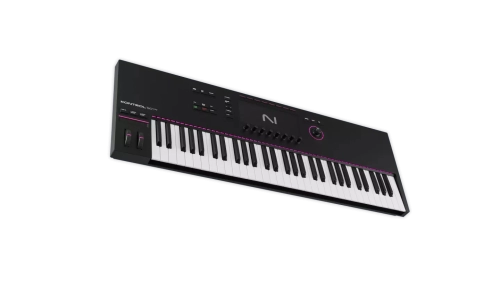
Native Instruments has made the most visible investment in accessibility among hardware-focused companies. The NI Accessibility Helper, now at version 2.0 (released August 2025), provides voice feedback for the Kontrol S-Series MK3 keyboard controllers and the Maschine production system. It describes physical buttons, encoders, and navigation elements via synthesized speech, includes a training mode that reads out controls without triggering their functions, and integrates with Logic Pro, Ableton Live, and experimentally with Reaper. Hardware synthesizer support is available via MIDI templates with spoken parameter descriptions. The Maschine 3.3.0 update improved integration with the accessibility app. The work is practically oriented: it targets the specific workflows that visually impaired producers actually use, rather than covering the interface uniformly at a surface level.
Ableton Live 12 took a different approach, investing in broad platform-level screen reader support with its 2024/2025 release cycle. Screen reader compatibility now covers VoiceOver on macOS, and NVDA, Narrator, and JAWS on Windows. An accessibility submenu adds speech controls for menu commands, slider ranges, and time display. High-contrast themes are included, and keyboard tab navigation works through most of the interface, with remaining gaps flagged for future releases. Known limitations include the Modulation Matrix in Wavetable, certain Operator parameters, and Max for Live, which remain unoptimized for screen readers. The scope of what has been addressed is significant for a product of Live's complexity.
Logic Pro is widely regarded by accessibility practitioners as the most fully accessible DAW currently available. All controls work with VoiceOver, Apple's standard macOS screen reader, and Logic's deep integration with macOS accessibility infrastructure gives it a structural advantage that cross-platform DAWs have to build from scratch. A small third-party ecosystem has also developed around Logic's accessibility: Logic Magician adds macros and scripts that extend native functionality and Keyboard Ninja key maps reduce the need for UI interaction in core workflows.
Arturia's path to accessibility has been slower and more openly acknowledged as difficult. Analog Lab includes accessibility improvements to its preset manager, with ongoing work across individual instruments. In published interviews, Arturia has been transparent that the hardest part of making their software accessible wasn't the programming: it was rethinking how the interface communicates with text-to-speech systems. Some components had to be approached from scratch. The practical cost of that gap was described concretely by Jason Dasent, a visually impaired music producer who had to hire a contractor for three days and spend between $500 and $1,000 just to convert Arturia Analog Lab presets into a format he could use. Arturia has acknowledged this directly and committed to iterative improvement based on direct user feedback.
iZotope has stated corporate-level commitment to WCAG 2.1 Level A and AA compliance and ADA standards, and partners with eSSENTIAL Accessibility. Product-level implementation varies. Certain plugins and installers still require mouse-only interaction in some workflows, and specific products have been flagged by users for screen reader issues. The policy is real; the implementation is still catching up.
The MIDI Association and Industry Coordination

 The MIDI Association's Music Accessibility Standard Special Interest Group (MASSIG) has been operating since at least 2024 as a forum connecting disabled musicians, accessibility researchers, educators, developers, and MIDI member companies. Its focus is deliberately practical: real-world workflows, hardware and software prototyping, and turning user experience feedback into input for technical standards development.
That work translated into a visible presence at three major conferences in the first half of 2026.
The 41st CSUN Assistive Technology Conference (March 9-13, 2026, Anaheim) is the largest assistive technology conference in the world. The MIDI Association attended and facilitated demonstrations of AptiPlay, UniMIDI Hub, and other music accessibility tools, a meaningful step into a space historically dominated by screen reader developers, mobility device manufacturers, and enterprise software teams.
ABLE Assembly 2026 (April 10-12, Berklee College of Music, Boston), hosted by the Berklee Institute for Accessible Arts Education, brought MIDI Association members together with music educators, disability advocates, and inclusive design practitioners. Sessions addressed adaptive instruments, neurodiverse learners, accessible music notation, assistive technology in educational settings, and the accessibility capabilities of MIDI 2.0, including MIDI-CI, Profiles, and Property Exchange.
The Music & Drama Education Expo (MDEE 2026) in the UK also featured MIDI Association member demonstrations of accessible tools in music education contexts.
Across all three, the same shift is apparent: accessibility in music technology is moving from isolated product decisions to a coordinated industry effort, with a standards body actively shaping what inclusive design looks like at the protocol level.
Andrii's story
At CSUN 2026, the MIDI Association shared the story of Andrii, a Ukrainian veteran wounded in combat approximately a year before the conference. He lost both arms and his sight.
Music had been central to his life before the war. When he understood the extent of his injuries, one of his first thoughts was that he might never play again. He began searching for solutions and eventually found MIDI technology, specifically a MIDI harmonica, that made it possible. As he described it, the instrument gave him "full full accessibility to any MIDI instrument." He plays music again.
His story, shared at CSUN and documented in a short video by the MIDI Association, is not a product story. It is a direct answer to the question of why any of this matters.
The MIDI Association's connection to Ukraine goes beyond Andrii. The organization has a member company based in Ukraine, and a Ukrainian refugee handles design work for their NAMM and Music China conference booths. The war has had a direct human presence within the MIDI community, which gives an additional dimension to the accessibility work being done at the intersection of MIDI technology and adaptive music-making.
YouTube.com/watch?v=vv1NV0gnq3A
What comes next
MIDI 2.0 is increasingly relevant to accessibility not just as a product feature but as a technical foundation. Where MIDI 1.0 sent a fixed stream of note and controller messages, MIDI 2.0's Capability Inquiry (MIDI-CI) and Profile protocols allow devices to negotiate and exchange configuration data dynamically, which means an adaptive controller like AptiPlay can communicate its specific input mapping directly to a DAW or instrument, rather than relying on static templates set up in advance. Property Exchange extends this further, enabling real-time parameter discovery and control. For accessible setups, this removes a significant layer of manual configuration that currently sits between an adaptive device and a usable musical performance. Expect more hardware designed around these capabilities as MIDI 2.0 adoption broadens.
Open-source development lowers the barrier for specialized accessibility solutions considerably. A music therapist or adaptive music educator who needs a specific controller configuration can now build from an existing open platform rather than commissioning custom hardware or making do with something designed for a different purpose.
The more persistent challenge is execution. The gap between stated commitment and in-product accessibility, visible in varying degrees across several major developers, requires sustained engineering investment and direct feedback loops with disabled users. The companies making the most tangible progress are the ones where accessibility is embedded in product development cycles, not appended at the end.
Where to go from here
For developers and plugin builders in the KVR community: MASSIG is an active forum with technical resources and direct user feedback from disabled musicians. Information and participation details are at midi.org.
For producers navigating the current landscape: the tools available in 2026 are materially better than they were two or three years ago. If you have specific accessibility needs, direct engagement with developers remains the fastest way to close remaining gaps. Most of the progress described above came from disabled users contacting teams directly and making the problem concrete.
Additional resources:
- Sound Without Sight — community and resource hub for blind and visually impaired musicians
- ABLE Assembly — annual conference on accessible arts education
- MIDI Association accessibility resources — MASSIG updates, event recaps, and product demonstrations
Sources: MIDI Association (midi.org), Native Instruments accessibility documentation, Ableton Live 12 accessibility manual, Engadget/Arturia accessibility interview, Sound Without Sight, EDM.com disability in music study, iZotope accessibility statement.

Discussion

Also to mention in this context is https://www.ableartist.org/. They address the problem, that accessibility is in most cases not primarily a technical question of good product design but a social and economic issue. Not one of the companies the article is referring to is on Able Artist Foundation's partner list. Partners are companies providing fundamental practical support by giving e.g. extra discounts for verified members of the network. audio modern, Caelum Audio, Focusrite, ujam among many others do and don't make much noise about it.
Please log in to join the discussion