



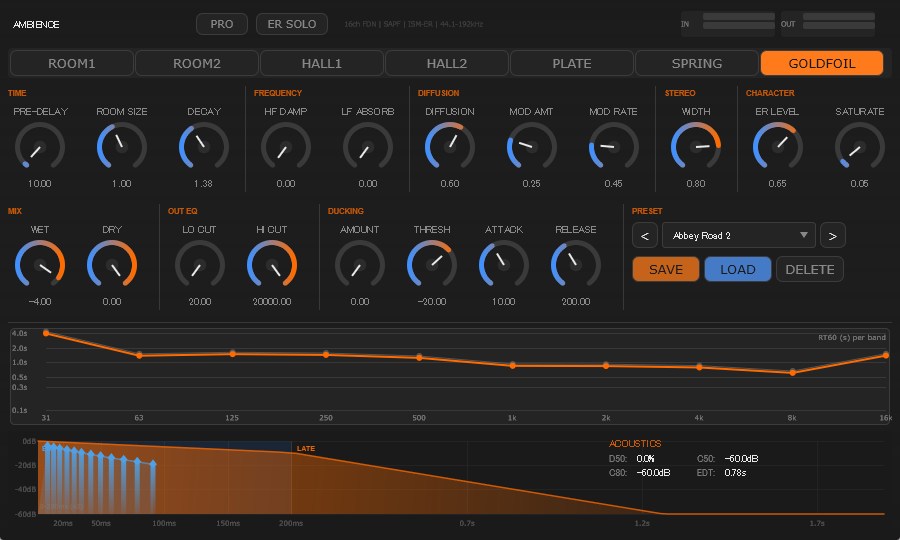
 Ambience is an algorithmic reverb VST3 built around a 16-channel Feedback Delay Network, released free and open-source under GPLv3 by OTODESK, the one-person project of developer Makoto Iida.
There is no convolution and there are no impulse responses anywhere in the signal path. The hall and studio presets are algorithmic approximations shaped by RT60 curves, early reflection patterns, and absorption models rather than sampled spaces.
The reverb core uses a Fast Walsh-Hadamard Transform feedback matrix across 16 delay lines, each tuned to a unique prime number distributed on a logarithmic scale. The coprime spacing is the mechanism for avoiding the comb-filtering that tends to give cheaper FDN designs a metallic character at small room sizes. Early reflections are handled separately, generated per algorithm using the Image Source Method with stereo imaging control, so the pre-echo can be soloed or balanced against the late field independently.
What sets Ambience apart from most free reverbs is the absorption stage. Each of the 16 FDN channels runs a 10-band graphic EQ cascade based on the Valimaki-Liski Weighted Least Squares method, which means RT60 can be targeted accurately on a per-band basis across the full audible spectrum. In practice that is the difference between a reverb that decays uniformly and one where the high end dies away faster than the low end, the way real rooms behave.
There are seven reverb algorithms (ROOM1, ROOM2, HALL1, HALL2, PLATE, SPRING, and GoldFOIL), each with its own topological routing and early-reflection patterns. The 21 factory presets are modeled on specific real-world spaces, including Abbey Road Studios 1 and 2, the Vienna Musikverein, Amsterdam Concertgebouw, Boston Symphony Hall, Carnegie Hall, EMT 140 plates, and various spring tanks.
The wet path also carries an ADAA (Anti-Derivative Anti-Aliasing) saturator with Warm, Tape, Tube, and Hard modes, plus Linkwitz-Riley output filtering, a brick-wall limiter at -0.5 dBFS, and sidechain-style ducking with independent threshold, attack, and release. Live readouts for D50, C50, C80, and EDT report acoustic metrics derived from real-time analysis. A Pro Mode panel exposes per-band RT60 multipliers from 31 Hz to 16 kHz, three Tilt EQ controls for low, mid, and high regions, and the saturation type selector.
The development story is worth noting. Iida says he is not a trained audio engineer and rebuilt the plugin from academic papers (the README cites Valimaki and Liski, Vicanek, Schlecht and Habets, and Parker et al.), using AI as a pair-programming and debugging partner for the C++ while making the DSP design decisions himself. Because the project is GPLv3, the full source is on GitHub for anyone to inspect, build, or fork.
One caveat worth flagging for anyone outside the Ableton camp: the plugin is compiled and optimized exclusively for Windows with AVX2, and OTODESK only verifies operation in Ableton Live 11 and 12. It includes specific hardening for Live, including a guard against Live's known sample-rate jitter behaviour. Other DAWs may work but are listed as unverified.
Key features
- 16-channel FDN reverb engine with FWHT feedback matrix and prime-tuned delay lines.
- 7 reverb algorithms: ROOM1, ROOM2, HALL1, HALL2, PLATE, SPRING, GoldFOIL.
- 10-band per-channel GEQ absorption (Valimaki-Liski) for frequency-dependent RT60.
- Image Source Method early reflections with stereo width and ER solo.
- ADAA saturator (Warm, Tape, Tube, Hard) plus internal loop micro-saturation.
- Real-time D50, C50, C80, and EDT acoustic readouts, RT60 and decay-curve visualizers.
- Pro Mode: 10-band RT60 multipliers (31 Hz to 16 kHz), Low/Mid/High Tilt EQ, saturation type.
- Output Lo/Hi Cut filtering, -0.5 dBFS brick-wall limiter, and ducking.
- 21 factory presets, file-based .ambpreset system for sharing.
Pricing & Availability
Ambience is free and open-source under GPLv3 for Windows 10 and 11 (64-bit) in VST3 and Standalone formats. It requires an AVX2-capable CPU. Tested in Ableton Live 11 and 12; macOS and AU are not supported.
