

First you quoted Sabatella as if the defintion somehow supported your idea that "swing is a simple technique and easy to learn". But you conveniently omitted the rest of Sabbatellas words about swing. I thought it was just fair to point that out and post some of it.nuffink wrote:What is your point?BosseJo wrote:Funny, you quoting Marc Sabatella...You forgot the important stuff though...nuffink wrote:From: Marc Sabatella
The most basic element of swing is the swing eighth note. In classical music, a set of eighth notes in 4/4 time are meant to take exactly one half of a beat each. This style is called straight eighth notes. Play a C major scale "C, D, E, F, G, A, B, C" in straight eighth notes. If you have a metronome, set it to 96 beats per minute. Those are quarter notes, "one, two, three, four". Subdivide this in your mind, "one and two and three and four and".
A common approximation to swing eighth notes uses triplets. The basic beats are be subdivided in your mind as "one-and-uh two-and-uh three-and-uh four-and-uh", and you play only on the beat and on the "uh". The first note of every beat will be twice as long as the second. This will sound like Morse Code dash-dot-dash-dot-dash-dot-dash-dot and is far too exaggerated for most jazz purposes. Somewhere in between straight eighth notes (1:1 ratio between first and second note) and triplets (2:1 ratio) lie true swing eighth notes. I cannot give an exact ratio, however, because it varies depending on the tempo and the style of the piece. In general, the faster the tempo, the straighter the eighth notes. Also, pre-bebop era players often use a more exaggerated swing than later performers, even at the same tempo. No matter what the ratio, the second "half" of each beat is usually accented, and beats two and four are usually accented as well. Again, the amount of accent depends on the player and the situation.
How is this hard to understand? Where's the mystery? Oh yeah, I know, it's no good because you didn't learn it from a ninja jazzist. By convection, presumably.
From the same page:
"There is also the issue of playing behind or ahead of the beat. When Dexter Gordon plays, even the notes that should fall on the beat are usually played a little bit late. This is often called laying back. It can lend a more relaxed feel to the music, whereas playing notes that should fall on the beat a little bit early can have the opposite effect. Bassists often play slightly ahead of the beat, particularly at faster tempos, to keep the music driving forward."
"Do not be fooled into thinking that swing is a universal constant."
"Learning to play natural sounding swing eighth notes is often the hardest part of learning to play jazz, since it can sound so bad until you can do it well."
"If you have been listening carefully to other musicians, you may be better at recognizing swing than at playing it."
"It has been said that if you cannot swing unaccompanied, you cannot swing. It is important to work on your own concept of swing in this way so that your perception of how you sound is not influenced by the sound of your accompanists."
"While being able to swing unaccompanied is important, it is not easy to do at first, and when developing your swing concept, it can also help to hear it occasionally in the context of a group performance."
I understand Ubiety. He thinks swing is something that you can't do until you've mastered it. I think it's a simple technique that you can learn (and hopefully go on to master).
What are you trying to say? Enlighten us.
Why does swing sound so "good" ?
-
- KVRian
- 593 posts since 18 Dec, 2005 from Sweden
-
- KVRAF
- 6519 posts since 13 Mar, 2002 from UK
I linked to the article. Why wouldn't I? There's nothing contrary in there.
And I'll ask again. I assert that swing is a simple technique that can be taught, Ubiety thinks it's something you can only get from spending decades in the Jazz Messengers.
Where do you stand?
And I'll ask again. I assert that swing is a simple technique that can be taught, Ubiety thinks it's something you can only get from spending decades in the Jazz Messengers.
Where do you stand?

Now with improved MIDI jitter!
-
- KVRAF
- 1534 posts since 18 Jan, 2005
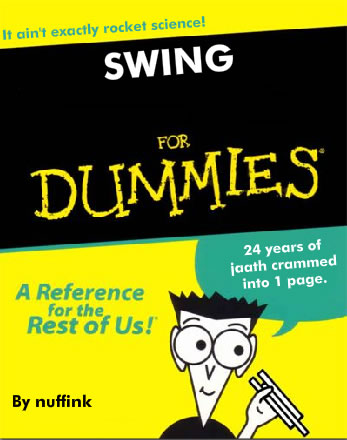
Publish your one paged book "Swing for Dummies" that reads, "Swing is delayed eighth notes." And be done with it. A Pulitzer is sure to follow.nuffink wrote:I linked to the article. Why wouldn't I? There's nothing contrary in there.
And I'll ask again. I assert that swing is a simple technique that can be taught, Ubiety thinks it's something you can only get from spending decades in the Jazz Messengers.
Where do you stand?
I ♥ Music.
-
- KVRAF
- 8389 posts since 11 Apr, 2003 from back on the hillside again - but now with a garden!
ahem, gentlemen.. I think maybe we need to agree to differ, let basic channel come back and say what he needs, then we can all just move on?
DSP
DSP

-
- KVRAF
- 6519 posts since 13 Mar, 2002 from UK
Why does it bother you so much?duncanparsons wrote:ahem, gentlemen.. I think maybe we need to agree to differ, and let basic channel come back and say what he needs, and we can all just move on?
DSP
Now with improved MIDI jitter!

-
- KVRAF
- 6519 posts since 13 Mar, 2002 from UK
Now with improved MIDI jitter!
-
- KVRAF
- 13442 posts since 14 Nov, 2000 from Hannover / Germany
And IMO you are both partially right.nuffink wrote:I assert that swing is a simple technique that can be taught, Ubiety thinks it's something you can only get from spending decades in the Jazz Messengers.
As said before, swing can be taught. Simple technique? By the principles behind it: yes. By the amount of time it takes to even remotely bring it to really good useage: no way.
So, Ubiety is more or less dead on that you can't learn how to swing without a *lot* of experience by playing with other folks. But having a more or less foolproof definition and/or analysis behind it, surely helps big time.
And herodotus: As far as notating even 8ths goes, it simply makes more sense. At higher tempi, things almost entirely lose any triplet feel. In addition, a lot of standards derive from originally evenly played tunes. And of course, 8th notes with a "swing" index allow for a greater amount of variation. Sometimes you swing more, sometimes less.
There are 3 kinds of people:
Those who can do maths and those who can't.
Those who can do maths and those who can't.
-
- KVRAF
- 13442 posts since 14 Nov, 2000 from Hannover / Germany
Excellentnuffink wrote:

Pic saved straight away.
There are 3 kinds of people:
Those who can do maths and those who can't.
Those who can do maths and those who can't.
-

- KVRAF
- 12615 posts since 7 Dec, 2004
- interestingly enough i think the "experienced musicians" here do not seem to ever think about what they're doing. do you guys not understand what i've written here and how it applies very broadly and accurately to all forms of rhythmic modulation?
are you willing to be technical at all, even a bit, or do you prefer just to play "monkey see monkey do", following other musicians as you've said? if you're not willing to be in the least bit technical, why are you having any discussion about this? nobody is interested in your "popes of swing" attitudes here except you yourselves.
nuffink is obviously, blatantly incorrect if he ever stated "the only definition of swing is an exact offset of odd eights". i do not see where he has stated this. he said exactly as i've said, that the common definition of swing is exactly that, and this is exactly true. the "offset" really depends upon the musician and the mood of the piece and so claiming it to be "exactly equal to x" is still completely incorrect, but overall what he stated - the common definition of swing being an offset of odd eights - is completely correct.
i'll be very happy if you can all stop flooding with useless shit and start to think of "swing" as "any patterned rhythmic modulation". that should satisfy everyone. you can if you like define "swing jazz swing" as some specific range of the superset "swing", but this does not mean that this more strict "swing jazz context" definition should be used in all places. the broader superset defined by "swing" as i've stated should be used in all places where the context has not been defined. only once the context is defined can you define the semantic value of "swing" more strictly.
the problem here is one of evolving semantics. the older "experienced musicians" have "swing" defined as "swing jazz swing" and in fact have very little or no experience with the modern definitions of "swing". this is an even stronger effect if they have learned this definition from an even older generation. i'm sorry about this guys, but evolution does not go backward. you are best to start using the term "jazz swing" or similar for what you're talking about. this is called "inclusive categorization" and is optimum. using the term "swing" as you wish it to be would be "exclusive categorization", and very impractical.
even if you want to keep your status as "pope of swing", being older you'll die while younger generations will continue to use the evolved definition. you're fighting an uphill battle, so just dont bother (tm).
http://en.wikipedia.org/wiki/Language_change
http://en.wikipedia.org/wiki/Semantics
are you willing to be technical at all, even a bit, or do you prefer just to play "monkey see monkey do", following other musicians as you've said? if you're not willing to be in the least bit technical, why are you having any discussion about this? nobody is interested in your "popes of swing" attitudes here except you yourselves.
nuffink is obviously, blatantly incorrect if he ever stated "the only definition of swing is an exact offset of odd eights". i do not see where he has stated this. he said exactly as i've said, that the common definition of swing is exactly that, and this is exactly true. the "offset" really depends upon the musician and the mood of the piece and so claiming it to be "exactly equal to x" is still completely incorrect, but overall what he stated - the common definition of swing being an offset of odd eights - is completely correct.
i'll be very happy if you can all stop flooding with useless shit and start to think of "swing" as "any patterned rhythmic modulation". that should satisfy everyone. you can if you like define "swing jazz swing" as some specific range of the superset "swing", but this does not mean that this more strict "swing jazz context" definition should be used in all places. the broader superset defined by "swing" as i've stated should be used in all places where the context has not been defined. only once the context is defined can you define the semantic value of "swing" more strictly.
the problem here is one of evolving semantics. the older "experienced musicians" have "swing" defined as "swing jazz swing" and in fact have very little or no experience with the modern definitions of "swing". this is an even stronger effect if they have learned this definition from an even older generation. i'm sorry about this guys, but evolution does not go backward. you are best to start using the term "jazz swing" or similar for what you're talking about. this is called "inclusive categorization" and is optimum. using the term "swing" as you wish it to be would be "exclusive categorization", and very impractical.
even if you want to keep your status as "pope of swing", being older you'll die while younger generations will continue to use the evolved definition. you're fighting an uphill battle, so just dont bother (tm).
http://en.wikipedia.org/wiki/Language_change
http://en.wikipedia.org/wiki/Semantics
Last edited by aciddose on Thu Apr 26, 2007 4:36 pm, edited 1 time in total.
-
- KVRAF
- 13442 posts since 14 Nov, 2000 from Hannover / Germany
Oh well, aciddose, I agree on almost everything you said - but: "jazz swing" isn't a part of any swing superset. The definiton of jazz swing covers *exactly* what swing is by technical means. If you start to delay other note values, if you start to apply "negative" swing (which is hardly ever happening), it's got nothing to do with swing at all anymore.
And yes, the term "swing" is an internationally accepted thing among musicians. Heck, even sequencers, synths and whatever follow the very term. When you apply swing to an arpeggiatior, the offbeat note values start getting delayed. That's all there is about swing from a technical point of view.
From a musical stylistic interpretion point of view, jazz swing is more complexed, as things such as phrasing come into play.
And yes, the term "swing" is an internationally accepted thing among musicians. Heck, even sequencers, synths and whatever follow the very term. When you apply swing to an arpeggiatior, the offbeat note values start getting delayed. That's all there is about swing from a technical point of view.
From a musical stylistic interpretion point of view, jazz swing is more complexed, as things such as phrasing come into play.
There are 3 kinds of people:
Those who can do maths and those who can't.
Those who can do maths and those who can't.
-
- KVRAF
- 1975 posts since 4 Feb, 2005
Swing is different in diff. genres, too. Swing in Rock and the blues is very different from swing in the bebop jazz sense.
In rock, is swing. There's a definite "triplet" quality to it, and in fact if you listen to the solo, or a solo from any other similarly styled song (anything by George Thorogood works nicely) you can hear that triplets are often employed in fast passages.
This is extremely DIFFERENT from a jazz swing (or shuffle, depending on your perspective I suppose), which comes out more like , and is far more ambiguous in its timing.
In rock, is swing. There's a definite "triplet" quality to it, and in fact if you listen to the solo, or a solo from any other similarly styled song (anything by George Thorogood works nicely) you can hear that triplets are often employed in fast passages.
This is extremely DIFFERENT from a jazz swing (or shuffle, depending on your perspective I suppose), which comes out more like , and is far more ambiguous in its timing.
Last edited by Toxikator on Thu Apr 26, 2007 4:52 pm, edited 3 times in total.

-
- KVRAF
- 12615 posts since 7 Dec, 2004
"If you start to delay other note values, if you start to apply 'negative' swing (which is hardly ever happening), it's got nothing to do with swing at all anymore."
this is probably the correct way to see things.. however we have a problem. there (is there?) is no single word which is defined as "rhythmic modulation". i guess generally "jazz swing" fits into two supersets, namely "rhythmic modulation" and "dynamic modulation". does anyone here want to include it as a member of "melodic modulation" as well?
anyway, these three sets are important things for musicians and composers to understand in great detail - so i'm extremely surprised i'm unaware of any names for them. i've never had any classical training in music, so i'm unsure if one of those damn latin terms used (eg legato) bears one or all of these meanings.
what this thread really needs is a technical discussion about these things. i'm using my own names for these sets of ideas because i've never learned any proper names for them. i do not assume there are no proper names - however i've been looking and i'm unable to find any. if anybody is willing to start discussing the multitude of possible variations in melody, dynamics and rhythm i think that would be very positive rather than the usual semantic engagements on kvr.
we could even add the results of our discussions to the kvr wiki.
http://en.wikipedia.org/wiki/Category:M ... erminology
this is probably the correct way to see things.. however we have a problem. there (is there?) is no single word which is defined as "rhythmic modulation". i guess generally "jazz swing" fits into two supersets, namely "rhythmic modulation" and "dynamic modulation". does anyone here want to include it as a member of "melodic modulation" as well?
anyway, these three sets are important things for musicians and composers to understand in great detail - so i'm extremely surprised i'm unaware of any names for them. i've never had any classical training in music, so i'm unsure if one of those damn latin terms used (eg legato) bears one or all of these meanings.
what this thread really needs is a technical discussion about these things. i'm using my own names for these sets of ideas because i've never learned any proper names for them. i do not assume there are no proper names - however i've been looking and i'm unable to find any. if anybody is willing to start discussing the multitude of possible variations in melody, dynamics and rhythm i think that would be very positive rather than the usual semantic engagements on kvr.
we could even add the results of our discussions to the kvr wiki.
http://en.wikipedia.org/wiki/Category:M ... erminology
-
- KVRAF
- 13442 posts since 14 Nov, 2000 from Hannover / Germany
Toxikator wrote: This is extremely DIFFERENT from a jazz swing (or shuffle, depending on your perspective I suppose), which comes out more like , and is far more ambiguous in its timing.

How is that ambiguous at all? It's faster, therefor the swing factor is lower. And that's about it.
And your "rock swing" example is using/showing *exactly* what's used in standard jazz swing. Really, not a single difference.
There are 3 kinds of people:
Those who can do maths and those who can't.
Those who can do maths and those who can't.
-
- KVRAF
- 1975 posts since 4 Feb, 2005
I guess just to say that when some people talk about swing, they're talking about that slower, "heavy" swing which is pretty metrically well-defined (to the point where fast passages will actually include the removed center triplet) while others may be referring to a faster "shuffle" swing and therefore wouldn't think it appropriate to talk about swing in such rigid terms...