

So what did BIAB have to say about this, bobsled?bobsled wrote:'preciate ya...runagate wrote:Brb w/corrected notes, edited back into the post above...

working on Latin
-

- KVRAF
- Topic Starter
- 10286 posts since 17 Sep, 2004 from Austin, TX
-

- KVRAF
- 26033 posts since 20 Oct, 2007 from gonesville
it seems obvious to me that runny prefers the color/timbre of one key to the othernuffink wrote:I can understand it sounding different over, say, a bassline which hasn't been transposed. But if everything's been transposed then the relationships will remain intact.runagate wrote:Nuffink, what you say makes sense to me logically, and certainly I played around with just moving it up 2 half steps in FL's piano roll.
But damn me if the cadence doesn't sound different. A lot different.
I'm hoping it's not just my overly finicky ear.
Maybe you prefer the timbre of the particular key you recorded it in.
why is it that C is supposed to be a challenge for the guitar player? even if he or she prefers the way an open string rings to a stopped one, and in some or most contexts needs to have open strings ringing, there is a device called a capo, which will preserve that (mostly, though C will have a C set of color/timbre, in relationships, and E will have its sets), in the case of C *as if E, per open strings*, sticking it on the'9th fret (they play an open position E, it sounds as a C). which even an ignorant rock guitar player usually unnerstans..
hey cj, I am open for bidness anytime you have a gittar=related theoretical provlem, just axe.

-
- KVRAF
- Topic Starter
- 10286 posts since 17 Sep, 2004 from Austin, TX
Well, of course I asked. And got corrected in about 30 seconds.
I was having a good old time making the cadence until I realized I uncharacteristically made it all in C. I didn't even ask the guitar player if he'd play it in C, I just switched it to E because, being in the very first stages of our collaboration there's no reason to make it harder than necessary. Besides, I'd want it in a lower C and not a higher C, so a capo wouldn't be any good. He wouldn't need a capo anyways; capos are for folk gimps who only know one strum pattern and don't know their chord fingerings. But being that, unbeknownst to me, 90% of my musical obsessions have surrounded this thing called "sound design" by synth people (I like fx more than synths - fx can make the original sound into what I need without worrying about what instrument the player is whacking on) I can't imagine just bumping it up almost an entire octave. Clearly, since even just different keys sound vastly different to me in equal temperament (when it comes to m7b5 chords, anyways, not with nice major chords) I don't have the kind of split-the-difference ear that guitar players have I'm a microtonal sort of person. If my cohorts and I hung out in real time instead of me composing at this evil little PC, it'd all work itself out much quicker I imagine. I should never, ever be a bandleader anyways, as I spin these ludicrous ideas around in my head all the time and make ludicrous noise. I have the opposite problem of most musicians that way. I make 1000 great sound parts and sonic ideas and transitions and all the goodies without being able to pare it down to something a civilian might actually sit still and listen to I could make 40 Latin jazz songs like this just today, but where would that get me? I've never been able to figure out what is up with guitar players (as opposed to my horn player attitude) trying for days on end to come up with 8 chords to string together and agonizing over the decision.
  I've had too much caffeine and I gotta make it home to compose for a while before something special happens tonight. My town, Saint Paul, Minnesota, U.S.A. declared it "Heiruspecs Day" in honor of that fine band's 10th year anniversary! I saw them play in their high school when they were little 16 year olds so I have to go
I was having a good old time making the cadence until I realized I uncharacteristically made it all in C. I didn't even ask the guitar player if he'd play it in C, I just switched it to E because, being in the very first stages of our collaboration there's no reason to make it harder than necessary. Besides, I'd want it in a lower C and not a higher C, so a capo wouldn't be any good. He wouldn't need a capo anyways; capos are for folk gimps who only know one strum pattern and don't know their chord fingerings. But being that, unbeknownst to me, 90% of my musical obsessions have surrounded this thing called "sound design" by synth people (I like fx more than synths - fx can make the original sound into what I need without worrying about what instrument the player is whacking on) I can't imagine just bumping it up almost an entire octave. Clearly, since even just different keys sound vastly different to me in equal temperament (when it comes to m7b5 chords, anyways, not with nice major chords) I don't have the kind of split-the-difference ear that guitar players have
I'm a microtonal sort of person. If my cohorts and I hung out in real time instead of me composing at this evil little PC, it'd all work itself out much quicker I imagine. I should never, ever be a bandleader anyways, as I spin these ludicrous ideas around in my head all the time and make ludicrous noise. I have the opposite problem of most musicians that way. I make 1000 great sound parts and sonic ideas and transitions and all the goodies without being able to pare it down to something a civilian might actually sit still and listen to I could make 40 Latin jazz songs like this just today, but where would that get me? I've never been able to figure out what is up with guitar players (as opposed to my horn player attitude) trying for days on end to come up with 8 chords to string together and agonizing over the decision. I've had too much caffeine and I gotta make it home to compose for a while before something special happens tonight. My town, Saint Paul, Minnesota, U.S.A. declared it "Heiruspecs Day" in honor of that fine band's 10th year anniversary! I saw them play in their high school when they were little 16 year olds so I have to go -
- KVRAF
- 26033 posts since 20 Oct, 2007 from gonesville
NB:
capos are for preserving open string/stopped string relationships, in chords, like I said
gimps use it out of laziness or inability, so what? Most chords can be transposed by an edumacated guitarist without using one, but that's neither here nor there; Hendrix used a standard tuning a lot, down a semitone, to have his cake and eat it too: open strings ringing as an acoustic phenomenon, and the BLUES KEY of Eb, which has its own color spectrum, acoustically.
my first guess, just by ear, was that you probably wanted the lower C on guitar, which may or may not be negated by the capo application; NB that a guitar sounds an octave lower than written.
here are the chord symbols for your thing:
F/C bass Dm7 Fm7b5
Em7 Ebm7b5
Dm7 Dbm7b5 Ab7 Fm7b5(b9)
Eb7#11 Fm7b5 Fm7b5(b9) Eb7b9(13)
a guitar player will find it necessary to re-voice the chords, and will likely prefer different inversions, which doesn't much matter unless it's a solo guitar and he/she needs to cover the bass function.
if I were a non-guitarist, my MO would've been, having decided for the compromise of key of E, to 'select all' in the key editor and hit the down arrow 8 times, or the up arrow 4 times.
BUT:
any jazz guitarist will be able to take the above symbols and make a part outta it.
and you must think guitarists are by definition a type of gimp;
there is no reason this type of chordism is any different in any key compared to any other, in terms of finding it on a guitar.
you assumed a guitar player hadda have 'E'; so you got 'dumb guitarist' answers like 'tune down to C' or 'stick a capo on there'.
capos are for preserving open string/stopped string relationships, in chords, like I said
gimps use it out of laziness or inability, so what? Most chords can be transposed by an edumacated guitarist without using one, but that's neither here nor there; Hendrix used a standard tuning a lot, down a semitone, to have his cake and eat it too: open strings ringing as an acoustic phenomenon, and the BLUES KEY of Eb, which has its own color spectrum, acoustically.
my first guess, just by ear, was that you probably wanted the lower C on guitar, which may or may not be negated by the capo application; NB that a guitar sounds an octave lower than written.
here are the chord symbols for your thing:
F/C bass Dm7 Fm7b5
Em7 Ebm7b5
Dm7 Dbm7b5 Ab7 Fm7b5(b9)
Eb7#11 Fm7b5 Fm7b5(b9) Eb7b9(13)
a guitar player will find it necessary to re-voice the chords, and will likely prefer different inversions, which doesn't much matter unless it's a solo guitar and he/she needs to cover the bass function.
if I were a non-guitarist, my MO would've been, having decided for the compromise of key of E, to 'select all' in the key editor and hit the down arrow 8 times, or the up arrow 4 times.
BUT:
any jazz guitarist will be able to take the above symbols and make a part outta it.
and you must think guitarists are by definition a type of gimp;
there is no reason this type of chordism is any different in any key compared to any other, in terms of finding it on a guitar.
you assumed a guitar player hadda have 'E'; so you got 'dumb guitarist' answers like 'tune down to C' or 'stick a capo on there'.
Last edited by jancivil on Sat Dec 22, 2007 7:42 pm, edited 2 times in total.
-
- KVRAF
- 2427 posts since 16 Jun, 2005 from Somewhere, NV
While it helps me make sense of conversations like this, it doesn't exactly sound runagate-ish.runagate wrote:So what did BIAB have to say about this, bobsled?bobsled wrote:'preciate ya...runagate wrote:Brb w/corrected notes, edited back into the post above...

-
- KVRAF
- Topic Starter
- 10286 posts since 17 Sep, 2004 from Austin, TX
Such things typically underlie the controlled chaos I normally present here in the Cafe.bobsled wrote: While it helps me make sense of conversations like this, it doesn't exactly sound runagate-ish.
@jan:

I tease my guitar-player friends a lot, but it's friendly teasing.
Because I posted in haste wondering wtf had happened to my progression instead of actually thinking about it it never occured to me to just detune it. Never a fun thing to do in a live situation, though, for a person with only one or two guitars. I actually did tell the guitar player "I understand you'll have to make inversions and such out of this" - I'm not a total newbie, I just carefully emulate one on days like yesterday.
I like your weird chord talk, jan
 My head is so packed full of jazz weirdness that it seems self-defeating to name all the chords such complicated things when they could live in one's ear happily as tones without names like the Tao which cannot be named. And yet I'm terribly fascinated by piles of arcane symbols (which I understand to a greater degree than I let on, though I'm not fluent - I could probably pick apart the sounds on a keyboard from those symbols in about 10 minutes per chord, and be about 40% correct lol).
Is that ignoring the simultaneous bass note relations? That F/C bass Dm thing looks suspiciously awkward but sounds consonant in the progression to my ear. I learned that nomenclature from BIAB on a friend's PC long, long ago oddly enough.jancivil wrote: here are the chord symbols for your thing:
F/C bass Dm7 Fm7b5
Em7 Ebm7b5
Dm7 Dbm7b5 Ab7 Fm7b5(b9)
Eb7#11 Fm7b5 Fm7b5(b9) Eb7b9(13)
In the notes/chords I posted, the bass and chords are essentially divvied up bar-by-bar, so one pile of bass notes per one chord per text line or somesuch.
I dunno - now I'm working on the tango-rhythm part, and hopefully it'll all sound nice together when I'm done and 4 other people get to play around with it outside the horrific robot-rhythms of melodic sketching in FL without being anal about syncopation which would make it all take forever.
-
- KVRAF
- 26033 posts since 20 Oct, 2007 from gonesville
there is a typo per the last chord, NB: it's a sharp nine (13).runagate wrote:
@jan:
I tease my guitar-player friends a lot, but it's friendly teasing.
Because I posted in haste wondering wtf had happened to my progression instead of actually thinking about it it never occured to me to just detune it. Never a fun thing to do in a live situation, though, for a person with only one or two guitars. I actually did tell the guitar player "I understand you'll have to make inversions and such out of this" - I'm not a total newbie, I just carefully emulate one on days like yesterday.
I like your weird chord talk, jan
Is that ignoring the simultaneous bass note relations? That F/C bass Dm thing looks suspiciously awkward but sounds consonant in the progression to my ear. I learned that nomenclature from BIAB on a friend's PC long, long ago oddly enough.jancivil wrote: here are the chord symbols for your thing:
F/C bass Dm7 Fm7b5
Em7 Ebm7b5
Dm7 Dbm7b5 Ab7 Fm7b5(b9)
Eb7#11 Fm7b5 Fm7b5(b9) Eb7#9(13)
In the notes/chords I posted, the bass and chords are essentially divvied up bar-by-bar, so one pile of bass notes per one chord per text line or somesuch.
I dunno - now I'm working on the tango-rhythm part, and hopefully it'll all sound nice together when I'm done and 4 other people get to play around with it outside the horrific robot-rhythms of melodic sketching in FL without being anal about syncopation which would make it all take forever.
all the chords are in 'root position' except for the first one, which is called 2nd inversion or a 6/4 chord in figured bass terms (a convention from like JS Bach days; an organist of classical training knows from those symbols like a jazzer knows from the ones I used above; the min7b5 is called a half-diminished seventh chord, IE., diminished triad with a minor 7th, in classical harmonic analysis)
just by ear, I think I'd lose the /C bass on the first F chord;
these type chords'd sound real good voiced in a sax choir
oddly conventional for you, contrasted with fairly characteristic runny bass
-
- KVRAF
- 26033 posts since 20 Oct, 2007 from gonesville
ALSO
per keys and color, this is a 'JAZZ' chord progression
the key winds up moving to Ab, which is relative to F (minor), and is the right kind of key for this exercise.
transposing it up two tones gives us E (then C) as a key, which might not be the right sort of color; if it continues to move around by major third relationships, it probably all comes out in the wash, but right now it's very 'key of C', which is close enough for jazz as they say in the trade, and 'key of E' is thought of as a hillbilly key (the ignint gittar factor) and has a distinct sound/color...
per your remark on weird chord nomenclature; these are chords derived from a convention called rhythm changes ({cycles of} ii-V implying I, after I Got Rhythm by the Gershwins), and is often more succinctly referred to by those symbols, which to its practitioners is more short-hand; the player hears that the fifth in the ii7 chords tends to be a flat 5, and a pianer player calls out stuff like 'rhythm changes in __'; 'goes to ___ here'; and the gist is easily gotten from your 'head'; you should be able to create a band arrangement without having to chart out every move for every member.
the chords I listed are common to chord charts, which even hillbillies like me get used to after a time.
see PM
per keys and color, this is a 'JAZZ' chord progression
the key winds up moving to Ab, which is relative to F (minor), and is the right kind of key for this exercise.
transposing it up two tones gives us E (then C) as a key, which might not be the right sort of color; if it continues to move around by major third relationships, it probably all comes out in the wash, but right now it's very 'key of C', which is close enough for jazz as they say in the trade, and 'key of E' is thought of as a hillbilly key (the ignint gittar factor) and has a distinct sound/color...
per your remark on weird chord nomenclature; these are chords derived from a convention called rhythm changes ({cycles of} ii-V implying I, after I Got Rhythm by the Gershwins), and is often more succinctly referred to by those symbols, which to its practitioners is more short-hand; the player hears that the fifth in the ii7 chords tends to be a flat 5, and a pianer player calls out stuff like 'rhythm changes in __'; 'goes to ___ here'; and the gist is easily gotten from your 'head'; you should be able to create a band arrangement without having to chart out every move for every member.
the chords I listed are common to chord charts, which even hillbillies like me get used to after a time.
see PM
-

- KVRAF
- 13140 posts since 7 May, 2006 from Southern California
You guys are nerds... and I love you.  I would be very interested to hear this with guitar on it. As it is, it sounds naked, but perhaps that is just because I'm anticipating it's potential.
Great work as always!
I would be very interested to hear this with guitar on it. As it is, it sounds naked, but perhaps that is just because I'm anticipating it's potential.Great work as always!
-
- KVRAF
- Topic Starter
- 10286 posts since 17 Sep, 2004 from Austin, TX
I should hope it sounds naked. It's just the skeleton of the bass and melody.justin3am wrote:You guys are nerds... and I love you.
Great work as always!
But useful to "paint" what the chord structure will be, even though the rhythms will be different. It's like your drums are before you 3am them. In this case they will be "made alive" by people, and not anally inched around with my mouse in 1/128th notes trying to achieve proper syncopation. Something that only live playing makes bearable still, though it's possible.
A lot of things I make are just showing off to pre-digital musicians what's possible in a DAW should one invest the ludicrous amount of time it takes to score it all.
Bower Pallid was to show acoustic guitar players that physical model guitar could trick their ear.
Grotta della Pace Discotheques shows off moused-in piano roll scoring that sounds like live improvising, but uses irrational rhtyhmic intervals that a human would be incredibly hard-pressed to play let alone score in sheet music.
But even I realize that only people can really play the parts I wish I could score quickly.
-
- KVRAF
- 26033 posts since 20 Oct, 2007 from gonesville
I saw about the last half of Pulp Fiction yesterday, the day before, donnorunagate wrote: He wouldn't need a capo anyways; capos are for folk gimps
Bring out the Gimp!
the ludicrous amount of time it takes to score it all.
Some perspective from the aged:
I always assume that any 'scoring' for any ensemble, real or otherwise
[(I am reminded of the opening line in a great speech I heard on 'Angel' this morning:
"you are all slaves to an insane construct"] is going to involve several choice forms of ludicrous behavior.
I have some experience trying to get a garage band aka chamber orchestra play 'actual' scores;
GINORMOUS pain-in-the-ass, and pretty time-intensive. And, it sure appears that to get anywhere in the vicinity of accurately hearing what one wrote is expensive as hell, also.
So, until the last year or so, with my DAW, I have had only the most half-baked notion of a result.
Now I have a fairly decent chance of hearing an orchestration, and it's down to my efforts. 100%.
I wouldn't have learned what I've learned about orchestration in the last six months by any means available to me any other way, including some alternate universe where I had actual money.
It's saved me decades of time, at least.
-
- KVRAF
- Topic Starter
- 10286 posts since 17 Sep, 2004 from Austin, TX
You're a fan of Zappa - the Shark permanantly cured me of wanting classical monkeys to play anything I write. What a pain, though nice if it's an option.jancivil wrote:I have some experience trying to get a garage band aka chamber orchestra play 'actual' scores;
GINORMOUS pain-in-the-ass, and pretty time-intensive. And, it sure appears that to get anywhere in the vicinity of accurately hearing what one wrote is expensive as hell, also.
So, until the last year or so, with my DAW, I have had only the most half-baked notion of a result.
Now I have a fairly decent chance of hearing an orchestration, and it's down to my efforts. 100%.
I wouldn't have learned what I've learned about orchestration in the last six months by any means available to me any other way, including some alternate universe where I had actual money.
It's saved me decades of time, at least.
Save decades of time? Quantum Leap Gold
Even film scorers just use DAWs most of the time now.
I am not trying to be provakative, it's just the reality of the situation.
If you were a Queen I'm sure you'd lovingly provide patronage for the poor, benighted philharmoniks. Realistically, a giant orchestra is no more pragmatic an emsemble than an accordion and theremin orchestra it was just on of those rare, beautiful accidents of history. I'll trade the power to create almost anything imaginable with DSP for just about any others to play a score of mine, simply because I barely have the heart to involve others in my madness.
I'd really like to hear what you've got dreamed up.
-
- KVRAF
- 26033 posts since 20 Oct, 2007 from gonesville
I would've seen Yellow Shark as encouraging, actually: the ensemble was in love with the music, paid their own travel expenses, and hung out in LA for a good minute (and is still devoted to the scores, transcribing synclavier-proprietary data to .mid and then to hard copy in dots and beams on staves) getting it right as possible. Going utterly against the grain of how's it's typically done.runagate wrote:You're a fan of Zappa - the Shark permanantly cured me of wanting classical monkeys to play anything I write. What a pain, though nice if it's an option.jancivil wrote:I have some experience trying to get a garage band aka chamber orchestra play 'actual' scores;
GINORMOUS pain-in-the-ass, and pretty time-intensive. And, it sure appears that to get anywhere in the vicinity of accurately hearing what one wrote is expensive as hell, also.
So, until the last year or so, with my DAW, I have had only the most half-baked notion of a result.
Now I have a fairly decent chance of hearing an orchestration, and it's down to my efforts. 100%.
I wouldn't have learned what I've learned about orchestration in the last six months by any means available to me any other way, including some alternate universe where I had actual money.
It's saved me decades of time, at least.
Save decades of time? Quantum Leap Gold
Even film scorers just use DAWs most of the time now.
I'd really like to hear what you've got dreamed up.
Yep, my whole approach to DAW is based on Zappa synclavier
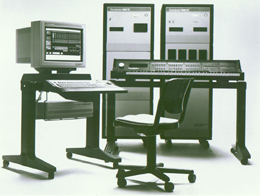
and Civilization Phaze III.
which reminds me: why is there no decent dedicated system for DAW (& don't point me to Receptor, it isn't one)? I have become about as acclimated to 43-ms latency as I care to. speaking of ludricous behaviors...
-
- KVRAF
- Topic Starter
- 10286 posts since 17 Sep, 2004 from Austin, TX
Well, there's the OpenLabs MiKo/NeKo, which is what I was going to buy until I realized that with my PC knowledge I could get a lot more, and better, stuff for the money. Which is why I worked like a deranged slave all summer to purchase gear which by KVRian standards is not even high-end but certainly represents the most money I've ever made and spent in my life.
Getting latency down would require a great CPU and more importantly an RME or MOTU or somesuch sound card. Mine is barely passable, but good enough considering.
As to syclavier to midi to score that's what's discouraging. It took forever, required willing participants to spend their own money, sounds like a damned nightmare.
A synclavier is not much of a machine compared to a DAW anymore.
I just talked to my guitar player compadre. He is having a little trouble finding reasonably playable voicings of a couple of these chords but is excited about the whole thing. Really great musicians who are creative and weird and experimental nevertheless never have too much of anything like this thrown at them once they are in the rock world. Especially indie rock I am having trouble conveying how simple learning the rhythms will be once we can play the tones we'll just knock it all out live but the harmonization is the hard part to communicate, and that the mp3s have essentially no relation to the rhythms that'll be emplyed. A weird paradigm shift in collaboration that I think eventually will far exceed the efficiency and creativity of any other way I've gone about it except improv jazzbos who can just magically do anything
Getting latency down would require a great CPU and more importantly an RME or MOTU or somesuch sound card. Mine is barely passable, but good enough considering.
As to syclavier to midi to score that's what's discouraging. It took forever, required willing participants to spend their own money, sounds like a damned nightmare.
A synclavier is not much of a machine compared to a DAW anymore.
I just talked to my guitar player compadre. He is having a little trouble finding reasonably playable voicings of a couple of these chords but is excited about the whole thing. Really great musicians who are creative and weird and experimental nevertheless never have too much of anything like this thrown at them once they are in the rock world. Especially indie rock
I am having trouble conveying how simple learning the rhythms will be once we can play the tones we'll just knock it all out live but the harmonization is the hard part to communicate, and that the mp3s have essentially no relation to the rhythms that'll be emplyed. A weird paradigm shift in collaboration that I think eventually will far exceed the efficiency and creativity of any other way I've gone about it except improv jazzbos who can just magically do anything -
- KVRAF
- 26033 posts since 20 Oct, 2007 from gonesville
is the Openlabs thing based on an OS that's designed to do nothing else? I have vaguely heard of it, but it seems like my initial look into it put me off by something, probably money. I'll Google. (gummint owes me some 35 grand); CPU is being eaten by background crap in any normal OS, which can be managed in OSX.3 very easily (more geek-intensive in later OSXs, and not manageable at all in Windows). as it stands, I work as if on a four-track with no degradation on overdubs;
render...
I woulda thought that other people willing to spend their own money doing my bidding was something other than a nightmare, but I'm royal like that. (basic tenet of Harvard MBA program: OTHER PEOPLE'S MONEY)
Assuming we are talking about the same chords as I gave to you in regular chord chart terms, I am somewhat mystified by any concern re: playability.
example given, the half-diminished chord (aka m7b5) is found on a guitar same as the rootless '9th chord' (dom 7th type, maj 9) [Fø]:
F, fourth string fret 3, index finger
Cb, third string fret 4, middle finger in a barre form
Eb, second string fret 4, middle finger in a barre form
Ab, first string fret 4, middle finger in a barre form
(or the 'third', ring finger as the barre if s/he's short)
alternate, non-barre fingering:
F, fifth string fret 8, index finger
Cb, fourth string fret 9, ring finger
Eb, third string fret 8, middle finger
Ab, second string fret 9, pinky finger
an abbreviated form of your final chord, a "Eb sharp nine":
G, fourth string fret 5, index finger
Db, third string fret 6, middle finger
F#, second string fret 7, ring finger;
incl. the root of that one:
Eb, fifth string fret 6, middle
G, fourth string fret 5, index
Db, third string fret 6, ring
F#, second string fret 7, pinky
all of which are known quantities, all over, in Nashville, TENN, btw
the last root position chord is the Foxey Lady chord, fyi. ('on E')
render...
I woulda thought that other people willing to spend their own money doing my bidding was something other than a nightmare, but I'm royal like that. (basic tenet of Harvard MBA program: OTHER PEOPLE'S MONEY)
Assuming we are talking about the same chords as I gave to you in regular chord chart terms, I am somewhat mystified by any concern re: playability.
example given, the half-diminished chord (aka m7b5) is found on a guitar same as the rootless '9th chord' (dom 7th type, maj 9) [Fø]:
F, fourth string fret 3, index finger
Cb, third string fret 4, middle finger in a barre form
Eb, second string fret 4, middle finger in a barre form
Ab, first string fret 4, middle finger in a barre form
(or the 'third', ring finger as the barre if s/he's short)
alternate, non-barre fingering:
F, fifth string fret 8, index finger
Cb, fourth string fret 9, ring finger
Eb, third string fret 8, middle finger
Ab, second string fret 9, pinky finger
an abbreviated form of your final chord, a "Eb sharp nine":
G, fourth string fret 5, index finger
Db, third string fret 6, middle finger
F#, second string fret 7, ring finger;
incl. the root of that one:
Eb, fifth string fret 6, middle
G, fourth string fret 5, index
Db, third string fret 6, ring
F#, second string fret 7, pinky
all of which are known quantities, all over, in Nashville, TENN, btw
the last root position chord is the Foxey Lady chord, fyi. ('on E')