

Ok I'm using roman numerals for writing down chords for playing songs live (such as I-V-IV-I, etc).
I have a little confusion to clear up before I proceed to use this system forever.
If I'm in C#min, "I" implies C#min, and "III" implies E Major, correct? In general, whatever scale you are in, you just do 1,2,3,4,5,etc. according to the notes in that scale, right?
For example, I understand that in C major, I-IV-VIb would be C,F,Ab Maj.
In a minor do I follow the same system? Cminor : I-IV-VIb would be Cmin, Fmin, Ab Maj? Correct??
Need help expressing chords in romans (nashville system)
-
- KVRAF
- 4340 posts since 8 Mar, 2005
-
- KVRAF
- 42529 posts since 21 Dec, 2005
my pain pills from surgery today are keeping me from explaining (plus it's been over a decade since I've used the NNS) but to quote from my old book....
"However, in Nashville, most of the time, for a song in a minor key, the chordchart will be written as if in the relative major key. Even if Aminor is the actual tonic, or "I" major chord, the chart is written as if in the key of C major. In which case the A minor chord is written as the 6 minor. It is therefore important to know how to find the relative major of a minor key.
I'll be happy to try and help with any questions, but mind you, I'll have to quote the book since I'm totally out of touch with the system (for me things are not like riding a bike, it's use it or loose it!)
"However, in Nashville, most of the time, for a song in a minor key, the chordchart will be written as if in the relative major key. Even if Aminor is the actual tonic, or "I" major chord, the chart is written as if in the key of C major. In which case the A minor chord is written as the 6 minor. It is therefore important to know how to find the relative major of a minor key.
I'll be happy to try and help with any questions, but mind you, I'll have to quote the book since I'm totally out of touch with the system (for me things are not like riding a bike, it's use it or loose it!)
-
- KVRAF
- Topic Starter
- 4340 posts since 8 Mar, 2005
Thanks..that's a bummer about the relative minor system. Once I start playing the song in C#min, my brain becomes fixed on thinking of C#min as "I". Its quite cumbersome to think of C#min as "VIm" when I'm sitting on the root chord like a cow.
Here's my version of the chord system that seems to work for me (and maybe others?) :
1).Take any scale- major or minor and I is the root chord (A major vs. A minor is represented as "I" vs. "Im").
2).Any chords relative to the root chord are represented in intervals - II,III,IV,V, etc. just like regular system. For a major scale, there's no problem. For minors, pretend to use only the natural minor. Why? The intervals are the same as for its relative major scale, so its easy to visualize chords relative to the root note.
3). Example (for a song in C#minor) : "C#min - E maj - A maj - B maj" written as "Im - III, VI, VII".
You can put a "M" if you want for major, or ignore it.
4). Use sharps and flats to denote chords whose root note doesn't fall in the original scale. Exm : F natural is not present in C#minor, so use III#m to denote F minor. Happens rarely, so don't worry about it.
And we have the plethora of dim, aug, 7, 9, 13, symbols to throw about if necessary.
Hopefully this helps someone else out too..And i'm writing this so that if i forget, I can search this thread and see what I did.

Here's my version of the chord system that seems to work for me (and maybe others?) :
1).Take any scale- major or minor and I is the root chord (A major vs. A minor is represented as "I" vs. "Im").
2).Any chords relative to the root chord are represented in intervals - II,III,IV,V, etc. just like regular system. For a major scale, there's no problem. For minors, pretend to use only the natural minor. Why? The intervals are the same as for its relative major scale, so its easy to visualize chords relative to the root note.
3). Example (for a song in C#minor) : "C#min - E maj - A maj - B maj" written as "Im - III, VI, VII".
You can put a "M" if you want for major, or ignore it.
4). Use sharps and flats to denote chords whose root note doesn't fall in the original scale. Exm : F natural is not present in C#minor, so use III#m to denote F minor. Happens rarely, so don't worry about it.
And we have the plethora of dim, aug, 7, 9, 13, symbols to throw about if necessary.
Hopefully this helps someone else out too..And i'm writing this so that if i forget, I can search this thread and see what I did.
-
- KVRAF
- 6519 posts since 13 Mar, 2002 from UK
The Nashville system is a simplified version of standard Roman notation. Unless you plan on making purely diatonic music with country musicians I'd give it a miss.keyman_sam wrote:Ok I'm using roman numerals for writing down chords for playing songs live (such as I-V-IV-I, etc).
I have a little confusion to clear up before I proceed to use this system forever.
If I'm in C#min, "I" implies C#min, and "III" implies E Major, correct? In general, whatever scale you are in, you just do 1,2,3,4,5,etc. according to the notes in that scale, right?
For example, I understand that in C major, I-IV-VIb would be C,F,Ab Maj.
In a minor do I follow the same system? Cminor : I-IV-VIb would be Cmin, Fmin, Ab Maj? Correct??
Standard Roman notation relates everything to a parallel major scale.
The notes of the major scale are therefore I,II,III,IV,V,VI,VII
The notes of the natural minor are I,II,bIII,IV,V,bVI,bVII
That's pretty much it, but there are a lot of quirks.
Chords with minor thirds are often notated in lower case, so the triads of the major scale are often notated - I,ii,iii,IV,V,vi,vii
Similarly for the natural minor - i,ii,bIII,iv,v,bVI,bVII but you'll notice, capitalised or not, the Roman numeral is still the same and it's still taken from the parallel major scale.
It's the same with the makeup of chords...
Major chord - I,III,V.
Minor chord I,bIII,V.
Minor 7th chord I,bIII,V,bVII
7 chord I,III,V,bVII
...always referred back to the parallel major scale.
oopses in yellow
Last edited by nuffink on Wed Aug 06, 2008 2:37 pm, edited 1 time in total.

Now with improved MIDI jitter!
-
- KVRist
- 179 posts since 11 Feb, 2008
My first question is, why - are you changing keys a lot? I started to do something similar but realized along the way that it would be very doubtful we'd ever change the key of any of the songs, so I just went with letter names - C7, F, etc.Ok I'm using roman numerals for writing down chords for playing songs live (such as I-V-IV-I, etc).
If I'm in C#min, "I" implies C#min, and "III" implies E Major, correct?
Not necessarily. There are a bunch of systems in use. In one, people use upper case for Major, and lower case for minor. In C#m, it would be:
i and III.
Another system uses all upper case, and assumes you know the quality of the chord:
I and III
Yet another system uses all upper case, but adds a lower case m for minor chords:
Im and III
Of these, for reading off music during a performance, the last is the clearest, so I'd use that. In the first, you have the issue of people mistaking upper case for lower case (especially for V) and in the second, you have to be confident everyone knows their keys. This makes the last one "safest" but again, using letters is safer yet.
bVI, not VIb, is more common.For example, I understand that in C major, I-IV-VIb would be C,F,Ab Maj.
This is a dangerous practice to get into.In a minor do I follow the same system? Cminor : I-IV-VIb would be Cmin, Fmin, Ab Maj? Correct??
Here are the chords in Major and minor:
I ii iii IV V vi viio
i iio III iv V (v) VI viio (VII)
Here are the chords in "old style" all upper case:
I II III IV V VI VII
I II III IV V VI VII
See the problem?
Here are the chords "Berklee Style"
I IIm IIIm IV V VIm VIIo
Im IIo III IVm V (Vm) VI VIIo (VII)
Generally speaking, you only put a modifier (m or M) or accidental (b, #) if the chord is different than what it would be diatonically (I'm only giving the 1st and 3rd method, as the 2nd makes no distinction)
In C Major:
Cm = i,Im
AbM = bVI, bVIM
In C minor:
C = I, IM
Gm = v, Vm
I prefer the upper case/lower case Roman Numeral system because it carries the most information in a single symbol - "bII" means a Major Chord built on lowered scale degree 2. "IV" is major, no matter what the key, and "iv" is minor, no matter what the key. But again, for reading during a performance, this system carries the danger of confusing upper case and lower case, especially if it's hand written.
There is one other system that people use both with Arabic and Roman numerals, though Arabic is more common. In this system, everything is related to X Major, period.
Thus an AbM chord is called "b" VI no matter whether the key is C Major or C minor.
C = 1, I
em = 3, IIIm
Eb = b3, bIII
etc.
Usually the use of Roman Numerals is because people are trying to make it seem "more academic" or "more legitmate". So I would seriously consider if you need to use Roman Numerals at all.
Outside of Nashville, NNS was rarely used at all - the only time it gained any popularity was because of the internet, and then its subsequent inclusion in programs like Finale and Sibelius. By far, the most common way to write out charts is to put the chord name - Cm, D7, F#m. You play the chord - doesn't matter what the key is.
Roman Numerals, for playing from, is virtually non-existent in my experience. It is only since people have started trying to make their music "more legit" that they started using them thinking it makes them seem like they know what they're doing. More often then not though, it becomes painfully obvious that the person does not know what they're doing, and furthermore, the music can't be played from without spending 20 minutes deciphering symbols.
Furthermore, you can't show inversions with Roman Numerals (or NNS) easily, unless you know that your readers know the system.
Will someone understand what bIII6/4 means?
But if you put Eb/Bb, they'll know exactly what it means (or, I should say, more players will be more familiar with that, than any other system other than notes).
So I would seriously consider if you even need to be using numerals rather than letters in the first place.
If you are going to be changing keys a lot, then most decent players would be able to do this by sight anyway. If they are good enough to read numerals on the fly, they're probably good enough to transpose by sight. This means, the numerals are again pointless.
OK, HTH,
Steve
-
- KVRAF
- 6519 posts since 13 Mar, 2002 from UK
That's not correct. The scale degrees should be referred back to the parallel major scale.llatham wrote:Here are the chords in Major and minor:
I ii iii IV V vi viio
i iio III iv V (v) VI viio (VII)
Here are the chords in "old style" all upper case:
I II III IV V VI VII
I II III IV V VI VII
See the problem?
Here are the chords "Berklee Style"
I IIm IIIm IV V VIm VIIo
Im IIo III IVm V (Vm) VI VIIo (VII)
Now with improved MIDI jitter!
-
- KVRist
- 179 posts since 11 Feb, 2008
Maybe you did not read clearly:nuffink wrote:
That's not correct. The scale degrees should be referred back to the parallel major scale.
There are at least 5 systems in use. None of them are "correct" as there has been no international committee established that has agreed on any one specific version.
Schoenberg and Piston use all upper case (the "old" system - I, I)
Kostka/Payne and Gualdin use upper and lower (I, i)
I understand from others the Berklee and things like Delamont use the "I, Im" system.
Nashville numbering is yet another system.
The "parallel" system is yet another.
Steve
-
- KVRAF
- 4908 posts since 10 Aug, 2004 from Colorado Springs
OK, not being a theorist, but I want to weigh in anyways...
Someone mentioned above in the thread that NNS isn't used outside of Nashville.
Sez who?
I'm in Michigan and when I write out chord charts for others in the bands I play in, it's always NNS with the original intended key written at the top of the page.
Most of the time, we'll play in that key, but now and then the singer(s) have a cold, or we want to experiment in a different key - no problem, just change the root.
This does have an expectation that everyone knows their scales.
-Scott
Someone mentioned above in the thread that NNS isn't used outside of Nashville.
Sez who?
I'm in Michigan and when I write out chord charts for others in the bands I play in, it's always NNS with the original intended key written at the top of the page.
Most of the time, we'll play in that key, but now and then the singer(s) have a cold, or we want to experiment in a different key - no problem, just change the root.
This does have an expectation that everyone knows their scales.
-Scott

-
- KVRAF
- 6519 posts since 13 Mar, 2002 from UK
To the op.
The reason that you refer the scale degree back to the parallel major is in order to gain not just key independence but scale independence.
Here are a couple of pics from Dolmetsch...
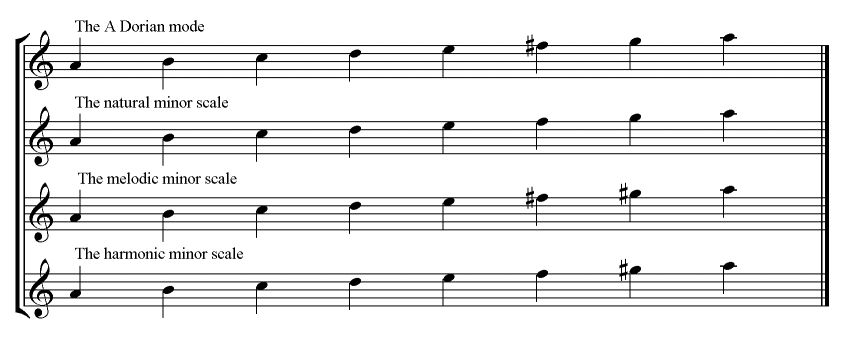
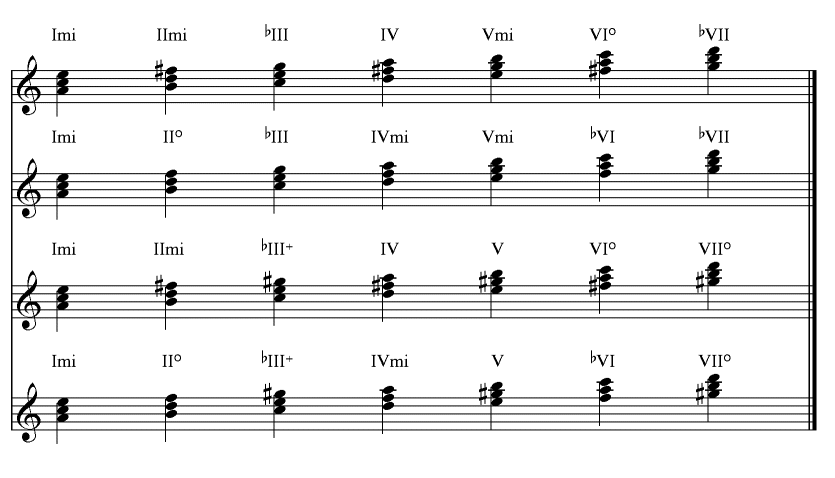
You'll notice that natural minor is spelled with bIII, bVI, bVII i.e. it is referred back to it's parallel major. If it weren't it would be spelled Imi, IIo, III, IVmi, Vmi, VI, VII.
If you want to spell these scales without referring them back to the parallel major you have to indicate in advance which flavour of minor scale you're using. The scale degrees may be key independent but they are not scale independent.
This becomes even more of a problem when dealing with scales having other than 7 notes.
The whole-half diminshed scale is I, II, bIII, IV, bV, bVI, VI, VII.
The wholetone is I, II, III, bV, bVI, bVII
It's not easy to see how either can be convincingly spelled at all without reference to the parallel major.
The reason that you refer the scale degree back to the parallel major is in order to gain not just key independence but scale independence.
Here are a couple of pics from Dolmetsch...
You'll notice that natural minor is spelled with bIII, bVI, bVII i.e. it is referred back to it's parallel major. If it weren't it would be spelled Imi, IIo, III, IVmi, Vmi, VI, VII.
If you want to spell these scales without referring them back to the parallel major you have to indicate in advance which flavour of minor scale you're using. The scale degrees may be key independent but they are not scale independent.
This becomes even more of a problem when dealing with scales having other than 7 notes.
The whole-half diminshed scale is I, II, bIII, IV, bV, bVI, VI, VII.
The wholetone is I, II, III, bV, bVI, bVII
It's not easy to see how either can be convincingly spelled at all without reference to the parallel major.
Now with improved MIDI jitter!
-
- KVRian
- 859 posts since 14 Sep, 2004
I don't play in studios, but the way I've seen it done that is most clear for everyone is to always use either lower-case for minor chords or to put a lower-case "m" next to the chord number.
I would never, never use un-appended upper-case letters for a minor chord and assume that all of the players would understand that it was minor because of the key. In this system, if you wanted to use a major chord where a minor chord might be expected (on a III chord, say), how would you indicate that you instead wanted a major III chord for a rock song?
In any case, I've seen the system that you describe used, but using either lower case letters or a lower case "m" for minor chords creates absolute clarity, and will be understood by anyone who is accustomed to the other system.
I would never, never use un-appended upper-case letters for a minor chord and assume that all of the players would understand that it was minor because of the key. In this system, if you wanted to use a major chord where a minor chord might be expected (on a III chord, say), how would you indicate that you instead wanted a major III chord for a rock song?
In any case, I've seen the system that you describe used, but using either lower case letters or a lower case "m" for minor chords creates absolute clarity, and will be understood by anyone who is accustomed to the other system.
-
- KVRAF
- 6519 posts since 13 Mar, 2002 from UK
Absolutely. I'm sorry if I gave the impression that chord types were optional. If you're describing a chord then the scale degree alone won't do it.
Now with improved MIDI jitter!