

I was curious about the definition of music theory that people find most useful. This is sort of an extension of the discussion of "is theory useful to you," which was degenerating somewhat based on contradictory definitions of what constitutes theory. The discussion got me to wondering when people say they like or dislike theory, it seems they are mostly describing very different things.
I imagine there are many properties that "music theory" could have, many traditions of music theory around the world, and traditions that completely reject abstract theory (which is, in a way, a theoretical position). There are probably areas of asking questions about music that are more or less within theory.
Okay, that's probably enough pomo rambling, I just am mostly wondering how other people think of what does or does not constitute "music theory." If this conversation has happened before, please let me know.
definition of music theory
-
- KVRAF
- 1585 posts since 13 Nov, 2005 from St. Paul
-
- KVRian
- 1084 posts since 12 Sep, 2008 from Your basement
I looked it up ol' "I made it up" apedia.org and it mentioned something about "the techniques of composition" but in doing so, fails to make the distrinction between theorical and applied princicples. 
I'll answer OPs question in the reverse.
Theory does NOT depict how music is created. If you don't believe me, test it out. Use the most elaborate Schenkerian analysis (or any other method) and give the analysis to someone and tell them to use this to create something like the original (re-synthesis).
What are the chances you are going to get Haydn back?
I'll answer OPs question in the reverse.
Theory does NOT depict how music is created. If you don't believe me, test it out. Use the most elaborate Schenkerian analysis (or any other method) and give the analysis to someone and tell them to use this to create something like the original (re-synthesis).
What are the chances you are going to get Haydn back?
-
- KVRAF
- Topic Starter
- 1585 posts since 13 Nov, 2005 from St. Paul
This raises a meta-question: Is what you just said a theory about music? If so, it is "music theory" in the sense that it's an empirical proposition that could be tested, or is not music theory because it undermines the usefulness of Theory as traditionally received?Ogg Vorbis wrote:Theory does NOT depict how music is created. If you don't believe me, test it out. Use the most elaborate Schenkerian analysis (or any other method) and give the analysis to someone and tell them to use this to create something like the original (re-synthesis).
If theory is rational, logical planning out of a composition it seems more like a second part of the process of writing, if it's going to be part of the process at all. So your real Haydn would sit down at the harpsichord with an intuitive melody in his head and pluck out the basic song form from his head, then experiment with different chords underneath that melody (using his inner ear and his knowledge of what is "supposed to come next" and violating those rules whenever he thinks that's the best way to work) until his judgment arrived at a piece that he'd like and Jan would hate.
But I was also wondering how many other theories there are, like the theory of how to make rock music based on the accepted principles of verse-chorus-verse, 4/4 time, and some of the stock chord progressions and phrase lengths.
Or the variety of formal Asian theories, of which I'm familiar with only a few and those I only know in passing--I know there's Hindustani systems for understanding music, the Carnatic system, Gamelan, Chinese melody, the Persian academic tradition, there must be others.
-

- addled muppet weed
- 111257 posts since 26 Jan, 2003 from through the looking glass
regarding comments from the other thread...
if, as we all seemed to agree in the other thread, music theory IS NOT a set of rules about how it should be done, then why did my music teacher tell me "you cant do that"? back when i was at school?
if, as we all seemed to agree in the other thread, music theory IS NOT a set of rules about how it should be done, then why did my music teacher tell me "you cant do that"? back when i was at school?

-

- KVRAF
- 26033 posts since 20 Oct, 2007 from gonesville
You studied with Nuffink?
Btw, I like Ravel's Menuet sur le nom de Haydn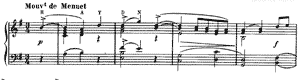
I did know know this til now: Ravel based this minuet on the notes B, A, D, D and G as the musical equivalents of Haydn's name. The motif is presented in mirror inversion, retrograde, transposition, and other variations appearing 11 times throughout in an amazingly short space of time.
actually I still DON'T know that; but someone does say this is so. Also, y = d, and n = g, apparently. Which I also didn't know.
it SOUNDS terrific.
Webern sounds pretty good sometimes too, go figure.
Btw, I like Ravel's Menuet sur le nom de Haydn
I did know know this til now: Ravel based this minuet on the notes B, A, D, D and G as the musical equivalents of Haydn's name. The motif is presented in mirror inversion, retrograde, transposition, and other variations appearing 11 times throughout in an amazingly short space of time.
actually I still DON'T know that; but someone does say this is so. Also, y = d, and n = g, apparently. Which I also didn't know.
it SOUNDS terrific.
Webern sounds pretty good sometimes too, go figure.
Last edited by jancivil on Sat Dec 13, 2008 12:44 am, edited 1 time in total.
-
- addled muppet weed
- 111257 posts since 26 Jan, 2003 from through the looking glass
the theory being wrong is not equal to working outside theory being wrong.jancivil wrote:You studied with Nuffink?
-
- KVRAF
- 26033 posts since 20 Oct, 2007 from gonesville
what theory is wrong? I was just riffing on "can't do that". It's true, it's best to fry or roast a bunny than to boil it. It gets gamey if you over boil.
If a theory is wrong, what's "working inside" it good for?
If a theory is wrong, what's "working inside" it good for?
-
- KVRAF
- Topic Starter
- 1585 posts since 13 Nov, 2005 from St. Paul
Sounds like you had a bad teacher.vurt wrote:if, as we all seemed to agree in the other thread, music theory IS NOT a set of rules about how it should be done, then why did my music teacher tell me "you cant do that"? back when i was at school?
Maybe this has everything to do with why some people think theory is cool and other people hate it. My music theory teachers always introduced it like it was a new crayon in the box, like a springboard for exploration. A typical lesson for me was along the lines of, "here's the whole tone scale--play around with that for a while and see what you come up with, then mix it together with some of those other scales you learned."
I still am certain that one can make excellent music with no conscious or formal knowledge of theory. I've known quite a few excellent players who couldn't read a note and had to really really think about it to tell you what notes they were playing. But they usually had very strong opinions on what sounded good to them and they were also fond of taking ideas from records as springboards for exploration.
-
- KVRian
- 1084 posts since 12 Sep, 2008 from Your basement
Suddenly, I'm not smart enough to participate in this thread. But I will say that you've made some assumptions about the compositional process (that is, the application of theory) which I think could be challenged.jmeier wrote: This raises a meta-question: Is what you just said a theory about music? If so, it is "music theory" in the sense that it's an empirical proposition that could be tested, or is not music theory because it undermines the usefulness of Theory as traditionally received?
Herr Haydn didn't study Rameau like you did. He studied counterpoint. Therefore I think if we are to make assumptions about how composers plied their wares, we should at least get the theory that THEY learned.
The other thing I still challenge is that ANY theory can be applied to the compositional process.
It's like a Kurt Goerdle kind of theorum of music which states: "Any theory of music proposed is a analytical tool and is therefore reductive in nature thus rendering it permanently incapable of producing what it describes."
With regard to re-animating Haydn's corpse, I think THAT would be awesome. He could open for Rob Zombie.

-
- KVRAF
- 26033 posts since 20 Oct, 2007 from gonesville
there is a person who 'plays' guitar and 'sings' at the Downtown BART station here, pretty sure she be zombified, and... she NOT AWESOME.
Did composers study Rameau style counterpoint along with the then oh-so-modern Baroque style, at the end of the 18th century or not?
what is this 'the compositional process' you speak of? does it speak of my process, yours, or some theoretical notion of such???
Did composers study Rameau style counterpoint along with the then oh-so-modern Baroque style, at the end of the 18th century or not?
what is this 'the compositional process' you speak of? does it speak of my process, yours, or some theoretical notion of such???
-
- addled muppet weed
- 111257 posts since 26 Jan, 2003 from through the looking glass
im not saying any theory is wrong, just iirc you and nuff where arguing over something you typed and he said you where incorrect.jancivil wrote:what theory is wrong? I was just riffing on "can't do that". It's true, it's best to fry or roast a bunny than to boil it. It gets gamey if you over boil.
If a theory is wrong, what's "working inside" it good for?
if youre gonna eat rabbt, make sure you eat a varied diet and not just rabbit.
-
- addled muppet weed
- 111257 posts since 26 Jan, 2003 from through the looking glass
believe me, ive eaten more rabbits than most other people have had shits.jancivil wrote:you should check out what I typed. it tastes great.
quite regularly a few dead rabbits curing in our shed as i was growing up.
sadly it has very little nutritional value beyond protein, you can read up on trappers dieing when all they had to do was thrw in a few bits of veg.
-
- addled muppet weed
- 111257 posts since 26 Jan, 2003 from through the looking glass
in only my music teacher had been the worst.jmeier wrote:Sounds like you had a bad teacher.vurt wrote:if, as we all seemed to agree in the other thread, music theory IS NOT a set of rules about how it should be done, then why did my music teacher tell me "you cant do that"? back when i was at school?
but yes, i would agree that your first introduction to anything is what forms your opinion of it for the future. a big part of the problem was(i see now) a very limited field of musical listening experience on her part. my aunties n uncles where all arty farty n traveller types, much of the music i heard while young was often non western in origin, lots of aboriginal musics from around the world, alongside lots of hippy psyche stuff from one uncle, hardcore punk from another and my hatred of elvis from another (he was an irish elvis impersonator, do you know what its like growing up with an uncle who is recognised as an elvis impersonator
 )
)where as on her part, very conservatove middle england tastes (dire straits n other "edgy" pop rock nonsence) which didnt go over well with my i suppose desire to recreate what i was hearing.