

yah
the way the fretboard is laid out forces certain chord structures, but as long as the notes are there it tends to work out
and that is why the guitar tends to have an open sound
those chords that have the notes right up against each other, CEG DFA, are called block chords. That's usually what everyone learns first on piano because it's easiest conceptually. Block chords or closed voicings are useful in horn arrangements.
Most keyboard players learn more open chord patterns similar to the more open voicing on guitar -- there's a host of useful patterns with root 7 in the left hand and 3 5 in the right and things like drop 2 voicings.
Conveniently enough the patterns work out for some nice voice leading and typically alternate the 3 and 7 position in common chord progressions.
On fretboards, what I've noticed is getting from one chord to another when there are alternate routes has a lot to do with how well a song holds together with its voice leading. Some progressions really work and 'sing' by resolving in pleasant ways, but a different choice of chord shapes and positions can break the internals of a progression.
Guitar scales and speed - How fast?
-
- KVRAF
- 2217 posts since 15 Jul, 2003
-
- KVRAF
- 2448 posts since 12 Sep, 2004
I meant to respond to your previous post, but haven't been available... It sounds like you're on the right track. Understanding triads is a critical part of basic theory, but as you've found out for yourself, when talking about guitar chord voicings you need to deal with the bigger picture of chord tones relative to a single scale position on the fretboard. To get the big picture you need to be able to see scales shapes in all positions... Once you get a firm handle on the scales you will see that the chord shapes repeat themselves all over the fretboard, as it sounds like you've already started to discover.rbarata wrote:Since no one replied anymore, I had to look elsewhere.
In the case of C major and D minor open chords, for example, you could condsider both chords to be played as a subset of the notes of a C major scale in that position. The "position" of the scale depends on the type of scales you're playing... the traditional 5-position major scales would be here:
http://www.yellowguitarbooks.com/fretbo ... 0Scale.pdf
Look at the 3rd position, and notice that it is exactly the same scale shape as you would play the C major scale in the "open" position of the fretboard.
BTW, Those 5 positions are related to something called the "CAGED" method, which is worth googling.
The other common scale types are called "3 note per string" scales:
http://www.guitarmasterclass.net/guitar ... opic=16647
With those scale shapes you end up with 7 positions... this is a convenient way to look at scales, IMO, because the 7 shapes map directly to the 7 modes -- Ionian, Dorian, etc. In the case of 3 note per string scales, the C major scale in the "open" position would be the position 3 scale shape out of the 7 3NPS scale shapes. In fact, position 3 from the 3-note-per-string looks similar to position 3 of the standard 5-position scales.
Also, I think that by spending time with the 3-note-per-string scales it's easier to start to pick out the repeating patterns that occur over the neck. Check out the guitarmasterclass.com page above and study the 7 3NPS scale shapes... you should start seeing patterns... for example, C D E F G A on strings 6/5 in pattern #1 repeat on string 4/3 in pattern #2, and also on strings 2/1 in pattern #3.
With the 3NPS scale shapes, pattern #1 happens to be the shape of an Ionian mode scale, pattern #2 is Dorian, etc.
Regarding your previous post... the reason the C major note sequence is different from the D minor note sequence, and also the reason why some strings are played and some aren't is because for those two chords you're playing different chord tones from the same major scale position, and the chord tone fingerings/sequences just happen to fall where they fall because of the scale position. If you were to play C major scale in some other position, and you figured out where the D minor chord tones were you would find chord shapes repeating in different parts of the fretboard... the reason is because scale shapes repeat over the fretboard.
For example, taking the open D minor chord shape for a second... you have D A D F. If you move up to the 10th fret and put your index finger across the 10th fret (this is a "barre"), then use ring on 5th string 12th fret and pinky on 4th string 12th fret, then strings 6,5,4,3 also give you D A D F. In fact, it's the same exact chord as the open D minor chord (same octave), only difference is that the note relationships look a bit different because the interval from G string (3) to B string (2) is a 3rd, as opposed to a 4th for all other string relationships. If you played all 6 strings, all of those notes would make up a D minor barre chord, and that particular barre chord shape is derived from the open E (minor) chord shape.
Next barre the 5th fret, and finger ring on 4th string 7th fret, pinky on 3rd string 7th fret, middle on 2nd string 6th fret... string 5,4,3,2 give you the same D A D F sequence and octave as the open D minor. Strings 1-5 for that chord give you a barre chord based on the open A (minor) chord shape.
Note that you could also play barre chords based on the open D chord, open G, etc. Your index finger is acting as the nut with a barre chord. stretching to barre a G chord shape might be a bit much for some.

-
PurpleCatfishBettie PurpleCatfishBettie https://www.kvraudio.com/forum/memberlist.php?mode=viewprofile&u=211816
- KVRAF
- 3278 posts since 22 Jul, 2009
If you're playing fast and make a mistake, whatever you do; don't stop picking. Just keep playing and try to get back in sync with the fretting hand at some point.
As a bonus, all kinds of unexpected but cool stuff can happen when you play through mistakes in this fashion. For example, sometimes when the fingering is off, some interesting, percussive stuff happens.
Some players will claim that you have to play perfectly clean in order for it to be worth anything. I do occasionaly enjoy listening to such players (Steve Vai), but don't at all agree with that sentiment.
Players like Jimi Hendrix and Jimi Page have made recordings which contain passages; passages which are examples of 'inexactitude' translating into sheer beauty.
In any event, you can get to the place where you don't make any noticeable mistakes, or learn to play through them instead.
As far as all of these people telling you which scales are what; just whing it.
I learned 'pentatonics' through a Michael Bloomfield book, and honed diatonic scales through college classical theory courses. To this day, there are difficulties in having scale/chordal discussions with other musicians, particularly of the jazz variety. They have a different nomenclature. Just so you understand what you're doing is the main thing; then there's the musical conversation ('jam sessions'). The ability to have a spoken conversation regarding scales/chords is a distant 3rd in importance.
You find something you like, then try to figure out the theoretical explanation; there will probably be at least 5 different explanations of what the musician is doing.
Oh, as for playing fast; also try the 'upstroke only' thing; in addition to the 'downstroke only' thing.
Whatever you're doing at a given moment, keep the pick as close to the string as possible. Keep the fingers as close to the fretboard as possible. Try to have as little wasted motion as possible.
Oh, work on both triplets, and quads for starters.
Figure out if the pinky on your fretting hand is fairly useless, or if it's integral to your playing. Michael Schenker never uses the pinky from what I can tell. A lot of players don't need to use their pinky much, because their fingers are so long that they can fake it, using the pinky only when absolutely necessary.
My thing is 12 notes per second; 16th notes at 180bpm. It's not at all totally clean, but it sure is fun. There definitely are faster/cleaner players. I play across multiple strings simultaneously that way, so there are a lot of notes flying all over the place.
As a bonus, all kinds of unexpected but cool stuff can happen when you play through mistakes in this fashion. For example, sometimes when the fingering is off, some interesting, percussive stuff happens.
Some players will claim that you have to play perfectly clean in order for it to be worth anything. I do occasionaly enjoy listening to such players (Steve Vai), but don't at all agree with that sentiment.
Players like Jimi Hendrix and Jimi Page have made recordings which contain passages; passages which are examples of 'inexactitude' translating into sheer beauty.
In any event, you can get to the place where you don't make any noticeable mistakes, or learn to play through them instead.
As far as all of these people telling you which scales are what; just whing it.
I learned 'pentatonics' through a Michael Bloomfield book, and honed diatonic scales through college classical theory courses. To this day, there are difficulties in having scale/chordal discussions with other musicians, particularly of the jazz variety. They have a different nomenclature. Just so you understand what you're doing is the main thing; then there's the musical conversation ('jam sessions'). The ability to have a spoken conversation regarding scales/chords is a distant 3rd in importance.
You find something you like, then try to figure out the theoretical explanation; there will probably be at least 5 different explanations of what the musician is doing.
Oh, as for playing fast; also try the 'upstroke only' thing; in addition to the 'downstroke only' thing.
Whatever you're doing at a given moment, keep the pick as close to the string as possible. Keep the fingers as close to the fretboard as possible. Try to have as little wasted motion as possible.
Oh, work on both triplets, and quads for starters.
Figure out if the pinky on your fretting hand is fairly useless, or if it's integral to your playing. Michael Schenker never uses the pinky from what I can tell. A lot of players don't need to use their pinky much, because their fingers are so long that they can fake it, using the pinky only when absolutely necessary.
My thing is 12 notes per second; 16th notes at 180bpm. It's not at all totally clean, but it sure is fun. There definitely are faster/cleaner players. I play across multiple strings simultaneously that way, so there are a lot of notes flying all over the place.
-
PurpleCatfishBettie PurpleCatfishBettie https://www.kvraudio.com/forum/memberlist.php?mode=viewprofile&u=211816
- KVRAF
- 3278 posts since 22 Jul, 2009
-
- KVRist
- Topic Starter
- 467 posts since 6 Feb, 2005 from Portugal
I know what you mean....I thinkyah
the way the fretboard is laid out forces certain chord structures, but as long as the notes are there it tends to work out
and that is why the guitar tends to have an open sound
those chords that have the notes right up against each other, CEG DFA, are called block chords. That's usually what everyone learns first on piano because it's easiest conceptually. Block chords or closed voicings are useful in horn arrangements.
Most keyboard players learn more open chord patterns similar to the more open voicing on guitar -- there's a host of useful patterns with root 7 in the left hand and 3 5 in the right and things like drop 2 voicings.
Conveniently enough the patterns work out for some nice voice leading and typically alternate the 3 and 7 position in common chord progressions.
On fretboards, what I've noticed is getting from one chord to another when there are alternate routes has a lot to do with how well a song holds together with its voice leading. Some progressions really work and 'sing' by resolving in pleasant ways, but a different choice of chord shapes and positions can break the internals of a progression.
There's a substancial difference in applying block chords in a song and arppegios. At least to me, it's easier to use block chords than arppegios because in arppegios might happen that some notes of the chord doesn't fit (or are enharmonic regarding the song tone at the time) in the song.
No problem, thanks for replying.I meant to respond to your previous post, but haven't been available...

I will do the following exercise which I think will be really useful: to find and play in the guitar all chords (triads and seventh chords=quads???) for the C Major scale and find their quality ( major, minor, augmented and diminished) for each one. This would be great to "stuck" all these concepts in my mind.It sounds like you're on the right track. Understanding triads is a critical part of basic theory, but as you've found out for yourself, when talking about guitar chord voicings you need to deal with the bigger picture of chord tones relative to a single scale position on the fretboard. To get the big picture you need to be able to see scales shapes in all positions... Once you get a firm handle on the scales you will see that the chord shapes repeat themselves all over the fretboard, as it sounds like you've already started to discover.
I'm will make the above-mentioned exercise in all scale modes of C major. I got a book called "The gig book of scales" which was sugested here. It's a great book that covers all modes).In the case of C major and D minor open chords, for example, you could condsider both chords to be played as a subset of the notes of a C major scale in that position. The "position" of the scale depends on the type of scales you're playing...
I already took a look at the CAGED system...unfortunately it is present in a way that I simply don't understand...I cannot see any patterns. But I always tend to find my own methods so I think it won't be a problem.
Thanks for the great reply. There's a lot of information in there.
When I'm trainning scales I start very slowly and then increase the speed (12 notes per second it's too much for me, stillOh, as for playing fast; also try the 'upstroke only' thing; in addition to the 'downstroke only' thing.
Whatever you're doing at a given moment, keep the pick as close to the string as possible. Keep the fingers as close to the fretboard as possible. Try to have as little wasted motion as possible.
Oh, work on both triplets, and quads for starters.
Figure out if the pinky on your fretting hand is fairly useless, or if it's integral to your playing. Michael Schenker never uses the pinky from what I can tell. A lot of players don't need to use their pinky much, because their fingers are so long that they can fake it, using the pinky only when absolutely necessary.
).I play the scale starting from the 6th string and then from the 1st without stopping, like a loop.
I use the pick in a up and down motion because at a certain point I can't play faster if I use only one type of movement.
About the pinky (the finger
), I never used it before but I think it's useful to "economize" your movements over the fretboard. If you are able to use it you can play a lot of notes almost without moving your hand.Thanks a lot for the replies.
-
generalstargazer generalstargazer https://www.kvraudio.com/forum/memberlist.php?mode=viewprofile&u=221391
- Banned
- 598 posts since 10 Dec, 2009
You can play 12 notes per second? You do know that's extremely fast right?rbarata wrote:When I'm trainning scales I start very slowly and then increase the speed (12 notes per second it's too much for me, still
I play the scale starting from the 6th string and then from the 1st without stopping, like a loop.
I use the pick in a up and down motion because at a certain point I can't play faster if I use only one type of movement.
About the pinky (the finger
Thanks a lot for the replies.
-
generalstargazer generalstargazer https://www.kvraudio.com/forum/memberlist.php?mode=viewprofile&u=221391
- Banned
- 598 posts since 10 Dec, 2009
this is 12 notes per second: http://video.google.com/videoplay?docid ... erson+wim#
most people play between 6-10 notes per second
most people play between 6-10 notes per second
-
- KVRAF
- 2448 posts since 12 Sep, 2004
That's why you should start with 3-note-per-string scales first, and come back to CAGED later when you can already see the whole fretboard...rbarata wrote: I already took a look at the CAGED system...unfortunately it is present in a way that I simply don't understand...I cannot see any patterns.
In case you misunderstood my post, there are two primary scale methods: CAGED (5-position) and 3-note-per-string (7 positions). Start with 3NPS.
-
- KVRist
- Topic Starter
- 467 posts since 6 Feb, 2005 from Portugal
Can you elaborate?In case you misunderstood my post, there are two primary scale methods: CAGED (5-position) and 3-note-per-string (7 positions). Start with 3NPS.
I'm learning the C major scale this way:
6th string: 8,10 frets
5th string: 7,8,10 frets
4th string: 7,9,10 frets
3rd string: 7,9,10 frets
2nd string: 8,10 frets
1st string: 7,8frets
I can play it also starting on the 6th string by the 8th, 10th and 12th frets.
Both ways have 3 or two notes per string, depending on the string-
Probably you're refering to the last one.
-
- KVRAF
- 2448 posts since 12 Sep, 2004
You're using one of the traditional 5-position scale patterns... If you look at the PDF in my first link (http://www.yellowguitarbooks.com/fretbo ... 0Scale.pdf) you'll see that you're playing effectively scale pattern #1, minus a couple of notes...rbarata wrote:Can you elaborate?In case you misunderstood my post, there are two primary scale methods: CAGED (5-position) and 3-note-per-string (7 positions). Start with 3NPS.
I'm learning the C major scale this way:
6th string: 8,10 frets
5th string: 7,8,10 frets
4th string: 7,9,10 frets
3rd string: 7,9,10 frets
2nd string: 8,10 frets
1st string: 7,8frets
I can play it also starting on the 6th string by the 8th, 10th and 12th frets.
Both ways have 3 or two notes per string, depending on the string-
Probably you're refering to the last one.
Here's the shape you're playing:

while pattern #1 in the linked PDF is the same shapes as yours but adds a "B" note before the lowest C, and a D just after the highest C. Do you se how those are the same scale shapes?
BTW, the pattern you're playing as well as the pattern #1 from the PDF are the same as the "E form" scale pattern in CAGED parlance. Look here: http://www.cyberfret.com/scales/major-caged/index.php -- do you see how the "E form" scale shape is the same as the pattern #1 shape from the PDF which in turn is the same shape you're playing for C major (minus two notes in your case)? Note that the scale diagrams from the CAGED scale page are rotated 90 degrees, so strign 6 is on the left and string 1 on the right.
Take another look at the 5 scale patterns in the PDF... as with your C major scale you'll notice that all of those scale shapes are collections of two- and three-note sequences across the strings.
In contrast, take a look at the 3-note-per-string link that I provided (http://www.guitarmasterclass.net/guitar ... opic=16647)...
Instead of 5 scale shapes/positions there are 7, and each scale shape/position uses 3 notes on each string, as opposed to sometimes 2 and sometimes 3 as with the other scales. Here's your C major scale using the 1st of 7 3NPS scales:

Notice how all strings have 3 notes. If you dig deeper into the 3NPS scales you'll start to see some patterns emerging... e.g., this repeating C D E F G A box shape was what I was referring to in my previous post:
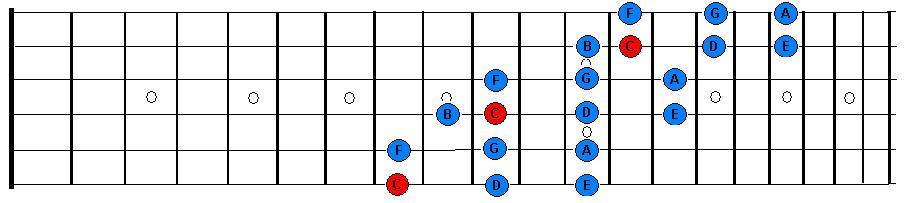
Read through the guitarmasterclass.net article on 3NPS scales when you get a chance, he breaks it all down in terms of how the scales are structured...
-

- KVRAF
- 1724 posts since 31 Dec, 2004 from betwixt
3NPS does really seem conducive to speed. Directional/economy picking fits very well into it. In several areas of the "traditional" two-octave position playing there is "wasted motion" - at least for me.
Speed isn't everything though. I used to be addicted to trying to play fast, and kept failing. It hasn't been until recently that I forced myself to play slowly, accurately, and to release the tension that was everywhere; that speed has started to come naturally.
Slow practice: thoroughly recommended.
Speed isn't everything though. I used to be addicted to trying to play fast, and kept failing. It hasn't been until recently that I forced myself to play slowly, accurately, and to release the tension that was everywhere; that speed has started to come naturally.
Slow practice: thoroughly recommended.
-
- KVRAF
- 2448 posts since 12 Sep, 2004
I'm not advocating 3NPS for speed necessarily, only that, in my opinion, as a whole it gives you a better "systematic" birds-eye view of the fretboard, especially when jumping to thinking in modes later on. The traditional scales are so burdensome if it's the first thing you're looking at when first starting out trying to grasp the fretboard... they seem like notes just plopped down randomly that happen to fit within scales. Again, just my opinion. They critical thing is seeing the whole fretboard, then you can play as fast or as slow as you damn well please, as far as I'm concerned. 

But yeah, alot of speed/sweep/legato type riffs use 3NPS type layouts...
Again, just my opinion. They critical thing is seeing the whole fretboard, then you can play as fast or as slow as you damn well please, as far as I'm concerned. But yeah, alot of speed/sweep/legato type riffs use 3NPS type layouts...
-
- KVRist
- 93 posts since 3 Apr, 2007
Since you said you're a newbie, here's something I wish I had known when I was starting out. We've all heard the old addage 'practice makes perfect.' It's a damn lie. Practice makes permanent, perfect practice makes perfect. Some people have a tendency to let the details slip and only focus on speed, or whatever it is they're trying to improve at the time. You should always make sure you have good form, and every note is fluid and musical even(or especially) when doing scales/drills. Trust me, unlearning bad habits is not fun.
-
generalstargazer generalstargazer https://www.kvraudio.com/forum/memberlist.php?mode=viewprofile&u=221391
- Banned
- 598 posts since 10 Dec, 2009
guys don't you think practicing scales is a bit boring? I usually just practice soloing with them over chord progressions