Guitar scales and speed - How fast?

Chords, scales, harmony, melody, etc.
RELATED
PRODUCTS

Post

Many thanks for your replies.

I need to take a closer look to the CAGED system. I can't see most of the pictures you've posted (I'm at work now) but an idea came to my mind.
To see the "E form" scale pattern in CAGED system, shall I look at the fretboard as if it was in a vertical position? :shock:

In the meanwhile I have another doubt....

As I told before, I've been trainning the C major scale this way:

6th string: 8,10 frets
5th string: 7,8,10 frets
4th string: 7,9,10 frets
3rd string: 7,9,10 frets
2nd string: 8,10 frets
1st string: 7,8frets

but I will start with a new C major type, like this:

6th string - 10 12 13
5th string - 10 12 14
4th string - 10 12 14
3rd string - 10 12
2nd string - 10 12 13
1st string - 10

Basically this scale is halftone higher than the previous.
My doubt is why is this different?
My assumption is that while it covers the same notes, it's first and last note is different to fit in a different chord progression.
We may have two songs with root key equal to C but in the between their chord progression can be different.
Am I thinking correctly?
Or is there another reason?

Post

The thing with guitar is you can play the same scale in many places, often only affecting the range of one or two notes. It's good to learn the same scales in as many positions as you can so you are free to move around the fretboard any way you wish. You can also play the C scale starting form the third fret on the A string, and you'd be playing the same note as the 8th fret on the E string.

As far as handling different progressions, it doesn't matter what position you start on, what matters is that you would concentrate on the tones in each chord as you play over them. So, if you have a progression that is C major, G major, F major, you might play CEG over the first chord, GDB over the next, and FAC over the F. You can, of course, mix in other notes from the C scale over each chord as well, but you would want to focus on the notes of each chord as the foundation of your melodies to begin with, then mix in other notes as you become familiar with what they do to the melody - some will add tension, some will make it darker, some work well when played quickly and not lingered on, etc....

Post

The scales are the same (consist of the same note) but the position is different. I see no correllation with chords / progressions. Some melodies will be easier to play in some position than another. That's all there is to it: more ways to skin a cat. You may use both in different situations.
My MusicCalc is temporary offline.
We are the KVR collective. Resistance is futile. You will be assimilated. :borg:

Post

So, it means learning different types of scales (C major type 1, C major type 2, etc) it's a good way to learn where the notes are along the fretboard.
I know the principle behid it from the years when I used to play the guitar (from a fun point of view, of course). At that time I've learned where the different notes are on the 6th string...but on the rest of them, I never learned it. Now it's the time. :)

Post

rbarata wrote:I need to take a closer look to the CAGED system.
Personally I would start with 3-note-per-string scales (7 positions), then come back to CAGED (5 positions) later. The important thing to know about CAGED for the time being is that there are 5 positions, but I think those 5 scale positions are a more difficult way to look at the fretboard when starting out.
To see the "E form" scale pattern in CAGED system, shall I look at the fretboard as if it was in a vertical position? :shock:
Yes, as I mentioned the scale diagrams on the cyberfret.com page are rotated 90 degrees compared to the first diagram I posted...

With this diagram string #6 is on the bottom and string #1 on the top:
Image
(http://davidcherubim.net/images/major-scale.gif)

The following is the same scale diagram but rotated -- string #6 is on the left and string #1 is on the right:
Image
(http://www.cyberfret.com/scales/major-caged/index.php)

Just be careful about that when reading stuff on the 'net... It can be a little confusing at first.
In the meanwhile I have another doubt....
[...]
but I will start with a new C major type, like this:

6th string - 10 12 13
5th string - 10 12 14
4th string - 10 12 14
3rd string - 10 12
2nd string - 10 12 13
1st string - 10

Basically this scale is halftone higher than the previous.
My doubt is why is this different?
My assumption is that while it covers the same notes, it's first and last note is different to fit in a different chord progression.
We may have two songs with root key equal to C but in the between their chord progression can be different.
Am I thinking correctly?
Or is there another reason?
You are playing the same notes as in C major, but you're actually playing D Dorian (minor) there... that is, if you were to emphasize the root notes as follows:

6th string - 10 .. ..
5th string - .. .. ..
4th string - .. 12 ..
3rd string - .. ..
2nd string - .. .. ..
1st string - 10

Each of those is the note D. C major is C D E F G A B C ... while D Dorian is D E F G A B C D ... same notes, but different tonal center (if you intend it to be), and therefore different scale. Technically D Dorian is a mode of C major. So you unwittingly played your first modal scale, which is not such a big deal if you consider that modes are just related scales (even though you think of them as their own scale types).

Go back to 6th string 8th fret (which is C), and play this sequence instead:

6th string - 8 10 12
5th string - 8 10 12
4th string - 9 10 12
3rd string - 9 10 12
2nd string - 10 12 13
1st string - 10 12 13

The above sequence is C major using 3-notes-per-string.

Now play this sequence, similar to what you did previously:

6th string - 10 12 13
5th string - 10 12 14
4th string - 10 12 14
3rd string - 10 12 14
2nd string - 12 13 15
1st string - 12 13 15

The above is either D Dorian minor or C major, depending on context (tonal emphasis)... they happen to be the same notes since D Dorian is a mode of C major.

Post

'12 notes per second'... 180 bpm = 3 beats per second, split into quadruplets (16th notes) = 12 notes per second.

An example of this kind of speed is at the 4:52 mark of this song:

http://www.4shared.com/file/198124914/c ... urf-2.html

the run at 4:51 or thereabouts probably fluctuates between slightly 'under' and 'over' 12 per second...

if a player were to do triplets at 180bpm, it would be 9 notes per second... an example of such a 'triplet run' is found at approx 0:53...

edit: in the 'quad run' at 4:50ish, there are intentional 'two string chords' or 'double notes' being hit in spots... sometimes it's 3 notes... in spots, the pick is crossing 2 and 3 strings per pass...

Post

Just be careful about that when reading stuff on the 'net... It can be a little confusing at first.
I know what you mean. From all the sites I tried to understand the CAGED system, any of them said that you should look at the fretboard at the vertical. No wonder I could never find it. :shock:
You are playing the same notes as in C major, but you're actually playing D Dorian (minor) there... that is, if you were to emphasize the root notes as follows:

6th string - 10 .. ..
5th string - .. .. ..
4th string - .. 12 ..
3rd string - .. ..
2nd string - .. .. ..
1st string - 10

Each of those is the note D. C major is C D E F G A B C ... while D Dorian is D E F G A B C D ... same notes, but different tonal center (if you intend it to be), and therefore
different scale. Technically D Dorian is a mode of C major. So you unwittingly played your first modal scale, which is not such a big deal if you consider that modes
are just related scales (even though you think of them as their own scale types).
Yeah, the notes are the same, just like all the other examples you posted. The only difference, like you said, is the tonal center. This tonal center and what you called as tonal emphasis (that depends on the context) it's what I was trying to say previously when I mentioned the chord progressions.
If you have a certain chord progression, the scale that you would use on top of it (as the basis for a melody or a solo) should be harmonically connected to these chords in each moment.
By other hand, higher pitches of a scale can give you different emotions than if you played it in a lower pitch...it all depends on the context (the chord progression).

I really don't know if this makes any sense but it's hard to explain. :)

Post

rbarata wrote:If you have a certain chord progression, the scale that you would use on top of it (as the basis for a melody or a solo) should be harmonically connected to these chords in each moment.
Generally speaking, yes. In practice it's not quite as black and white as "playing notes from scale X, then playing notes from scale Y" etc. A good example is the use of pentatonics and blues notes/scales, which is prevalent in every non-classical western guitar music. In some senses, depending on context, a pentatonic riff or whatever is neither here nor there. For example, over the same dom7 chord you could play either a minor pentatonic riff or a major pentonic riff, depending on the "sound" you're looking for (sad or happy :) ). As another example, the same minor pentatonic riff could be played over either a (major) dom7 chord or a min7 chord of the same root, again depending on context, etc. How could that be? It's sorta the nature of the notes that make up major/minor pentatonics and blues scale, etc.

On the other hand, you would not want to play a C minor scale over a Cdom7 chord! :) So... there are the rules of harmony and whatnot, but as always rules are made to be broken (or maybe just bent a little out of shape).

But getting back to tonal centers and modes for a sec... for example, a common basic chordal structure in jazz is "ii-V-I". Let's say in terms of C major you would have chords: Dmin7 Gdom7 Cmaj7. In modal terms your tonal centers could be interpreted as D Dorian - G Mixolydian - C Ionian, where each of those scales is a mode of C major. In technical terms your modes would be made up as:

D Dorian -- D major w/ b3 and b7 (D E F G A B C D)
G Mixolydian -- G major w/ b7 (G A B C D E F G)
C Ionian -- C major

They all sound "correct" in the context of C major because all of the notes from each of the 3 scales are taken only from the C major scale. The key is in the phrasing... what notes do you emphasize or center your riffs/phrases around to make the notes of C major scale sound like G Mixolydian? Well, G would be a good one, and B, and F, etc...

But again, just playing strictly to tonal centers can produce stilted results. Sometimes you want to connect things using blue notes or maybe chromatically or with certain types of harmonic substitutions, etc. But thinking in terms of tonal centers is a good start, if not a little overkill for a beginner. :P
I really don't know if this makes any sense but it's hard to explain. :)
Sounds like you're on the right track...

Post

Let's say in terms of C major you would have chords: Dmin7 Gdom7 Cmaj7. In modal terms your tonal centers could be interpreted as D Dorian - G Mixolydian - C Ionian, where each of those scales is a mode of C major. In technical terms your modes would be made up as:

D Dorian -- D major w/ b3 and b7 (D E F G A B C D)
G Mixolydian -- G major w/ b7 (G A B C D E F G)
C Ionian -- C major

They all sound "correct" in the context of C major because all of the notes from each of the 3 scales are taken only from the C major scale. The key is in the phrasing... what notes do you emphasize or center your riffs/phrases around to make the notes of C major scale sound like G Mixolydian? Well, G would be a good one, and B, and F, etc...


Basically, as far as I understood correctly, although all notes of these modes are taken from the C major scale, I can not keep playing it in the same range between C4 (middle C) and C5 along the progression Dmin7 Gdom7 Cmaj7. I would need to start the D Dorian in the lower octave, D3 (same for G Mixolydian) or start it in D4, then G4 and finish the C Ionian in C5, one octave higher.

Post

It could be that you're too concerned with 'right' and 'wrong' notes.

Listen to other players, and when you hear something you like, try and figure out what they did; then create your own variation on the same.

If you are trying to figure out something you like, and can't understand what they're doing, ask in this forum again. You're sure to get a lot of good answers.

Post

It could be that you're too concerned with 'right' and 'wrong' notes.
Well, I'm just trying to understand the theory and it's rules. I know there are a lot of rules breaking in the music, nowadays.
One of the good things of knowing the theory is to know which rules are being broken. :hihi:
Anyway, I would like learn it in a way different from the "trial and error", which I ve been used since I started to play and create music.
It's a good method but rather slow because you pick-up different isolated cases but then you have to "glue" them all together to "see the whole picture".
Of course I will keep doing that but it would be really usefull (if not quicker) to have some theory knowledge behind as a start.
I've been overloading all you guys with a lot of questions. So far your help has been tremendous and I thank you for that. :)

Post

rbarata wrote:Basically, as far as I understood correctly, although all notes of these modes are taken from the C major scale, I can not keep playing it in the same range between C4 (middle C) and C5 along the progression Dmin7 Gdom7 Cmaj7. I would need to start the D Dorian in the lower octave, D3 (same for G Mixolydian) or start it in D4, then G4 and finish the C Ionian in C5, one octave higher.
I think I know what you're asking... do I need to switch positions or octaves wholesale to play D Dorian vs. G Mixoldian vs. C Ionian... is that right? I guess the short answer is "no", and the more involved answer is "it depends on what you're trying to do melodically". The important thing is which notes you are playing, not so much where you are playing them.

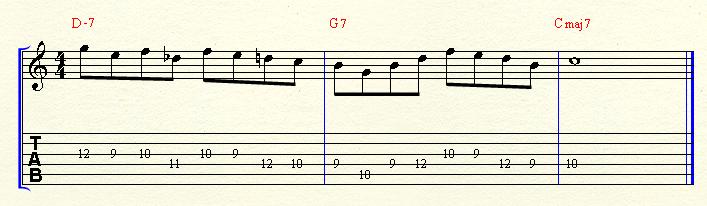
I put this simple example together in PrintMusic based on the ii-V-I in C major:
Image

This is what it sounds like: http://www.hepcat.biz/ii_V_I_example.mp3

Not too exciting. :) The Dmin7/G7 change is stretched out using 8th notes over two full measures to illustrate the point... which is that through the changes all notes are played in one small portion of the fretboard. The Dmin7 line is sort of a descending linear thing, while the G7 line is based more on a G7 arpeggio. Note that the Db is bending the rules a bit... that's my one "jazzy" note for this example :lol: In this context it's really acting as a C#, which relative to the Dmin7 would be your maj7 tone of D. This gives you a tension between the Dmin and the maj7 tone, and in fact there is such a chord called a maj/min7 chord: play a minor triad and add the maj7 instead of b7. Oooh, my ears are all tickley. There are other harmonic relationships to that Db/C# as well.

So you only need to worry about jumping from scale to scale or position to position if it fits your specific melodic needs. You could modulate in and out of modes within one little octave if you have something good to say within that one octave... not that I do necessarily... :)

Post

I think I know what you're asking... do I need to switch positions or octaves wholesale to play D Dorian vs. G Mixoldian vs. C Ionian... is that right?
Not exactly. :)

What I mean is this: If I play the CMajor scale straight, without any variations, on top of chord progression Dmin7 Gdom7 Cmaj7, I should start the scale in D when the Dmin7 chord starts and be sure that I reach the note G simultaneously with chord Gdom7, the same to the C and Cmaj7.
Of course, in this way the speed of the chord progression will be dependent of the scale speed but we can overcome this by introducing some variations in the scale (like you did in your example).
The more variations in the scale, the higher the speed is needed when playing it (considering the speed of chord progression as constant).

Post

I thought about that after posting, and don't mean to be a buzzkill.

One thing to consider is, learn an entire scale, all across the fretboard. For each 'position' or 'box' along the way (from open strings to the highest frets), use a fingering which works best for you.

A goal might be to be able to see the equivalent of the piano's 'white and black keys,' anywhere you look on the fretboard. If you memorize all of the notes of the C major scale, from the open 'low e,' all the way to the highest note on the 'high e' string, then you will have all of the 'naturals' or 'white keys' memorized.

If you wanted to play something 'instantly weird' over a chord progression that's in C major, you could play nothing but 'black keys' (notes not belonging to the C major scale) for a phrase or two.

Post

A goal might be to be able to see the equivalent of the piano's 'white and black keys,' anywhere you look on the fretboard. If you memorize all of the notes of the C major scale, from the open 'low e,' all the way to the highest note on the 'high e' string, then you will have all of the 'naturals' or 'white keys' memorized.
Yes, together with scales, I'm also learning where all the natural notes are, in the fretboard. It's not very difficult, just need practice.

Now, just a curiousity...
My son is taking guitar lessons (his teacher is teaching two guys without knowing :)). Yesterday he learned the minor pentatonic scale. I got curious and played the pentatonic major, minor and blues scale with Major thirds and flatted fifth. As I was playing it, I could "ear in my mind" a typical blues chord progression and noticed that the pentatonic scale it self is a blues solo (or is it the other way around?). :wink:
These are great scales to understand what a scale is and how it works in a song.

This thread is going for so long...
Many thanks to all of you guys for your effort in helping me. I'm a drummer trying to learn guitar theory. :D
As a "retribution" for your help, if you need to put "real" drums in some of your songs, please ask me and I'll be really glad to do it. I can record them very easily and quick.

Post Reply

Return to “Music Theory”