Limiter Forms and Definitions

How to do this, that and the other. Share, learn, teach. How did X do that? How can I sound like Y?
RELATED
PRODUCTS

Post

'Brickwall' and 'Clipper' are certainly not buzzwords.
Says who? Anyone who has driven any of these two a bit too hard KNOWS that they start to buzz and fart.So, there. These two ARE (!!) BUZZwords. (BUZZfarts?)

A clipper was sometimes called a "peak-stop" limiter, usually in broadcast applications.

One should look f.e. at certain Orban schematics.

LA2A and 1176 were traditionally used to "pack" the signal.
It's a slightly different process, but essentially this could be called "maximizing" before it hit the tape, whaere it was further "maximized" by the nature of the medium.

In other words, a classic R'n'R signal was already "maximized" (at least) twice before it was mixed.

Now, what was it all about ... er.. AHA!!! ... BUZZWORDS.
Image

Add your own nurse pics.
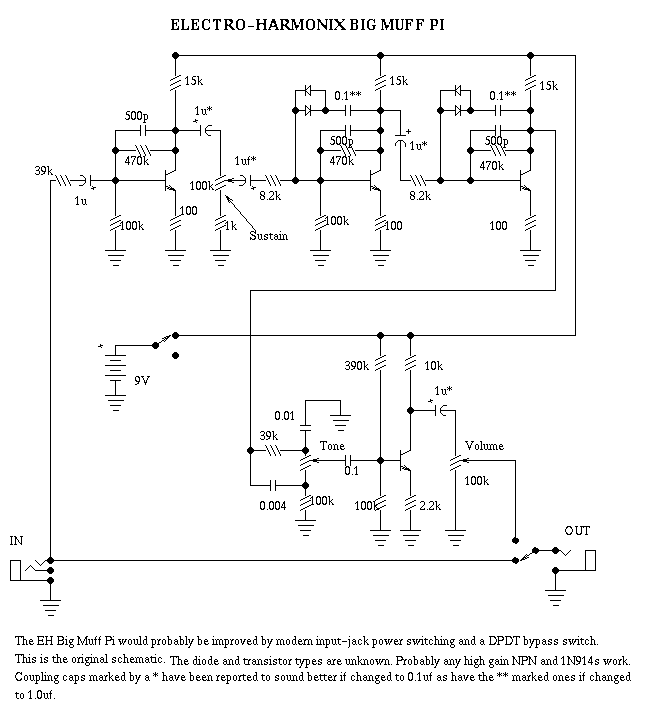
When you come to think about it, in ESSENCE, Big Muff isn't THAT far awya from Orbans' "peak stop" clippers-limiters...

Program DENSITY was the word.

Post

First of all, thanks for contributing yet again. But maybe we all need to calm down a little bit, since it's driving a bit off IMO.
Kim (esoundz) wrote: 'Brickwall' and 'Clipper' are certainly not buzzwords. They have very specific meanings, which I've described several times in this thread. Your lack of understanding doesn't make those terms meaningless.

Perhaps I haven't been as clear or unambiguous as I intended.
Trust me, you have been clear and I'm certainly don't lack any form of understanding. But I have to backup mauseoleum here, which is why I wanted different opinions regarding this topic than just 2-3 people (so thanks or stepping in, mauseoleum).

I'm sure that there was a lot of crazy nametagging (hence the buzzwords) back in the day with R&D sections, and this caused the whole drama with the descriptions of the tools we know today. Though I still think it is misleading (as could be clearly seen in the last pages).

I understand that certain tools need a specific meaning to set them apart. But, if a basic compressor with unlimited ratio and the right settings is capable of doing signal limiting without signal overs, yet is not called "brickwall", but a digital "limiter" is - then something's wrong and it certainly is due to a "catchphrase"/tag that it's like that.

At least in my opinon. I'm not saying that I misunderstand what's going on (I was confused with the Clipper), I however say that the definitions of the discussed devices are misleading. Especially if I look at mauseoleum's quote:
mauseoleum wrote:A clipper was sometimes called a "peak-stop" limiter, usually in broadcast applications.
I mean... look at certain devices on the market. I've seen plugins where we (for example) have a knob that is called drive, and one called compensation on a compressor. So what do these knobs do? Yes, the one "drives" the signal into the threshold (aka input gain/drive) and the other one is a regular gain knob (output gain/compensation).

So here, we have misleading tagging yet again. Just as example if we want to go that far OT.


Kim (esoundz) wrote: Who's doing the tagging? And on what basis?
The "tagging" on the GUI's by firms to declare certain function for example.
Kim (esoundz) wrote: I think there's a fundamental misunderstanding that's under the surface here.

A pure clipper works by waveshaping.
A pure compressor works by gain reduction.

A clipper can be used as a distortion device.
A clipper can be used as a limiter.
A compressor can be used as a limiter.

A 'limiter' may use a mix of gain reduction AND waveshaping.
Trust me, I understood that. Though if a "limiter" may use a mix of gain reduction and waveshaping, it's not a pure limiter by compression basis anymore - right?

Kim (esoundz) wrote: A limiter with a non-zero attack can't be a brickwall limiter unless it either has a lookahead delay (so it starts reducing gain *before* the peak) or it's followed by a clipper or other overload protection. Just because a device has an 'attack time' control and is billed as a gain-reduction limiter doesn't mean that's all it does. There's usually a lot more under the hood.
Not to disregard your knowledge, but I pretty much abused PT's own compressor as "brickwall" limiter with microsecond values. And that one has no look ahead mode. Same with ReaPlug's ReaComp. TbT's Maximizer also does no overs - though I'm not too sure on the internal setup. Don't have Daniel's description at hand (he sent it to me via mail once).

Kim (esoundz) wrote: Who says an LA2A is a maximiser (or a brickwall limiter)? I've never heard of it, and Google seems to think it's *only you* who's saying it.
Woha, easy there. I said it "looks" like a maximiser, since you only have an input gain and an output gain, while the internals are setup. Isn't that the usual setup of a nowadays known "maximiser"?


I'm definietly not disregarding your knowledge (neither yours Kim, nor yours mauseoleum - though I don't know if you're joking in any way). I appreciate your sparetime to join this discussion. So thanks again for contributing.
[ Mix Challenge ] | [ Studio Page / Twitter ] | [ KVRmarks (see: metering tools) ]

Post

I mean... look at certain devices on the market. I've seen plugins where we (for example) have a knob that is called drive, and one called compensation on a compressor. So what do these knobs do? Yes, the one "drives" the signal into the threshold (aka input gain/drive) and the other one is a regular gain knob (output gain/compensation).

So here, we have misleading tagging yet again.
Look, I don't want to appear all smart and snide, but I think that any "misleading" tagging should be viewed from the perspective of application - IOW, look at the patent I posted.

It says it's a "limited amplifier" - that's not so far from a "limiting amplifier".

A "limiter" in applicable form is exactly that: a limiting amplifier. IOW, a limiting cell and a makeup amp.

The implementations vary - the end use and applications determine that.

F.e., a "peak-stop" limiter in broadcast is often an anti-parallel diode pair in the NFB leg of an opamp, after the pre-emphasis circuit. By broad definition, this is a clipper, and yes, it is a clipper, but its function is to act as a "peak-stop" limiter. Of course - it IS a limiting AMPLIFIER as well, and it performs it's LIMITING fuction by using an anti-parallel diode pair, which is - a CLIPPER.

And it is, in essence, the "same shit" as one stage in the Big Muff. Only it is done with an opamp, and the muff uses a discrete transistor as an "amp".

Loadsa BS, eh?


Edit: re. your compressor question. It appears that your two-knobber is made to be "hit" with signal, hot. That's why it has a knob that says "drive" (which seems different than "makeup", IOW it is "pre-gain") and a knob that determines how much you will squash that signal. IOW, this looks like an "effect" compressor, for "sound-design" and for drums.

A "mixing" compressor would (in my conservative mind) have a "threshold" knob and a "makeup" knob, and some others...


-----------------------------------------
(when I'm joking it's classy AND obvious)

Post

Compyfox wrote:First of all, thanks for contributing yet again. But maybe we all need to calm down a little bit, since it's driving a bit off IMO.
Cheers. And I agree - we should calm down a bit. I think I was getting a bit carried away. ;-)

Compyfox wrote:Though if a "limiter" may use a mix of gain reduction and waveshaping, it's not a pure limiter by compression basis anymore - right?
It's still a limiter. It just uses a blend of techniques instead of just one. The term 'limiter' is a description of its function and intended use - not a description of its internal design.

Compyfox wrote:
Kim (esoundz) wrote: Who says an LA2A is a maximiser (or a brickwall limiter)? I've never heard of it, and Google seems to think it's *only you* who's saying it.
Woha, easy there. I said it "looks" like a maximiser, since you only have an input gain and an output gain, while the internals are setup. Isn't that the usual setup of a nowadays known "maximiser"?
I think this might be where the confusion lies.

Just because an LA2A has the same controls as a limiter or maximiser doesn't make it a limiter or maximiser. Those same controls are seen on many compressors and also distortion devices - just have a look at a lot of guitar stompboxes. Many have little more than three controls - input/drive, tone, and output level. I could build a de-esser or a ducking delay with the same controls as an LA2A or a maximiser, but that doesn't make them equivalent.

Compyfox wrote:I'm definietly not disregarding your knowledge (neither yours Kim, nor yours mauseoleum - though I don't know if you're joking in any way). I appreciate your sparetime to join this discussion. So thanks again for contributing.
Cheers! :-)

-Kim.

Post

mauseoleum wrote:Loadsa BS, eh?
Somewhat yeah, but if it can't be handled any different in the analog realm, it's totally understandable.
mauseoleum wrote: Edit: re. your compressor question. It appears that your two-knobber is made to be "hit" with signal, hot. That's why it has a knob that says "drive" (which seems different than "makeup", IOW it is "pre-gain") and a knob that determines how much you will squash that signal.
Well most 2-knobbers I know use Drive (Input Gain) and Output (Output Gain). The first drives the signal into compression (hot), the second adjusts the output volume. So yeah, basically the same concept - think LA-2A, Fairchild, 1176. Though most digital limites (if not all) use a feed forward signal detection setup, while the LA/Fairchild/1176 use feed back signal detecion. They are not only softer in terms of signal control , they also let peaks through.

Or was it the other way around? Or... uhm... (late, brain shut down already)

mauseoleum wrote:IOW, this looks like an "effect" compressor, for "sound-design" and for drums.
I wouldn't say "effect" compressor, but more like a simplyfied concept. Such compressor setups are of course for a certain "effect" only (think LA-2A yet again) - depends how it is setup however.

mauseoleum wrote: A "mixing" compressor would (in my conservative mind) have a "threshold" knob and a "makeup" knob, and some others...
Interesting point of view and description given for "standard" compressors and "two knob" compressors.

mauseoleum wrote: (when I'm joking it's classy AND obvious)
I'm usually slow on that end. ;)

Kim (esoundz) wrote:
Compyfox wrote:Though if a "limiter" may use a mix of gain reduction and waveshaping, it's not a pure limiter by compression basis anymore - right?
It's still a limiter. It just uses a blend of techniques instead of just one. The term 'limiter' is a description of its function and intended use - not a description of its internal design.
Well, but wouldn't that mean, that these particular devices need (in theory) an own distinguishable description? Would be simpler to separate these devices and make the concept of them more obvious.

Kim (esoundz) wrote: I think this might be where the confusion lies.
And I guess this is the very same reason why some people still have problems understanding the concepts. So it kind of is an R&D issue as well IMO.

Kim (esoundz) wrote:I could build a de-esser or a ducking delay with the same controls as an LA2A or a maximiser, but that doesn't make them equivalent.
True. A de-esser is basically a compressor with internal sidechain for the detection path. So it could be setup with a couple of knobs only compared to the full setup. Yet it is not a "compressor" by definition.

I guess this is where all the confusion (hypernym) originates from.


That leaves us with only one question for the time being:

Why is it, that certain digital "limiter" or compressors set up to "limit the signal", even though they are not declared as brickwall (due to the missing instant attack), not letting any signal through the set limit?

e.g.1 PT's Compressor, Att => lowest microseconds, ratio 20:1 to infinity:1
e.g.2 ReaComp Ratio infinity:1, attack = 0.0ms, 0.1ms to 1ms max, tested with Classic Attack on/off, RMS values at 0ms and 5ms, Feed Forward mode. No look-ahead (pre-comp).

Just checked with StylusRMX, a heavy DnB loop from EZ Rollers cranced up, the comp set to bite at -30dB to -40dB. InspectorXL showed no HID clipping, no Digital Overs either. Even tried 8x Oversampling in ReaComp just to be sure.

If compressors setup in "limit mode" react like brickwall limiters, why are they not declared as such? Tells me that instant attack is not a necessity?

Would this clear, why TbT's Maximizer and Yohng's W1 also doesn't do any overs (no matter if HID or Digital Over)?


*edit: sorry if some of the text doesn't make real sense - I blame it on the lack of sleep*
[ Mix Challenge ] | [ Studio Page / Twitter ] | [ KVRmarks (see: metering tools) ]

Post

Compyfox wrote:
Kim (esoundz) wrote:
Compyfox wrote:Though if a "limiter" may use a mix of gain reduction and waveshaping, it's not a pure limiter by compression basis anymore - right?
It's still a limiter. It just uses a blend of techniques instead of just one. The term 'limiter' is a description of its function and intended use - not a description of its internal design.
Well, but wouldn't that mean, that these particular devices need (in theory) an own distinguishable description? Would be simpler to separate these devices and make the concept of them more obvious.

[...]

Why is it, that certain digital "limiter" or compressors set up to "limit the signal", even though they are not declared as brickwall (due to the missing instant attack), not letting any signal through the set limit?

[...]

If compressors setup in "limit mode" react like brickwall limiters, why are they not declared as such? Tells me that instant attack is not a necessity?

Would this clear, why TbT's Maximizer and Yohng's W1 also doesn't do any overs (no matter if HID or Digital Over)?
The naming of a tool is only loosely related to its internal design.

A tool's name is best interpreted as the developer's intention of how it would be used.

Many tools called 'compressors' can also be set up as limiters. Why are they not called limiters? Because the developer intends them to be used as compressors, not limiters.

Likewise many limiters can be used as track compressors. Indeed, some limiters afford more control and range of sound than some track compressors. Why are those limiters not called compressors? Because the developers intend them to be used as limiters.

Similarly, many analogue-modelled devices can be used as distortion devices - even compressors and EQs. And I bet some distortion/saturation plugins also use some dynamic compression too. And equalisation too. Sophisticated devices will use a blend of compression, saturation, tonal adjustment (EQ), phase alteration... even mid/side operation or multiband processing.

In some cases, limiters are not called 'brickwall' limiters because the developer thinks the term 'brickwall' is implied. Perhaps a limiter is designed for digital mastering? It probably has brickwall behaviour - regardless of whether the term appears anywhere.

It can be very confusing if you expect the tool's label to exactly describe its inner workings.

Compyfox wrote:
Kim (esoundz) wrote:I could build a de-esser or a ducking delay with the same controls as an LA2A or a maximiser, but that doesn't make them equivalent.
True. A de-esser is basically a compressor with internal sidechain for the detection path. So it could be setup with a couple of knobs only compared to the full setup. Yet it is not a "compressor" by definition.
A de-essor is certainly a compressor. It's just got an EQ in the sidechain. Otherwise, what's the difference between a de-essor and something like Compadre, which has EQ'd sidechaining as a feature? Not to mention all the other compressors out there that EQ the sidechain without being obvious about it.

What's your definition of a compressor?

-Kim.

Post

Kim (esoundz) wrote: A de-essor is certainly a compressor. It's just got an EQ in the sidechain.
A broad-band de-esser is a compressor with side-chain filtering.

However, many de-essers duck just the sibilant frequencies rather than the overall gain, so should actually be considered dynamic equalisers.

And there is also the Eiosis de-esser, which I undertand uses a different approach altogether.

So proving your point really: they are all de-essers, but the underlying algorithms are all different.

Post

Well most 2-knobbers I know use Drive (Input Gain) and Output (Output Gain). The first drives the signal into compression (hot), the second adjusts the output volume.
This implies that the "gain element" (you listed an opto, a vari-mu and a fet lim.) has a "fixed threshold" and you must vary the incoming signal level in order to get the device to "react" (this is somewhat inherent to feedback type of comps). The "makeup gain" amount is then an "unknown" variable, and has to be set-up manually for each case.

If you can read schematics, study the LA2A and 1176 schematics.
Also, "that" corp. has alot of data-sheets and app-sheets for their "all-in-one-chip" compressors/dynamics.

http://www.thatcorp.com/Design_Notes.shtml

Edit: o.k., "design notes" they have.. my bad.
THERE IS ALWAYS A WORKAROUND

Post

Kim (esoundz) wrote: Similarly, many analogue-modelled devices can be used as distortion devices - even compressors and EQs. And I bet some distortion/saturation plugins also use some dynamic compression too. And equalisation too. Sophisticated devices will use a blend of compression, saturation, tonal adjustment (EQ), phase alteration... even mid/side operation or multiband processing.
This is not too un-common as of late, especially while looking at certain compressor models or EQs. They have an own "saturation factor" (if you want to call it that way) already while inserting, some compressors even add a certain EQ courve. So yes, if you know what an unit does (thanks to analysing), it can indeed be abused for anything.

Kim (esoundz) wrote: In some cases, limiters are not called 'brickwall' limiters because the developer thinks the term 'brickwall' is implied. Perhaps a limiter is designed for digital mastering? It probably has brickwall behaviour - regardless of whether the term appears anywhere.
This might be the case and could be the ultimate answer to why certain tools are defined "brickwall", even if they are not by "specs". Still leaves the question open why certain limiters are called maximisers or brickwall, even though they don't mimic the specs that kind of declare "brickwall" and "maximizer". (like TLs Maximizer, where you can change the attack/release response with the "algorhythm" switch).

Though I get the feeling, that this would drift to ad infinitum.

Kim (esoundz) wrote: It can be very confusing if you expect the tool's label to exactly describe its inner workings.
I can definitely confirm that.

Kim (esoundz) wrote:A de-essor is certainly a compressor. It's just got an EQ in the sidechain. Otherwise, what's the difference between a de-essor and something like Compadre, which has EQ'd sidechaining as a feature? Not to mention all the other compressors out there that EQ the sidechain without being obvious about it.
Well, by clear definition it "would" be a de-esser indeed. But it seems that the lines blend clearly here. It's like with ReaComp where you can also use the HP/LP filter in the sidechain detection to only react to a certain signal or frequency range. Does it make a de-esser? I'd say no - not if we're talking about individual instruments. But if we talk about vocals, it's a known term that tells us "ah! this reduces the ess-vowels, so it's a 'de-esser' ".

Again, confusing. Yet logical on the long run.

IIRs wrote:A broad-band de-esser is a compressor with side-chain filtering.

However, many de-essers duck just the sibilant frequencies rather than the overall gain, so should actually be considered dynamic equalisers.
Well in it's own definition, maybe. But isn't that kind of de-esser a multiband compressor in reality?


Or in case of the "dynamic EQ": an EQ after a gate with a filtered detection path (sidechain) that opens the main signal path to an EQ if the desired detection signal goes over the threshold? While the "raw" signal is "closed" with another gate with the same filtered detection path?

At least to my understanding.

So in short:

Code: Select all

Signal Original: 
signal -> gate (closes if sibilance goes above threshold)

Signal Copy: 
signal -> gate (opens if sibilance goes above threshold) -> EQ with narrow cut
Though that goes a tiny little bit off topic.

IIRs wrote: And there is also the Eiosis de-esser, which I undertand uses a different approach altogether.
To my understanding, the Eiosis E2 De-Esser uses several parallel signals to control the sibilances and the raw signal separately. I guess this is done with either an inverted signal for "ducking" or a very clever controlled parallel setup. If you think about it, it's even logical. Though it still is an own beast.


mauseoleum wrote:This implies that the "gain element" (you listed an opto, a vari-mu and a fet lim.) has a "fixed threshold" and you must vary the incoming signal level in order to get the device to "react" (this is somewhat inherent to feedback type of comps). The "makeup gain" amount is then an "unknown" variable, and has to be set-up manually for each case.
Yeah, this was actually what I was talking about. Only voiced differently. The confusing part hereby was, that it's kind of the concept of modern known maximisers, even though those modules aren't!

They're very simplified compressors with feedback signal detection and different response (release) due to it's internal setup (opto especially).


Thanks for the link in this case. Definitely interesting material for some bedtime reading.

Kim (esoundz) wrote: What's your definition of a compressor?
Excellent question. My definition would be that it needs attack/release, a threshold, a knee, ratio and of course output gain to be a standard signal leveler (there we have it again!). It can only go from there.

I guess you can not really give it a specific or more like exact definition, since a compressor is that versatile in it's usage. It's a sound shaper, just like an EQ. Only that the EQ works frequency based, and the compressor time/level based.

In theory, you really only need a very versatile compressor, an active filter and a versatile delay - from these modules you can build your own arrays of gates, delay, chorus, flanger, EQ, comps/limiters, etc... Since these devices are built upon the same modules in it's core. And if you know that, not to mention how to handle it, I think this really makes you a great engineer.

But this is a different topic.


Again, thanks for contributing.
[ Mix Challenge ] | [ Studio Page / Twitter ] | [ KVRmarks (see: metering tools) ]

Post

Compyfox wrote:
Kim (esoundz) wrote:That's correct. A clipper *is* a distortion device. Clippers are sometimes used as limiter though, because in some situations they can perform the same function - reducing peak level in order to reduce headroom requirements of the audio.
Then it is clearly wrongly tagged as "limiter".
I could be all wrong here so if i am then just dismiss this or correct me :)

Well if you take a look at some of the very nice and for me at least very unafordable D/A converters they alot of the time have some form of clipping built-in or engineers have found that by driving the output hotter they can achieve as mentioned a more transparent way of finalizing after already maybe using conventional compressors/Levelling Amplifers/Limiters. As it only shaves the very peaks its also pleasing compared with brickwall limiting or (worse) used in conjuction with to 'shred' material. However if for example a chain were set up with a rms compressor followed by a peak detector to prevent any over shoots and used sparingly the rms compressor would raise the average whilst the peak is doing little work in comparison as the D/A converters stage can slice off the top of the remaining rapid transients driven more for evem more rms power whilst sounding (subjectively) way less noticable. In practice used as a limiter hence the tag.

It is confusing though and i get my wires all crossed at times also!
very good area to bring up and discuss as its an informative/interesting reading oppose to the 'What is the best synth...' and 'List your fave synths...' etc. which crop up every day it seems :tu:

http://www.mercenary.com/weentwoch19a.html
http://www.mercenary.com/heddigsigpro.html
http://www.mercenary.com/prsodrdatwoc.html

Some tests/comparisons done by the Mercenary Audio team on what is amongst the best available which is interesting yet i will never get chance to do this

http://www.lavryengineering.com/index_flash.html

There are some decent PDF on Lavry's support page

Cheers to all

Post

Compyfox wrote:
IIRs wrote:A broad-band de-esser is a compressor with side-chain filtering.

However, many de-essers duck just the sibilant frequencies rather than the overall gain, so should actually be considered dynamic equalisers.
Well in it's own definition, maybe. But isn't that kind of de-esser a multiband compressor in reality?


Or in case of the "dynamic EQ": an EQ after a gate with a filtered detection path (sidechain) that opens the main signal path to an EQ if the desired detection signal goes over the threshold? While the "raw" signal is "closed" with another gate with the same filtered detection path?
No, I really did mean dynamic EQ, ie; modulating the gain of an EQ filter.

Post Reply

Return to “Production Techniques”