

I'm brushing up on my music theory skills, so bear with me!
So, I always hear how to figure out a scale from chords, but how do you do it the opposite way around?
I know how to find the chords from the C Major scale, but that's because where I have learned this from, this is the only example it uses!
How about other scales? Exotic ones, Greek ones, blues etc..
How do I go about finding what chords/chord progression I can create a chosen scale?
I didn't know what to search here, Google wasn't being much help - probably because I couldn't phrase this haha.
How to figure out what chords come from a scale
-
- KVRian
- 1084 posts since 12 Sep, 2008 from Your basement
That's a rough one, because any given chord progression may or may not express a single "natural" scale. I use the word "natural" to mean a division of the octave comprised of seven pitch classes using a combination of major or minor seconds as step intervals.
It can be argued how "natural" they are, but you'll have to take that up with Pythagorus, not me.
But deriving a scale from a chord progression MAY yield one particular scale. For example, I can have Dm7 G7 CMaj7 and you can extract C Major from that and perhaps vice versa.
But what about this...
Eb7(+5) D7 Bm7(-5) E7 (-9) Am7 Ab7 GMaj9
What scale does this express? Well, the changes are in G Maj. But there are a lot of secondary dominants in there and two substitutions. So you several scales in a series.
A given chord progression can, therefore either express one "natural" scale, several scales or one "synthetic scale."
Take this set of changes...
Dm Em Gm Bm Dm
Okay, so you can probably make one synthetic scale from the whole thing that would be:
D E F G A Bb B C D
But if I were analyzing that, I might extract a different scale from each of these individual harmonies. Think about a modal tune like "So what" by Miles Davis. It has a set of changes similar to Gm7 for four bars to Am7 for four bars and back again. If you were John Coltrane and you were soloing, would you play just one scale derived from both chords?
So it's not always cut and dried. But in my estimation, there is never one "right" answer to theory questions. Someone may tell you that there is one answer like two plus two is ALWAYS four, but I don't tend to think that way in music theory.
In music theory, to me the question is always, "what am I going to do with this piece of theoretical analysis?" How can I take this scalar extraction from a chord progression and MAKE ACTUAL MUSIC from it? This clarifies whether the answer is a single scale or multiple scales.
It can be argued how "natural" they are, but you'll have to take that up with Pythagorus, not me.
But deriving a scale from a chord progression MAY yield one particular scale. For example, I can have Dm7 G7 CMaj7 and you can extract C Major from that and perhaps vice versa.
But what about this...
Eb7(+5) D7 Bm7(-5) E7 (-9) Am7 Ab7 GMaj9
What scale does this express? Well, the changes are in G Maj. But there are a lot of secondary dominants in there and two substitutions. So you several scales in a series.
A given chord progression can, therefore either express one "natural" scale, several scales or one "synthetic scale."
Take this set of changes...
Dm Em Gm Bm Dm
Okay, so you can probably make one synthetic scale from the whole thing that would be:
D E F G A Bb B C D
But if I were analyzing that, I might extract a different scale from each of these individual harmonies. Think about a modal tune like "So what" by Miles Davis. It has a set of changes similar to Gm7 for four bars to Am7 for four bars and back again. If you were John Coltrane and you were soloing, would you play just one scale derived from both chords?
So it's not always cut and dried. But in my estimation, there is never one "right" answer to theory questions. Someone may tell you that there is one answer like two plus two is ALWAYS four, but I don't tend to think that way in music theory.
In music theory, to me the question is always, "what am I going to do with this piece of theoretical analysis?" How can I take this scalar extraction from a chord progression and MAKE ACTUAL MUSIC from it? This clarifies whether the answer is a single scale or multiple scales.

-
- KVRist
- 364 posts since 15 Aug, 2009
Perhaps this link and this link may point you in the right direction.klackt wrote:I'm brushing up on my music theory skills, so bear with me!
So, I always hear how to figure out a scale from chords, but how do you do it the opposite way around?
I know how to find the chords from the C Major scale, but that's because where I have learned this from, this is the only example it uses!
How about other scales? Exotic ones, Greek ones, blues etc..
How do I go about finding what chords/chord progression I can create a chosen scale?
I didn't know what to search here, Google wasn't being much help - probably because I couldn't phrase this haha.
-
- KVRer
- Topic Starter
- 8 posts since 1 Nov, 2009
Thanks for that jcrisman,
I know that I can get a major chord by finding 1 3 5, or M3 + m3
How can I derive a minor from a scale (using m3 + M3 = Minor Triad) but my steps don't land on a note in the chosen scale?
Thanks again
I know that I can get a major chord by finding 1 3 5, or M3 + m3
How can I derive a minor from a scale (using m3 + M3 = Minor Triad) but my steps don't land on a note in the chosen scale?
Thanks again
-

- KVRAF
- 26033 posts since 20 Oct, 2007 from gonesville
"How can I derive a minor from a scale but my steps don't land on a note in the chosen scale?"
the process is not different than deriving triads from a major scale. "A minor" unaltered:
A C E
B D F
C E G
D F A
E G B
F A C
G B D
a couple of these, as it occurs, are minor triads. If, on the other hand, you want to build a minor triad on one of the tones that doesn't produce a minor triad 'naturally' within this set, you just do that.
How it will fit in 'A minor' is another, somewhat more subtle question.
the process is not different than deriving triads from a major scale. "A minor" unaltered:
A C E
B D F
C E G
D F A
E G B
F A C
G B D
a couple of these, as it occurs, are minor triads. If, on the other hand, you want to build a minor triad on one of the tones that doesn't produce a minor triad 'naturally' within this set, you just do that.
How it will fit in 'A minor' is another, somewhat more subtle question.
-
- KVRist
- 364 posts since 15 Aug, 2009
I'm not understanding the above question and may need further clarification.klackt wrote:Thanks for that jcrisman,
I know that I can get a major chord by finding 1 3 5, or M3 + m3
How can I derive a minor from a scale (using m3 + M3 = Minor Triad) but my steps don't land on a note in the chosen scale?
Thanks again
However if you look at the below chart you'll notice that there are Roman numerals depicting the order of triads within each progression. Each triad consist of the notes within the scale, but as importantly each triad contains an alternating sequence. That is, the first Roman numeral chord contains the 1st, 3rd, and 5th note of the scale; the second Roman numeral chord has the 2nd, 4th, and 6th note of the scale; the third Roman numeral chord has 3rd, 5th, and 7th scale notes; and so forth.
Most chords and scales will work together in this way. There are some exceptions (e.g., blues scales over I-IV-V or I-III-IV, jazzy chord substitutions, or passing chromatic notes), but most of the time chords consist solely of notes within a particular scale.
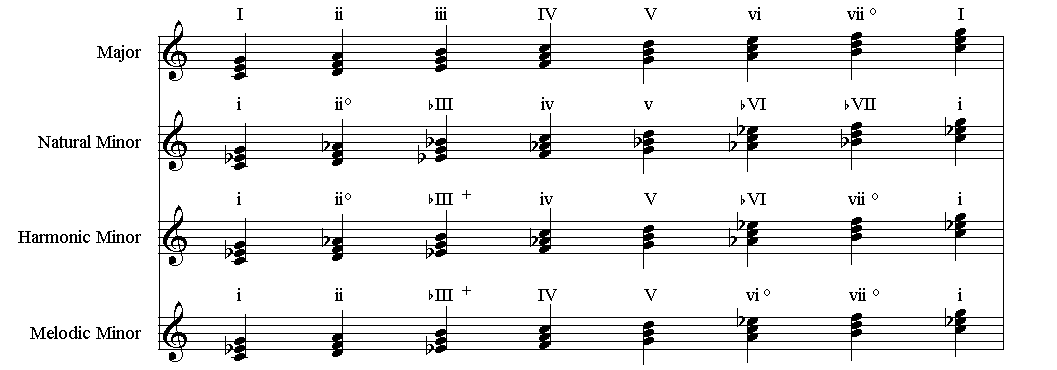
Also, any three or more notes within a scale can comprise a chord that fits within the scale. Suspended chords (sus2 or sus4) that contain the scale notes--but omit the major or minor third--too are sometimes used in lieu of the usual major or minor chords.
-
- KVRAF
- 2217 posts since 15 Jul, 2003
perhaps the chord scale theory as taught at Berklee and expouunded in a recent book is what you're looking for?
http://www.google.com/#hl=en&expIds=252 ... 86b3c06fd8
http://www.google.com/#hl=en&expIds=252 ... 86b3c06fd8
-
- KVRAF
- 4265 posts since 21 Oct, 2001 from my bolthole in the south pacific
Finding the chords that fit on a scale - working them out yourself is an exercise that will only help you. Write down all the notes of the scale and then, taking each degree or note from the scale by turn, consider all the rest of the notes.
Take A harmonic minor as an example.
A B C D E F G# A
If you look at the scale tones available using the 7th degree of this scale (G#) as a chord root you have the following mode:
G# A B C D E F G# which gives you
1(root) b2 b3 b4(= same note as ma3) b5 b6 bb7 (= dim 7th same note as ma6 )
So for the scale tone chord on the 7th degree you could use G# dim 7th - with b9 and b13th as possible extensions.
Do this with each of the 7 degrees and you have a complete harmonic analysis of that scale and all its modes. Pretty handy really - of course you will next want to try to find chord voicings built using the scale tones that you like on your guitar or keyboard.
Take A harmonic minor as an example.
A B C D E F G# A
If you look at the scale tones available using the 7th degree of this scale (G#) as a chord root you have the following mode:
G# A B C D E F G# which gives you
1(root) b2 b3 b4(= same note as ma3) b5 b6 bb7 (= dim 7th same note as ma6 )
So for the scale tone chord on the 7th degree you could use G# dim 7th - with b9 and b13th as possible extensions.
Do this with each of the 7 degrees and you have a complete harmonic analysis of that scale and all its modes. Pretty handy really - of course you will next want to try to find chord voicings built using the scale tones that you like on your guitar or keyboard.
-
 Dean Aka Nekro Dean Aka Nekro https://www.kvraudio.com/forum/memberlist.php?mode=viewprofile&u=162100
 - KVRAF
- 6178 posts since 4 Oct, 2007 from Escaped At Last
I am not a short cut man but this is useful for a quick reference now and again:
http://en.wikipedia.org/wiki/File:Circl ... luxe_4.svg
But no subsitute for putting it all inside the grey matter. Weed helps me think but YMMV extremely on that one!
http://en.wikipedia.org/wiki/File:Circl ... luxe_4.svg
But no subsitute for putting it all inside the grey matter. Weed helps me think but YMMV extremely on that one!
-
Dean Aka Nekro Dean Aka Nekro https://www.kvraudio.com/forum/memberlist.php?mode=viewprofile&u=162100
- KVRAF
- 6178 posts since 4 Oct, 2007 from Escaped At Last
The wrath of jancivil and theory can be severejancivil wrote:that'll teach 'em to come up in here with a noob question
 My cheating post with Circle of IVth link will not go down well
  (Sorry) but jancivil is usually worth listening to seriously on this subject
Peace out

Dean/Nekro
-
- KVRian
- 1084 posts since 12 Sep, 2008 from Your basement
Was that TMI on my part? I didn't mean to go too Pythagorus on his ass.jancivil wrote:actually in that post I was merely having a chuckle at Oggie's advanced-class 'A' to a noobish 'Q'.

-
- KVRAF
- 26033 posts since 20 Oct, 2007 from gonesville
I didn't even understand his question, so who knows.Ogg Vorbis wrote:Was that TMI on my part? I didn't mean to go too Pythagorus on his ass.jancivil wrote:actually in that post I was merely having a chuckle at Oggie's advanced-class 'A' to a noobish 'Q'.
If it were me, I'd'a just googled 'minor scales chords'
(wrathful FTW)
BUT! I would NOT have got: ["So What" 2 chords] If you were John Coltrane and you were soloing, would you play just one scale derived from both chords?
-
- KVRian
- 1084 posts since 12 Sep, 2008 from Your basement
Hmm... that example made perfect sense to me. I would have put on that record and tried it myself. I might have even transcribed the actual solos and figured out what scales they were.jancivil wrote:I didn't even understand his question, so who knows.Ogg Vorbis wrote:Was that TMI on my part? I didn't mean to go too Pythagorus on his ass.jancivil wrote:actually in that post I was merely having a chuckle at Oggie's advanced-class 'A' to a noobish 'Q'.
If it were me, I'd'a just googled 'minor scales chords'
(wrathful FTW)
BUT! I would NOT have got: ["So What" 2 chords] If you were John Coltrane and you were soloing, would you play just one scale derived from both chords?
Sometimes a single scale cannot fit a set of changes, this isn't landing the space shuttle here.
