

I know it's a hard question to answer, but who were the pioneers of OTS?
* I guess it was first used in folk music, but who was the first to take it into structured, written music?
* By odd time signature I mean 5/X, 7/X, 11/X etc. Not talking about 3,6,9,12 although some people would consider it "odd".
Thanks.
When was the first documented use of odd time signature in western music?
-
- KVRist
- 31 posts since 11 Oct, 2005
-
stephenpaulharper stephenpaulharper https://www.kvraudio.com/forum/memberlist.php?mode=viewprofile&u=73921
- KVRian
- 778 posts since 4 Jul, 2005 from Atlanta
This is a really good question. Brahms came to mind first because of the folk music connection. Telemann takes the honors according to Wiki, but I'm unfamiliar with the piece, and don't know the context. My guess is that some kind of dance from the Renaissance that was written out would qualify.
Steve
Steve
Windows 10, Reaper
-
- KVRAF
- 2285 posts since 20 Dec, 2002 from The Benighted States of Trumpistan
You're probably right. Meter as such didn't formally exist in the Renaissance, but phrasing suggested all sorts of unusual and irregular meters, often changing from one phrase to the next. In a way, that's even more radical and experimental than writing in a consistent odd meter.algodon wrote:My guess is that some kind of dance from the Renaissance that was written out would qualify.
Only the 3/X and 9/X of that list; 6/X and 12/X are even meters.cosmogrill wrote:* By odd time signature I mean 5/X, 7/X, 11/X etc. Not talking about 3,6,9,12 although some people would consider it "odd".
Wait... loot _then_ burn? D'oh!
-
- KVRAF
- 2830 posts since 2 Mar, 2003 from The only civilized county in Texas
If you go back far enough, music wasn't notated in time signatures.
The Baldwin manuscript dates from the late 1500s and it is rythmically wild. Five over 3, nine over eight. It took western music a couple of centuries to come up with anything remotely as strange.
Victor.
The Baldwin manuscript dates from the late 1500s and it is rythmically wild. Five over 3, nine over eight. It took western music a couple of centuries to come up with anything remotely as strange.
Victor.
-

- KVRAF
- 5703 posts since 8 Dec, 2004 from The Twin Cities

-
- KVRAF
- 5703 posts since 8 Dec, 2004 from The Twin Cities
And I suppose that I should do my normal party-pooper act and mention that 'time signature' is not identical with 'meter'.
All Indian Classical music, for example, has a meter, but none of it had what we would call a 'time signature'.
And Indian Classical music has had odd meters for a long time. Though how far back these go is hard to determine.
All Indian Classical music, for example, has a meter, but none of it had what we would call a 'time signature'.
And Indian Classical music has had odd meters for a long time. Though how far back these go is hard to determine.
-
- KVRAF
- 2830 posts since 2 Mar, 2003 from The only civilized county in Texas
Wish I could oblige you. Googling gives just a couple of links, and none that help.herodotus wrote:Linkee?VicDiesel wrote: The Baldwin manuscript
And I just moved so I can't find anything, otherwise I'd be happy to scan a page or two.
Victor.
-
stephenpaulharper stephenpaulharper https://www.kvraudio.com/forum/memberlist.php?mode=viewprofile&u=73921
- KVRian
- 778 posts since 4 Jul, 2005 from Atlanta
All quite true, but the OP specifically asked for examples of written Western music.herodotus wrote:And I suppose that I should do my normal party-pooper act and mention that 'time signature' is not identical with 'meter'.
All Indian Classical music, for example, has a meter, but none of it had what we would call a 'time signature'.
And Indian Classical music has had odd meters for a long time. Though how far back these go is hard to determine.

Steve
Windows 10, Reaper
-
- KVRAF
- 5703 posts since 8 Dec, 2004 from The Twin Cities
Actually he asked for 'structured, written music', assuming that odd meters were 'first used in folk music'.algodon wrote: All quite true, but the OP specifically asked for examples of written Western music.
Steve
I was more questioning this assumption than I was answering his question, because Indian classical music is definitely structured, and it isn't folk music.
As for who first used 5, 7, or 11 based meters in western music, I have no idea, although for some reason I want to say 'Scriabin'. I do know that odd meters were used on an ad hoc basis long before anyone wrote whole pieces in them.
The first composers to make extensive, prolonged use of odd meters that I am aware of were Ives, Stravinsky, and Bartok. I am sure that there must have been others doing it earlier, but for the life of me I can't recall their names.
-
- KVRAF
- 2285 posts since 20 Dec, 2002 from The Benighted States of Trumpistan
Indeed, indeed; point taken. Still, we all know what we mean, and it's faster and easier to write "meter" than "time signature" or the even more precise "pulses or beats per regular unit of time (aka bar)." Then again, "TS" is much faster and just as precise.herodotus wrote:And I suppose that I should do my normal party-pooper act and mention that 'time signature' is not identical with 'meter'.
All Indian Classical music, for example, has a meter, but none of it had what we would call a 'time signature'.
And Indian Classical music has had odd meters for a long time. Though how far back these go is hard to determine.
 It's all good.
Oh, and thanks for the links; looks like a lot of great stuff therein.
Wait... loot _then_ burn? D'oh!
-
stephenpaulharper stephenpaulharper https://www.kvraudio.com/forum/memberlist.php?mode=viewprofile&u=73921
- KVRian
- 778 posts since 4 Jul, 2005 from Atlanta
Absolutely. Not coincidentally, three of my favorite composers. Barber too, maybe? Holst, Fauré and Milhaud? I still think Brahms should be in the mix — the Hungarian dances — I'm pretty sure there are some odd signatures in those, although I haven't listened to them in years. Number 5 for sure, 'cos I played it back at university.herodotus wrote: The first composers to make extensive, prolonged use of odd meters that I am aware of were Ives, Stravinsky, and Bartok.
Man, I gave up trying to keep up with composers a long time ago. I always manage to find somebody I haven't heard of before on the radio, particularly Baroque and pre-Baroque guys.herodotus wrote:I am sure that there must have been others doing it earlier, but for the life of me I can't recall their names.
Steve
Windows 10, Reaper
-
- KVRAF
- 2830 posts since 2 Mar, 2003 from The only civilized county in Texas
Scriabin probably predates that waltz-in-five movement in some Tchaikovsky symphony.herodotus wrote: for some reason I want to say 'Scriabin'. I do know that odd meters were used on an ad hoc basis long before anyone wrote whole pieces in them.
And your second point is an excellent one. That Baldwine manuscript uses cantus firmus of any length, and the weird time signatures are superimposed, but not systematically.
You're in luck. I dug into some stacks of paper and found it. This edition calls it the Baldwine Manuscript. Here are two pages (in the wrong order. sue me):
http://dl.dropbox.com/u/4104137/miserere.pdf
The first page has a nine-over-four (or at least three-triplets-over-four) and the second seven-over-six. One of my recorder teachers told me how some students of his did a three-voice piece like this as their final examination piece. The notes are trivial, the rhythm is hell. That piece had a passage with nine notes over eigth notes of the cantus firmus. Ouch. (To spell it out: set your metronome for 120, now play nine equally long notes over 8 clicks. Ouch.)
Note that this is a realization from parts books. Also, the original notation is nothing like what's used here, however I'm not a notation expert.
Victor.
-
- KVRAF
- 16977 posts since 23 Jun, 2010 from north of London ON
Was this the note style you mentioned? This one was from Ludford's Lady's Mass
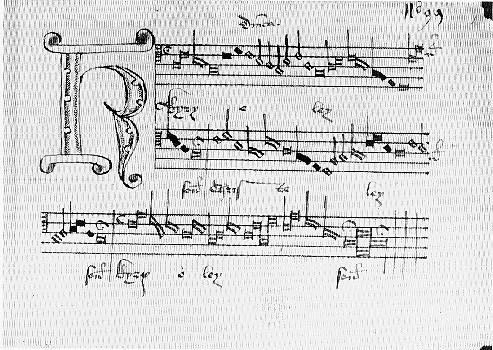
or the Forrest-Heyter Part Books---
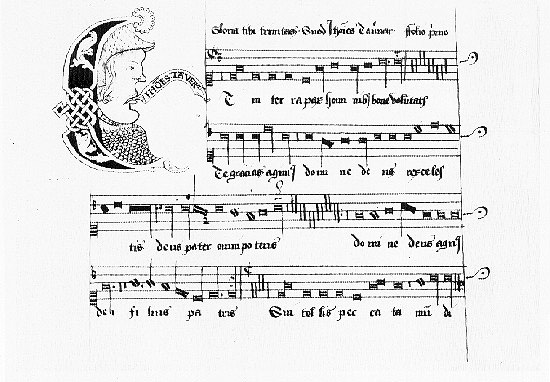
I tried some of these things out at one time..
or the Forrest-Heyter Part Books---
I tried some of these things out at one time..
Barry
If a billion people believe a stupid thing it is still a stupid thing
If a billion people believe a stupid thing it is still a stupid thing
-
- KVRAF
- 2830 posts since 2 Mar, 2003 from The only civilized county in Texas
I believe Baldwin was involved in that.trimph1 wrote:Was this the note style you mentioned?
....
or the Forrest-Heyter Part Books---
Victor.
-
- KVRAF
- 16977 posts since 23 Jun, 2010 from north of London ON
I think you are right. He was sort of mentioned in here---VicDiesel wrote:I believe Baldwin was involved in that.trimph1 wrote:Was this the note style you mentioned?
....
or the Forrest-Heyter Part Books---
Victor.
http://www.bl.uk/reshelp/findhelprestyp ... dynev.html
But I found no mention of him in this site here
http://www.hoasm.org/IVM/partbooksgcc.html
I can see digging around in here one can find all kinds of odd tempo things out---
Barry
If a billion people believe a stupid thing it is still a stupid thing
If a billion people believe a stupid thing it is still a stupid thing