
distance

VST, AU, AAX, CLAP, etc. Plugin Virtual Effects Discussion
RELATED
PRODUCTS

Post

I know EAReverb is used by classical music composers who need to place instruments on a virtual stage (some "positioning" presets are included since I know that).

Beat Kaufman produced a demo of EAReverb's positioning capabilities. 3 instances of EAReverb are used to place a solo trumpet to 3 different locations and a small global reverb processes the master bus.

Tomaso Giovanni Albinoni - "Sonata in F"
http://www.eareckon.com/music/Albinoni_ ... Reverb.mp3
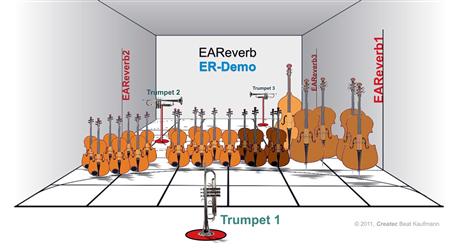
Image

I received some requests to build a plugin based on EAReverb which could be used as a 2D placement tool. IMHO, EAReverb is not very difficult to use (you can for example use a positioning preset and then use the mix knob to change the postion of the source) but I may think to work on such a plugin in the future if there are some interest for it.

Should you want to give EAReverb a try, please feel free to leave some comments about it so I know if it is worth working on a dedicated (simpler to use but less flexible) "positioning" plugin.

All the best,
Philippe

Image

Post

xh3rv wrote:
chacka wrote:For years I have this idea of making distance vs. sound difference measurements. Does someone know of results of such measurements? Some frequency graphs at various distances would be great.
Hmm, found this - http://www.sengpielaudio.com/calculator-air.htm

The inclusion of atmospheric moisture is cool. In terms of FX processing, I'd guess just some shelf EQ could probably capture a whole lot of this sort of effect /shrug. I'd guess environmental reverberation effects, even just spectrally, probably are more important to the overall image.

I tend to believe overall we're always submersed in awareness of space and depth, but the difference these days is just that the tools and practices have evolved a great capability to depict non-real or highly exaggerated spaces.
Sorry for the late reply! Thanx a lot for this. I will check this out later in depth. Lotsa work these days. :)

Post

it's quite possible that i took something out of context, so i may be wrong, but if not, part of the equation to sound over distance is something like 1/Hz * sqrt(1/Hz).. or similar.. which isn't really 6dB/octave. good luck finding the exact attenuation if anyone's building a parametric filter for it :)
you come and go, you come and go. amitabha neither a follower nor a leader be tagore "where roads are made i lose my way" where there is certainty, consideration is absent.

Post

ISO 9613-1 says attenuation in dB/m is
Image
Image

Post

farlukar wrote:ISO 9613-1 says attenuation in dB/m is
Image
... I'm sure that's correct :hihi:

When I try to imagine the sound of something far away through the air, I usually think of airplanes or cars. Makes me also think about words like 'jet' or 'whoosh' used for modulation effects. Atmospheric!
chacka wrote:Lotsa work these days. :)
The fact that u-he is pushing to do stuff The Right Way helps me sleep at night.

Post

xh3rv wrote:
chacka wrote:Lotsa work these days. :)
The fact that u-he is pushing to do stuff The Right Way helps me sleep at night.
Thanx for your warm words. Today some exciting parts arrived. Will have some more fun today... :D

Post

farlukar wrote:ISO 9613-1 says attenuation in dB/m is
Image
Bloody hell, that's complicated! The inverse square law, 1/(r-squared), is a bit easier to get your head around and maybe a better bet for non-scientist types to focus on. The sound intensity is inversely proportional to the square of the distance from the source, if I remember my physics A-Level days rightly. Roughly, you measure the volume of a sound at distance X from its source, and the sound pressure drops by 6dB each time you double the distance X. Can anyone confirm/expand this? This assumes ideal conditions that never really exist. I'm guessing farlukar's more complex equation takes all these real world factors into account. Additional sound from reverberation is the obvious biggie that the inverse square law doesn't take into account, but at least you'll know how far to drop your 'dry' slider!

A handy calculator can be found here: http://www.sengpielaudio.com/calculator-squarelaw.htm

I'm happy to just intuitively approximate this kind of stuff for music but it might be useful for people matching sound with images. As I mentioned a little earlier in the thread, for distance effects that catch the ear I believe that keeping it unreal rather than true to life is the way forward. Things that don't quite chime with our real world experience 'catch the brain' more than things which do. If you successfully trick the brain, the brain doesn't even register the trick. :)

Post

cron wrote:Roughly, you measure the volume of a sound at distance X from its source, and the sound pressure drops by 6dB each time you double the distance X. Can anyone confirm/expand this?
Yes, I learned that, too.
cron wrote:If you successfully trick the brain, the brain doesn't even register the trick. :)
Which is actually the tricky part of the trick, isn't it? :D

Post

cron wrote:Bloody hell, that's complicated! The inverse square law, 1/(r-squared), is a bit easier to get your head around
It assumes a loss-free medium which is fine & dandy for nearfield, but for longer distances absorption in air (viscosity, heat conductivity, molecular thermodynamic relaxation) becomes noticeable. And that is indeed complicated stuff.

Luckily ISO 9613-2 gives a nice indication table for α (atmospheric attenuation coefficient in dB/Km):
Image

The atmospheric attenuation then becomes Aatm=αd/1000 (A in dB, d in m)

Note 1: this is absorption, which goes on top of your inverse square law, as that is just about the wave propagation.
Note 2: this is only atmospheric absorption; considering ground surface (hard/porous), distance above the ground etc. make stuff even more fun :hihi:
Image

Post

Wow. Screw the math. I can't even do basic math.

Check out RaySpace by QuikQuak?

RaySpace isn't it but I am VERY interested in a user-friendly plug to do modeled binaural spacialization with "live" reverb calculation. All the HRTF plugs out there give localization minus ambient reflections and all the reverb plugins give environmental emulations minus the locality. There are a total of two plugs that combine the two processes but it's a useless (not truthful) mere mixing of the two together instead of actually integrating them (you can't just use HRTF impulses on a reverb signal or visa versa). There's one massive package for full modeling (ray casting reverb) that claims binaural simulation called Odeon but it's not a plug in, it's horrifically asinine in its use (one of the worst GUIs I've ever encountered) and isn't meant for processing audio (it simulates the acoustics of a modeled space on specific sample sounds and it's way more complicated than it needs to be).

When will someone create a truly binaural, ray cast reverb spacialization plug that gives users a simple 3D sound stage and icons representing audio sources and listener position? This would include distance calculation, of course :)

QuikQuak's RaySpace is half way there but lacks binaural processing of the listener's position. I sent them an inquiry about adding binaural spacialization to the listener but never got a reply back.
- dysamoria.com
my music @ SoundCloud

Post

Jace-BeOS wrote:Wow. Screw the math. I can't even do basic math.
Can you use an equalizer?
Pick the 20°/70% row in the table and EQ proportionally to those figures until your sound is 'distant' enough. All done! :D
Image

Post

with a resolution of three or four significant digits it's hardly worth bothering with it :hihi:
you come and go, you come and go. amitabha neither a follower nor a leader be tagore "where roads are made i lose my way" where there is certainty, consideration is absent.

Post

Image

Post

carrieres wrote:spacestation : http://www.kvraudio.com/product/1240
This doesn't allow you to place a sound in the distance but it gives an effect of something moving, which isn't useful for the same reasons that a static distance simulation would be.
miedex

Post

miedex wrote:
This audio effect device is for those who are into careful placement of sonic events in the stereo field. Its main parameter is the 'distance' control. It affects volume, filtering, pan and stereo width of the incoming audio signal. With the right choice of settings it provides a very nice simulation of a source disappearing in the distance: The further away, the less high frequencies, the more the stereo image is reduced to a mono source and the lower the signal level. New in Version 2: bipolar mode for advanced panning, adjustable lag for the distance knob, nicer GUI, transfer curves for all parameters.
That is monolake's description of his m4l distance plugin, which works really well. Is there something like this in the VST world? Not a reverb based thing or a studio monitor thing but a real *holy crap* distance effect?
My post won't be useful since these Vsts are not available anymore! but a few years ago i also search for some 3D plugins and found these.

http://www.kvraudio.com/product/3d_pann ... _spinaudio

http://www.kvraudio.com/product/ambisone-by-prosoniq
[-'/_-O-_\'-]

Post Reply

Return to “Effects”
