Oberheim OB-X vs. OP-X PRO-II

VST, AU, AAX, CLAP, etc. Plugin Virtual Instruments Discussion
RELATED
PRODUCTS

Post

Ok, thanks for all your votes!

I'll post the solution now, before we have too many winners ;-)

This in fact was not prepared for a contest, just was an immediate idea that the mp3 clips could be posted as a riddle.

The solution is:

2 2 2 1 1 1 1 2 2

Voters:

2 2 2 1 1 1 1 2 2 (9/9) rasscass
2 2 2 1 1 1 1 2 2 (9/9) hakey
2 2 2 1 1 1 1 2 2 (9/9) Examigan
2 2 2 1 1 1 1 1 2 (8/9) izonin
2 2 2 2 1 1 1 1 2 (7/9) opus diaboli
2 2 2 1 2 2 1 2 1 (6/9) braj
2 1 2 2 1 1 2 1 1 (4/9) The unshushable Coktor
2 1 1 2 2 2 1 2 2 (4/9) breakmixer

So we have 3 winners (9/9): rasscass, hakey and Examigan - congratulations! :-)
Will send you a pm

Here are the clips once more with the solution:

Brass:
Listen: OP-X PRO-II
Listen: OB-X

Sweep1:
Listen: OP-X PRO-II
Listen: OB-X

Sweep2:
Listen: OP-X PRO-II
Listen: OB-X

Pmpad1:
Listen: OB-X
Listen: OP-X PRO-II

Pmpad2:
Listen: OB-X
Listen: OP-X PRO-II

Strings:
Listen: OB-X
Listen: OP-X PRO-II

BrightStrings1:
Listen: OB-X
Listen: OP-X PRO-II

BrightStrings2:
Listen: OP-X PRO-II
Listen: OB-X

SyncSolo:
Listen: OP-X PRO-II
Listen: OB-X

---
Last edited by Peter999 on Tue May 01, 2012 7:37 pm, edited 2 times in total.

Post

Congrats to the winners. :)

Post

...
Last edited by ghettosynth on Sun Apr 25, 2021 10:13 pm, edited 2 times in total.

Post

Congrats to the winners! Cool little contest, I'm glad it didn't go on for 6 weeks :-)
If you have requests for Korg VST features or changes, they are listening at https://support.korguser.net/hc/en-us/requests/new

Post

Now, as the contest is over, I can admit that I was not able to make my decisions by listening to the sounds themselves. They are far to close to the real thing. Instead I tried to listen to the tiny bit of noise at the beginning and / or end of the sound, which is typical for real analog synthesis and amplifying, because you can't really eliminate it. :)

Post

I listened on headphones and the OB-X's audible noise floor was the give away.

Without that to go on I'd have had trouble telling which was which. :wink:

Post

Yes, that's what I feared after listening again to the clips myself with headphones over a no-noise soundcard :-)

A fair analog-digital riddle indeed should have some extra noise-floor added on both sides, otherwise it's too easy! But just not no worry eventual hardware OB-X buyers: OB-X is one of the least noisy analogue synths, noise is only very very slight, never an issue (compared to some other synths of the past, the worst of them are the string machines...)

Post

Man, I was really off this time. Listening to the clips again, I "imagine" I can hear it a little better this time, the difference. But the mind can play tricks, as we know.

Post

ghettosynth wrote:
olikana wrote:why these comparisons are always with slow modulated sweeps and pads and never with snappy or punchy sounds. that's how vst developers have been getting away with comparisons since 12 year to not unearth filter feedback lag.
compare a ressy bass, a filter zap, a self osc kick drum and 1/32 modulation...
then it may be a worthy comparison.
BOOM! You are correct sir!

But, in a sense, so is Peter, the OBX was not exactly a "snappy" machine. If you're going to pick a vintage synth to emulate and sell on authenticity, the Oberheim polys, the OBX in particular, are certainly a reasonably safe choice. I'm not sure you could do a "kick drum" that doesn't sound like somebody spanking a flat tractor tire with a dead chicken.

The envelopes are certainly capable enough, being 3310s., but there may be an issue in how they are driven via the DAC. The VCAs are the same as the OBXS and OBXA but the latter have the CEM 3320 filter which, to my ears, doesn't sound as good. It's the filter, however, that's probably the real culprit as it is only 12db/oct. It sounds smooth, but, it isn't ideal for filter zaps.
Yes, that's correct. With OB-X btw. it's not possible to make the filter self resonating (so that it outputs a sine wave itself), so filter zaps à la Kraftwerk are not possible at all with it. But one should not forget that OP-X PRO-II, even if it looks like it from the GUI, isn't a straight clone. OB-X sounds are just a part of it. It can do much more than OB-X sound-wise, and too can be much snappier and punchier. Just some examples:

Listen: Filter Zap - OP-X PRO-II

Listen: Punchy Bass - OP-X PRO-II

Listen: Jupiter Perc - OP-X PRO-II

Listen: Frequency Modulation - OP-X PRO-II

Listen: Filter Morphing - OP-X PRO-II

Listen: Mixed Notch - OP-X PRO-II

No OB-X could do any of these sounds, since it lacks punch or features (fm, fast envelopes, 24db, multimode, filter self resonance).

Here's a comparison of the filter envelopes at their shortest time. You need to listen to them on full range speakers, headphones completely fail here:

Listen: Envelopes - OB-X
Listen: Envelopes - OP-X PRO-II

---

Post

...
Last edited by ghettosynth on Sun Apr 25, 2021 7:39 pm, edited 1 time in total.

Post

At least my results show that I didn't cheat. :wink: As with most other emulations, the oscillators are almost there, but the filters sound different from the analog. Now I want an OB-X. :)

Post

...
Last edited by ghettosynth on Sun Apr 25, 2021 7:38 pm, edited 1 time in total.

Post

ghettosynth wrote:
izonin wrote:At least my results show that I didn't cheat. :wink: As with most other emulations, the oscillators are almost there, but the filters sound different from the analog. Now I want an OB-X. :)
Seriously? They just aren't all that. I don't know what people see in the early Oberheim polys. Even the SEMs sound a bit "restrained" but at least they are flexible and do more with the limited circuits.

The OBX is Oberheim's second go at a SEM based poly. You can see it clearly in the schematics. That pretty much had no choice but to take the envelopes to ICs as their discrete envelopes were not going to be easily made voltage controllable. They saved pretty much all of the oscillators and most of the filter, but only the lowpass part. You can see further evolution in the OBXA and OBXS where they don't change much of the control structure but replace the VCO/VCF with CEM chips and add a few features that essentially come along for the ride with those chips.

They had to take a lot of shortcuts for the sake of programability in the OBX, however, and it's those shortcuts that takes all of the life out of it. And it's the size of a tank! They are built like one though, I'll give them that.

All that said, if I WERE Going to buy one of the early oberheim poly's, I'd probably buy the OBX. But, she'd get molested with the hot end of my soldering iron. I'd sacrifice total programability for flexibility. I'd make up a whole bunch of octal VCA boards and try to put back in as much of the SEM as I could but keeping it as a poly. It would be as close to a stable n-voice as you can get. It might even be worth it to build up a separate programming circuit for the mods and somehow tie it in to the original, could be as simple as just using the same switch matrix. There aren't many mostly discrete polys that are also programmable and relatively easy to work on. Don't try any of this with a memorymoog, you'll never figure out how to get it back together.

A nice SEM demo:
OB-X's filter adds that sweet something, that makes you fall in love with the sound. It might be secondary harmonics due to the saturation. But at $3,500.. maybe in another life.

Post

I agree. The filter of OB-X is one of the most exciting, maybe even THE most exciting sounding one of all polyphonic analogues (imho). It really has a noble shine and sweetness, and it doesn't thin out at all at high resonance settings. It also sounds less transistory (due to the discrete design) than the CEM3320 based ones in OB-Xa and OB-8.

I think the OB-X is a good go if you want to have the basic sound of the SEM based Eight Voice but with full programmability and easier handling. The voice cards use CEM3310s for the EGs instead of the discrete ones in the SEM (I guess mainly to save space) and it (unfortunately) lacks the state variable multimode feature (cut down to 12db lowpass here), but on the other hand it has more modulation features and cross modulation for non-harmonic sounds. If you don't calibrate the voices to sound exactly the same you even also have some of the voice variation magic of the Eight Voice.

Regarding lacking multimode, I once read that the filters of OB-X can be given back the multimode functionality with a mod. I decided against it since I didn't want to destroy the beautiful interface drilling holes etc.

The main problems of OB-X are a) that there aren't too many devices around since it only was built for about one year before it was replaced with OB-Xa and b) it can be unreliable because of all the tons of plug contacts, some of the ICs can be susceptible to heat, and the old tantalum condensers tend to die after 32 years (there are many...). So never do a blind purchase unlike you are ready to invest a lot of additional time and money afterwards.

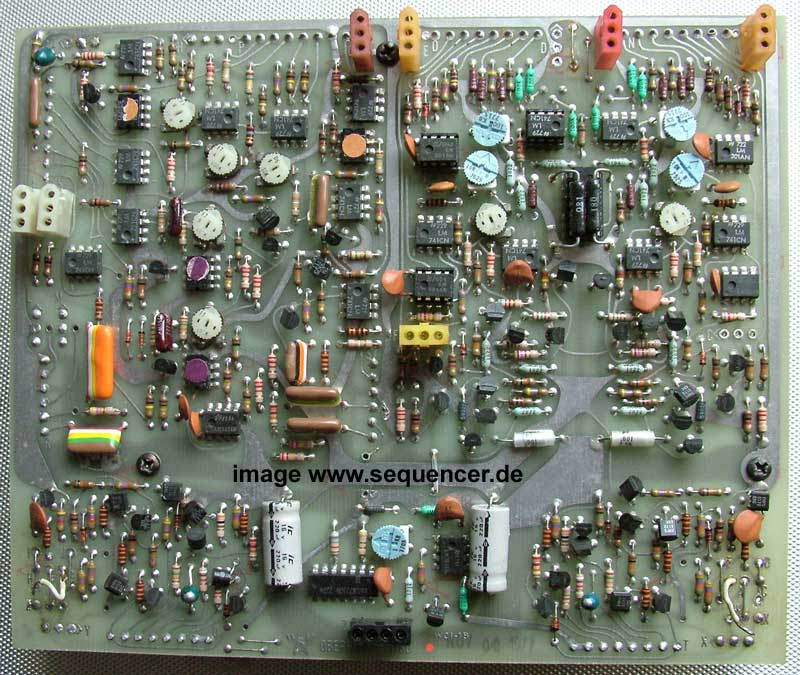
Regarding voice wiring, you can see the similarities of the SEM and a voice card of OB-X here:

SEM (click to enlarge):
Image

Top right: Oscillators (Temco regulated), top left: filter, bottom left and right: discrete EGs

OB-X voicecard (featuring replaced trimpots, click to enlarge):
Image

Left side: Discrete oscillators (Temco regulated), top right: discrete filter (the small chips are just opamps), bottom right: the two CEM3310 envelope genarator chips (which replace the discrete ones of the SEM)

---

Post

izonin wrote:At least my results show that I didn't cheat.
Hmm...nope. I don't believe that anyone who really could hear a difference wouldn't also hear the noise floor (it was fairly obvious). Which leads me to conclude that you deliberately got one wrong so that you could then make the claim you just have.

Sneaky, but not sneaky enough. ;)

Post Reply

Return to “Instruments”