Research on "humanizing" beats & natural rhythmic imperfections

Anything about MUSIC but doesn't fit into the forums above.
RELATED
PRODUCTS

Post

Interesting article on in Phyiscs Today with the following link to some examples:

http://www.nld.ds.mpg.de/~holgerh/drum.html
http://www.nld.ds.mpg.de/~holgerh/gallery

Basically, there are long-range correlations in human rhythm generation - patterns in the noise - such that white-noise humanization algorithms don't' do the best job of modeling natural-sounding beats. It's interesting to listen to the difference between the examples, though it's hard to tell if I was already biased to have a preference by knowing the preferred result. There's also a link for participating in research.

Will read more about this when I have time, but it looks interesting.

(I like saying "rhythm algorithm" :wheee: )

Post

It's hard to make those Bach inventions sound anything more than a rigidly quantized MIDI sequence... cuz that's how it's written and intended to sound. Better, well-placed dynamics over broad sections would help, as would not using that cheezy GM piano sound. :roll:

Glenn Gould himself can't help sounding a bit machine-perfect 90% of the time with such material...


Notice the dynamics though... adds a flowing quality... you don't need an algorithm for such dynamics, though, only a continuous, user-drawn curve.

That pop song though... oh, My Lord is that irritating... no session musician worth his hourly fee would fluctuate like that. That particular tune exudes a bit of high energy... the rhythm section should be on top of the beat, never lagging! The drums and bass should be push push pushing, with the chunky guitars as a whole closer to spot on to slightly lagging to give it that somewhat sloppy power pop vibe. Those arbitrariy stalls are just totally unnatural, and to my ears quite a bit annoying!

The s=7.5 versions are less noticeable, but there are still moments where you can hear things lag a bit... like, let's push the energy here, fellas. but I can't blame the computer... it only knows how to compute standard deviations, white noise, and random fluctuations. :lol:
You need to limit that rez, bro.

Post

those humanizing examples are awful and worthless.

out of rhythm,cut off notes,nobody would play like this.

Post

I'm not a humanizing expert, but in my ears the humanized audio examples are not sounding "human" at all, but even more artificial then the non-humanized ones.

The beat of the humanized pop song sounds as if the drummer were under influence of drugs... :lol:

Do we really need humanizing algorithms, can't we simply humanize manually?
:?

Post

I think the issue, for example, is that even, say, a good percussionist can never play perfectly on the beat, but his fluctuations follow a predictable pattern, as opposed to just averaging +/- 1% fluctuation with a gaussian distribution, etc.

Even if you are playing percussion (rather than programming it/drawing it in) on pads/midi keyboards, latency issues , the unnatural feel of the input device, etc., often results in less-than-satisfactory results, as compared to the type of tempo variations a percussionist playing a real conga might produce

IMHO there's still value in determining how to best randomize a beat so it sounds natural. I do tend to "un-quantize" by hand, but there are no guidelines as to what those random patterns should be to mimic natural playing. It may be, for example, that percussionists (unconsciously) often anticipate the beat more often for certain motifs, or leading into a chorus, and lay behind a bit for others, or are even affected by harmonic changes (slowing down minutely during a minor chord, etc.).

And yes - any time academics provide musical examples they generally suck! :D But they may still hold valid for testing preferences among the general population, who don't hear one note of a GM piano and barf. :hihi:

What did the drummer say to the band leader?
Want me to play too fast or too slow?

Post

I don't think there's a "one-size-fits-all" solution. It depends on the character and the mood of the drummer, on the song part (if there is a chorus line or a verse or a bridge), on the situation itself, on the distractions and much more...

So if my intention was to imitate a real drummer, I would humanize manually. I don't believe that any humanizing algorithm could substitute the playing style of a real drummer. There is too much randomizing, while a real drummer "humanizes" dependent on the situation.

Post

Tricky-Loops wrote:I don't think there's a "one-size-fits-all" solution. It depends on the character and the mood of the drummer, on the song part (if there is a chorus line or a verse or a bridge), on the situation itself, on the distractions and much more...

So if my intention was to imitate a real drummer, I would humanize manually. I don't believe that any humanizing algorithm could substitute the playing style of a real drummer. There is too much randomizing, while a real drummer "humanizes" dependent on the situation.
Agree for the most part, but my confusion is:

If you are trying to imitate a real drummer by humanizing manually, what heuristics do you use to determine how to do that? In other words, unless we understand what makes a real drummer "human" - the characteristics of the randomness - how do we imitate it? Whether an algorithm does it, or we do it drawing on a piano roll makes less difference than what it is we do.

The gist is that simply randomly distributing the beats of a quantized drum part, for example, does not in fact mimic a real drummer (whether done by an algorithm or by human "hand").

Then again, if we get used to quantized or randomly distributed de-quantized beats, we might eventually find THAT preferable to the real thing. :-o

Post

Well you might.

There is a certain amount of art to controlling how far off a beat should fall.

As far as a studio musician and hitting the mark. I take great umbrage with that statement having several thousand sessions under my belt. Generally speaking there are several styles that don't sound natural when one tries to quantize a particular beat/feel.

Look no further then Keith Richards. When he first started with the rolling stones his timing was more precise and less rigid. After studying under Ry Cooder his playing changed varying where the note fell. As a result his playing was more bluesier it had/has swagger.

In Eric Turkel's book Arranging techniques for Synthesists
http://www.amazon.com/Arranging-Techniq ... 082561130X

He goes into great detail about the why's and wherefores of timing and articulation of various performers and there instruments.

It is similar to the instability of tuning on a guitar.
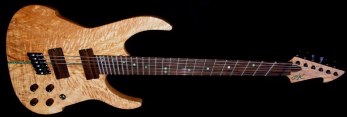
Todd Keehn makes a very unique guitar that while not being of perfect intonation comes much further then traditional guitar neck design.
Image

Guitar manufacturers have long known that the current fretboard layout is a poor design for note accuracy and still persist in making guitars necks the same way they always have. And people have been slow if at all to adapt to a better design. Why? Guitarists are used to the slightly out of tune sound of the guitar and having one that is much closer to Equal temperament somehow sounds wrong to them. They'd rather have the character of a slightly unequally tuned instrument then one that produces a more accurate tuning across the frets.
Dell Vostro i9 64GB Ram Windows 11 Pro, Cubase, Bitwig, Mixcraft Guitar Pod Go, Linntrument Nektar P1, Novation Launchpad

Post

JoeCat wrote:If you are trying to imitate a real drummer by humanizing manually, what heuristics do you use to determine how to do that? In other words, unless we understand what makes a real drummer "human" - the characteristics of the randomness - how do we imitate it? Whether an algorithm does it, or we do it drawing on a piano roll makes less difference than what it is we do.

The gist is that simply randomly distributing the beats of a quantized drum part, for example, does not in fact mimic a real drummer (whether done by an algorithm or by human "hand").

Then again, if we get used to quantized or randomly distributed de-quantized beats, we might eventually find THAT preferable to the real thing. :-o

In the case of humanizing drums, in particular, I would actually prioritize as follows:

1.) nuance wrt. dynamics

2.) nuance wrt. variation

3.) nuance wrt. timing -- both intentional and unintentional

The first two add "interest". The third is primarily intentional for the purpose of adding interest, but is secondarily unintentional in that timing is obviously affected by a human's inability to be machine-perfect to within nanoseconds of accuracy. But most importantly, timing nuance is intentional, not random!

Specifically with regard to rhythm section work, you have playing behind the beat, playing on top of the beat, playing time against time (esp. at micro levels, like what is commonly done on a hihat), etc. etc. These things are all about "feel", "groove", "push", "pull", "momentum", "energy", "rhythmic complexity" (e.g., polyrhythms), "accents", etc., which are the result of a continuum of expressive thought, not randomness.
You need to limit that rez, bro.

Post

kbaccki wrote: But most importantly, timing nuance is intentional, not random!

Specifically with regard to rhythm section work, you have playing behind the beat, playing on top of the beat, playing time against time (esp. at micro levels, like what is commonly done on a hihat), etc. etc. These things are all about "feel", "groove", "push", "pull", "momentum", "energy", "rhythmic complexity" (e.g., polyrhythms), "accents", etc., which are the result of a continuum of expressive thought, not randomness.
Exactly. What I'm wondering is, how one determines what is natural for someone playing a particular instrument in a particular context? Does it sound more natural in a certain genre, for example, if the drummer pushes the beat ahead of the chorus, then lays back during the verse? What are the incongruities in Bonham's "shuffle" that makes it so awesome? You can of course program that manually, but you need to know what you are after. Stating the obvious (and repeating what you said earlier), one can't just randomly push a few notes off the beat in any direction (white noise) and assume they're achieving a natural groove.

I think it's worse when trying to emulate instruments like a piano (I play both piano and drums, though not professionally). For example, in a set of triplets whereby the 1st and 3rd notes repeat and the 2nd changes, carrying a melody, the piano player might impart a natural rubato whereby (besides accenting the melodic note) he/she holds that note a bit longer, and robs the third note of its time - playing in strict tempo but an unequal distribution of the triplet times. The notes are not quantized to the triplet beat, but they are certainly not randomly distributed off the beat.

Any algorithm that tried to capture that (and similar for drums, etc.), would have to understand the context of the music.

(Which makes me think about what you said about drawing a curve. Do any applications allow you to do that - draw a curve over midi pushes/pulls the notes? That would be awesome...)

Or as a famous physicist once said, "Gould does not play dice". (that was the quote, wasn't it?) :hihi:

Post

tapper mike wrote:There is a certain amount of art to controlling how far off a beat should fall.

As far as a studio musician and hitting the mark. I take great umbrage with that statement having several thousand sessions under my belt. Generally speaking there are several styles that don't sound natural when one tries to quantize a particular beat/feel.

Look no further then Keith Richards. When he first started with the rolling stones his timing was more precise and less rigid. After studying under Ry Cooder his playing changed varying where the note fell. As a result his playing was more bluesier it had/has swagger.
great points.

music played by hand breathes, flows, expands, contracts. it's contextual. music played by humans doesn't conform to a metronome very tightly.

there was a tutorial video explaining the timeline warp feature new to Cubase at some version. very enlightening; the workflow is find the tempo by locating the downbeats/bars from a piece of imported audio, you drag the bar lines in the timeline to your downbeats, and if you like to beats within the bar... used a Pretenders track, solid, steady rock track. it was found that the actual BPMs were all over the place.

I wouldn't expect much joy from trying to find a science to it. it's going to be context-dependent. reggae swing isn't even going to be the same from this to that to the other thing. it might vary so widely in a single rhythn guitarit's performance as to be impossible to boil down.

I have a LOT of experience with moving things around in a timeline creating the effect of live via MIDI. It's a very complex thing, the push and pull of time.

it surely isn't random. even to find actual groove off the record you like, and go to make a template to over-quantise your parts, a real groove is not the same bar to bar.

getting music to happen is labor-intensive at some level, really it is. I think doing music for real is more fun than maths myself. but beyond a point, seeking to reduce the effort involved is going to tell on you. it's more honest to get your hands dirty IME.

Post


Post

kbaccki wrote:In the case of humanizing drums, in particular, I would actually prioritize as follows:

1.) nuance wrt. dynamics

2.) nuance wrt. variation

3.) nuance wrt. timing -- both intentional and unintentional
^^ this :tu:

a heavily-quantised, dynamically-nuanced performance, will sound more human than a sloppily-timed, dynamically-rigid performance. one will sound like a very good drummer, while the other will sound like a very bad drum machine

i get around this issue by playing my beats in by hand, then editing in the piano roll to reign in notes that have really strayed. takes practise, but is much more satisfying

Post

arkmabat necro'ed this thread


what makes one drummer human may not be the same thing as another drummer. can an algo contribute meaningfully to a performance.. consider if the implementation is intrinsic to the performance, in which case it is essential, or if it is a "black box solution" for magically squirting over quantised beats to turn them into awesome.

i think the latter perhaps exists more in the imagination of people who are desperately waiting for someone to sell them something. people who should quit feeling comfortable about having "professionals" do everything and learn to actually code if they're going to use computers for composition, so they understand the real meaning of things.
you come and go, you come and go. amitabha neither a follower nor a leader be tagore "where roads are made i lose my way" where there is certainty, consideration is absent.

Post

el-bo (formerly ebow) wrote:a heavily-quantised, dynamically-nuanced performance, will sound more human
F E E D
Y O U R
F L O W

Post Reply

Return to “Everything Else (Music related)”