

Excellent!Galbanum wrote:Updated manual is online now. It's not 100% complete quite yet but it is getting there and is much more thorough than the previous temp version. Final version some time next week. Thanks.jbraner wrote:Andrew,full and final manual text for these features:
Can you give us a shout here when the final manual is ready? The web site still has the "preliminary" one
Thanks.

2CAudio B2: Full Body. Maximum Attitude.
-
- KVRian
- 788 posts since 18 Sep, 2010


-

- KVRAF
- Topic Starter
- 2621 posts since 12 Sep, 2008
All your E Piano Are Belong To Us!
http://soundcloud.com/2caudio/b2-instru ... rew-souter
http://soundcloud.com/2caudio/b2-instru ... w-souter-e
Three voices of Logic EVP88.
Two instances of B2. One for Bass and mids, medium chamber-ish preset using ER + LR configuration. One for soaked high melody using Cascade configuration preset...
http://soundcloud.com/2caudio/b2-instru ... rew-souter
http://soundcloud.com/2caudio/b2-instru ... w-souter-e
Three voices of Logic EVP88.
Two instances of B2. One for Bass and mids, medium chamber-ish preset using ER + LR configuration. One for soaked high melody using Cascade configuration preset...
-
- Banned
- 22457 posts since 5 Sep, 2001
[DELETED]
-

- KVRAF
- 2707 posts since 23 Mar, 2005 from Detroit
I listened to the the wet then the dry and then was like, can I haz reverbs, specially on da leeds partz.
-
- KVRAF
- Topic Starter
- 2621 posts since 12 Sep, 2008
All your Breaks are belong to us!
http://soundcloud.com/2caudio/b2-mix-an ... uter-idm-1
http://soundcloud.com/2caudio/b2-mix-andrew-souter-idm
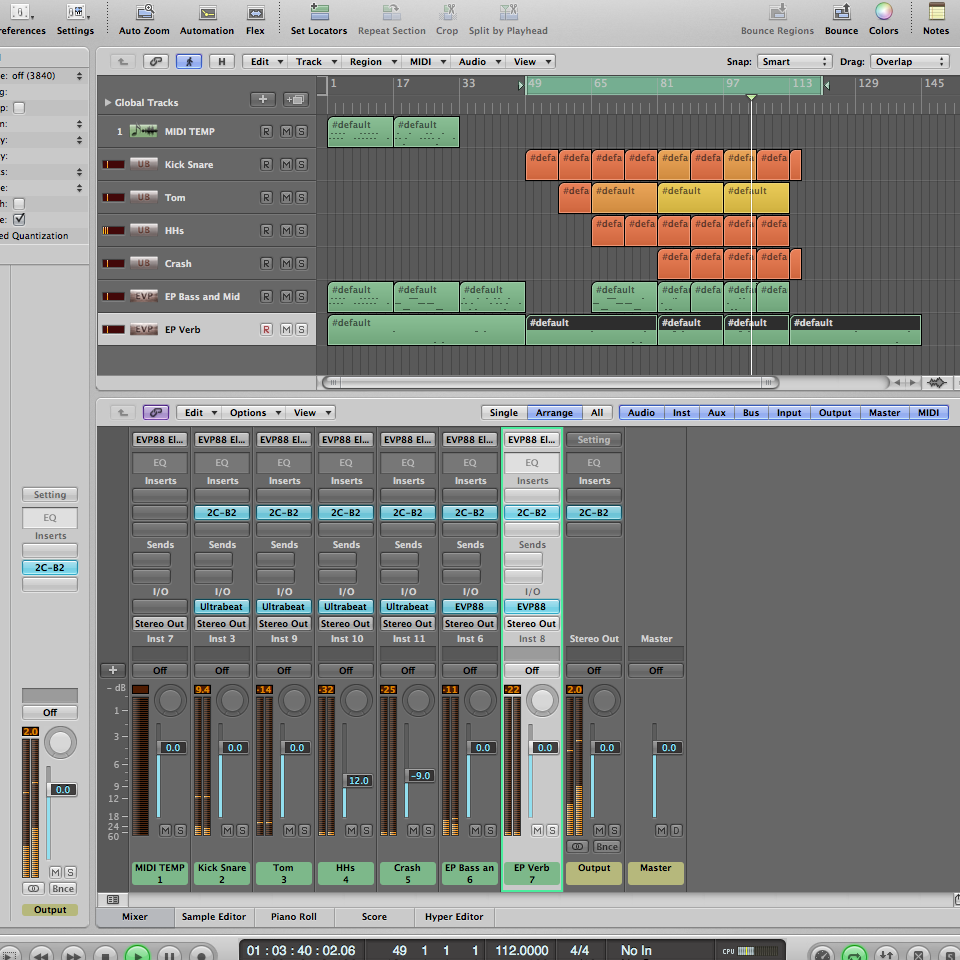
Tools used: Logic + B2. Nothing else! Not really mixed perfectly or mastered, but sounds quite nice for a 45min experiment...
4 UltraBeat
2 EVP88
7 B2
Nothing else. (intentionally using limited tool set to show off B2 features)
Kick & Snare B2 uses extreme Attitude + Side-chained Gated verb
Tom B2 B2 uses extreme Attitude + verb (same as kick and snare but not gated)
HHs and Crash use clean verbs, crash uses longer tail variation of the same preset
Bass and Mid EP use medium chamber-ish dual engine preset using ER/LR config
Wet EP, uses dual engine Cascaded config
Master bus uses Attitude only preset for Saturation (in place of using a limiter... though in a final project I would also use third parting comp and limters...)
http://soundcloud.com/2caudio/b2-mix-an ... uter-idm-1
http://soundcloud.com/2caudio/b2-mix-andrew-souter-idm
Tools used: Logic + B2. Nothing else! Not really mixed perfectly or mastered, but sounds quite nice for a 45min experiment...
4 UltraBeat
2 EVP88
7 B2
Nothing else. (intentionally using limited tool set to show off B2 features)
Kick & Snare B2 uses extreme Attitude + Side-chained Gated verb
Tom B2 B2 uses extreme Attitude + verb (same as kick and snare but not gated)
HHs and Crash use clean verbs, crash uses longer tail variation of the same preset
Bass and Mid EP use medium chamber-ish dual engine preset using ER/LR config
Wet EP, uses dual engine Cascaded config
Master bus uses Attitude only preset for Saturation (in place of using a limiter... though in a final project I would also use third parting comp and limters...)
-
- KVRAF
- Topic Starter
- 2621 posts since 12 Sep, 2008
Final manual info regarding Attitude:
////////////////////////////////////////////////////////
Attitude (Knob)
The Attitude control adds non-linear distortion to the signal. It is measured in percent and has a range of 0% to 100%. Higher knob values add more distortion. All Attitude functions are optimized to give a fairly moderate effect at the 50% knob value, and generally could be used on most musical material without extreme distortion, particularly when applied to input. This is usually about as far as you want to push things unless you are intentionally moving into sound-design territory.
Low to moderate Attitude values can give a sonic character similar to the imperfections of various classical hardware devices that had to deal with electrical engineering issues such as poor power supplies and other real-world things we don't claim to fully understand all the details of. Extreme Attitude values allow you to spectrally shift, mangle, strangle, torment, decimate, destroy, warp, shred, bit-crush, and generally mess up your audio. Sometimes in order to create, you must first destroy, and this feature is a favorite among sound-designers and more adventurous electronic music producers. Extreme Attitude settings work best on drums, basses, monophonic leads, and synth pads with few transients.
Note: All Attitude types employ advanced mathematics that attempt to preserve the average energy of the signal for all possible settings. This generally works perfectly under "lab conditions" where a full scale while noise or saw wave signal is used as the input. In real-world use however, the input signal and its energy content is unknown, and thus preserving the total energy of the signal is impractical or impossible. Extreme Attitude settings can therefore have a fairly drastic effect on the RMS level of some input signals. This becomes even more true if the input signal is not close to being full scale. Adjust the global Gain control to taste when using extreme Attitude settings in order to maintain similar levels between the input and output signals.
////////////////////////////////////////////////////////
Attitude (Knob)
The Attitude control adds non-linear distortion to the signal. It is measured in percent and has a range of 0% to 100%. Higher knob values add more distortion. All Attitude functions are optimized to give a fairly moderate effect at the 50% knob value, and generally could be used on most musical material without extreme distortion, particularly when applied to input. This is usually about as far as you want to push things unless you are intentionally moving into sound-design territory.
Low to moderate Attitude values can give a sonic character similar to the imperfections of various classical hardware devices that had to deal with electrical engineering issues such as poor power supplies and other real-world things we don't claim to fully understand all the details of. Extreme Attitude values allow you to spectrally shift, mangle, strangle, torment, decimate, destroy, warp, shred, bit-crush, and generally mess up your audio. Sometimes in order to create, you must first destroy, and this feature is a favorite among sound-designers and more adventurous electronic music producers. Extreme Attitude settings work best on drums, basses, monophonic leads, and synth pads with few transients.
Note: All Attitude types employ advanced mathematics that attempt to preserve the average energy of the signal for all possible settings. This generally works perfectly under "lab conditions" where a full scale while noise or saw wave signal is used as the input. In real-world use however, the input signal and its energy content is unknown, and thus preserving the total energy of the signal is impractical or impossible. Extreme Attitude settings can therefore have a fairly drastic effect on the RMS level of some input signals. This becomes even more true if the input signal is not close to being full scale. Adjust the global Gain control to taste when using extreme Attitude settings in order to maintain similar levels between the input and output signals.
-
- KVRAF
- Topic Starter
- 2621 posts since 12 Sep, 2008
Attitude Type and Routing (Menu)
The Attitude menu contains two separate selection options: Attitude Type, and Attitude Routing. These are two separate preset attributes that are handled by this single menu.
B2 offers the following Attitude Types:
• Sat I A gentle Saturation function that adds a few odd harmonics
• Sat II A slightly less gentle Saturation function that adds a few odd harmonics
• Soft I A gentle Soft-Clip function that adds a few more odd harmonics
• Soft II A slightly less gentle Soft-Clip function that adds more odd harmonics
• Med A Medium knee clip function that adds many odd harmonics
• Hard A Hard-Clip function that adds and almost infinite number of odd harmonics and will alias
• Tube I A Tube function that adds both odd and even harmonics and increases dynamic range
• Tube II Another Tube function that adds both odd and even harmonics and increases dynamic range
• Fat A sigmoid saturation function that adds only odd harmonics and decreases dynamic range
• Thin An inverse saturation function that adds only odd harmonics and increases dynamic range
• Big An inverse power function that adds only odd harmonics and decreases dynamic range
• Small A power function that adds only odd harmonics and increases dynamic range
• Warm A gentle function that adds only the second harmonic
• Harm I A gentle function that adds only the second and third harmonic
• Harm II A gentle function that adds only the second and fourth harmonic
• Two The second Chebyshev polynomial, with variable mix weight
• Three The third Chebyshev polynomial, with variable mix weight
• Four The fourth Chebyshev polynomial, with variable mix weight
• Five The fifth Chebyshev polynomial, with variable mix weight
• Six The sixth Chebyshev polynomial, with variable mix weight
• Seven The seventh Chebyshev polynomial, with variable mix weight
• Eight The eighth Chebyshev polynomial, with variable mix weight
• Nine The ninth Chebyshev polynomial, with variable mix weight
• Oct Adds even harmonics accenting the second, fourth, and eighth harmonic
• Wood Adds odd harmonics
• Color Adds the second, third, and fourth harmonic in random weightings
• Hue Adds the second, third, and fourth harmonic in random weightings
• Even Adds only even harmonics and removes the fundamental
• Scream Adds many odd harmonics in an aggressive manner
• Shout Adds many even harmonics in an aggressive manner and removes the fundamental
• Warp Adds many odd harmonics in an aggressive manner and will alias
• Shred Adds many odd and even harmonics in an aggressive manner
• Bits A bit reduction function that gives a range of 18 to 2 bits. 50% knob position is 10- bits.
B2 offers the following Attitude Routings:
• Input Pre-Dynamics
• Input Post-Dynamics
• Output Pre-EQ
• Output Post-EQ
Input routings generally have a less sever effect than output routings. Input routings will expand the bandwidth of the signal prior to going into the reverb structure of the engine where modulation, feedback, and damping will tame the effects of the distortion some by smearing the local resonant peaks that are a product of the input signal, the reverb settings, and the Attitude control. Input positions can be used to spectrally shift the energy of the reverb tails upwards into higher harmonics. This can be particularly interesting with bass sounds.
When using moderate to extreme Attitude settings together with B2's Dynamics engine, subtle differences can be achieved depending on whether or not the Attitude function is applied either pre or post Dynamics. If it is applied after the dynamics engine, this will create a spectral envelope in the source sound where the harmonic content and the character of the distortion imposed by Attitude control will be variable over time depending on the Dynamics settings. This can be very interesting in and of itself even without engaging B2's reverb engines.
Output routings are generally more severe in effect than input routings. This is do to the fact that the reverb engine creates thousands or even millions of copies of the input signal which are modulating in complex ways and create both constructive and destructive interference when mixed together with one another. When such a signal is subjected to a non-linear distortion process such as B2's Attitude control, "intermodulation distortion" occurs as well. In the input routing case non-linear distortion creates harmonics which are simply integer multiples of the harmonic/spectral content of the input signal. If the input is a sine wave at 100 hertz, the output will have energy at 100, 200, 300, 400, etc. Hertz. In the output routing case we no longer have only one 100-Hertz sine wave component in the signal. We have potentially millions of sine waves! We may have something like: 99.812, 99.976, 100.023, 100.156, 100.231 etc. Each of these will produce its own set of harmonics. Furthermore the difference signal between each pair of sine waves (i.e. 100.231 - 99.812 = 0.419 Hertz) will produce its own set of harmonics using the difference signal as the fundamental. The mathematics of combinations and permutations dictates that there will be trillions or more of such potential interactions. Moreover the constructive and destructive interference of all these various signals will sum to create a rough amplitude envelope that will give random amplitude modulations in the signal. This will cause the spectral components introduced by the non-linear distortion to evolve and shift over time in a complex and effectively random fashion. The end result is incredibly unpredictable and depends greatly on the selected Attitude type as well as the nature of the input signal. This is a very novel area to explore for advanced sound-designers and can lead to all kinds of novel textures and sonic treasures.
When using output positions an additional level of refinement is possible depending upon whether the Attitude function comes before or after the output filter. This difference can range from subtle to drastic depending on the EQ filter type and severity as well as the current Attitude settings. Each method has its merits, and experimentation is the key here.
Attitude Disable (Special Feature Button)
The Attitude Disable Special Feature Button is directly to the left of the Attitude label. Engaging this control disables the Attitude distortion process completely and saves CPU resources.
The Attitude menu contains two separate selection options: Attitude Type, and Attitude Routing. These are two separate preset attributes that are handled by this single menu.
B2 offers the following Attitude Types:
• Sat I A gentle Saturation function that adds a few odd harmonics
• Sat II A slightly less gentle Saturation function that adds a few odd harmonics
• Soft I A gentle Soft-Clip function that adds a few more odd harmonics
• Soft II A slightly less gentle Soft-Clip function that adds more odd harmonics
• Med A Medium knee clip function that adds many odd harmonics
• Hard A Hard-Clip function that adds and almost infinite number of odd harmonics and will alias
• Tube I A Tube function that adds both odd and even harmonics and increases dynamic range
• Tube II Another Tube function that adds both odd and even harmonics and increases dynamic range
• Fat A sigmoid saturation function that adds only odd harmonics and decreases dynamic range
• Thin An inverse saturation function that adds only odd harmonics and increases dynamic range
• Big An inverse power function that adds only odd harmonics and decreases dynamic range
• Small A power function that adds only odd harmonics and increases dynamic range
• Warm A gentle function that adds only the second harmonic
• Harm I A gentle function that adds only the second and third harmonic
• Harm II A gentle function that adds only the second and fourth harmonic
• Two The second Chebyshev polynomial, with variable mix weight
• Three The third Chebyshev polynomial, with variable mix weight
• Four The fourth Chebyshev polynomial, with variable mix weight
• Five The fifth Chebyshev polynomial, with variable mix weight
• Six The sixth Chebyshev polynomial, with variable mix weight
• Seven The seventh Chebyshev polynomial, with variable mix weight
• Eight The eighth Chebyshev polynomial, with variable mix weight
• Nine The ninth Chebyshev polynomial, with variable mix weight
• Oct Adds even harmonics accenting the second, fourth, and eighth harmonic
• Wood Adds odd harmonics
• Color Adds the second, third, and fourth harmonic in random weightings
• Hue Adds the second, third, and fourth harmonic in random weightings
• Even Adds only even harmonics and removes the fundamental
• Scream Adds many odd harmonics in an aggressive manner
• Shout Adds many even harmonics in an aggressive manner and removes the fundamental
• Warp Adds many odd harmonics in an aggressive manner and will alias
• Shred Adds many odd and even harmonics in an aggressive manner
• Bits A bit reduction function that gives a range of 18 to 2 bits. 50% knob position is 10- bits.
B2 offers the following Attitude Routings:
• Input Pre-Dynamics
• Input Post-Dynamics
• Output Pre-EQ
• Output Post-EQ
Input routings generally have a less sever effect than output routings. Input routings will expand the bandwidth of the signal prior to going into the reverb structure of the engine where modulation, feedback, and damping will tame the effects of the distortion some by smearing the local resonant peaks that are a product of the input signal, the reverb settings, and the Attitude control. Input positions can be used to spectrally shift the energy of the reverb tails upwards into higher harmonics. This can be particularly interesting with bass sounds.
When using moderate to extreme Attitude settings together with B2's Dynamics engine, subtle differences can be achieved depending on whether or not the Attitude function is applied either pre or post Dynamics. If it is applied after the dynamics engine, this will create a spectral envelope in the source sound where the harmonic content and the character of the distortion imposed by Attitude control will be variable over time depending on the Dynamics settings. This can be very interesting in and of itself even without engaging B2's reverb engines.
Output routings are generally more severe in effect than input routings. This is do to the fact that the reverb engine creates thousands or even millions of copies of the input signal which are modulating in complex ways and create both constructive and destructive interference when mixed together with one another. When such a signal is subjected to a non-linear distortion process such as B2's Attitude control, "intermodulation distortion" occurs as well. In the input routing case non-linear distortion creates harmonics which are simply integer multiples of the harmonic/spectral content of the input signal. If the input is a sine wave at 100 hertz, the output will have energy at 100, 200, 300, 400, etc. Hertz. In the output routing case we no longer have only one 100-Hertz sine wave component in the signal. We have potentially millions of sine waves! We may have something like: 99.812, 99.976, 100.023, 100.156, 100.231 etc. Each of these will produce its own set of harmonics. Furthermore the difference signal between each pair of sine waves (i.e. 100.231 - 99.812 = 0.419 Hertz) will produce its own set of harmonics using the difference signal as the fundamental. The mathematics of combinations and permutations dictates that there will be trillions or more of such potential interactions. Moreover the constructive and destructive interference of all these various signals will sum to create a rough amplitude envelope that will give random amplitude modulations in the signal. This will cause the spectral components introduced by the non-linear distortion to evolve and shift over time in a complex and effectively random fashion. The end result is incredibly unpredictable and depends greatly on the selected Attitude type as well as the nature of the input signal. This is a very novel area to explore for advanced sound-designers and can lead to all kinds of novel textures and sonic treasures.
When using output positions an additional level of refinement is possible depending upon whether the Attitude function comes before or after the output filter. This difference can range from subtle to drastic depending on the EQ filter type and severity as well as the current Attitude settings. Each method has its merits, and experimentation is the key here.
Attitude Disable (Special Feature Button)
The Attitude Disable Special Feature Button is directly to the left of the Attitude label. Engaging this control disables the Attitude distortion process completely and saves CPU resources.
-
 Sampleconstruct Sampleconstruct https://www.kvraudio.com/forum/memberlist.php?mode=viewprofile&u=191286
 - KVRAF
- 16748 posts since 12 Oct, 2008 from Here and there
This Soundscape I made last night uses 1 engine in "only-attitude"-mode for all the distortion you hear and it is then cascaded into a longer space in the second engine. I really like the sound of the Attitudes and now often use a dedicated instance of B2 only for distortion/saturation, substituting and/or complementing my other distortion and saturation tools. So much to explore...
http://soundcloud.com/sampleconstruct/u ... atmosphere
http://soundcloud.com/sampleconstruct/u ... atmosphere

-
Sampleconstruct Sampleconstruct https://www.kvraudio.com/forum/memberlist.php?mode=viewprofile&u=191286
- KVRAF
- 16748 posts since 12 Oct, 2008 from Here and there


-
- Banned
- 22457 posts since 5 Sep, 2001
[DELETED]
-
- KVRAF
- Topic Starter
- 2621 posts since 12 Sep, 2008
This is exactly what Denis has been working on for the past few months. It is almost done...tlacuache wrote:64bit OSX support please!!!!!
I will share more info as soon as there is more info to share...
-
- KVRian
- 1290 posts since 13 Mar, 2007
contrary wrote:So is the manual done now ???
Should I DL the pdf ??
TX
???????????????????????????????????????????????????????????????????????????????????????????????????????????????????????????????????????????????????????????????????????????????????????????????????????????????????????????????????????????????????????????????????????????????????????????????????????????????????????????????????????????????????????????????????????????????????????????????????????????????????????????????????????????????????????????????????????????????????????????????????????????????????????????????????????????????????????????????????????????????

Financial solvency and KVR Mix as well as oil and water.