

Hi guys
There are true stereo reverbs out there, softube, relab, valhalla and I think either to name a few.
But in the final analysis when mixing electronic music, no mikes involved, does it really make a difference?
I theory I imagine you have better control over your final image, panning and width will stay true, but I've never paid any attention to this.
Just asking incase anyone knows from experience. I've not got the time to do any experimenting with this right now.
I think a lot of hardware reverbs are not true stereo right and studio's have been using them for years.
Sami

True Stereo Reverbs. A meaningful difference?
-

- KVRAF
- 4083 posts since 29 Jun, 2011 from USA
Aiynzahev-sounds
Sound Designer - Soundsets for Pigments, Repro, Diva, Virus TI, Nord Lead 4, Serum, DUNE2, Spire, and others
Sound Designer - Soundsets for Pigments, Repro, Diva, Virus TI, Nord Lead 4, Serum, DUNE2, Spire, and others
-
- KVRian
- 527 posts since 7 Apr, 2010
It's up to your ears.
I will say that more classical & orchestral composers are using algos these days. Less muddled mixes.
I will say that more classical & orchestral composers are using algos these days. Less muddled mixes.
-
- KVRAF
- 2432 posts since 15 Jul, 2004 from Italy
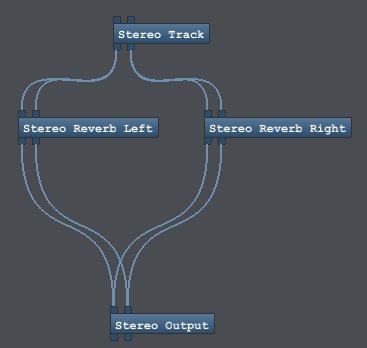
While I'm not sure about what "true stereo reverb" means, because if I got it right it is two separate channels for L-R in algorithmic reverbs and four separate channels for convolution reverbs (two for L and two for R), but I'm probably wrong, I'm sure more isn't always better for me.
E.g. I often prefer stereo convolution reverb settings (one channel for L and one for R) than the equivalent true stereo (four channels), because it sound more focused and with a more defined stereo image to me.
I very often prefer dual mono (L to left and R to right).
I think they all are simply different options for different tracks. The more options you have, the better you can mix and build the stereo image you want.
A true stereo reverb is the more versatile if you can setup it to work as simple stereo or mono to stereo.
I don't think the point is tracked or synthetic sound
E.g. I often prefer stereo convolution reverb settings (one channel for L and one for R) than the equivalent true stereo (four channels), because it sound more focused and with a more defined stereo image to me.
I very often prefer dual mono (L to left and R to right).
I think they all are simply different options for different tracks. The more options you have, the better you can mix and build the stereo image you want.
A true stereo reverb is the more versatile if you can setup it to work as simple stereo or mono to stereo.
I don't think the point is tracked or synthetic sound
-

- KVRAF
- 3426 posts since 15 Nov, 2006 from Pacific NW
If you aren't feeding the reverb a stereo source, it won't make much of a difference. Some stereo reverbs do a better job of retaining the panning position of mono sources than others, but many stereo reverbs just do something different for left and right channels. This is CRITICAL to avoid weird phasing issues with stereo miked recordings, but for panned mono sources it is less important.Aiynzahev wrote:Hi guys
There are true stereo reverbs out there, softube, relab, valhalla and I think either to name a few.
But in the final analysis when mixing electronic music, no mikes involved, does it really make a difference?
EDIT: If you are feeding a stereo effect into a reverb, it is best if it is a true-stereo reverb. For example, many ensemble/chorusing effects work in stereo, and summing these to mono *may* produce unwanted coloration. So this is a case where true stereo reverbs might be better for purely electronic sources.
Sean Costello
Last edited by valhallasound on Mon Oct 08, 2012 8:17 pm, edited 1 time in total.
-
- KVRAF
- 3426 posts since 15 Nov, 2006 from Pacific NW
Many high end reverbs are true stereo:Aiynzahev wrote: I think a lot of hardware reverbs are not true stereo right and studio's have been using them for years.
The Lexicon 224, 224XL, 480L & 300 were all true stereo. The PCM60, PCM70, and the LXP series were all mono-in, but this was due to the high cost of A/D convertors in those days - almost all the Lexicon algorithms were stereo-in, stereo-out.
The EMT250 was mono-in, quad-out.
The Quantecs were usually stereo-in, quad-out.
I forget how the RMX16 worked.
The reverbs in my H3000 are mono-in, stereo-out. The Stereo Room in the SP2016 is true stereo. Most modern Eventide algorithms (i.e. DSP4000 and up) are true stereo.
The TC reverbs apparently had true stereo early reflections, but mono-in late reverbs.
Most EMT plates were mono-in, stereo-out, although I think that they could be modified to be stereo-in. The signals would mix almost instantly, so the main differences between left inputs and right inputs would be phase, but this is true of some true stereo reverbs as well.
Sean Costello
-
- KVRAF
- 1724 posts since 10 Feb, 2008 from Berlin, Germany
True Stereo can actually make a night and day difference to just stereo reverb.Aiynzahev wrote:There are true stereo reverbs out there, softube, relab, valhalla and I think either to name a few.
But in the final analysis when mixing electronic music, no mikes involved, does it really make a difference?
With True Stereo Reverb you will be able to get a much better seperation of your elements in the mix and a much more natural sound!
I think I have an audio example somewhere, which demonstrates it.
Edit:
https://www.box.com/s/cf78f28777e95853cdbc
What you described as Dual Mono is just Stereo, or no?quintosardo wrote:E.g. I often prefer stereo convolution reverb settings (one channel for L and one for R) than the equivalent true stereo (four channels), because it sound more focused and with a more defined stereo image to me.
I very often prefer dual mono (L to left and R to right).
If you compare Stereo vs. True Stereo, make sure, you do actually compare the same "amount of panning". Stereo will always sound wider than True Stereo.
If you compare similar levels of wideness, you will see, that True Stereo is actually giving a lot more definition than just Stereo.
-
- KVRAF
- 2432 posts since 15 Jul, 2004 from Italy
Mh... no , I meant L and R going to a couple of exactly identical channels.
Yes, the feeling with true stereo is less width, I have to test your suggestion comparing stereo and true stereo at similar levels of wideness.
Yes, the feeling with true stereo is less width, I have to test your suggestion comparing stereo and true stereo at similar levels of wideness.
-

- KVRAF
- 2324 posts since 22 Aug, 2006
This Reaper thread is worth a look. I learnt a lot from this regarding True Stereo reverb.
http://forum.cockos.com/showthread.php?t=67620
http://forum.cockos.com/showthread.php?t=67620
satYatunes.com
Discover free skins, themes, plugins, deals and soundsets. Sell and promote your product.
Follow us on Facebook, Twitter, Instagram for latest updates.
Discover free skins, themes, plugins, deals and soundsets. Sell and promote your product.
Follow us on Facebook, Twitter, Instagram for latest updates.
-

- KVRAF
- 7691 posts since 11 Jun, 2006
this!Nokenoku wrote: With True Stereo Reverb you will be able to get a much better seperation of your elements in the mix and a much more natural sound!
i like TAL Reverb2 its a great true stereo plate reverb
HW SYNTHS [KORG T2EX - AKAI AX80 - YAMAHA SY77 - ENSONIQ VFX]
HW MODULES [OBi M1000 - ROLAND MKS-50 - ROLAND JV880 - KURZ 1000PX]
SW [CHARLATAN - OBXD - OXE - ELEKTRO - MICROTERA - M1 - SURGE - RMiV]
DAW [ENERGY XT2/1U RACK WINXP / MAUDIO 1010LT PCI]
HW MODULES [OBi M1000 - ROLAND MKS-50 - ROLAND JV880 - KURZ 1000PX]
SW [CHARLATAN - OBXD - OXE - ELEKTRO - MICROTERA - M1 - SURGE - RMiV]
DAW [ENERGY XT2/1U RACK WINXP / MAUDIO 1010LT PCI]
-
Echoes in the Attic Echoes in the Attic https://www.kvraudio.com/forum/memberlist.php?mode=viewprofile&u=180417
- KVRAF
- 12016 posts since 12 May, 2008
Is true stereo the same for algorithmic reverbs as for convolution? Ie. True stereo sends both the L and right channels through their won individual L and R processing signals?
And then for algorithmic, what is regular stereo? It's not left through just left and right through just right is it? I think that's dual mono... So I guess I'm not sure what regular stereo is.
And then for algorithmic, what is regular stereo? It's not left through just left and right through just right is it? I think that's dual mono... So I guess I'm not sure what regular stereo is.
-
- KVRAF
- 10260 posts since 19 Feb, 2004 from Paris
Yes it makes a difference in the mix : More space, another dimension, more details, and mak it easier to place signal in a mix. Some Xils synths/effects allow users to switch from True Stereo to *pan* and it makes a difference.
http://www.lelotusbleu.fr Synth Presets
77 Exclusive Soundbanks for 23 synths, 8 Sound Designers, Hours of audio Demos. The Sound you miss might be there
77 Exclusive Soundbanks for 23 synths, 8 Sound Designers, Hours of audio Demos. The Sound you miss might be there
-
- KVRAF
- 3426 posts since 15 Nov, 2006 from Pacific NW
Not necessarily. I would say that most algorithmic true stereo reverbs will have separate paths for left and right signals, but with the "left" path having taps to both the left and right output channels, and vice versa. In addition, the "left" path will usually end up recirculating through the "right" path at some point, and the "right" path will recirculate through the "left" path, but with enough randomization that it is harder to pick up on this pattern.Echoes in the Attic wrote:Is true stereo the same for algorithmic reverbs as for convolution? Ie. True stereo sends both the L and right channels through their won individual L and R processing signals?
I have read about some algorithmic reverbs that have separate paths for L->L, L->R, R->R, and R->L, but it is hard to tell whether this implies truly separate paths, or different output tap patterns for left and right outputs in a given path. If an algorithm is well designed, you wouldn't be able to tell whether a given stereo output comes from 2 parallel paths, or a single path that has different outputs for left and right.
Sean Costello