Jennings 1946 Valve Synth - new lower price!

Sampler and Sampling discussion (techniques, tips and tricks, etc.)
RELATED
PRODUCTS

Post

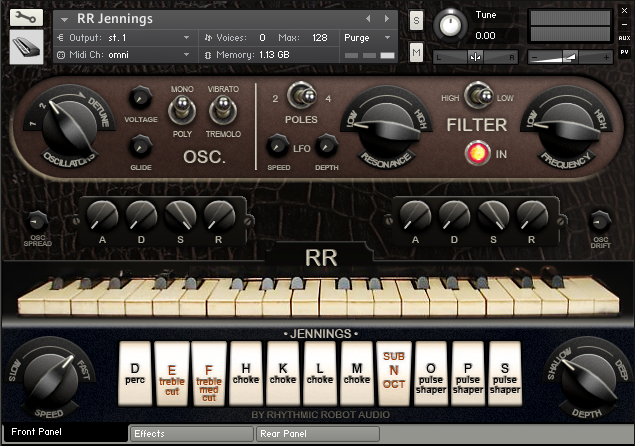
Computer Music have just reviewed Jennings, our meticulous recreation of a 1946-era valve (tube) synthesiser. They said

"Jennings has been beautifully realised and sounds gorgeous - weird, warm and characterful. It's a triumph of virtualisation."

But they also thought that, at £59.95, it was too expensive. And we do listen to these things, honest.

So Jennings is now just £44.95

That buys you an incredible, vintage tone and a host of contemporary sound-sculpting capabilities, all tied up in a lush UI that's bound to inspire. Just thought you'd like to know 8)

You can read more, and buy Jennings, here: http://www.rhythmicrobot.com/page0/page ... index.html
Image

Happy synthing!

The Professor (and Mongo)

Post

Awesome! thanks for the link!

Post

The Jennings Univox was 'invented' in 1951 not in 1946! It was a copy of the Clavioline (1948). To avoid copyright issues the Jennings factory changed the design of the oscillator, although the idea and the appearance was the same.

Post

007 wrote:The Jennings Univox was 'invented' in 1951 not in 1946! It was a copy of the Clavioline (1948). To avoid copyright issues the Jennings factory changed the design of the oscillator, although the idea and the appearance was the same.
Well, you could be right, because we can't be 100% sure on these dates - it was a long time ago, and the past is a different country :D . On the other hand, 1946 is the only date we could dig up when we went Scooby-searching for data on the Univox's birthday, and we got it from several places; it also makes sense in the timeline of Tom Jennings's company history, so until further evidence comes to light, we're sticking with it...

It's a rat's nest of information out there. For example, although you say the Clavioline is a 1948 instrument, both Sound on Sound and Wikipedia claim it was developed in 1947. And the Sound on Sound history of the Clavioline at http://www.soundonsound.com/sos/mar07/a ... ioline.htm (which is fascinating reading in its own right) notes that several Clavioline-alikes (like the Hammond Solovox) predate the Clavioline "by as much as seven years". Clearly the 40s were a boom time for developing valve-based synths, and the Univox was among these.

It has to be said, though, that the author also says in the same breath, "sources are not entirely definitive on the dates, and I wasn't around to confirm things one way or the other" - which is exactly the position we're in too!

The article at http://www.melbournemusiccentre.com.au/ ... nivox.html is pretty specific about the 1946 development date, and it tallies with the Wikipedia biography of Tom Jennings, where it mentions that " In 1946, Jennings set up his first shop in Dartford Kent and began importing accordions. He also started inventing new products, the first being the Univox Electronic organ, which was a huge success, and became the springboard from which he would build his instrument-manufacturing empire."

Now, we know that the Jennings Organ Company was founded in 1946, and it seems very reasonable that Tom called it an Organ Company (and not an Accordion Company) because he was already working with... you guessed it, organs. It's a bit of a jigsaw, but it kind of makes sense.

So... you can see that we tried very hard to do our homework properly on this one! If you've got better info than we found (which is entirely possible: Mongo isn't infallible and I let him do most of the work on this) do share it - we want to be accurate with our description of Jennings. But the dates we quote are very much the consensus of several sources - and we couldn't find anything that substantively disagreed with them. Meanwhile, one thing's for absolute certain: this is a pretty wonderful and mysterious machine! :D

Best wishes,

The Professor (and Mongo)

Post

Well, the webpage wich you give was written in 1997 and it gives the wrong inventor and the wrong date! The Univox was invented in 1951 by Leslie James Hilss and not by Underdown. Internet information is often copied including the mistakes. You can look at the patentnumbers which are written on the Univox.


The solovox is technical different to the clavioline although the clavioline copied it's appearance. The clavioline's design is a simple copy, or version if you like, of the Ondioline which was a very good and astonishing instrument. There are some good Ondioline examples on youtube.

Post

I hear what you're saying, but could you give some evidence for it? I can't find any references to Leslie James Hilss. Anywhere. (And I Googled him twice. TWICE!!! :D ). But a lot of sources reference Tom Jennings and Derek Underdown, of the Jennings Organ Company, developing the Jennings Univox valve organ, just as I've described. Not just the one article you say has got it wrong. If you know different, share! Tell us where you're getting this insider info :)

Not that it really matters one way or the other, since what we really care about is the sound of the thing... which is of course magnificent 8)

Post

Well, it does care regarding the history of electronic instruments.
One example : http://www.reinout.nl/?page_id=7

As said, look at the patents. Also all Univox instruments are dated.

Post

What you've pointed to there doesn't contradict what I and others are suggesting about 1946 being the start of the Univox's development. Derek Underdown says that Les Hills had been employed to copy, with modifications, the Clavioline's circuit layout (to avoid patent infringement), but that the resulting machine - cobbled together by the accordion shop staff - was unreliable and tended to break when it arrived in the hands of customers.

Underdown goes on to say "I was head hunted by Tom to sort out the reliability problems. This took a few months of circuit, component testing plus improvements to the mechanics. This was in 1951 period. In about 1951/1952 the Univox took off in a big way due to its competitive price and Tom's country wide marketing program."

Now, if in "1951 period" Underdown was troubleshooting, testing and improving a product that had quality issues and was dying on its customers, surely that product must already have been in production and shipping? Shoddy, yes, but developed. So for development to have started in 1946 is entirely credible: it just took Jennings five years to get to the point where Underdown was called in to help him out. Or am I missing something?

Thanks very much for the link to the info, though: another fascinating part of the jigsaw :D

Post

The Univox was designed in 1946 by Derek Underdown and Tom Jennings. It was manufactured in the 50s and 60s.

change "invented" with "designed" and everything is fine. :hihi:

auf wiedersehen!

Post

Well, you have a wide view of interpretation!

As said the link you provided gave the wrong inventor and the wrong date. Please do decent research yourself!
I gave enough information for research and quit the discussion.

Post

Sounds really nice. May have to get this one...
Zerocrossing Media

4th Law of Robotics: When turning evil, display a red indicator light. ~[ ●_● ]~

Post

007 wrote:Please do decent research yourself!
This is what I keep telling Mongo. But he insists that indecent research is more fun :D
zerocrossing wrote:Sounds really nice. May have to get this one...
Thank you! If you want to hear how it sounds before buying, there's a free taster pack on the website. But the full version is so tweakable it's insane. Imagine a subtractive synth with 4000 starting waves instead of just a handful... :shock:

Post

murnau wrote:The Univox was designed in 1946 by Derek Underdown and Tom Jennings. It was manufactured in the 50s and 60s.

change "invented" with "designed" and everything is fine. :hihi:

auf wiedersehen!
For the sake of completeness one more time:

The problem is that the univox was invented, or designed if you like that is better indeed, by Leslie James Hills and not as you say by Jennings and Underdown. That is what the patents say and that is what Underdown himself says. Both the patents and Underdown give the correct date and name of the inventor. Underdown also told the complete story about the Univox. Besides all Univox instruments are dated. Please try to find one which is dated 1946. My instrument is from 21 march 1954. 1946 is the date that the Jennings company was founded and they made home organs. After the succes of the Clavioline they asked Hills to make a copy, that was in 1951. Please provide correct information especially about WHO 'invented' the instrument. Some days ago I offered the developer of this software to send the patents, which he can't find, but he did not react to this. So he goes on with providing information which is not correct.

Post

In fairness, I did ask you very nicely in my previous post to pass on any information you had. I fully admit this is a complicated area where the history is muddled and that we may not have the full story. So if you've got information, share it! But I'm getting the sense that you feel this is some kind of geek conspiracy to cover up the sordid truth that Tom Jennings didn't "invent" the Univox. That's not what I'm saying at all. All I'm doing is providing a bit of (perhaps incomplete) history on a marvellous instrument that we've modelled meticulously in software for everyone with a copy of Kontakt to enjoy. (Okay, shameless plug over :D )

The article that you cite in your post above says that Tom Jennings "employed" Hills to copy that Clavioline circuitry. If Hills's name is on the patents in 1951 (if you have access to these, please point us to them as I asked before), then that just shows that by 1951 working circuitry was in place to the point where a patent application could be filed. As I said above, it seems to me highly likely that that circuitry had been DEVELOPED before 1951. Say, starting in 1946. You see what I mean here? And saying that Hills "invented" the Univox when really all he was asked to do was develop circuit diagrams based on someone else's instrument (the Clavioline) at a third person's behest (Jennings's) is stretching the definition of "invention" to breaking point. At best he copied and developed when asked and paid to do so by someone else whose idea it was in the first place to create a Clavioline-alike.

So what we appear to know is that Jennings, Underdown and Hills all had a hand in development of the Univox. But Hills didn't come to Jennings with the idea; Jennings employed Hills. That's what Underdown says in the article YOU pointed us to, remember? So it's a bit strong to accuse me of not doing "decent research". We did as much research as possible within reason: my job's software development and mad hair, not historical research, but I still think we did a good job!

I can't help thinking this is a bit of a storm in a teacup. Basically, it seems beyond the bounds of possibility that the Univox was conceived of, "invented", developed, prototyped, put into early production, sold to customers, found to be flawed, redrafted by a new employee, patented and re-released with a marketing campaign all in one year. We Brits are tenacious chaps, but that's a LOT of progress for 1951. It makes much more sense that '51 saw the culmination of a development process that had been going on for some years. That's not so very far-fetched, is it?

In fact I'm amazed this has become the source of contention, rather than what instrument was really used on Telstar... I was convinced that would be the divisive claim! :D Let the flaming on THAT subject begin! :lol:

Best wishes,

The Professor (and Mongo)

Post

007 wrote:I gave enough information for research and quit the discussion.
another lie! :cry:

:lol:

the prof pointed it out. nothing to add.

Post Reply

Return to “Samplers, Sampling & Sample Libraries”