Can't find the scale and my head is smoking

Chords, scales, harmony, melody, etc.
Post Reply New Topic
RELATED
PRODUCTS

Post

Hi there,

I'm warping my head around for months now trying to understand the theory with chord progessions. While I learned most popular scales and progressions and can play them (slowly), I still stuck with some basic rule I think. Read so many tutorial that I don't get anything anymore.... I have worked with chords and I can play some good melodys as I been said through my latest releases, but the theory is something that kills me. My head is smoking.

Just made my daily practice session, while I came along a midi file by Kaskade and Deadmau5 - Move For Me lying around on my harddrive. I tried to find out the scale and thought it could be the C Phrygian, but the corresponding chords don't fit.

Till now I do my progressions/melos by ear and it works, but I would love to know the logic behind the theory. As exsample. How I can find out if a chord is a inversion by the chord that comes before? Is the track even in any scale?
Image

Post

tarsonis wrote:I would love to know the logic behind the theory.
My Introduction to Music Theory might be useful.
Unfamiliar words can be looked up in my Glossary of musical terms.
Also check out my Introduction to Music Theory.

Post

'C Phrygian'; is there a strong C tonic? If not, it isn't C Phrygian.

your post is a good example of why reading is not at all sufficient for this 'music theory' understanding.
the theory is something that kills me
*what* theory isn't working for you?

'inversion' of a chord means a note other than the root of the chord is in the bass at the time.
Is the track even in any scale?
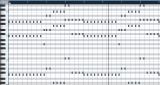
I see in your TINY image the notes Ab C Db Eb F G. In all probability if there is a B in this row it is Bb. Either way, yes, it's a scale. Is it Ab Major, is it C Phrygian? What is the predominant feeling of home, C or Ab? Or F. I'm looking at a tiny pic having heard nothing, can't tell you.

It looks like there is a first inversion of an F minor triad as Ab is in the bass. Where did you get the idea of 'Phrygian' here? I get the sense you have no experience with C Phrygian, I mean apart from looking at the information.

That row of tones [incl Bb] over, for instance a drone C, a bass line that gravitates around C, is going to have a certain feel to it, that is your "C Phrygian". A mode is more than a scale, it has [modal] properties, the first of which is the tones relate to the tonic of the mode, in this case C; otherwise why wouldn't C Phrygian be Ab major or another of six things with the same set. Rather than look for chords to determine this, what you need is 'is C home'.

Post

JumpingJackFlash wrote: My Introduction to Music Theory might be useful.
Thanks! I give it a read now.
'C Phrygian'; is there a strong C tonic? If not, it isn't C Phrygian.

your post is a good example of why reading is not at all sufficient for this 'music theory' understanding.
I don't know. There are a lot of inversions. As I said I'm not just reading. Over the last month I'm able to play the scales mayor/minor withot counting and also learing to play those chords in that scales. It's of course important to get a good balance between reading and actual doing it.
I see in your TINY image the notes Ab C Db Eb F G.
You can see a large picture by clicking on the tiny image. Here you can listen to the progression (at the beginning):

The notes are C Db Eb F Ab Bb
It looks like there is a first inversion of an F minor triad as Ab is in the bass. Where did you get the idea of 'Phrygian' here? I get the sense you have no experience with C Phrygian, I mean apart from looking at the information.
Yes you're right I have no experience with Phrygian. I thought it would be a better to learn the exotic scales after the most prominent ones. But I might mixed that up yesterday. I meant the Pentatonic Blues scale, where a C chord in the second inversion (F C G) would fit to the first chord of the exsample.
That row of tones [incl Bb] over, for instance a drone C, a bass line that gravitates around C, is going to have a certain feel to it, that is your "C Phrygian". A mode is more than a scale, it has [modal] properties, the first of which is the tones relate to the tonic of the mode, in this case C; otherwise why wouldn't C Phrygian be Ab major or another of six things with the same set. Rather than look for chords to determine this, what you need is 'is C home'.
You are right. Unfortunetly I'm not that far with understanding modes. English is not my first language. As I read about the topic modes I didn't understand how to determine when you are hearing/working with a mode. I have to get into it more.

Post

My impression here is F minor. Your confusion is understandable because the chords are a little bit strange (not in a bad way, but they aren't your typical triads). I think the bass line really tells the story here. When we ultimately resolve to a chord with F in the bass, it is hard to believe that this is any kind of C chord. We often see the notes CFG as a C chord with suspended fourth. But in this context that doesn't make much sense. The chord is stable and F is the bass note. In a Csus chord, the F wants to move. Here it does not.

Post

Nystul wrote:My impression here is F minor. Your confusion is understandable because the chords are a little bit strange (not in a bad way, but they aren't your typical triads). I think the bass line really tells the story here. When we ultimately resolve to a chord with F in the bass, it is hard to believe that this is any kind of C chord. We often see the notes CFG as a C chord with suspended fourth. But in this context that doesn't make much sense. The chord is stable and F is the bass note. In a Csus chord, the F wants to move. Here it does not.
I think you are right with the of the F minor. The the first chord would be a suspended F chord with inversion?

Post

I more or less concur with Nystul. The beginning is hard to call, it doesn't settle anywhere but eventually the thing settles on F as home, but with a kind of ambiguity with Ab that isn't too unusual.
how to determine when you are hearing/working with a mode
When there is a consistent reference to the tonic of that mode. Cf., Nystul's description of C begging for F, C doesn't establish as tonic.

the feeling of C Phrygian - "As I read about the topic modes I didn't understand" & which you won't know from reading JJF's charts - owes to the Db C and at the level of its fifth, Ab G, the character tones and their relationship to C. Improvise w. those seven notes over a drone C or a bassline that does not substantially deviate from C - as opposed to this kind of bassline - if you want to 'understand' this mode.

Post

Hey there, I played some chords yesterday for practice. At the start I just played some random chords and luckily recorded the stuff.
random_chords - PreMaster.mp3
Image

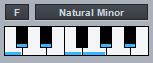
Well I didn't play in any specific scale, just wanted to get my hands warm (and I did't play it that tight - its quantized :)) Now I'm struggling to determin which scale fits most. A C# Major scale,
Image

D# Major
Image

and also a F Natural Minor
Image

would fit with this progression.

I know that a natrual minor scale is pretty uncommon and also that in my first chord the c# would be the tonic of a c# major scale, but how do I know extactly which scale it definitely is?!

Post

For what it is worth, the proper spelling in this case would be Db, Eb, F. If you start trying to make them sharps you would need to use E sharp and F double sharp in order to be consistent. DAWs tend to use naturals for the white key notes and sharps for the black key notes by default, but sometimes it will be easier to see what is going on if we spell things properly so that the scale has one note per letter.

When you play/listen to these chords, where do you feel like you have arrived at the home chord? Is it when you go back down to the Db major chord? Or is it when you hit that F minor chord? Hopefully you can sense it and this will tell you whether the tonic is Db or F. If you get the right answer then maybe you start to understand what it means to be playing in a certain key.

Post

tarsonis wrote:I know that a natrual minor scale is pretty uncommon*
Did you read that somewhere? In what music is this supposed to be 'uncommon'? In the type of music you're into at the moment it is likely to be quite common. One could make such an observation as per 'classical' type of practice in the 18th, 19th century, or the like, but I wouldn't narrow this down from such a notion.
tarsonis wrote: and also that in my first chord the c# would be the tonic of a c# major scale, but how do I know extactly which scale it definitely is?!
do any of these scales consistently work with your chords? *: what you are doing is trying to sort things by words and reading. The thing to do at this stage is gain experience with music in the world and observe what happens, make notes for yourself. In your own efforts, as Nystul suggests, where is home, the tonal center here? You should firmly have that if you're going to proceed. Absent that [experience with playing songs, singing songs, something], you're at a point where too much information is going to clutter your thoughts and lead you to follow red herrings.

Post

tarsonis,
for what its worth if you are into Trance I wouldn't get too hung up on music theory. Really just a few well chosen chords can go a very long way.

I think its fair to say a basic grounding is an advantage but for Trance especially uplifting its more about the feel.

A lot of producers these days (I am hesitant to call them musicians) just bang out riffs using 2 fingers and then embellish their work later on. (the hard part)
Its almost like the chords produced are a by-product rather than anything that you'd establish from the outset. You will then discover that in a lot of cases borrowed chords work really well.

For sure some sort of tonality needs to be established but don't fall into the trap of mapping a riff around a progression based on a static key using triads although that would work the end result would be far too predictable. Better to produce a riff that works or sounds cool and then find what chords fit afterwards.
Remember a chord may have just 2 notes often beefed up by voice doubling.

Trance really does rely on production technique far more than theory.
Good luck. :)

Post

aquar wrote: A lot of producers these days (I am hesitant to call them musicians) just bang out riffs using 2 fingers and then embellish their work later on. (the hard part)
Its almost like the chords produced are a by-product rather than anything that you'd establish from the outset.
that's a good point and does apply to the example. it's going to be quite problematic to make this naive kind of chord usage fit music theory which is derived from classical music practice for example.

Post Reply

Return to “Music Theory”