I recently discovered IK Multimedia's Amplitube for my iPad.
And IK makes a bluetooth footpedal (BlueBoard) that can turn stomps on and off, or swap between presets, etc. But I use a volume pedal a lot (back when I had my PODHD500) and I really need that. And the BlueBoard has no expression pedal port.
And I'm sure there is a way to get this done via some other midi contraption, and a USB hub going into my iPad, but it suddenly dawned on me. Why not just use an analog volume pedal. Duh!
But the problem is I don't own an analog volume pedal, nor do I presently have the $100 or so to get one.
But what I did have was a Vox V847 Wah pedal I bought about 10 years ago and have used maybe twice in those 10 years.
I did a lot of research on converting a wah to a volume pedal and all of that, and I found some bits and pieces of info that helped me but, nothing that would tell me how to do it, or verify that it would even work.
I play an Ibanez RG with 2 humbuckers. And from what I can tell the volume knob in my guitar is a 250Kohm potentiometer. And if I want to put a volume pedal between the guitar and an amp (or an iPad in my case) I would need to have a pedal with at least a 250Kohm pot in it. So I gutted my Wah pedal. The only thing I left in there were the two 1/4" TS jacks and the pot. The Pot as I discovered with my voltimeter was a 100Kohm pot. That wasn't enough.
But later I read somewhere that if you put the volume pedal after the effects chain (or after my iPad) you could get by with a lot less resistance. And at that point in the signal chain a 100Kohm pot would be more than enough.
And really that is where I prefer my volume pedal to be anyway. I want to play a chord, and have the amp (or iPad) start resonating, and then just use the pedal to throttle the output.
So to the details.
There is a lot of stuff in the V847. You have a toe-switch, a PCB board with some nice little capacitors and resistors, and inductors etc. on it. Yeah, we're gonna rip all that stuff out.

First of all when you cut the wires to remove everything, leave some of the wire hanging off of the pot. Wires are colored, and there is no other indication on the pot which post is which, so I will refer to the wire colors.
There is a black wire, a yellow wire and two blue wires. If you have a voltimeter that checks ohms, then you can figure it out. But not everyone does, so if you just stick with the colors you won't need one.
You have two sides of a resistor, and the black and blue wires are those two sides, and you can use either one as your common wire, but if you use the wrong one, then the pedal will work backward from what you want. Toe-down will be silence, and heel-down will be full volume. Maybe that's what you want, but that's not how most volume pedals operate.
So my procedure assumes that you want full-volume with your toe down.
If you want it to work backwards for some twisted reason, you can just swap the blue and black wires at the pot.
Onward...
So at this point, take your soldering iron and remove the pieces of wire still stuck to the posts on the TS jacks.
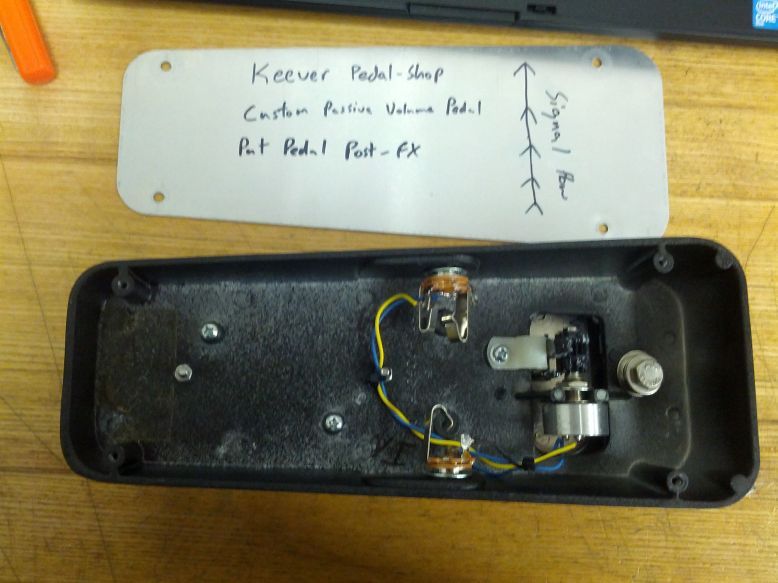
Now what you should be looking at is a relatively empty pedal. You have your pot with a black tail, a yellow tail and two blue tails. And then you have 2 TS jacks.
So you will need 4 short pieces of wire. Maybe 8 inches long.
I personally had some multi-condutor phone cable laying around, and I pulled out the blue black and yellow conductors for this, because I wanted to keep everything the same color as it was. If you're going to try and keep it color-coded like I did, then you will take a Blue and a Yellow wire and twist them together. Then take a Blue and a Black wire and twist them together.
On pair will go to one TS jack and the other will go to the other TS jack.
And both sets will land on the Pot.
Just going in the order I did it, I removed the blue wires from the pot with my soldering iron. Then I attached both of my blue wires to that same post.
Then I removed the Black wire from the pot and replaced it with my black wire.
Then I did the same for the yellow.
I had to remove the Pot to solder the wires onto it, and then I put it back in the pedal.
I took a marker and wrote "IN" by the left jack (assuming you have the pedal flipped over and the heel is toward you) and the right jack I labelled "out."
This is backwards of what is stamped in the rubber on the top of the pedal, where is says instrument, that side I labeled "Out" and where it says Amplifier I labeled "In."
I am not sure how important it is, or if it wouldn't work just as well either way, but that's how I did it and it worked. So if you want to be guaranteed it will work, stick with the plan. Now that it's finished, I'm pretty certain the pedal will work either way, and the IN OUT labels don't really matter at this point, but it helped keeping things organized while wiring it up.
So I ran the Black/Blue pair to the IN jack.
Black on the Tip and Blue on the Sleeve.
Then I ran the Yellow/Blue pair to the OUT jack.
Yellow on the Tip and Blue on the Sleeve.
Of course while doing this I routed the wire, and trimmed it to the proper length, and even zip-tied it to one of the bolts, so it doesn't get hung up in the gears on the Pot.
The only thing I did was run the pot all the way (the direction it moves as you press down on the toe end of the pedal. Turn the pot all the way that direction until it stops. It's more important that the pot goes all the way that direction than the other.
Then I noticed the cam or straight gear or rack or whatever you want to call it, was hitting the bottom plate when the toe was all the way down. The toe switch apparently stopped it from going that far down and I had removed the toe switch, so it went down too far.
I put a 1/4" bolt in that hole where the switch was, and I stacked washers on it to get it to the right length, to where when the pedal goes down on the toe end, it stops on the bolt just before it goes too far.
Then I noticed it made noise when I pressed the heel down. So I got a small piece of velcro, and stuck it under the heel to quiet that down.
That's about it.
Put it all back together and it worked.
As advertised, it doesn't work completely when you put it between the guitar and FX (or iPad), it does work, but when you press the heel it doesn't get completely quiet, there is still a tiny bit of sound that leaks through. But it's still probably usable for most purposes.
But when you put it after the FX (or iPad) it works perfectly.
My only complaint is the travel is a little short.
I.E. the distance from fully down to fully up isn't that far, like pedals made specifically for volume. But it's totally usable once you get used to it.
And it saved me $100. I had wire and a soldering iron at work so this project cost me $0.00 to do.
If your not Eddie Van Halen, or Stevie Ray Vaughn like I'm not, and bought a wah pedal on a whim, and really would have more use for a volume pedal, this might be your answer.
I hope this helps someone.
It definitely helped me.
edit: I just remembered, the OUT jack is actually a TRS not a TS. But you just treat it like a TS and don't connect anything to the Ring post.
2nd edit: I didn't mention that little white wire holder, that VOX uses to hold the rack against the pinion. But I thought it was kind of obvious what that thing was doing, and that you need to loosen the screw and turn it, in order to disconnect the rack from the pinion, so to adjust the travel of the pot. But maybe it's not obvious, so there you have it.