

Someone asked here recently, why are there 7 notes to the octave? The thread got rather long, and I think people stop reading long threads, so I thought I'd start a new thread about this.
Why seven? A very profound question! Most musical cultures all over the world and over all recorded history are either heptatonic or pentatonic. Hexatonic or octotonic is much rarer. In the West, the concept of 7 notes is much older than the concept of 12 notes. We're talking ancient Greeks vs late middle ages. So any explanation of this phenomenon must not be based on 7 notes as a subset of 12 notes, because 7 came before 12. Also, many musical cultures do not have a concept of 12 notes to the octave, for example Indian music with its 22 shrutis. Where did their 7 come from?
There are sound mathematical reasons to prefer either 5 or 7 note scales, and to NOT prefer 6 or 8 notes. The short answer is, 7 fifths add up to a semitone. 5 fifths add up to a major 7th, which is a descending semitone. Both of these are small intervals. But 6 fifths make a tritone, and 8 fifths make a minor 6th, or a descending major 3rd, both big intervals. Big intervals create problems, as we'll see.
Here's the long version. First let's define some terms. The concept of X number of notes per octave I call a framework, so there's the pentatonic framework, the heptatonic framework, the 9-note framework, etc. An interval's stepspan is one less than degree, so a fifth has degree of 5 but a stepspan of 4, a fourth has stepspan 3, etc. Using stepspans instead of degrees makes the calculations much easier, because when you add two intervals, their stepspans always add up too.
The two most universal intervals are the octave (2/1 frequency ratio = 1200¢) and the fifth (3/2 ratio = 702¢). Basically, 7 and 5 are favored because the stepspan of the octave implies the stepspan of the fifth, and only certain combinations of octave stepspan and fifth stepspan make sense.
Let's look at a framework that doesn't work. If there's 8 notes to the octave, the fifth has to be either 4 steps or 5 steps. Let's start with 5 steps. Going up from the fifth to the octave is a fourth, and this fourth must be 3 steps wide. But then all fourths must be 3 steps wide, which means there must be another step in between the fourth and the fifth, which will sound like a tritone.
Now consider the note a fifth above the fifth, which when octave-reduced, sounds like a major 2nd. 5 steps plus 5 steps makes 10 steps. Octave-reduced, it has to be 2 steps wide, which means there must be a note in between the tonic and this note, something kind of like a minor 2nd. By the same logic, two fourths add up to something 6 steps wide that sounds like a minor 7th, which means the 7-step interval is some sort of major-7th interval. And we've got our 8 notes:
tonic - min2 - Maj2 - Perf4 - tritone - Perf5 - min7 - Maj7 - octave
Not a very useful scale! Too many wide gaps, no 3rd, etc. But wait, it gets worse! What's the note one fifth above the major 2nd? It sounds like a major 6th, but it's 7 steps wide, so it's higher in the scale than the minor 7th of 6 steps! How'd that happen?
The sum of 5 fourths minus two octaves is about 90¢. I say "about" because the fourth can be slightly tempered from 498¢, the octave can be slightly stretched or compressed, etc. But assuming the fourth is fairly well tuned, we get an interval about a semitone wide. If there are 8 steps to the octave, and the fifth is 5 steps wide, and the fourth is therefore 3 steps wide, this interval will have a stepspan of 5 * 3 - 2 * 8 = -1. It's what I call a negative 2nd, and it means this semitone-sized interval takes you down the scale but up in pitch. A paradoxical interval like that means that a simple chain of 5 fifths "breaks" the 8-note framework.
If instead the octotonic fifth is 4 steps, then the sum of 7 fifths minus 4 octaves, which is about 114¢, equals 7 * 4 - 4 * 8 = -4 = a negative fifth! Now so far we've only used just octaves and fifths, what's called 3-limit just intonation. Let's consider 5-limit JI, with the major 3rd 5/4 = 386¢. Its stepspan should be 2 steps. The sum of 3 fifths plus a major 3rd minus 2 octaves is a semitone-sized interval of about 92¢. The stepspan is 3 * 4 + 1 * 2 - 2 * 8 = -2 = a negative 3rd! Another paradox, and one that took fewer steps to reach. Because it's a 3rd, it takes us up in pitch but down the scale by two steps, not just one!
That's the 8-note framework. For 6 notes, you can find similar paradoxical intervals. The hexatonic fifth must be either 3 steps or 4 steps. If the hexatonic fifth is 4 steps, the fourth must be 2 steps. The sum of 5 fourths minus two octaves, which as we saw is about 90¢, is 5 * 2 - 2 * 6 = -2 = a negative 3rd.
If instead the hexatonic fifth is 3 steps, the fourth must also be 3 steps. The major third must be 2 steps, to avoid the minor third having a larger stepspan than it. The sum of a fifth and a major 3rd is 5 steps and sounds like a major 7th. But the sum of two fourths is 6 steps that sounds like a minor 7th. Paradox! 3 fifths and a major third minus 2 octaves = 3 * 3 + 1 * 2 - 2 * 6 = -1 = a negative 2nd.
For most other frameworks, you can similarly find a semitone-sized interval that has a negative stepspan and breaks the system. It turns out that in every framework, even our 7-note and 12-note frameworks, paradoxes arise. But in a good system, these paradoxes only arise when you add together a LOT of intervals. For example, the sum of 12 fifths minus 7 octaves has a stepspan of 12 * 4 - 7 * 7 = -1. But a) that's a lot of fifths, and b) that interval is only 24¢ for untempered fifths. A very slight flattening of the fifth solves this problem. You have to go clear out to 19 fifths to create a real problem.
So with the 7-note and 5-note frameworks, you can have a nice long chain of fifths and sidechain some major thirds off of it, and not have any weird naming problems. Now that's not the only way to make a scale, but it is an obvious way, and if a framework can't handle that, it's not a very useful framework, is it?
So 5 and 7 make good frameworks, what else does? It turns out that 12 makes a great framework with hardly any paradoxes at all. Other good frameworks are 19, 22, 31, 41 and 53. What makes a good framework? The first thing to notice is that a fifth is very nearly 7/12 of an octave, because 7/12 * 1200¢ = 700¢. In other words, If we divide the octave into 12 more-or-less equal steps, some number of those steps will be roughly equal to a fifth. But if you divide the octave into 11 or 13 steps, you won't get a good approximation of a fifth at all. You get numbers like 654¢ or 738¢. Because the error is so large, when you add fifths together, the error quickly gets big enough to create a paradox.
7 works well because a fifth is about 4/7 of an octave = 686¢, and 5 works because a fifth is about 3/5 of an octave = 720¢. 6 doesn't work because the fifth is nowhere near 3/6 of an 8ve = 600¢ or 4/6 of an 8ve = 800¢. Likewise 19 works because 11/19 * 1200¢ = 695¢.
The error for 7 notes is only about a seventh of a semitone, because 7 fifths add up to about a semitone. The error for 6 notes is 1/6 of a tritone = 1 semitone. That's why in the short answer, I said big intervals create problems. They create big errors, which quickly create paradoxes.
The 12-note framework also approximates 5/4 well. 386¢ is close to 4/12 * 1200¢ = 400¢. But major thirds don't get chained as much as fifths do, so the 5/4 isn't as crucial.
A few more points: First, lots and lots of Western music uses 8 or 9 notes per octave, it just doesn't use 8 or 9 note names.
Also, we've been assuming harmonic timbres (voice, strings, wind instruments, etc.), which require your fifths to be not too far from 702¢. The 8-note framework doesn't work, because it implies 750¢ fifths that will sound awful. But if you're using inharmonic timbres, like electronic techno or dirty grunge or marimbas or something, then you can get away with 750¢ fifths, and the 8-note framework becomes quite viable.
I encourage anyone interested in this type of music theory to read the book I'm writing, the outline is here http://www.tallkite.com/words.html. It's combined with the manual for the microtonal software I've written, described here: http://www.kvraudio.com/product/alt-tun ... e-software. Alt-tuner lets you easily explore other frameworks, and even change the number of notes per octave on your keyboard.
why our scales have seven notes, part 2
-

- KVRist
- 75 posts since 1 May, 2013 from Portland Oregon USA
-
JumpingJackFlash JumpingJackFlash https://www.kvraudio.com/forum/memberlist.php?mode=viewprofile&u=44005
- KVRian
- 1227 posts since 10 Oct, 2004
The mathematics of scales might well be interesting, buy none of that explains why we have 7 notes in the scale.
You're reverse engineering something to fit in with your preconceived theories - you're letting the cart pull the horse, rationalising long after the fact.
You're also using a lot of assumptions like the need to fit notes into an octave - why is that important? Not all cultures recognise the octave as a boundary.
Why do we have 26 letters in our alphabet?
Why does November have 30 days whereas December has 31?
Why is the fashion of today not the same as the fashion of the 1960's?
Can you use mathematics to explain these things? - You might well try, but that won't actually answer the question "why". Like scales, these things were not invented by mathematicians.
The diatonic pitch set (ABCDEFG...) has existed since the very beginning of recorded musical history. Our major and minor scales are just two (relatively recent) ways of ordering these pitches.
As I said on the other thread, the answer as to why our scales have 7 notes is because they evolved that way over many centuries. If you want to know more, you have to look at history, not mathematics.
Our major/minor scales evolved from the ecclesiastical modes, which evolved from Greek modes, which evolved from Greek Tetrachords.
You're reverse engineering something to fit in with your preconceived theories - you're letting the cart pull the horse, rationalising long after the fact.
You're also using a lot of assumptions like the need to fit notes into an octave - why is that important? Not all cultures recognise the octave as a boundary.
Why do we have 26 letters in our alphabet?
Why does November have 30 days whereas December has 31?
Why is the fashion of today not the same as the fashion of the 1960's?
Can you use mathematics to explain these things? - You might well try, but that won't actually answer the question "why". Like scales, these things were not invented by mathematicians.
The diatonic pitch set (ABCDEFG...) has existed since the very beginning of recorded musical history. Our major and minor scales are just two (relatively recent) ways of ordering these pitches.
As I said on the other thread, the answer as to why our scales have 7 notes is because they evolved that way over many centuries. If you want to know more, you have to look at history, not mathematics.
Our major/minor scales evolved from the ecclesiastical modes, which evolved from Greek modes, which evolved from Greek Tetrachords.
Unfamiliar words can be looked up in my Glossary of musical terms.
Also check out my Introduction to Music Theory.
Also check out my Introduction to Music Theory.
-
- Banned
- 3946 posts since 25 Jan, 2009
Agree. At best what is explained might be some advantages of tonality within an already established 7 note scale within already established divisions of pitch ranges into octaves within an already established western cultural system of preference. Reverse engineering is a well chosen term her, because you basically explain the origin of the 7 note scale with the result of the invention, namely itself. Thus the explanation becomes circular. It is like saying that the wheel was invented because it's advantage of being round and not retangular. Go figure.
At least the math is a little more comprehensible than what we saw in the other thread but used as a source of explanation (of causes to the 7 note scale) rather than a mean of description (of the already established 7 note scale) it becomes misleading and also very ethnocentric, as if the use of other scales for musical expression somehow are mathematical -and therefore musical- inferior.
At least the math is a little more comprehensible than what we saw in the other thread but used as a source of explanation (of causes to the 7 note scale) rather than a mean of description (of the already established 7 note scale) it becomes misleading and also very ethnocentric, as if the use of other scales for musical expression somehow are mathematical -and therefore musical- inferior.
-

- KVRAF
- 26033 posts since 20 Oct, 2007 from gonesville
Yes. Possibly the worst example here, for me is: "Not a very useful scale! Too many wide gaps, no 3rd, etc. But wait, it gets worse! What's the note one fifth above the major 2nd? It sounds like a major 6th, but it's 7 steps wide, so it's higher in the scale than the minor 7th of 6 steps! How'd that happen?"JumpingJackFlash wrote:You're reverse engineering something to fit in with your preconceived theories - you're letting the cart pull the horse, rationalising long after the fact.
 I think you created it as if you were proving something. Why is it 'not useful'? It's exotic to you out of a lot of prejudice and ignorance.
 Go search for the Melakarta system for Carnatic music, which abstractly/purely constructs scales, and you'll see a lot of things which I'm sure will violate your principles. This one particularly strikes me as ad culum.
-

- KVRAF
- 5564 posts since 13 Jan, 2005 from the bottom of my heart
this explain "Why 12 notes to the Octave? " very good and works also for the question here:
http://www.math.uwaterloo.ca/~mrubinst/tuning/12.html
http://www.math.uwaterloo.ca/~mrubinst/tuning/12.html
Whoever wants music instead of noise, joy instead of pleasure, soul instead of gold, creative work instead of business, passion instead of foolery, finds no home in this trivial world of ours.
-
- KVRAF
- 26033 posts since 20 Oct, 2007 from gonesville
I've been working in Marwa raga. If we boiled it down to a scale on C: C Db E F# A B.
The rising form is prescribed: B Db E F# A B ^Db ^C
The descending form is prescribed: ^Db B A F# E Db A C
It's all wrong isn't it. It gets worse! While C is the 'tonic', the Db/A are the Vadi and Samvadi, & the whole thing comes across more as an A major pentatonic with a 'final' C natural. Although talking about it like that doesn't do it any justice, it's kind of spooky and that's on purpose.
How did this happen? The creator of this was after things you don't care about. Your entire exercise is tainted by your worldview which is evidently very narrow. ALL of the technical stuff demands a cart pull the horse.
"Big intervals create problems, as we'll see." This is a non-sequitur, you don't show anything but your own thinking. This is illustrative of the problem with your thinking: "Let's look at a framework that doesn't work. If there's 8 notes to the octave, the fifth has to be either 4 steps or 5 steps. Let's start with 5 steps. Going up from the fifth to the octave is a fourth, and this fourth must be 3 steps wide. But then all fourths must be 3 steps wide, which means there must be another step in between the fourth and the fifth, which will sound like a tritone." You use this notion, which has no particular basis other than your own work, 'stepspan' to justify your conclusive premise.* But no: let's take the symmetrical octatonic in one of its two forms: C Db Eb E F# G A Bb. What do we name G rising to C? a perfect fourth. The thirds are still conventional, you can haz teh triads. et cetera. There is no problem with it other than you prefer something else as if it is a basis. All of the problems are fabricated by you in service of that.
There "are" 12 to an octave, or 22, or 25, or 53, or only seven equal, or only six equal, or five in some arrangement, whatever; whatever one conceives of. All of this is mere convention. There is no necessity of a system. A system is a conception in thought, in order to obtain a result. If we arrive at a scale of 8 out of more-or-less 12 equal semitones within 2:1, there is a musical reason for it. Just as with 7. Making an 'eight note system' follows from that. There isn't a lot of point in it as the real system is in the 12 that idea is based in, just as your frameworks all are.
In a twelve note octave, yes, no shit, there is another step between the P4 and P5 - BOTH OF WHICH ARE CONVENTIONS - called the +4 or -5. SO WHAT? The result of a convention sounds like [a word about] the result of the convention? As JJF put it, you have reverse-engineered something and of course everything you find can suit it. *In terms of logic, this is called begging the question. You have a system which seems perfect to you as your premises are based in your conclusions.
You reveal a fatal flaw here: "It turns out that in every framework, even our 7-note and 12-note frameworks, paradoxes arise. But in a good system, these paradoxes only arise when you add together a LOT of intervals. For example, the sum of 12 fifths minus 7 octaves has a stepspan of 12 * 4 - 7 * 7 = -1. But a) that's a lot of fifths, and b) that interval is only 24¢ for untempered fifths. A very slight flattening of the fifth solves this problem." AHA!
The sum of 12 3:2s multiplied out gives 531441:524288. ≠1. That's a real problem and you know it had to be addressed. So the exercise of getting 12 to come out at unity was a "bad framework" from the very outset. You're fabricating, skewing the whole of it to justify one result out of it as a 'good framework' ('our' seven-note framework?). As if a sound premise '12 is a lot!' (perfectly justifying 'you need a lot for there to be a problem', am i right). Well, 12 is the whole ballgame. System collapsed.
The rising form is prescribed: B Db E F# A B ^Db ^C
The descending form is prescribed: ^Db B A F# E Db A C
It's all wrong isn't it. It gets worse! While C is the 'tonic', the Db/A are the Vadi and Samvadi, & the whole thing comes across more as an A major pentatonic with a 'final' C natural. Although talking about it like that doesn't do it any justice, it's kind of spooky and that's on purpose.
How did this happen? The creator of this was after things you don't care about. Your entire exercise is tainted by your worldview which is evidently very narrow. ALL of the technical stuff demands a cart pull the horse.
"Big intervals create problems, as we'll see." This is a non-sequitur, you don't show anything but your own thinking. This is illustrative of the problem with your thinking: "Let's look at a framework that doesn't work. If there's 8 notes to the octave, the fifth has to be either 4 steps or 5 steps. Let's start with 5 steps. Going up from the fifth to the octave is a fourth, and this fourth must be 3 steps wide. But then all fourths must be 3 steps wide, which means there must be another step in between the fourth and the fifth, which will sound like a tritone." You use this notion, which has no particular basis other than your own work, 'stepspan' to justify your conclusive premise.* But no: let's take the symmetrical octatonic in one of its two forms: C Db Eb E F# G A Bb. What do we name G rising to C? a perfect fourth. The thirds are still conventional, you can haz teh triads. et cetera. There is no problem with it other than you prefer something else as if it is a basis. All of the problems are fabricated by you in service of that.
There "are" 12 to an octave, or 22, or 25, or 53, or only seven equal, or only six equal, or five in some arrangement, whatever; whatever one conceives of. All of this is mere convention. There is no necessity of a system. A system is a conception in thought, in order to obtain a result. If we arrive at a scale of 8 out of more-or-less 12 equal semitones within 2:1, there is a musical reason for it. Just as with 7. Making an 'eight note system' follows from that. There isn't a lot of point in it as the real system is in the 12 that idea is based in, just as your frameworks all are.
In a twelve note octave, yes, no shit, there is another step between the P4 and P5 - BOTH OF WHICH ARE CONVENTIONS - called the +4 or -5. SO WHAT? The result of a convention sounds like [a word about] the result of the convention? As JJF put it, you have reverse-engineered something and of course everything you find can suit it. *In terms of logic, this is called begging the question. You have a system which seems perfect to you as your premises are based in your conclusions.
You reveal a fatal flaw here: "It turns out that in every framework, even our 7-note and 12-note frameworks, paradoxes arise. But in a good system, these paradoxes only arise when you add together a LOT of intervals. For example, the sum of 12 fifths minus 7 octaves has a stepspan of 12 * 4 - 7 * 7 = -1. But a) that's a lot of fifths, and b) that interval is only 24¢ for untempered fifths. A very slight flattening of the fifth solves this problem." AHA!
The sum of 12 3:2s multiplied out gives 531441:524288. ≠1. That's a real problem and you know it had to be addressed. So the exercise of getting 12 to come out at unity was a "bad framework" from the very outset. You're fabricating, skewing the whole of it to justify one result out of it as a 'good framework' ('our' seven-note framework?). As if a sound premise '12 is a lot!' (perfectly justifying 'you need a lot for there to be a problem', am i right). Well, 12 is the whole ballgame. System collapsed.
-
- KVRAF
- 26033 posts since 20 Oct, 2007 from gonesville
I've already done every bit of that work in the other thread.murnau wrote:this explain "Why 12 notes to the Octave? " very good and works also for the question here:
http://www.math.uwaterloo.ca/~mrubinst/tuning/12.html
-
- Banned
- 3946 posts since 25 Jan, 2009
All in all a very strange way of thinking: 1) Either it fails miserably in the platonic misconception that the tonal system was invented on basis of an already perfect idea existing in the realm of mathematical conceptions, or if that is not what it meant then 2) in the notion that a tonal system has to be justified mathematically once established by cultural conventions. 
-
- KVRist
- 350 posts since 11 May, 2008
Well, in the previous topic I tried to give a detailed answer that noone cared about, sunk somewhere in the middle pages, just check it out in case of doubt. I give it again. It is a maybe a compromise between the idea of superimposed fifths reduced to an octave AND notes coming the harmonic series.
Why do I think this way? Well, because there are very few universals in music, but if you think about practice, convenience and simplicity, the concept of fifth makes sense as well as octave (splitting a string the simplest possible ways), and the concept of harmonic series also makes sense from a "natural" and "physical" point of view.
Then you just have to go to history and think about the instruments, how they were made and tuned, and the possibilities they had to produce sounds easily. Also, what kind of repertoire was being produced by people. So, things that favoured simplicity ought to stand out. So it's believable to me, that pitches around these concepts (octaves, fifths, harmonic series) would naturally emerge more often and reinforce the practice itself.
Somewhere along the time line a systematization had to be made to also reinforce all this...
Why do I think this way? Well, because there are very few universals in music, but if you think about practice, convenience and simplicity, the concept of fifth makes sense as well as octave (splitting a string the simplest possible ways), and the concept of harmonic series also makes sense from a "natural" and "physical" point of view.
Then you just have to go to history and think about the instruments, how they were made and tuned, and the possibilities they had to produce sounds easily. Also, what kind of repertoire was being produced by people. So, things that favoured simplicity ought to stand out. So it's believable to me, that pitches around these concepts (octaves, fifths, harmonic series) would naturally emerge more often and reinforce the practice itself.
Somewhere along the time line a systematization had to be made to also reinforce all this...
Play fair and square!
-
- KVRAF
- 26033 posts since 20 Oct, 2007 from gonesville
At least you have the qualifier 'maybe'.Musicologo wrote: It is a maybe a compromise between the idea of superimposed fifths reduced to an octave AND notes coming the harmonic series.
Why do I think this way? Well, because there are very few universals in music, but if you think about practice, convenience and simplicity, the concept of fifth makes sense as well as octave (splitting a string the simplest possible ways), and the concept of harmonic series also makes sense from a "natural" and "physical" point of view.
The first few partials of the harmonic series will fit this. You may say that the more audible partials make sense as reflected in certain musical systems. However if you present them as a source for material they really just don't work. Why do I think this? Because I've used it a number of times for material. It just does not provide us with a 'useful' scale for a western sort of sound, or for an Indian Classical Music sound; and it doesn't get us very far, if anywhere in terms of explaining Arabic thought in their tunings, which have to do with ratios. It would take a serious investigation to begin to understand 'the reasons' for decisions informing Arabic maqam, and you're going to run into a lot of complexity and circuitous pathways. They really do have a different idea of things you seem to take for granted from the vantage point of western europe. They are constructed by seconds, actually and they have a notion of them that is not reducable to this stacking fifths first principle. Even out of the very same old Greek theory; for instance they took the comma and went further with it. We haven't touched on the more minute intervals out of that theory at all here, note well. So we get to 'seconds' that are designed after another idea.
They have 'medium thirds'. These measurements appear to exist towards an inflection of melody that we must place in culture and history. So when you go to do this:
You might be careful to ask, are we talking about a limited scope of 'history' and 'instruments' and have we focused the illumination on a bias determined by this cultural stuff. Yes, you're going to get heptatonic scales in Arabic music but the construction of eg., the Oud follows that music. What happens in a modulation in a Maqam? The simplicity you want might be out the window.Musicologo wrote:Then you just have to go to history and think about the instruments, how they were made and tuned, and the possibilities they had to produce sounds easily. Also, what kind of repertoire was being produced by people. So, things that favoured simplicity ought to stand out.
The very first thing I thought in order to counter this argument was "Javanese Gamelan". I have sort of a glancing awareness of it over the years but I don't know it. It's really hard to know. I did a little search and what I found was tunings where very little of what you and the OP of this thread have asserted is true. I think there is really only one thing that is completely true, they do the scales within an octave (and certain cases of the music calls for unison octave doubling of the tune). You get instruments built for something quite different than western, Indian, or Arabic musics. They do not appear to have a perfect fifth in a given construction.
http://sumarsam.web.wesleyan.edu/Intro.gamelan.pdf
See page 4.
So, I don't know if you missed all the objections to this kind of hypothesizing: 'this is ethnocentric', et cetera but this is a truism. Music is not governed by abstractions per se. Not everything you say is desired worldwide. As examined fully, you will find that the overtone series - interestingly called 'the harmonic series' - does not agree with you past a point and it's an early point where it gets away from your idea.
-
- Banned
- 3946 posts since 25 Jan, 2009
I am not going to pretend for a second that I can counter the thinking so elegantly example based as Jancivil does it here. But staying at the offset for even thinking the OP's way, the main point can be illustrated with this:
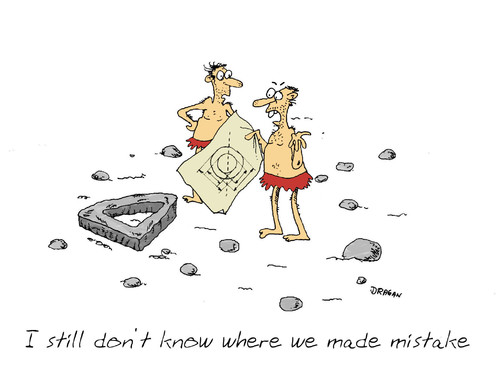
versus this:

Touching the core of ancient intellectual conflicts between idealists (including creationism) and materialists (including evolutionism and historicism).
Thus is the math of the wheel (read: scales) an already given premise to man by God or the universe and just has to be "discovered" and applied accordingly? Or is the math of the wheel a product and not a premise of it's invention based on evolving human practise/tradition and therefore relative to exactly this?
As far as I can see, Jancivil's counter examples to the approach of the OP and the respective followers should be more than enough to answer the question in this context. At least there are several exceptions to the proposed universals to be explained if the proponents of math theory wish to take this any further.
versus this:
Touching the core of ancient intellectual conflicts between idealists (including creationism) and materialists (including evolutionism and historicism).
Thus is the math of the wheel (read: scales) an already given premise to man by God or the universe and just has to be "discovered" and applied accordingly? Or is the math of the wheel a product and not a premise of it's invention based on evolving human practise/tradition and therefore relative to exactly this?
As far as I can see, Jancivil's counter examples to the approach of the OP and the respective followers should be more than enough to answer the question in this context. At least there are several exceptions to the proposed universals to be explained if the proponents of math theory wish to take this any further.
-
- D.H. MOD
- 17872 posts since 21 Jun, 2008
As a rule, don't do this, please.TallKite wrote:The thread got rather long, and I think people stop reading long threads, so I thought I'd start a new thread about this.
No longer a moderator.
-
- KVRAF
- 2616 posts since 17 Apr, 2004
42
Voted KVR's resident drunk Robert Smith impersonator (thanks Frantz!)
https://open.spotify.com/artist/2myYesRBRgQB3LkZzEYdt5 | https://soundcloud.com/steevm/
https://open.spotify.com/artist/2myYesRBRgQB3LkZzEYdt5 | https://soundcloud.com/steevm/
-
- KVRer
- 1 posts since 18 Nov, 2013
tl;dr, but maybe tallkites post is about "why we *still have 7 notes".. i mean, from a mathmatic or todays perspective one could ask why it's still a convenient system. then you can write about it and if you convince people that it's a good system to learn, why not.
related thought: sometimes when playing keyboard, i think how would it be if there were no black keys, just 12 white keys for each octave. it would have helped me maybe, though you might lose the right key for not knowing where the c is. (if anyone happens to know a software that maps midi keys like this, i'd be curious to test such a thingy.)
related thought: sometimes when playing keyboard, i think how would it be if there were no black keys, just 12 white keys for each octave. it would have helped me maybe, though you might lose the right key for not knowing where the c is. (if anyone happens to know a software that maps midi keys like this, i'd be curious to test such a thingy.)
-
- Banned
- 3946 posts since 25 Jan, 2009
To which the answer would be "because of conventions and not of math" to the opponents. Nothing gained or solved by this way of reframing it I am afraid.shurg wrote:tl;dr, but maybe tallkites post is about "why we *still have 7 notes.