


VOS + TDL + VLADG = SlickEQ
-

- KVRAF
- 24413 posts since 7 Jan, 2009 from Croatia
It increases the sample rate.
-
- KVRAF
- 3506 posts since 27 Dec, 2002 from North East England
Quick note with regard to checking if you can truly hear the differences between 2 files... If you're on Windows, Foobar2000 + the ABX comparator component is a great, easy way of doing true double-blind listening tests that completely remove confirmation bias from the equation. Our auditory system can play far more amazing tricks on us than mere preference due to confirmation bias (see the McGurk illusion). Give it a shot. The ABX comparator is on the components page. http://www.foobar2000.org/components
It's an extremely useful tool for audio communities, particularly those that actively engage with developers. It's half the reason that the LAME MP3 encoder is as good as it is these days. There's a great community of people who don't take their perception for granted surrounding it, and members don't consider you unskilled or 'inferior' if you can't hear something. I'd actually like to see a KVR where (as at Hydrogen Audio) ABX results are mandatory when discussing controversial aspects of sound quality. Without ABX you could be written off as a golden-eared loon despite discovering (for instance) a serious bug in someone's code where something 'should' be transparent (see the aliasing bug someone found affecting all of Valhalla DSP's products a year or so back). Pretty sure any dev would want to know about that!
It's an extremely useful tool for audio communities, particularly those that actively engage with developers. It's half the reason that the LAME MP3 encoder is as good as it is these days. There's a great community of people who don't take their perception for granted surrounding it, and members don't consider you unskilled or 'inferior' if you can't hear something. I'd actually like to see a KVR where (as at Hydrogen Audio) ABX results are mandatory when discussing controversial aspects of sound quality. Without ABX you could be written off as a golden-eared loon despite discovering (for instance) a serious bug in someone's code where something 'should' be transparent (see the aliasing bug someone found affecting all of Valhalla DSP's products a year or so back). Pretty sure any dev would want to know about that!
-
- KVRist
- 316 posts since 1 Dec, 2012
I completely agree that ABX is a very important part in mixing, and even more so in plugin development. And the most important part is to compare signals with equal loudness, when trying to decide if something is "better".
For those who use Reaper there's a very easy way to do this:
1. Import the two clips to a new project
2. RMS Normalize them (SWS has actions for this), and decrease the gain equally for if needed to prevent clipping.
3. Make a shortcut for "Item properties: Toggle items/tracks mute (depending on focus)"
4. Mute one of the items, then select them both
5. Press play, close your eyes, mash the mute button a couple of times so you don't know which is which
6. ABX away and profit
PS. Try to get at least 3-5:1 ratio for correct quesses for the "better" to ensure objectivity.
For those who use Reaper there's a very easy way to do this:
1. Import the two clips to a new project
2. RMS Normalize them (SWS has actions for this), and decrease the gain equally for if needed to prevent clipping.
3. Make a shortcut for "Item properties: Toggle items/tracks mute (depending on focus)"
4. Mute one of the items, then select them both
5. Press play, close your eyes, mash the mute button a couple of times so you don't know which is which
6. ABX away and profit
PS. Try to get at least 3-5:1 ratio for correct quesses for the "better" to ensure objectivity.
-

- KVRist
- 183 posts since 15 Jul, 2009 from Russia
Yeah! Cool, isn't it? In this way oversampled 20-bit ADCs/DACs achieve 24-bit precision for example.Burillo wrote:oversampling increases *bit-depth*? not sample rate?
2 more illustrations. 1) you have initial sample values 1 & 2, but after upsampling you may have 1.1, 1.3, 1.6, so you got values "between" initial ones; 2) you have initial samples 1, 1, 2, 1 and after downsampling you may have (average) sample value of 1.25. In both cases you have integer input but fractional output.
Vlad from Tokyo Dawn Labs
-
- KVRAF
- 14739 posts since 19 Oct, 2003 from Berlin, Germany
Wait wait wait...
What if I run at 24bit or even 32bit float already?
And if you say OS increases the bit-depth in this case rather than the SRC... wouldn't that be a waste of processing power if you already WORK in that area?
The higher the bitrate, the higher the dynamic range (which will never be used), but also the finer the resolution of the stream.
What if I run at 24bit or even 32bit float already?
And if you say OS increases the bit-depth in this case rather than the SRC... wouldn't that be a waste of processing power if you already WORK in that area?
The higher the bitrate, the higher the dynamic range (which will never be used), but also the finer the resolution of the stream.
-

- KVRAF
- 4469 posts since 15 Nov, 2006 from Hell
...except i believe they don't. 24-bit sample value only has lower noise floor than 20-bit - the actual values of samples aren't changed. it's like converting 32-bit int to 64-bit int - you can get bigger values, but 32-bit "10" is in no way different from 64-bit "10'. IOW, you get more dynamic range, but the range that already was there in the first place is not affected - you're still effectively storing 20-bit signal in 24-bits.vladg wrote:Yeah! Cool, isn't it? In this way oversampled 20-bit ADCs/DACs achieve 24-bit precision for example.Burillo wrote:oversampling increases *bit-depth*? not sample rate?
correct me if i'm wrong but 1) doesn't have anything to do with increasing bit depth. in fact, those values are still there, they're just averaged out. they would still be reproduced when converted back to analog. never mind that you're still in the same dynamic range you were before (i.e. between (int) 1 and (int) 2). and unless you're converting from int to float and back, you're not changing anything. now, if you internally process in 64-bit float like a lot of plugins do, that i follow you, but you'd achieve the same thing without oversampling but just converting everything to double.vladg wrote:2 more illustrations. 1) you have initial sample values 1 & 2, but after upsampling you may have 1.1, 1.3, 1.6, so you got values "between" initial ones; 2) you have initial samples 1, 1, 2, 1 and after downsampling you may have (average) sample value of 1.25. In both cases you have integer input but fractional output.
so i still don't see how oversampling increases bit-depth

I don't know what to write here that won't be censored, as I can only speak in profanity.
-

- KVRian
- 1184 posts since 24 Feb, 2012
Burillo, have a look at
http://en.wikipedia.org/wiki/Direct_Stream_Digital
this technique uses 1bit to produce 120dB of dynamic range.
Indirectly, both sample-rate and bit-depth are interchangeable (within certain ranges). Homework!
This is what Vlad is talking about. But it generally seems really difficult to discuss any technical aspect in a calm and relaxed manner! The subtle things in particular!
I personally try to be aware of the http://en.wikipedia.org/wiki/Dunning%E2 ... ger_effect , but I have my difficulties with it as well. (no pun intended!)
http://en.wikipedia.org/wiki/Direct_Stream_Digital
this technique uses 1bit to produce 120dB of dynamic range.
Indirectly, both sample-rate and bit-depth are interchangeable (within certain ranges). Homework!
This is what Vlad is talking about. But it generally seems really difficult to discuss any technical aspect in a calm and relaxed manner! The subtle things in particular!
I personally try to be aware of the http://en.wikipedia.org/wiki/Dunning%E2 ... ger_effect , but I have my difficulties with it as well.
(no pun intended!)Fabien from Tokyo Dawn Records
Check out my audio processors over at the Tokyo Dawn Labs!
Check out my audio processors over at the Tokyo Dawn Labs!
-
- KVRAF
- 4469 posts since 15 Nov, 2006 from Hell
ah OK that explains it. Thanks!FabienTDR wrote:Burillo, have a look at
http://en.wikipedia.org/wiki/Direct_Stream_Digital
this technique uses 1bit to produce 120dB of dynamic range.
Indirectly, both sample-rate and bit-depth are interchangeable (within certain ranges). Homework!
i wasn't implying you didn't know what you're talking aboutFabienTDR wrote:This is what Vlad is talking about. But it generally seems really difficult to discuss any technical aspect in a calm and relaxed manner! The subtle things in particular!
I personally try to be aware of the http://en.wikipedia.org/wiki/Dunning%E2 ... ger_effect , but I have my difficulties with it as well.
i'm not too big on DSP, it's just what was being said contradicted my basic understanding of it, hence i asked for clarifications.I don't know what to write here that won't be censored, as I can only speak in profanity.
-

- KVRian
- Topic Starter
- 1157 posts since 9 Apr, 2012
Wow, some nice knowledge droppin` here.
Me likes that.
I have to admit that I have spotted the Soviet Model pretty late on the screenie. I know mostly the usual suspects like the British or US stuff but what can we expect here? I am not that experienced when it comes to Soviet sound. I know some early Eduard Artemyev soundtracks and maybe some Jazz stuff but that`s it. Some funky Jazz from Poland, CSSR & Hungary and mostly 60s & 70s stuff. But I could not nail a specific sound right now.
I would like to hear some more about the Soviet model.
Regards
Sebastian
Me likes that.
I have to admit that I have spotted the Soviet Model pretty late on the screenie. I know mostly the usual suspects like the British or US stuff but what can we expect here? I am not that experienced when it comes to Soviet sound. I know some early Eduard Artemyev soundtracks and maybe some Jazz stuff but that`s it. Some funky Jazz from Poland, CSSR & Hungary and mostly 60s & 70s stuff. But I could not nail a specific sound right now.
I would like to hear some more about the Soviet model.
Regards
Sebastian
Underground Music Production: Sound Design, Machine Funk, High Tech Soul
-
- KVRAF
- 14739 posts since 19 Oct, 2003 from Berlin, Germany
Hm... I think you folks lost me on something with the former posts...
To my understanding, plain oversampling relates to Sampling Rate, not the bitrate. But if I understood the bost by Vlad and yours Fabien... did you use a different modulation matrix and actually went for the DSD type technology - but in software form?
This could then clear both the ASIO usage and the fixed latency. And you'd be the first to go that route? I've not seen anyone actually go to OS the bitrate - mainly only the sampling rate.
So to my (currently limited) understanding, you basically only bump the bitrate for a smoother courve? Never knew that were possible as well - like I said, only SRC. I'd really love to know more about what you actually did here. For understanding purposes.
To my understanding, plain oversampling relates to Sampling Rate, not the bitrate. But if I understood the bost by Vlad and yours Fabien... did you use a different modulation matrix and actually went for the DSD type technology - but in software form?
This could then clear both the ASIO usage and the fixed latency. And you'd be the first to go that route? I've not seen anyone actually go to OS the bitrate - mainly only the sampling rate.
So to my (currently limited) understanding, you basically only bump the bitrate for a smoother courve? Never knew that were possible as well - like I said, only SRC. I'd really love to know more about what you actually did here. For understanding purposes.
-
- KVRian
- 1184 posts since 24 Feb, 2012
@Burillo: It really wasn't meant to be offensive, maybe my last post was too hard
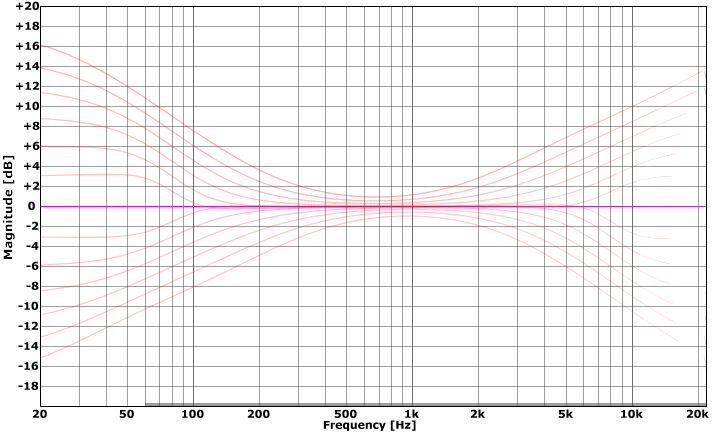
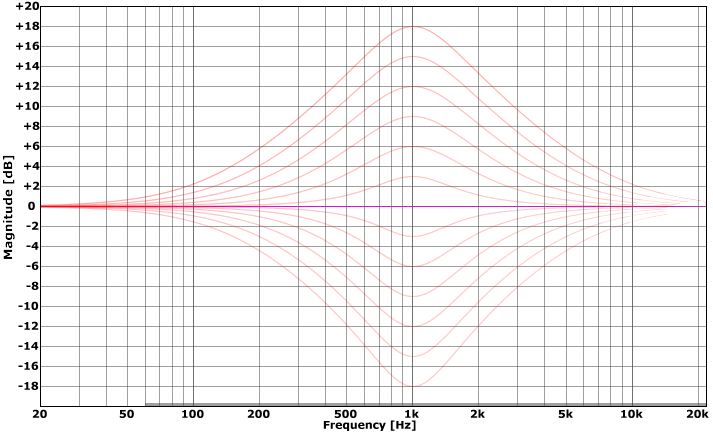
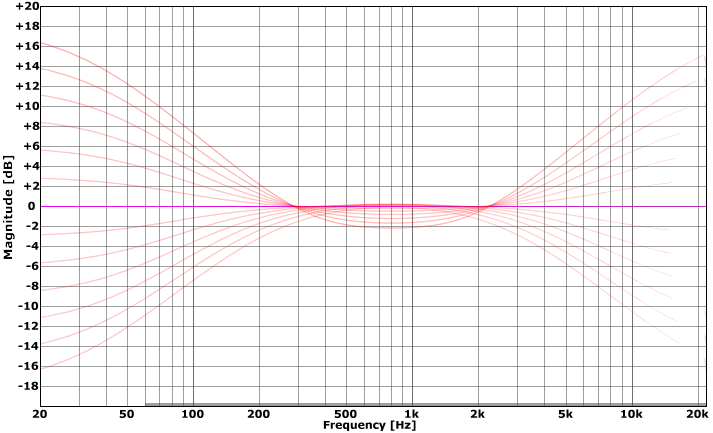
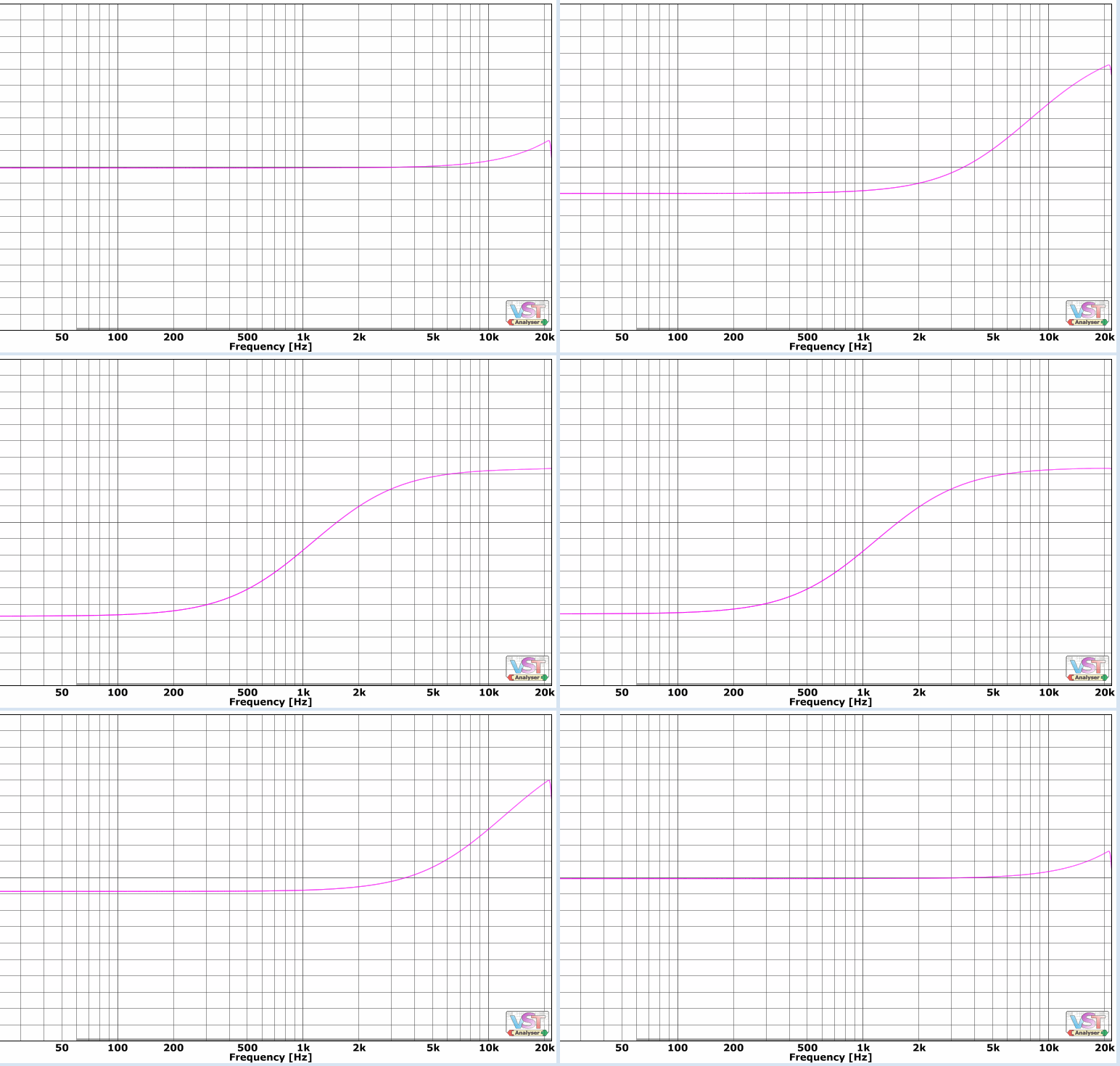
@Halma: The "Soviet" model is a strange "inverse proportional Q" design, which turned out to be surprisingly useful in our tests.
Here's how the "Soviet" filters behave (very steep at low boost/cuts, but increasingly wider as the gain/cut growth):
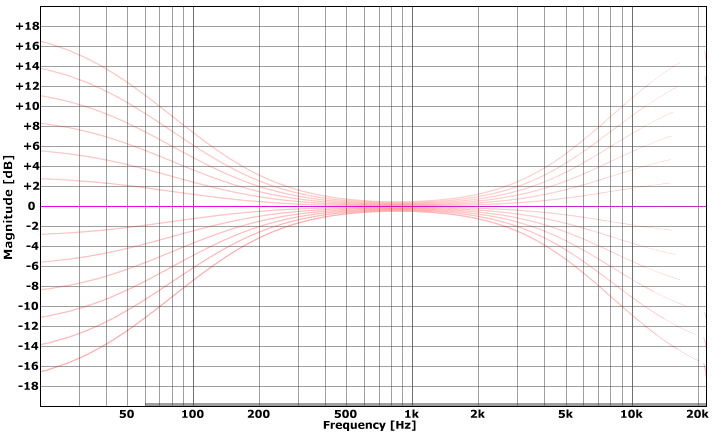
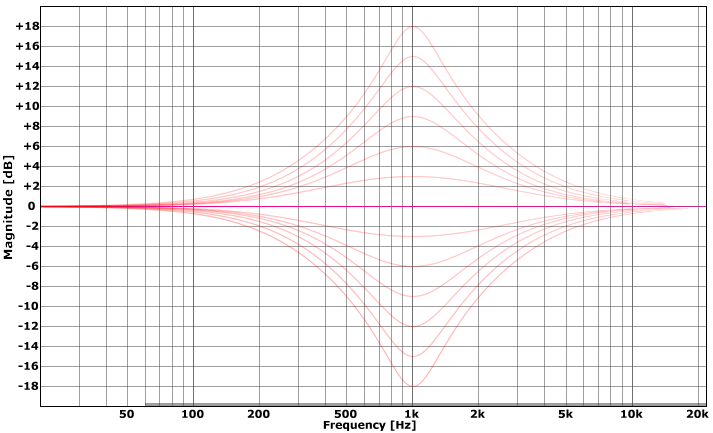
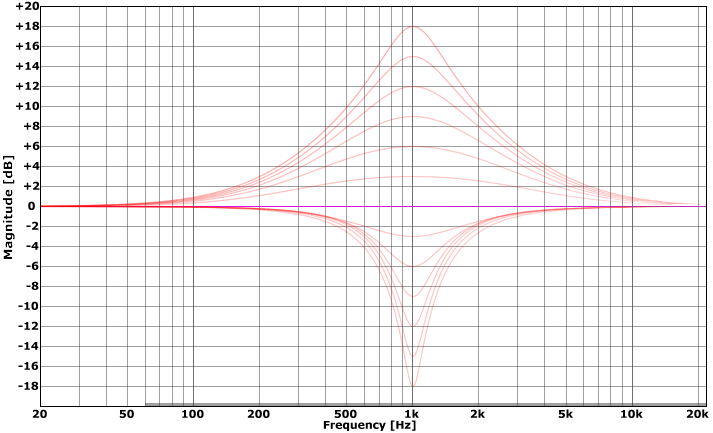
In contrast here's how the "American" filters behave:
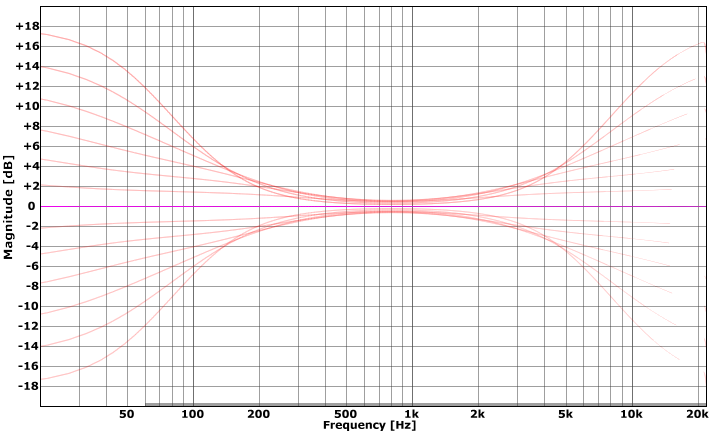
The "British" filters:
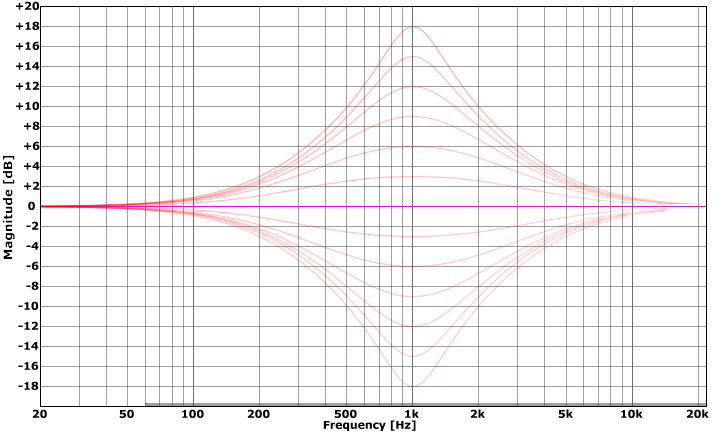
And finally the "German" model (note the almost linear "tilt" style shelves at low boosts):
Additionally, here's a small demo of the auto gain feature. It’s a HF shelf +18.0 dB sweep from 40 kHz to 500 Hz and back with auto-gain mode on (“American” model selected):
From the manual:
"EQ models represent a specific set of curves and EQ behaviours, each offering distinct musical “feel”. The different names and colors have no deeper meaning, they are meant to help with memorization and identification of the different models."
@Halma: The "Soviet" model is a strange "inverse proportional Q" design, which turned out to be surprisingly useful in our tests.
Here's how the "Soviet" filters behave (very steep at low boost/cuts, but increasingly wider as the gain/cut growth):
In contrast here's how the "American" filters behave:
The "British" filters:
And finally the "German" model (note the almost linear "tilt" style shelves at low boosts):
Additionally, here's a small demo of the auto gain feature. It’s a HF shelf +18.0 dB sweep from 40 kHz to 500 Hz and back with auto-gain mode on (“American” model selected):
From the manual:
"EQ models represent a specific set of curves and EQ behaviours, each offering distinct musical “feel”. The different names and colors have no deeper meaning, they are meant to help with memorization and identification of the different models."
Last edited by FabienTDR on Mon Mar 24, 2014 7:59 pm, edited 6 times in total.
Fabien from Tokyo Dawn Records
Check out my audio processors over at the Tokyo Dawn Labs!
Check out my audio processors over at the Tokyo Dawn Labs!
-
- KVRian
- 724 posts since 15 Feb, 2012 from France
-
- KVRist
- 316 posts since 1 Dec, 2012
Could you also post another example, where the oversampling produces an audible difference (for the better)? You seem to be willing to compromise the latency to increase the quality, but the last example nulled to -95dBFS when RMS normalized, in which case I'd rather have zero latency personally.
Just a little criticism to help you reach the perfection you are after..
PS. mmmm.. sexy curves..
Just a little criticism to help you reach the perfection you are after..
PS. mmmm.. sexy curves..
-
- KVRian
- 1184 posts since 24 Feb, 2012
@Compyfox: No, I was just answering burillo's question. It is possible to "trade" sample-rate for bit depth. But the other way around doesn't work.
In fact, Vlad's post relates to a technical "dispute" we had during development. I was arguing that a higher rate might be problematic for filters tuned to very low freq. However, he successfully demonstrated to me that I've been wrong. Really, this is a detail aspect of our early evaluation and design phase and not meant for the "Goldwaage".
I don't want to speak like a politician, just to make sure nobody can quote me out of context. But.. you certainly get the point
@nilhartman: The more we tease, the more we fix bugs in the background!
@Eleventh: Beside the typical problems of null-tests, I must repeat myself: This is not the way we approach things. Lowest common denominator is not our style. There are millions "OK", "good enough" EQs out there. "Slightly better" has a price, and it is still much, much lower than the one you pay on the analogue market (or high end EQ in general). Pls keep in mind we have an army of real-world mastering engineers and sound design pros in our evaluation team.
In fact, Vlad's post relates to a technical "dispute" we had during development. I was arguing that a higher rate might be problematic for filters tuned to very low freq. However, he successfully demonstrated to me that I've been wrong.
Really, this is a detail aspect of our early evaluation and design phase and not meant for the "Goldwaage". I don't want to speak like a politician, just to make sure nobody can quote me out of context. But.. you certainly get the point
@nilhartman: The more we tease, the more we fix bugs in the background!
@Eleventh: Beside the typical problems of null-tests, I must repeat myself: This is not the way we approach things. Lowest common denominator is not our style. There are millions "OK", "good enough" EQs out there. "Slightly better" has a price, and it is still much, much lower than the one you pay on the analogue market (or high end EQ in general). Pls keep in mind we have an army of real-world mastering engineers and sound design pros in our evaluation team.
Fabien from Tokyo Dawn Records
Check out my audio processors over at the Tokyo Dawn Labs!
Check out my audio processors over at the Tokyo Dawn Labs!
-
- KVRist
- 316 posts since 1 Dec, 2012
I have much respect for the work of you and your team mates, releasing quality audio plugins for free to the community. I was by no means critisizing you with the "perfect" comment, quite the contrary. I'm much of a perfectionist myself and I think it's a positive quality. Maybe that's why I'm kind of nit-picking here about this issue.FabienTDR wrote:@Eleventh: Beside the typical problems of null-tests, I must repeat myself: This is not the way we approach things. Lowest common denominator is not our style. There are millions "OK", "good enough" EQs out there. "Slightly better" has a price, and it is still much, much lower than the one you pay on the analogue market (or high end EQ in general).
Doesn't matter who you've got there, as long as you feed them loudness-compromised material, the opinion will be biased, no? I just found it bothering that the files vladg posted - that were supposedly used to make decisions about critical aspects of the plugin, like the quality vs. latency - were not properly normalized. Anyway, I wish you good luck with the development and hopefully we KVR-world people get to try the plugin soon too.FabienTDR wrote: Pls keep in mind we have an army of real-world mastering engineers and sound design pros in our evaluation team.
