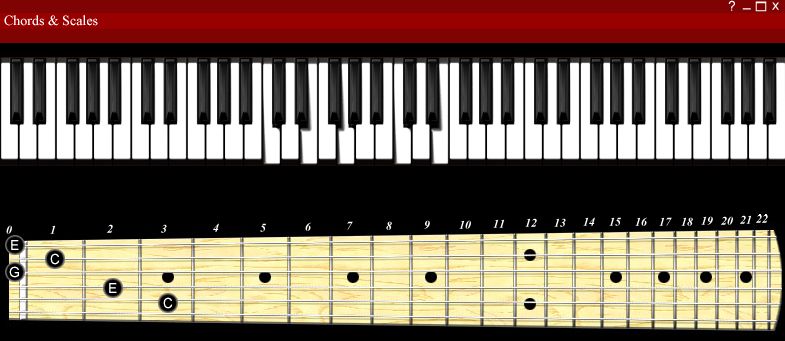
Lately I've been writing a lot more for guitar than usual. The problem is that I like to compose on the piano, especially when I want to use more akward chords and progressions. And then I come up with beautiful lines of left hand 4 and 5 note made-up-chords (sometimes even clusters) that most of them are absolutely impossible to play in the guitar in those voicings.
One example: left hand plays B2-Db3-F3-A3 and then G2-B2-Db3-Fb3 and alternates these 2 chords for a while. While this is easy to do on a piano, I have no idea how to do this on a guitar. I had to eliminate some notes to come up with something different like x-x-7-6-6-5 (A2-C#3-E#3-A3) and x-x-2-0-2-0 (E2-G2-C#3-E3) which sounds relatively similar but are NOT exactly the same chords...
Then I have to go through a fastidious, slow, process of voicing every chord for the guitar and shaking my head at "which notes" to left out and "which frets" are more adequate to put these made-up chords into (implying often functional analysis to find suitable replacements), etc...
I'd like to know if there is any algorithm for this, if there is any modern app or finale/logic plugin to do that: I play left hand chords on the MIDI keyboard and I get a MIDI/score/chart out with possible and correct voicings for the guitar.
Piano to guitar voicing.
-
- KVRist
- 350 posts since 11 May, 2008
Play fair and square!
-

- KVRAF
- 26033 posts since 20 Oct, 2007 from gonesville
Well, I don't like that kind of reliance on software, of course. How do you think composers got on without it? Benjamin Britten was no guitarist, he wrote Nocturnal for Bream, for just one instance. You can get basically a map together and obtain the lay of the land. If you're going to really compose for the instrument and be idiomatic worth a shit, you're going to have to know the instrument. Build an algorithm in your mind. Now, there might be a samples library for the particular instrument that makes actual impossible shit impossible by design and that's a potential tool... But a software shortcut means you don't really know what you're doing, isn't it.
Now, if B2 means the one just below middle C (Yamaha numbering; that's an octave lower in Roland terms) these two chords are doable on the guitar. Very stretcho in any case, but get higher up the neck reduces the pain.
Yer 1st chord: 4th finger on B (Cb) 14th fret, 5th string; 2nd finger on Db 11th fret, 4th string; 1st finger barre on F and A, 3rd and 2nd strings. Now, one thing to know about this is that using the thicker strings owing to this position sounds a little different than managing it down to the left on thinner strings. It's possible but a real crunch doing Cb 4th finger, 9th fret 4th string; Db 2nd finger, 6th fret 3rd string; F 3rd finger, 6th fret 2nd string; A 1st finger, 5th fret 1st string. That 2nd and 3rd fingers in that position with the stretch of 4th finger is... I prefer not. Many people would not come close to managing that.
Yer 2nd chord is also doable. G is 4th finger, 10th fret 5th string; B is 3rd finger, 9th fret 4th string; Db and F are barred, 1st finger 6th fret (3rd and 2nd string). I assess that one as no problem for a real guitarist. Both I deem acceptable, at least in the positions I describe. If your end game is a weak guitarist, they may cry, I donno.
Now, if B2 means the one just below middle C (Yamaha numbering; that's an octave lower in Roland terms) these two chords are doable on the guitar. Very stretcho in any case, but get higher up the neck reduces the pain.
Yer 1st chord: 4th finger on B (Cb) 14th fret, 5th string; 2nd finger on Db 11th fret, 4th string; 1st finger barre on F and A, 3rd and 2nd strings. Now, one thing to know about this is that using the thicker strings owing to this position sounds a little different than managing it down to the left on thinner strings. It's possible but a real crunch doing Cb 4th finger, 9th fret 4th string; Db 2nd finger, 6th fret 3rd string; F 3rd finger, 6th fret 2nd string; A 1st finger, 5th fret 1st string. That 2nd and 3rd fingers in that position with the stretch of 4th finger is... I prefer not. Many people would not come close to managing that.
Yer 2nd chord is also doable. G is 4th finger, 10th fret 5th string; B is 3rd finger, 9th fret 4th string; Db and F are barred, 1st finger 6th fret (3rd and 2nd string). I assess that one as no problem for a real guitarist. Both I deem acceptable, at least in the positions I describe. If your end game is a weak guitarist, they may cry, I donno.
Last edited by jancivil on Sat Sep 12, 2015 8:53 pm, edited 1 time in total.
-
- KVRAF
- 5710 posts since 24 May, 2004 from []1
Vsts will do the conversion automatically. Download the demo of GS-2 at applied acoustics system, take a look at realguitar, acou6tics, etc..
-
- KVRian
- 503 posts since 24 Nov, 2008
I've been using scale software for so long that when I see a Neapolitan scale I can only think about getting some ice cream.
-
- KVRist
- Topic Starter
- 350 posts since 11 May, 2008
Thanks for the useful answers!!
1) Jancivil, yeah, mostly I've been trying to do idiomatic "real" writing. I'm recording with samples, so samples can play whatever crap I give them, but in the end I don't feel good putting that on a score (I always make scores for all of my songs) if no real player can do it. I have the dream that someday I will have the opportunity for human players to actually record all my songs, so just in case, i want to have scores ready... But that is so fastidious!... Because it's like you said, I have to go chord by chord imagining human hands on the strings and figure them out, and I'm a crappy guitar player so in the end I "reduce" my chords to mostly open ones in the lower part of the guitar at the expense of cute notes. Still I end up losing hours just doing "fret math" versus "human hand size".
2) So, I was very impressed with GS-2. I think physical modelling is the future of musical instruments. They have much much less size and memory wasting versus recorded samples and have infinite costumization possibilities. I was aware of Pianoteq, Sample modeling brass and winds and Synful orchestra but totally oblivion to this GS-2. I liked the engine and the idea of having 63 guitars in 50MB and I played around for two hours with it and the "playability" sounds very promising. Unfortunately the sound is not really there. I don't find it realistic enough yet. The "dark fat nylon" was the one I liked the most for my purposes, still i find it far away from alfama sounds... I think at this stage perhaps the ideal match would be if GS-2 was able to export its results as a full MIDI track, and then I could render that MIDI track with Alfama sounds, so I would be only using the engine... I tried to look up for an engine + good samples combined and I think ilya efimov nylon guitar might be it. However, I always twist my nose in spending money on yet another "sample library" just because of the engine.
I really hope physical modelling instruments could come more realistic in the near future. I'd love to replace all my 500GB sample libraries with just 1GB of physical modelling instruments xD
1) Jancivil, yeah, mostly I've been trying to do idiomatic "real" writing. I'm recording with samples, so samples can play whatever crap I give them, but in the end I don't feel good putting that on a score (I always make scores for all of my songs) if no real player can do it. I have the dream that someday I will have the opportunity for human players to actually record all my songs, so just in case, i want to have scores ready... But that is so fastidious!... Because it's like you said, I have to go chord by chord imagining human hands on the strings and figure them out, and I'm a crappy guitar player so in the end I "reduce" my chords to mostly open ones in the lower part of the guitar at the expense of cute notes. Still I end up losing hours just doing "fret math" versus "human hand size".
2) So, I was very impressed with GS-2. I think physical modelling is the future of musical instruments. They have much much less size and memory wasting versus recorded samples and have infinite costumization possibilities. I was aware of Pianoteq, Sample modeling brass and winds and Synful orchestra but totally oblivion to this GS-2. I liked the engine and the idea of having 63 guitars in 50MB and I played around for two hours with it and the "playability" sounds very promising. Unfortunately the sound is not really there. I don't find it realistic enough yet. The "dark fat nylon" was the one I liked the most for my purposes, still i find it far away from alfama sounds... I think at this stage perhaps the ideal match would be if GS-2 was able to export its results as a full MIDI track, and then I could render that MIDI track with Alfama sounds, so I would be only using the engine... I tried to look up for an engine + good samples combined and I think ilya efimov nylon guitar might be it. However, I always twist my nose in spending money on yet another "sample library" just because of the engine.
I really hope physical modelling instruments could come more realistic in the near future. I'd love to replace all my 500GB sample libraries with just 1GB of physical modelling instruments xD
Play fair and square!
-
- KVRAF
- 5710 posts since 24 May, 2004 from []1
You can open the midi files that come with gs-2 and drag them to a track in your host. That way you can edit/mix/match as you want. Maybe search on aas and youtube for performances using gs-2 before deciding it can't sound real enough.
...
...
-

- KVRist
- 149 posts since 28 Sep, 2006