Apples new returns policy seems to be illegal (at least in the EU)

For iOS (iPhone, iPad & iPod), Android, Windows Phone, etc. App and Hardware talk
RELATED
PRODUCTS

Post

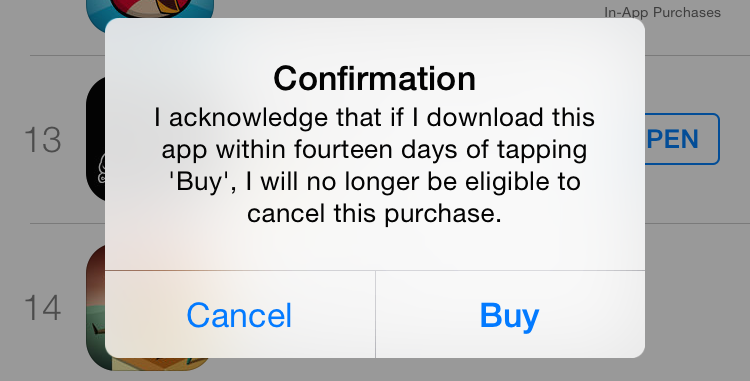
I've suddenly started getting these messages when I download an app from the Appstore:

Image

http://www.idownloadblog.com/2015/01/12 ... rn-policy/

according to this it is a result of people 'abusing' the returns system but what qualifies as 'abuse' seems to be entirely up to Apple, I have not been doing so but I have returned a few items that did not do what they were advertised as doing or that were too buggy for use, and don't see why I and others should have to put up with such a system that effectively deprives people of their consumer rights to return defective products - the fact is many apps in the appstore misrepresent their capabilities, there are a lot of crappy badly written and buggy apps, and most do not have demos. How can you know if a product is right for you without downloading it?

Post

They seem to be taking the distance selling rules (which give 14 days right to cancel) and suggesting that actually downloading the product within those days removes that right.
Some items are not eligible for return in this respect, and that (unfortunately) includes software where the 'wrapping' has been broken - I guess a download is considered in the same way.

Of course, you're quite correct with respect to whether the app is worth buying, and I would suggest that anything without a demo is avoided.

Note, this shouldn't affect rights for faulty products - it's only the right to cancel and return something after you changed your mind, AFAIK.

Oh yeah... IANAL

Post

i got this gottcha only with apps on sale so far. and i managed to return an app which was buggy all the way - though i had to insist on a refund.

Post

koalaboy wrote: Of course, you're quite correct with respect to whether the app is worth buying, and I would suggest that anything without a demo is avoided.
Problem is very few appstore apps have demos, and in most cases these tend to be in the form of lite or ad funded versions. So effectively they are saying now if you download something you waive your right to return it even if the developers have misled people into thinking it does something it doesn't do, or actually works as intended.

Post

It's just more of the same computer industry consumer abuse, based on excusing computers from the same consumer protection that other industries are required to abide by. The computer industry exceptions have been spreading to other industries that are able to claim software is their product's core functionality. Once everything is computerized, nothing has a warranty.

The solution isn't to bash individual corporations and their execution. The solution is to mandate warranty on software. But we have very successful memes and myths that consumers themselves support to keep that from happening (like "software can never be bug free", which is a self-fulfilling prophecy of functional limitations). Change the laws that the industry must play by and you change the problem for everyone. Good luck trying to change it. The pendulum is swinging to the far end of consumer abuse and corporate untouchability, not consumer protection.

I'm not saying "don't complain". I'm absolutely encouraging it. Just aim it at your lawmakers and your fellow computer product consumers who think software can never be held to the same standards of reliability and merchantability that existed for non-software goods.
- dysamoria.com
my music @ SoundCloud

Post

Jace-BeOS wrote:like "software can never be bug free", which is a self-fulilling prophecy of functional limitations).
No, its a pragmatic assessment of the nature of a task. Delivering bug-free software requires a mechanism for proving that the software is bug-free. The complexity of a modern software applicatiion can be hundreds of thousands or millions of manipulations of data, and, as a result, billions of possible combinations of cases to be tested.
In fact, any mechanism for testing software completely would have to intrinsically cater for more complexity than the software it is testing.
And how exactly would you test the test? Recurse here.

'Making' software bug-free is actually 'guaranteeing' software is bug free, and that is effectively an infinite, open-ended task that could never be finished. If it was somehow made mandatory, software could never ever be shipped, and we'd be about the same level of computing, globally, as we were in the 40's.
An idiot on Set Theory:
"In some cases there is an object called red that contains everything that is red. In much the same way a pot is a plate."

Post

By law, anyone have the right to return any good purchased within at least 30 days, and get a complete refund. I don't remember reading any exclusions about software or any special cases. Apple seem to consider themselves above the law (Avid store has a similar statement, BTW). Once they tried the same regarding warranty, but they were forced to fulfill the two year warranty when it is the case of final customers, yet, they still say that any computer bought in their online store only has only one year warranty (which is against the law).

I think this Apple and other companies behaviour should be denounced to the legitimate EU authorities to start the legal procedures in order to avoid these kind of abuse. It's up to them to find a way to fulfill the law, not impose another law on the customer. Nobody asked them to create the Apple Store and make some products Apple Store exclusive.

Unfortunately, they seem to think that they can make their own laws.
Fernando (FMR)

Post

whyterabbyt wrote:
Jace-BeOS wrote:like "software can never be bug free", which is a self-fulilling prophecy of functional limitations).
No, its a pragmatic assessment of the nature of a task. Delivering bug-free software requires a mechanism for proving that the software is bug-free. The complexity of a modern software applicatiion can be hundreds of thousands or millions of manipulations of data, and, as a result, billions of possible combinations of cases to be tested.
In fact, any mechanism for testing software completely would have to intrinsically cater for more complexity than the software it is testing.
And how exactly would you test the test? Recurse here.

'Making' software bug-free is actually 'guaranteeing' software is bug free, and that is effectively an infinite, open-ended task that could never be finished. If it was somehow made mandatory, software could never ever be shipped, and we'd be about the same level of computing, globally, as we were in the 40's.
Then the fundamental problem is the software architecture itself. It is too complicated to be reliable. Computers are too complicated to be reliable.

Thing is, I've used software that was reliable. Most of it isn't, but some has been. Not so much these days. The development and distribution speeds and lack of attention to detail, and lack of proper quality assurance time going on in most of the industry today is shit. The behavior of developers to sell a product when it no longer compiles with fatal errors is a huge part of this. Rather than actually testing the software and the hardware it will be used on... Etc. wtf ever. No one cares.
- dysamoria.com
my music @ SoundCloud

Post

Honestly, I'm most irritated over the utter lack of accountability. When companies ship software, it could be relatively bug free. It's not even remotely bug free any more. There was some point where the complexity overtook the ability of developers to manage the product. If there was accountability, they wouldn't let things get to that point or would spend the appropriate time iterating on their reliability testing. This is not the nature of computers. It's the nature of capitalism.

http://angryartboy.blogspot.com/2012/08 ... puter.html
- dysamoria.com
my music @ SoundCloud

Post

whyterabbyt wrote:
Jace-BeOS wrote:like "software can never be bug free", which is a self-fulilling prophecy of functional limitations).
No, its a pragmatic assessment of the nature of a task. Delivering bug-free software requires a mechanism for proving that the software is bug-free. The complexity of a modern software applicatiion can be hundreds of thousands or millions of manipulations of data, and, as a result, billions of possible combinations of cases to be tested.
In fact, any mechanism for testing software completely would have to intrinsically cater for more complexity than the software it is testing.
And how exactly would you test the test? Recurse here.

'Making' software bug-free is actually 'guaranteeing' software is bug free, and that is effectively an infinite, open-ended task that could never be finished. If it was somehow made mandatory, software could never ever be shipped, and we'd be about the same level of computing, globally, as we were in the 40's.
But this is not about all software on all systems. This is about Apple apps sold exclusively on an Apple site to Apple systems. Therefore it is a closed-end system with finite variables (older models, etc) that should be easy to make "bug free".

If Apple wants to restrict the rights of the buyer from returns, then the software should be checked by Apple itself and list which systems it is qualified to work on. This would eliminate the need for return due to operational problems.

Post

OK I wasn't really wanting to get into a discussion of whether software should be totally bug free, obviously there will always be some bugs, but for me it should at least work as advertised in the appstore and if it doesn't purchasers should have the right to return it. I do recognise that there is potential for some people to abuse the 14 day return law (although on iOS that is quite limited really), but this should not end up in penalizing people like myself who have returned products for perfectly legitimate reasons. What worries me most is I have no ability to challenge or remove this limit from my account, I tried support but they were of no use.

Post

fmr wrote:By law, anyone have the right to return any good purchased within at least 30 days, and get a complete refund. I don't remember reading any exclusions about software or any special cases.
Digital content is different - see: http://europa.eu/youreurope/citizens/co ... dex_en.htm

You can understand why in *some* cases - you shouldn't be able to watch part of a streamed movie, then demand a refund as you don't want it anymore.

Apple are playing the loopholes, by deeming the software to be 'digital content' which it is technically within the law - they are, of course, completely bypassing the spirit of the law.

To play devil's advocate, should a consumer be able to buy software that they only need for 1 week, use it, then get a full refund ?

Post

koalaboy wrote: Apple are playing the loopholes, by deeming the software to be 'digital content' which it is technically within the law - they are, of course, completely bypassing the spirit of the law.
Which clearly it is not, since digital content doesn't perform any task - its just for watching, or listening. Games and applications are not digital content, films ad music are, therefore, if someone raises this, EU courts will definitely have to force them to act conform to the law.
koalaboy wrote: To play devil's advocate, should a consumer be able to buy software that they only need for 1 week, use it, then get a full refund ?

In what way does this differ from any other product? Theoretically, you could buy something, like for example a hard-drive, work with it for a week, and then return it to the store, and you would be entitled for a refund. It's the law, and Apple has to play according to it, as everybody else. If they don't agree with the law, it's up to them to not do business at all. If they choose to do it, they have to play according to the rules.

Apple is constantly chasing loopholes, like they do with taxes, and then come justifying with the exaggeration of taxes in some place, like if they were the only ones hurted by that. And they should be forbid to take advantage of EU incentive policies, paid with the citizens taxes, like they are doing in Ireland. Those "incentives" are not for multimillion companies that ripoff the customers and end up piling millions in profits, basically by stealing everybody everywhere.
Fernando (FMR)

Post

JJ_Jettflow wrote:But this is not about all software on all systems. This is about Apple apps sold exclusively on an Apple site to Apple systems. Therefore it is a closed-end system with finite variables (older models, etc) that should be easy to make "bug free".
Says someone who, just like Jace, clearly has never written any non-trivial software ever.
An idiot on Set Theory:
"In some cases there is an object called red that contains everything that is red. In much the same way a pot is a plate."

Post

fmr wrote:
koalaboy wrote: Apple are playing the loopholes, by deeming the software to be 'digital content' which it is technically within the law - they are, of course, completely bypassing the spirit of the law.
Which clearly it is not, since digital content doesn't perform any task - its just for watching, or listening. Games and applications are not digital content, films ad music are, therefore, if someone raises this, EU courts will definitely have to force them to act conform to the law.
Instead of just constantly disagreeing with me, read the links I posted, and do some more research

Apple aren't breaking any laws - in fact they're just starting to comply with them.

Digital downloads are not included (and should not be provided until the customer acknowledges they don't have a cooling-off period for them).

It doesn't matter if it's pictures of your neighbours cat, or if it's the North Korean Nuclear reactor control system.

Anyway, I'm not going to keep trying to point this out - it's stated pretty clearly everywhere. I don't *agree* with the concept, but it's what the EU have decided is the case.

Post Reply

Return to “Mobile Apps and Hardware”