Repro-1 (out now)

VST, AU, AAX, CLAP, etc. Plugin Virtual Instruments Discussion
Post Reply New Topic

To your ears, which filter behaves most analogue

1
87
22%
2
28
7%
3
88
22%
4
118
30%
5
74
19%
 
Total votes: 395

RELATED
PRODUCTS
Repro$169.00Buy

Post

sinemotor wrote:I don't know which filter sounds the most analog because I have no experience with analog synths but to my ears I just prefer Filter 1.
...so you prefer that, with high resonance, as soon as the cutoff gets past "6" (and exactly at 6, like a switch) it introduces all sorts of ugly behavior? useless for high-res filter sweeps. i have a hard time believing that a real Pro-One works like that (does it?), i really wonder what's up with "Filter 1". could have some uses, but i'd never want a synth with a filter that operates like that.

EDIT: even still, i'm finding that i prefer #1 myself at certain settings. seems to have the most "character" of all the choices, which works great for some sounds.
Last edited by jbuonacc on Tue Apr 05, 2016 8:16 pm, edited 1 time in total.

Post

pdxindy wrote:grit and noise does not necessarily mean aliasing...
Image

Post

nl3tweaker wrote:All starts to get interesting.
Seven years to make a post, two years since the last visit, but good for you you've finally found a topic worth commenting on after all this time :hihi:
:hihi:
Last edited on Sun Apr 17, 2016 12:42 pm, edited 17 times in total.
:dog: :hihi: :lol:

Post

nl3tweaker wrote:All starts to get interesting when doing audio-rate filter modulation, producing vowel-like sounds.
Filter 5 is the only one that sounds smooth enough for this modulation at all - although, honestly, I'd wish for an even more "analog" sounding filter, because when torning the filter modulation knob, some ranges just sound artificial.
Number 5 shares a problem Diva has, which is that the modulation knob often isn’t changing the sound much between the 5 and 10 mark, whereas model number 1 generally makes more use of the range. I don’t think it helps the “feel” of an instrument, even if virtual, when there’s a lot of control travel not changing the sound.

I do wonder if the modulation differences on the others (1-4) are really a direct result of lower CPU calculations, or an attempt to mask something by applying certain modulation patterns?

Whatever, it’s a bit of a pity the plainest sounding (number 5) ends up being the answer. 52341, most to least, on that basis.

I think I’d rather see number 1 souped up on a wavetable style synth :tu:

Post

PAK wrote: Number 5 shares a problem Diva has, which is that the modulation knob often isn’t changing the sound much between the 5 and 10 mark, whereas model number 1 generally makes more use of the range. I don’t think it helps the “feel” of an instrument, even if virtual, when there’s a lot of control travel not changing the sound.

I do wonder if the modulation differences on the others (1-4) are really a direct result of lower CPU calculations, or an attempt to mask something by applying certain modulation patterns?
I agree - somewhat.
To me, the "changing the sound much" sounds more like aliasing than analog behavior however.
I would carefully guess that the filters work at different oversampling rates, hence the audible artifacts.

From this thread I find it surprisingly obvious that not everybody expects the same character from an "analog sounding" filter :wink:

Post

OutCider wrote:
nl3tweaker wrote:All starts to get interesting.
Seven years to make a post, two years since the last visit, but good for you you've finally found a topic worth commenting on after all this time :hihi:
Oh my god, I'm shocked how time flies nowadays :zzz:

Post

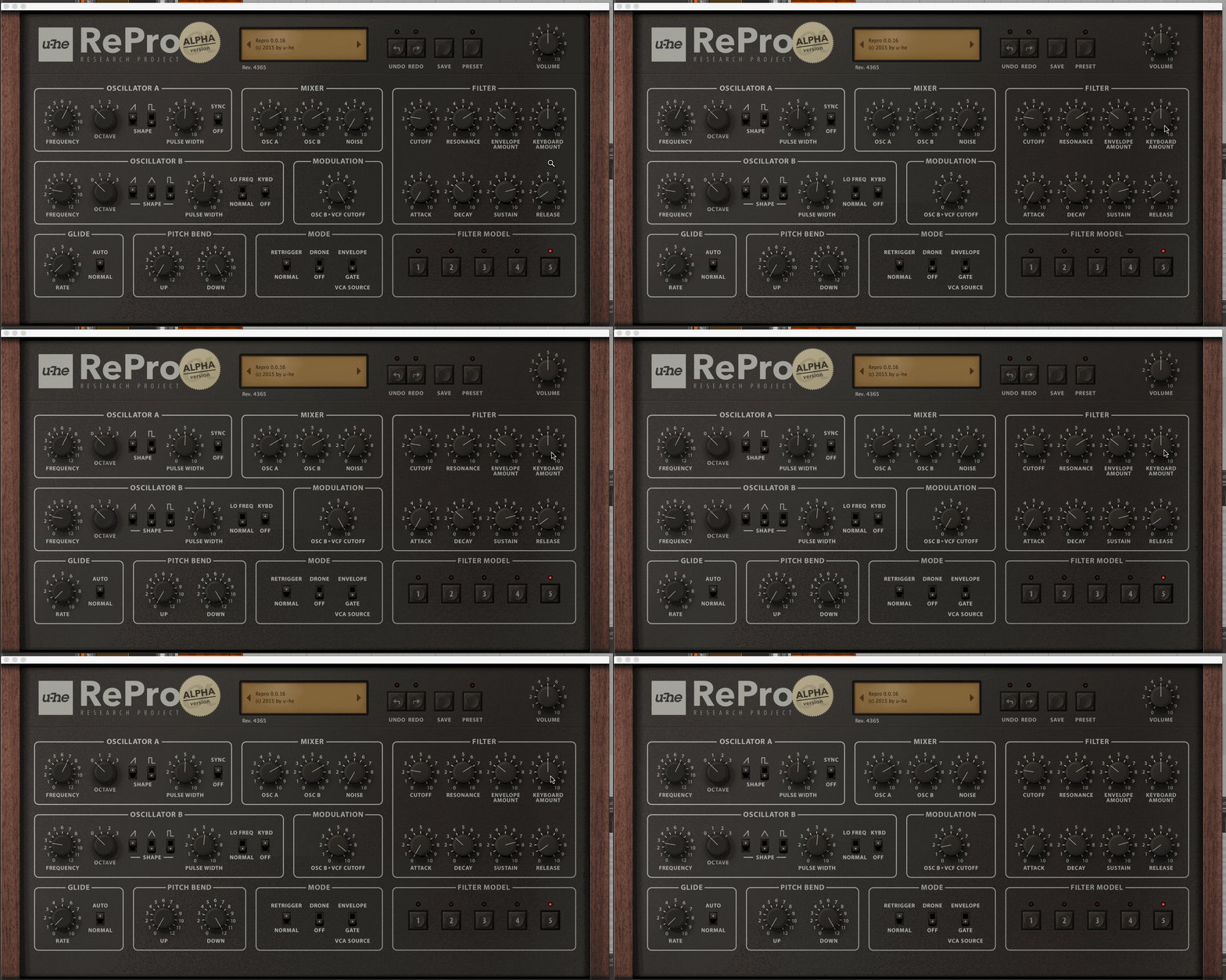
Made some comparison files with these settings, modulating the OSC B to Filter modulation:

Image

Filter1

Filter2

Filter3

Filter4

Filter5

With these setting Filter 3 sounds best to me, while Filter 5 is also nice. Filter one sounds broken, and Filter 4 also has some of the grit of Filter 1. Filter 2 and 3 do not differ too much.
Last edited by Cyoon on Tue Apr 05, 2016 7:56 pm, edited 1 time in total.
JamWide - a cross-platform Ninjam client for DAWs

Post

When I took the filter and resonance to some extreme settings to my ear 5 and then 2 sounded best. 3 came at third place (haha). 1 and 4 was is good but they can be provoked to give strange modulated pitched stuff I did not like.

Post

i think Urs also mentioned that he would like to know, if there is a need for complex filters even on not so extreme settings right? So he could combine the low CPU filters on regular settings and switch over internally to the more CPU intensive ones with extreme setting. I`d say Filter 2 and 3 do work fine on lower cutoff values like in the settings above, while high resonance and cutoff would need filter 4 or 5.
JamWide - a cross-platform Ninjam client for DAWs

Post

Filters 3 and 4 seem very close to each other... but I expect Filter 3 to be the most "expensive" one... its high frequency response seems the most accurate with high resonance. Also no aliasing spottable there.

On a side note: Knob response on Filter 5 seems odd... as if it was "linearized".

cheers,
kybernaut

Post

Suloo wrote:With these setting Filter 3 sounds best to me, while Filter 5 is also nice. Filter one sounds broken, and Filter 4 also has some of the grit of Filter 1. Filter 2 and 3 do not differ too much.
In your example, I would rank them 5 > 1 > 4 > 3 > 2. 2 and 3 both sound the most irritating to me.

So far I've not found any case where I prefer 2 or 3 over any of the rest.

Post

nl3tweaker wrote:To me, the "changing the sound much" sounds more like aliasing than analog behavior however.
I would carefully guess that the filters work at different oversampling rates, hence the audible artifacts.
I think that’s correct. What I was referencing was how some of them get moved around. For example, the cutoff freq on 1 and 5 get shifted up, but it’s left alone on 2,3, and 4. Then there’s the volume differences, where 1 is usually the loudest.

The small changes are enough to shift the modulation pattern with the res, and you can compensate for that between the models within certain ranges. It’s only when you go further up the scale that things stand out.

Seems this was more of a traditional aliasing test than a “spot the level of detail in the models” test. :(
From this thread I find it surprisingly obvious that not everybody expects the same character from an "analog sounding" filter :wink:
Ahh, but is there one truth? ;)

Also, it was specifically the resonance in combination with Osc B modulation being tested. So that’s into a weirder category of noises, where there’s more room to second guess and it helps hugely to be familiar with both aliasing and a Pro One.

A lot of people assume the first. But, even a decade ago, obvious aliasing was already rare, since it was usually tackled by keeping the high frequencies to a minimum. These days a lot of people don’t know what it is. Really :D

Post

Suloo wrote:i think Urs also mentioned that he would like to know, if there is a need for complex filters even on not so extreme settings right?
Even plainer politer things, like a Juno 60, can have a pleasant scratchy/fuzzy quality to the resonance, and you don’t have to modulate rapidly to hear it. Plus it evolves more, and for quite a long time, as the harmonics decay. That level of detail would be nice from emulations..

Post

PAK wrote:
nl3tweaker wrote:To me, the "changing the sound much" sounds more like aliasing than analog behavior however.
I would carefully guess that the filters work at different oversampling rates, hence the audible artifacts.
I think that’s correct.
Hint: All filters are 8x oversampled at 44.1/48kHz, 4x at 88/96, 2x at 176/192

The amount of aliasing (hopefully) is the same among them, but the amount of (digital) artifacts isn't.

Post

Seems that some people confuse "aliasing" with distortions created when the mixer is overloaded and the result fed into a high resonant filter!

Post Reply

Return to “Instruments”