

talk about ad hominem.
well sorry, I think you're full of it on this. I get that you are referring to the early music definition of "modal" but contemporary theorists use the word in different ways.
The original reason I got uppity is because it's annoying to see people try and pigeonhole a term that has a lot of different meanings depending on who you talk to. We're not talking about science here. We're talking about music theory, in which pedantic people such as yourself will bicker with each other for decades about pretty much anything.
If it's as set in stone as you say, then surely you can produce a source that backs it up? Somehow I expect you will give me a reason why it's not worth your time or something. Whatever.
Modal Harmony vid series
-
- KVRian
- 804 posts since 18 Apr, 2011
-
- KVRian
- 804 posts since 18 Apr, 2011
I mean.. maybe I'm wrong here.. but I'm referring to what I was taught in my fourth semester at university. I respected my teacher a lot, and I don't think he was full of it. Granted you can obviously go deeper in the study of theory than i have. I'm just a jazz musician, but I am more knowledgable about theory than most jazz musicians i know.
-

- KVRAF
- 26033 posts since 20 Oct, 2007 from gonesville
Yeah, on reflection I can't be sure you're "totally" an example of D-K Effect, I mean maybe you can change. It's close to ad hom (indicating a psychological condition) so I want to be fair and not a hypocrite. You can say 'OCD' and I'll take it figuratively rather than literally then, too. I take that back. 
But Dunning-Kruger Effect means one believes they've done better on the test than they did in fact, and in particular have erred here relative to the others' performance. You believe you know better here while you know really nothing about it. Your pagro snark suggests the classic 'I'm on top by nature' attitude of the D-K Effect case. So here's this total top-down approach to the question, rather than studying it from the ground up.
I'd recommend looking into logical fallacies, additionally: "most college texts" is fallacious appeal to authority; fallacious as we can't reasonably recognize the authority and now we find it's texts from the wrong field.
Good luck to you. I'm done wth ya, yer tiresome and kind of just a dick so far and I'm too old for this shit.
But Dunning-Kruger Effect means one believes they've done better on the test than they did in fact, and in particular have erred here relative to the others' performance. You believe you know better here while you know really nothing about it. Your pagro snark suggests the classic 'I'm on top by nature' attitude of the D-K Effect case. So here's this total top-down approach to the question, rather than studying it from the ground up.
I'd recommend looking into logical fallacies, additionally: "most college texts" is fallacious appeal to authority; fallacious as we can't reasonably recognize the authority and now we find it's texts from the wrong field.
Good luck to you. I'm done wth ya, yer tiresome and kind of just a dick so far and I'm too old for this shit.
Last edited by jancivil on Fri Oct 21, 2016 2:47 am, edited 1 time in total.
-
Chandlerhimself Chandlerhimself https://www.kvraudio.com/forum/memberlist.php?mode=viewprofile&u=318799
- KVRAF
- Topic Starter
- 1819 posts since 19 Dec, 2013 from Japan
Thanks. I hope the videos are useful to you. Perhaps you're right, some people seem to have closed minds and other just dislike me personally, so there is no reason for me to go back and forth with them.topaz wrote:Thanks for taking the time to post these, ignore the usual forum lynch mob / muso snob thread hijackers.

My Youtube page https://www.youtube.com/user/GuitarChandler
-
- KVRist
- 442 posts since 21 May, 2014
http://musictheoryblog.blogspot.ca/2007 ... scale.html
the classical modes are based on C major. Why are you disputing that? I am talking about MODAL harmony in contrast with TONAL harmony. I really dont know why you are getting so uptight about this.
http://www.jazclass.aust.com/lessons/jt/jt14.htm
http://www.jazclass.aust.com/lessons/jt/jt14.htm#01
http://www.jazclass.aust.com/lessons/jt/jt14.htm#02
But the most salient point to reinforce is that when you overlap two tones, it creates harmony. In the actual physical world, of acoustics and sound pressure waves. You are creating harmony....and you can choose to create this HARMONY using tones found in the CLASSICAL modes, which are based on C major(ionian etc). OR you can deviate from that..
once you deviate from that, you are now changing the rules, and completely discplacing yourself from the tried and tested and true form that is imbued in the CLASSICAL Greek modes. (the INTERVALS).
once you deviate from that, you are choosing to use tones(new Mother set of intervals) based on MELODY. you want to create more exotic or more rich melodic patterns. that will give different outcomes from the classic modal intervals.
however, once you start to focus solely on MELODY, this will erode the intrinsic cohesion and GEOMETRIC HARMONIC CLEANliness found in the classic Greek Modes.
and again, once you do that, you are consequently left with trying to use that TONAL scale, as the basis for HARMONY...(this is just a consequence)....BUT that is not going to lead to pleasing harmonic outcomes...so you have to revert back into using "MODAL harmony"....in the sense that you are using only the tones available within the classic greek modes
(i get that you dont think there is such thing as "modal harmony", ok I understand that by adhering strictly to a very defined understanding of the subject, there is no such thing as "modal harmony", but that is completely misleading with respect to having an understanding about ACTUAL REAL harmony...like the TONES that you HEAR overlapping eachother in real time with your ears...the REALITY...of sound...not intangible abstractions)
you keep going on about medieval stuff, this is BEFORE medieval times...the Greek period of history was like 2000 years before the medieval times. whatever they did in medieval times is irrelevant to what the Greeks realized about how our universe works and the inherent geometry that exists in it.
its irrelevant to developing a deeper sonic understanding of music and how sound works.
i agree with jancivil that modes, modal etc, this is about melody...and melodic intervals, and fmr what you are saying about how any harmony that derives from "modes" is irrelevan, i agree with that too,
but that "harmony" DOES still exist...in REALITY.....it's still HARMONY...when you overlap two tones....it doesnt matter what someone SAYS about whether that is HARMONY or not...because it IS harmony....in the actual physical sense.
ok, MODES, their purpose is not HARMONIC...but you can still derive HARMONY from using MODES. to dispute THIS is ignorant.
the classical modes are based on C major. Why are you disputing that? I am talking about MODAL harmony in contrast with TONAL harmony. I really dont know why you are getting so uptight about this.
http://www.jazclass.aust.com/lessons/jt/jt14.htm
http://www.jazclass.aust.com/lessons/jt/jt14.htm#01
JT 14.2 - The ancient Greek modesA mode is therefore a displaced scale.
It uses the same notes as the mother scale but the tonic note is different. This produces a different musical flavour which is unique for that mode.
http://www.jazclass.aust.com/lessons/jt/jt14.htm#02
you can play these word games you are playing but i like to always think of music in terms of function. Not semantics. Modes perform a function. Tones perform a function. When you OVERLAP multiple TONES...it creates HARMONY. I really dont care what words or descriptions or what magic dust you want to sprinkle on all of this. It's all just talk, and words. The function is what is important. And choosing to use "MODAL" tones, to form harmony will yield very different results than using "TONAL" tones...ie. scales NOT based on tones that are ONLY found in classical modes.The seven modes are :
Mode name
Tonic
Notes
(C) Ionian mode C C - D - E F - G - A - B C
(D) Dorian mode D D - E F - G - A - B C - D
(E) Phrygian mode E E F - G - A - B C - D - E
(F) Lydian mode F F - G - A - B C - D - E F
(G) Mixolydian mode G G - A - B C - D - E F - G
(A) Aeolian mode A A - B C - D - E F - G - A
(B) Locrian mode B B C - D - E F - G - A - B
But the most salient point to reinforce is that when you overlap two tones, it creates harmony. In the actual physical world, of acoustics and sound pressure waves. You are creating harmony....and you can choose to create this HARMONY using tones found in the CLASSICAL modes, which are based on C major(ionian etc). OR you can deviate from that..
once you deviate from that, you are now changing the rules, and completely discplacing yourself from the tried and tested and true form that is imbued in the CLASSICAL Greek modes. (the INTERVALS).
once you deviate from that, you are choosing to use tones(new Mother set of intervals) based on MELODY. you want to create more exotic or more rich melodic patterns. that will give different outcomes from the classic modal intervals.
however, once you start to focus solely on MELODY, this will erode the intrinsic cohesion and GEOMETRIC HARMONIC CLEANliness found in the classic Greek Modes.
and again, once you do that, you are consequently left with trying to use that TONAL scale, as the basis for HARMONY...(this is just a consequence)....BUT that is not going to lead to pleasing harmonic outcomes...so you have to revert back into using "MODAL harmony"....in the sense that you are using only the tones available within the classic greek modes
(i get that you dont think there is such thing as "modal harmony", ok I understand that by adhering strictly to a very defined understanding of the subject, there is no such thing as "modal harmony", but that is completely misleading with respect to having an understanding about ACTUAL REAL harmony...like the TONES that you HEAR overlapping eachother in real time with your ears...the REALITY...of sound...not intangible abstractions)
you keep going on about medieval stuff, this is BEFORE medieval times...the Greek period of history was like 2000 years before the medieval times. whatever they did in medieval times is irrelevant to what the Greeks realized about how our universe works and the inherent geometry that exists in it.
its irrelevant to developing a deeper sonic understanding of music and how sound works.
i agree with jancivil that modes, modal etc, this is about melody...and melodic intervals, and fmr what you are saying about how any harmony that derives from "modes" is irrelevan, i agree with that too,
but that "harmony" DOES still exist...in REALITY.....it's still HARMONY...when you overlap two tones....it doesnt matter what someone SAYS about whether that is HARMONY or not...because it IS harmony....in the actual physical sense.
ok, MODES, their purpose is not HARMONIC...but you can still derive HARMONY from using MODES. to dispute THIS is ignorant.
Last edited by zethus909 on Fri Oct 21, 2016 3:37 am, edited 3 times in total.
Sincerely,
Zethus, twin son of Zeus
Zethus, twin son of Zeus
-
- KVRian
- 804 posts since 18 Apr, 2011
ah.. as expected. totally dodging the question by saying "wrong." nice donald trump tactic.jancivil wrote:Yeah, on reflection I can't be sure you're "totally" an example of D-K Effect, I mean maybe you can change. It's close to ad hom (indicating a psychological condition) so I want to be fair and not a hypocrite. You can say 'OCD' and I'll take it figuratively rather than literally then, too. I take that back.
But Dunning-Kruger Effect means one believes they've done better on the test than they did in fact, and in particular have erred here relative to the others' performance. You believe you know better here while you know really nothing about it. Your pagro snark suggests the classic 'I'm on top by nature' attitude of the D-K Effect case. So here's this total top-down approach to the question, rather than studying it from the ground up.
I'd recommend looking into logical fallacies, additionally: "most college texts" is fallacious appeal to authority; fallacious as we can't reasonably recognize the authority and now we find it's texts from the wrong field.
Good luck to you. I'm done wth ya, yer tiresome and kind of just a dick so far and I'm too old for this shit.
-
- KVRist
- 442 posts since 21 May, 2014
yea but if you are also disputing the fact that you can create harmony from using modes then this is also DK effect. because thats exactly what "modal" harmony is. in reality anyway...from a pure musical function standpoint.But Dunning-Kruger Effect

Sincerely,
Zethus, twin son of Zeus
Zethus, twin son of Zeus
-
- KVRian
- 804 posts since 18 Apr, 2011
and on your whole paragraph about my false claim about the college text.. first of all i didn't say "most college texts" i said the most widely used college text, which you can confirm is the book i was talking about.
but then, i realized i had remembered wrong, and wasn't in the book but a lesson my professor had made. and i corrected myself. so why are you arguing with a point that i already said was invalid?
it's kind of bizzare that you spend so much time on this forum trying to intimidate people by talking over their heads and talking about logical falicies (for f**k sake.. this is what every forum troll trying to act holier than thou does)..
if you actually care about music. why not try to help people to understand concepts instead of shooting them down? I'm not referring to myself as much as someone who might be really confused on the matter. I know what you're saying, i just think it's incredibly pedantic.
but then, i realized i had remembered wrong, and wasn't in the book but a lesson my professor had made. and i corrected myself. so why are you arguing with a point that i already said was invalid?
it's kind of bizzare that you spend so much time on this forum trying to intimidate people by talking over their heads and talking about logical falicies (for f**k sake.. this is what every forum troll trying to act holier than thou does)..
if you actually care about music. why not try to help people to understand concepts instead of shooting them down? I'm not referring to myself as much as someone who might be really confused on the matter. I know what you're saying, i just think it's incredibly pedantic.
-

- KVRAF
- 11162 posts since 16 Mar, 2003 from Porto - Portugal
The people who wrote this know NOTHING about music theory, know NOTHING about music history, and know NOTHING about modes. They are inventing norms and theories to fit their music practice. It's ignorants teaching ignorants. Unfortunately, I see the jazz field filled with this kind of people. They should talk less and play more, maybe, and when asked they should simply say: "I play like THIS", and keep the "theories" to themselves.zethus909 wrote:http://musictheoryblog.blogspot.ca/2007 ... scale.html
the classical modes are based on C major. Why are you disputing that? I am talking about MODAL harmony in contrast with TONAL harmony. I really dont know why you are getting so uptight about this.
http://www.jazclass.aust.com/lessons/jt/jt14.htm
http://www.jazclass.aust.com/lessons/jt/jt14.htm#01A mode is therefore a displaced scale.
It uses the same notes as the mother scale but the tonic note is different. This produces a different musical flavour which is unique for that mode.
Last edited by fmr on Fri Oct 21, 2016 1:07 pm, edited 2 times in total.
Fernando (FMR)
-
- KVRAF
- 11162 posts since 16 Mar, 2003 from Porto - Portugal
Really? You are trusting a jazz blog to teach you something about music? Basically EVERYTHING in this text is wrong. It wasn't Pythagoras that created modes, he just proposed different ways to calculate intervals, and therefore created a new tuning system, which, BTW, were not accepted by the Greek musicians because it was against their practice. And the Greeks were NOT using anything of what you quote above. Those are simply scales of notes that some people in the last few centuries decided to call with Greek names, but of Greek they only have the names. Greek system was way more complicated than that, and BTW - the Greek Dorian started with E, not D. Here, take a read on a real knowledgeable text, and learn something about the REAL Greek modes (and the medieval modes, which are the ones that came until today, and the ones that really were used to make music):zethus909 wrote: JT 14.2 - The ancient Greek modes
http://www.jazclass.aust.com/lessons/jt/jt14.htm#02
The seven modes are :
Mode name
Tonic
Notes
(C) Ionian mode C C - D - E F - G - A - B C
(D) Dorian mode D D - E F - G - A - B C - D
(E) Phrygian mode E E F - G - A - B C - D - E
(F) Lydian mode F F - G - A - B C - D - E F
(G) Mixolydian mode G G - A - B C - D - E F - G
(A) Aeolian mode A A - B C - D - E F - G - A
(B) Locrian mode B B C - D - E F - G - A - B
https://www.britannica.com/art/mode-music.
A clue: Ionian, Locrian and Aeolian were not even EVER used in modal music (Aeolian, in terms of notes is the same as the plagal of Dorian, except that in the second the End note - Finalis - is D, not A). Those are just theoretical builds by Glareanuns in a music treatise called Dodecachordon published in 1547. Again, like Pithagoras, he was "trying" to make musicians "expand" their system. In total, he added four new modes. He also "proposed" the Locrian and Hypolocrian, but "advised" to avoid their use because the fifth degree of the mode forms a diminished fifth with the final tone, and that interval wasn't accepted as polar in the music canon of that time. Of course, HIS system never existed outside of the treatise. By the time, music was already evolving into tonality, which became established in the XVIIth century.
And forget all that jazz mambo-jambo. It's just a product of ignorance and misinformation. Anyway, you already showed in that other thread about dissonance that you have difficulties in leaving or expanding that narrow musical universe where you have lived. Your musical concepts are from a common musician of the XVIII century.
Fernando (FMR)
-
JumpingJackFlash JumpingJackFlash https://www.kvraudio.com/forum/memberlist.php?mode=viewprofile&u=44005
- KVRian
- 1227 posts since 10 Oct, 2004
I've been trying not to get too involved in the various arguments here, but this is categorically wrong, and if you base your argument on this faulty premise then it too can only be nonsense.zethus909 wrote:the classical modes are based on C major. Why are you disputing that?
The modes existed centuries before any concept of "C major" did.
Btw, the Greek "modal" system is completely different from what we now understand by the term. Medieval theorists adopted some of the names but that's basically where the similarity ends. This would be an entirely different topic and has virtually no relevance to the current discussion.
Regarding "modal harmony":
It is a fact that modes are originally and primarily a melodic concept.
Of course you can have different notes sounding at the same time, but historically, that was a result of counterpoint, not harmony - and the distinction is important. Harmony came with the development of tonality.
Now, the modal system didn't just disappear overnight once tonality began to develop, and there was a time when both existed and influenced each other. So you might get modal melodies that are harmonised tonally for example (see J.S. Bach et al); such settings ride the spectrum between "tonal" and "modal".
But now that (most Western) people are accustomed to hearing tonally, it is very difficult to hear modally. There are for example several pieces of music which would have been conceived as being in the Phrygian mode (for example), but sound to us like they are in A minor framed by the dominant.
So, in terms of modern music, yes, nothing is stopping you adding "harmony" to a modal melody, but one has to do so with great care otherwise it destroys the sense of the mode. It won't necessarily be heard the way you envision it.
fmr is right by the way and a very knowledgeable chap. I would listen if I were you. And don't rely on the Internet, it is full of rubbish.
Unfamiliar words can be looked up in my Glossary of musical terms.
Also check out my Introduction to Music Theory.
Also check out my Introduction to Music Theory.
-
- KVRAF
- 11162 posts since 16 Mar, 2003 from Porto - Portugal
Thank you. Appreciated. Having you and jancivil (two persons that realy showed their knowledge countless times) supporting me really is something. I feel flatteredJumpingJackFlash wrote: fmr is right by the way and a very knowledgeable chap. I would listen if I were you. And don't rely on the Internet, it is full of rubbish.

Fernando (FMR)
-
- KVRian
- 804 posts since 18 Apr, 2011
This is basically the same thing I've been saying, with more eloquent phrasing. As I said earlier it might be useful to look at certain pieces in this way to define and categorize a certain sound in your head.JumpingJackFlash wrote: Regarding "modal harmony":
It is a fact that modes are originally and primarily a melodic concept.
Of course you can have different notes sounding at the same time, but historically, that was a result of counterpoint, not harmony - and the distinction is important. Harmony came with the development of tonality.
Now, the modal system didn't just disappear overnight once tonality began to develop, and there was a time when both existed and influenced each other. So you might get modal melodies that are harmonised tonally for example (see J.S. Bach et al); such settings ride the spectrum between "tonal" and "modal".
But now that (most Western) people are accustomed to hearing tonally, it is very difficult to hear modally. There are for example several pieces of music which would have been conceived as being in the Phrygian mode (for example), but sound to us like they are in A minor framed by the dominant.
So, in terms of modern music, yes, nothing is stopping you adding "harmony" to a modal melody, but one has to do so with great care otherwise it destroys the sense of the mode. It won't necessarily be heard the way you envision it.
And yes he's exactly right, it is of limited usefulness (I also said this) because it will have tendency to revert to the sound of a major or minor.
That's basically all I was getting at. Obviously it doesn't fall into common practice but who cares? Music theory has been blown wide open and people have been coming up with novel and rediculous concepts to base their pieces on for the last hundred years.
-
- KVRian
- 1002 posts since 1 Dec, 2004
Modes, as seen by fmr:

(Wikipedia, from the work of William Smyth Rockstro, 1880)
Notes:
- Ignore the Aeolian, Locrian and Ionian modes. They were not used and were basically inventions of later theorists.
- The modern major and minor scales come from the lydian and dorian modes, using Bb (B could be switched between Bb and B in modal music).
- Notice that the dominant could be on the 3rd, 4th, 5th or 6th degree, and the mediant, on the 2nd, 3th, 4th, 6th and 7th degree.
- The tonic is not really a tonic but a "final", and there are "participant" notes (whatever that is).
- Modes are different depending on if the high or low range is used (authentic vs plagal) and relate to the male vocal range.
Modes, as seen by zethus909 (and jazz/pop/non-classical musicians):
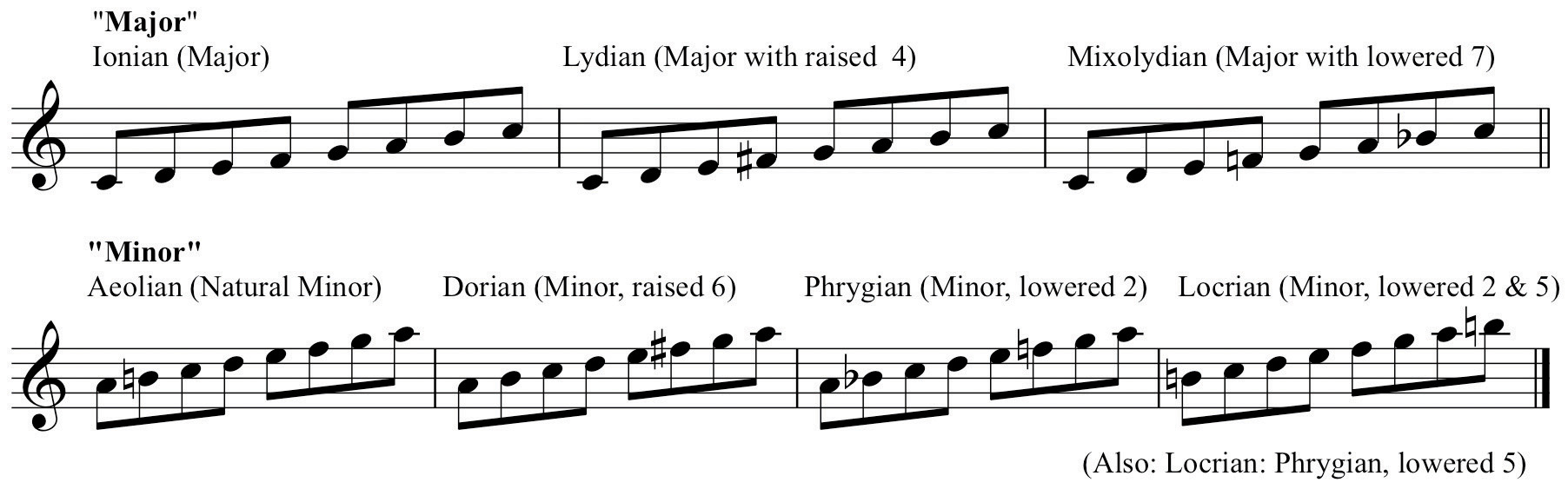
- Locrian mode is only used in the "chord-scale theory to" explain half-diminished chords (m7b5), never used for melody.
- Modes are essentially altered major and minor scales.
- The dominant is always the 5th degree. The mediant is always the 3rd degree.
- The tonic is very strong. Notes are defined by their relationship to the tonic and to chords based on various degrees.
- Modes have no relationship to pitch and can be transposed to any key.

(Wikipedia, from the work of William Smyth Rockstro, 1880)
Notes:
- Ignore the Aeolian, Locrian and Ionian modes. They were not used and were basically inventions of later theorists.
- The modern major and minor scales come from the lydian and dorian modes, using Bb (B could be switched between Bb and B in modal music).
- Notice that the dominant could be on the 3rd, 4th, 5th or 6th degree, and the mediant, on the 2nd, 3th, 4th, 6th and 7th degree.
- The tonic is not really a tonic but a "final", and there are "participant" notes (whatever that is).
- Modes are different depending on if the high or low range is used (authentic vs plagal) and relate to the male vocal range.
Modes, as seen by zethus909 (and jazz/pop/non-classical musicians):
- Locrian mode is only used in the "chord-scale theory to" explain half-diminished chords (m7b5), never used for melody.
- Modes are essentially altered major and minor scales.
- The dominant is always the 5th degree. The mediant is always the 3rd degree.
- The tonic is very strong. Notes are defined by their relationship to the tonic and to chords based on various degrees.
- Modes have no relationship to pitch and can be transposed to any key.
-
- KVRAF
- 26033 posts since 20 Oct, 2007 from gonesville
modal praxis:
[Both Hexatonic
1st sec. of this: 1 #2 3 #4 5 b7
Next: 1 2 3 #4 5 b7
(# & b indications compared w. Ionian*)]
(*: Bilaval Thaat in ICM; but note that their 'pure' (shuddha) starting point is same concept as listing Ionian first. Nonetheless I def. caution against taking Ionian (let alone major scale) as the basis for the others. While 'Dorian is the 2nd mode of Ionian' is of course true, 'Ionian is the 7th mode of Dorian' is a true statement as well.
[Both Hexatonic
1st sec. of this: 1 #2 3 #4 5 b7
Next: 1 2 3 #4 5 b7
(# & b indications compared w. Ionian*)]
(*: Bilaval Thaat in ICM; but note that their 'pure' (shuddha) starting point is same concept as listing Ionian first. Nonetheless I def. caution against taking Ionian (let alone major scale) as the basis for the others. While 'Dorian is the 2nd mode of Ionian' is of course true, 'Ionian is the 7th mode of Dorian' is a true statement as well.