

Sampleconstruct wrote:LOL, ok, my faultFleer wrote:Your fault, Sampleconstruct
But I do love Pro-L and VVV as well
 indeed..!

Sampleconstruct wrote:LOL, ok, my faultFleer wrote:Your fault, Sampleconstruct
But I do love Pro-L and VVV as well
indeed..!
I'm up for pedantic! The cascaded allpass delay topology first showed up in 1962, in an AES paper:Ichad.c wrote:If you wanted to be pedantic, the topology was proposed by Schroeder in the 70s, but was discarded as unnatural/metallic sounding.valhallasound wrote: Blackhole is based on a DSP4000 algorithm, that dates from the early 1990s. Algorithmic reverbs don't necessarily become obsolete with the passage of time.
btw this is clearly the kind of pages i've bookmarked...find a time later to read more carefully ...very interesting informations !Fleer wrote:Sean Costello, you are reverb royalty


Thanks for the correction Sean. Did not know of that Hal Chamberlin version, thanks!valhallasound wrote:I'm up for pedantic! The cascaded allpass delay topology first showed up in 1962, in an AES paper:Ichad.c wrote:If you wanted to be pedantic, the topology was proposed by Schroeder in the 70s, but was discarded as unnatural/metallic sounding.valhallasound wrote: Blackhole is based on a DSP4000 algorithm, that dates from the early 1990s. Algorithmic reverbs don't necessarily become obsolete with the passage of time.
http://valhalladsp.com/2009/05/30/schro ... algorithm/
The Schroeder cascaded allpass reverb had 5 series allpasses, as opposed to the several dozen found in Blackhole and ValhallaShimmer. I'm not sure if Schroeder expanded on this design in later papers - if you know of any, please let me know!
Hal Chamberlin published an allpass reverberator in his 1980 book "Musical Applications of Microprocessors," that featured 3 series allpass delays, running into 2 parallel channels of allpass delays (each channel had 2 allpass delays in series). If you vastly increased the number of allpass delays in this network, and modulated the length of every allpass delay, you would get the Blackhole architecture.
I agree about the series allpass reverbs sounding metallic without modulation. WITH modulation, they become magical.
Sean Costello
I love springs, and not all of them are uber-metallic sounding. The best springs IMHO are MicMix/MasterRoom springs, the springs are cut and tuned to very specific lengths that smooths out it's harshness a bit, I own one of these and it works great on vox:MogwaiBoy wrote:One reverb I would describe as metallic is real spring reverb.

Here's the Hal Chamberlin algorithm, for reference:Ichad.c wrote:Thanks for the correction Sean. Did not know of that Hal Chamberlin version, thanks!
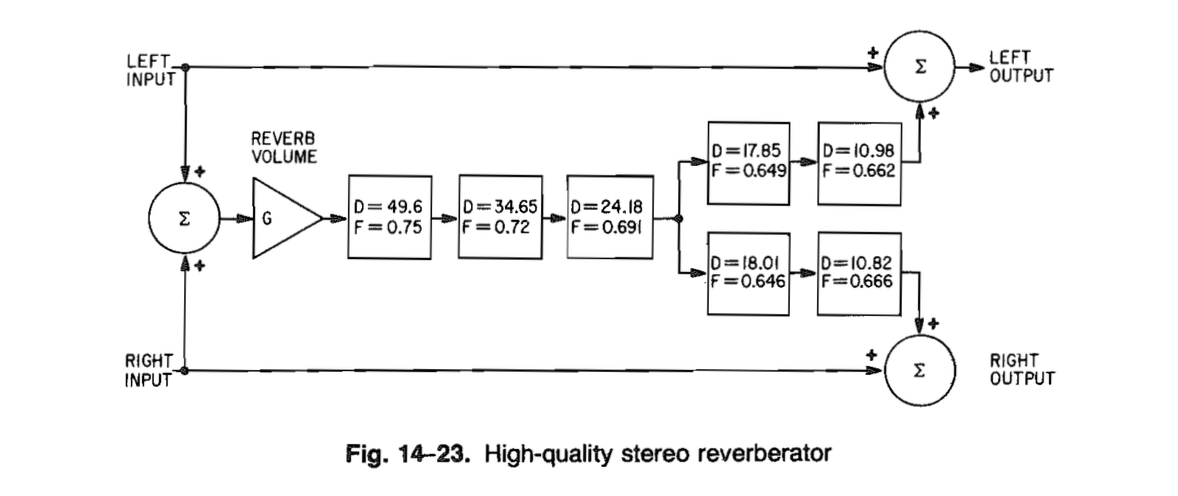
Musicisbest wrote:Nice, thanks for these tasty examples.SteveWZ wrote:Here are some detailed examples of BOTH reverbs.keyman_sam wrote:Is it possible to get close to the sound of the blackhole with Valhalla vintage verb? It's a unique ambienty lush sound. I found an echo-something preset in vvv that was somewhat similar.
First, individually, then BOTH together in the same mix.
Blackhole in a mix, automated with the "Extraordinary Spaces" presets:
Vintage Verb Examples with "Pro Expansion" presets:
BOTH reverbs, side by side in the same mix:

The linear interpolation makes a big change to the sound. It can make things "duller," to the point where many people prefer the sound of the BlackHole running on the H8000 at 96 kHz. This would push the linear interpolation artifacts into a much higher frequency range, and would make the sound brighter, without being too bright.Ichad.c wrote:Thanks for the pic! Yeah I heard the Blackhole has 30+ allpasses, add to that filtering and feedback + modulation support(linear interpolation?), that is definitely brute force! I do take my hat off for whoever tuned it though, seems they hit the sweet spot.

Hello Sean,valhallasound wrote:This makes a BIG difference, as the artifacts caused by linear interpolation are very dependent on the sampling rate, and running at a 22.05/24 kHz sampling rate internally will put the linear interpolation artifacts into a very audible range.

I'm not in front of a DAW right now, but you can hear the differences by using the demo versions of a few Valhalla plugins:Novalis wrote:Hello Sean,valhallasound wrote:This makes a BIG difference, as the artifacts caused by linear interpolation are very dependent on the sampling rate, and running at a 22.05/24 kHz sampling rate internally will put the linear interpolation artifacts into a very audible range.
could you maybe post an audio example in which these interpolation artifacts are very pronounced and clearly audible, please?
This would help my ear to pick up the sound and identify it later... and so that I know what the heck you're all talking about here
I have VVV, but I would like to know how I can identify what linear interpolation artefacts sounds like.valhallasound wrote:I'm not in front of a DAW right now, but you can hear the differences by using the demo versions of a few Valhalla plugins:Novalis wrote:Hello Sean,valhallasound wrote:This makes a BIG difference, as the artifacts caused by linear interpolation are very dependent on the sampling rate, and running at a 22.05/24 kHz sampling rate internally will put the linear interpolation artifacts into a very audible range.
could you maybe post an audio example in which these interpolation artifacts are very pronounced and clearly audible, please?
This would help my ear to pick up the sound and identify it later... and so that I know what the heck you're all talking about here
- ValhallaShimmer: The color mode toggles between bright (full-bandwidth delay interpolation) and dark (linear interpolation).
- VintageVerb: Most of the algorithms use linear interpolation in the 80s mode, and full-bandwidth interpolation in the NOW mode.
- ValhallaÜberMod: the EQ Mode switches between bright interpolation and dark interpolation.
Submit: News, Plugins, Hosts & Apps | Advertise @ KVR | Developer Account | About KVR / Contact Us | Privacy Statement
© KVR Audio, Inc. 2000-2026

